132 points · by hhs · 7y ago · 92 comments
Remarkably, a majority of these feelings are positive, so this advertising initiative, which has been successful at increasing per-ad revenues by as much as 80%, is creating a financial incentive for the NYT to produce content that generates positive feelings in readers!
On its face, this is shocking to me. I would have never, ever expected positive content to be more profitable than negative content! In hindsight, however, after thinking about it a bit, it kind of makes sense. I'm now wondering, could advertising perhaps become (gasp) a force for good, at least in certain settings?
NYT PREDICTED FEELINGS
Optimistic (+)
Inspired (+)
Self-Confident (+)
Amused (+)
Adventurous (+)
In the mood to spend ( )
Love (+)
Sadness (-)
Boredom ( )
Interest (+)
Fear (-)
Hate (-)
Hope (+)
Happiness (+)
Nostalgic ( )
Indulgent ( )
Competitive (+)
Informed (+) curl 'https://www.nytimes.com/2019/04/14/sports/tiger-woods-wins-masters.html' | perl -n -e'/"emotions":"([^"]*)"/ && print $1'
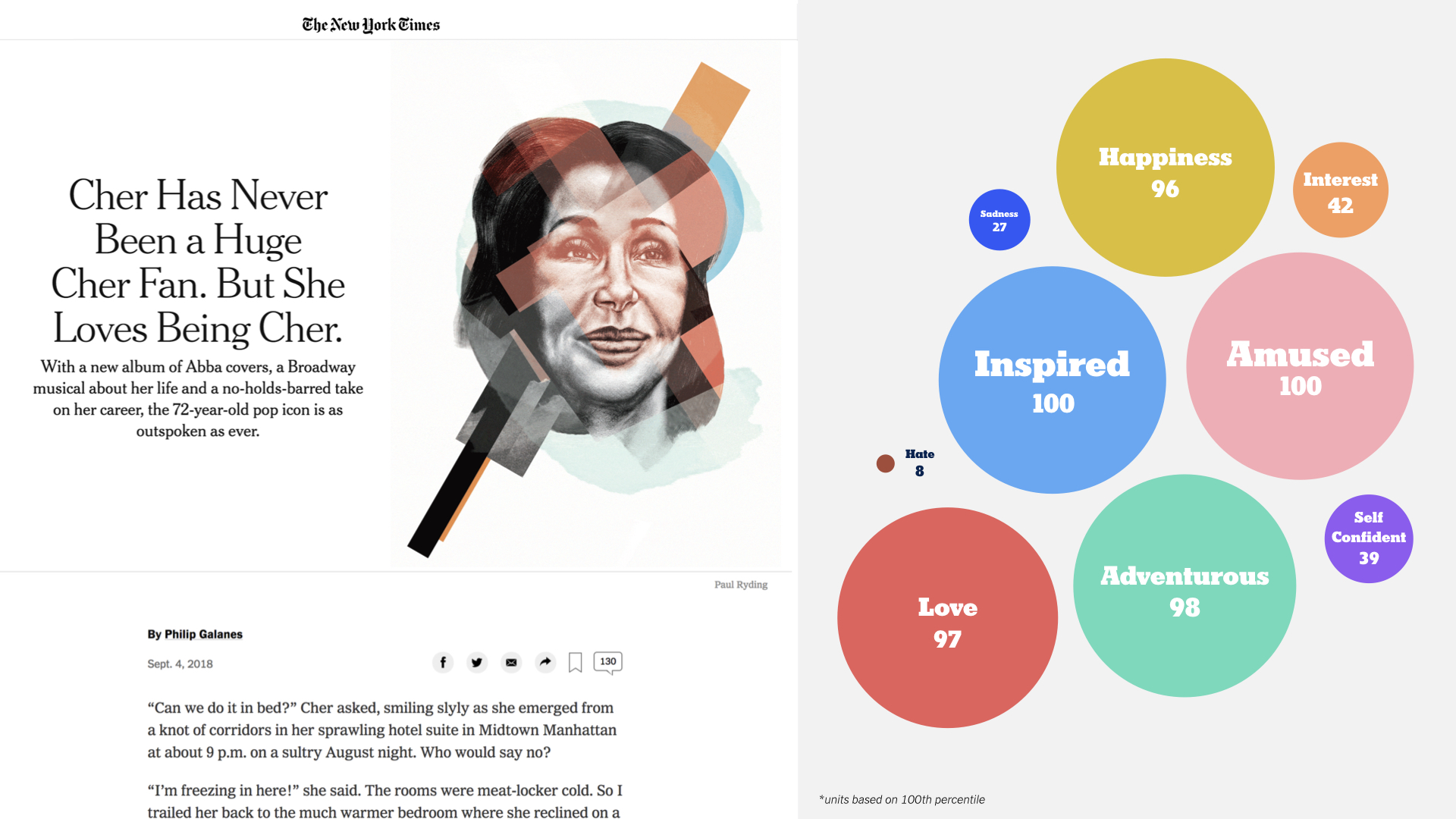
inspired,boredom,happiness,optimistic,not_interest,not_hate,not_amused,not_inthemoodtospend,not_informed,not_love,not_sadness,not_fear,not_hopeThis one is a little surprising. Does the NYT think this article dashes any hopes readers might have of winning the Masters?
I guess it shows that it is all about marketing.
And yet, the NYT has withstood the pressure to become the ground level equivalent of an in-flight magazine.
Can we maybe credit them for that, instead of just assuming that everybody agrees that they will succumb to economic pressure without feeling the need to even make the case for it?
This predates the Internet; it's why glossy Sunday sections exist.
News are good when they are neither positive nor negative by design.
They are good when they are relevant, useful, and informative (including them not being cherry-picked examples of stories with no impact to their readership, e.g. about some sensational murder case 10.000 miles away, and so on).
These metrics should only be used for categorizing purpose only. We need to be very careful in using it as a driver for more of the same articles, because in the long run this will only create a feedback loop that will keep feeding us the same content and narrowing our views, making us blind to more critical issues at hand.
https://blogs.lse.ac.uk/politicsandpolicy/why-is-there-no-go...
Journalism has historically prided itself on telling the truth. The truth is not always a feel-good experience.
All good news, all the time is potentially a dystopian scenario where the truth is forbidden because it isn't profitable enough.
Also, competitive as positive? I'd see that much more as a neutral (or maybe negative).
Would you get the same result from USA Today, WSJ, WaPo, and the LA Times?
The favoritism towards certain groups and the dismissal of others raises a lot of eyebrows. I would say it is mainly relevant to NYC and to everyone else I would pass it in favor of a local news source. I would agree that it has become a fairly niche news source and it is quite amusing in my opinion how they are trying to hype up their ad units as they struggle with declining readership.
"Thousands killed in [less-developed country] civil war; more food left for survivors!"
"Average global temperatures up 4' C in past decade; boom in tourism in Hudson Bay and Siberia!"
"BigCo lays off 70,000 workers; social services employees self-worth increases!"I know the mention of emotions creeps people out. But it’s probably the only salient connection a general interest publisher such as the Times can offer advertisers. Very few of their articles mention any product, product category, or really any factual nexus to anything somebody might want to sell.
Where many people like to propose that journalists and editors are steered by the business and sales staff-my own experience couldn’t be further from the truth.
I can’t speak for less reputable outlets. The journalistic outlets I’ve worked with have been very dedicated to their own voice—and passionately so.
> Journalists and other news purists may also wonder whether the Times newsroom is now being tasked with producing lots of emotional stories.
> Neither is the case, Allison Murphy, senior vice president of advertising innovation, told me in an interview. The newsroom turned out plenty of emotionally charged stories, anyhow. So it has done nothing different.
As an alternative to current targeted advertising, this seems much worse. At least I can block ads and trackers. I can't block content that's been engineered to manipulate.
From the article - """Journalists and other news purists may also wonder whether the Times newsroom is now being tasked with producing lots of emotional stories.
Neither is the case, Allison Murphy, senior vice president of advertising innovation, told me in an interview."""
If this isn't a lie already it will be in a few months.
The simplistic counterargument is that writers do this already but as we know... once we have numbers to target the optimizations will kick in.
This won't end well :P
In a news environment driven by ad revenues, expect the news to avoid hard hitting stories that make you feel bad. Shame and anger are emotions that cause change -- they don't sell consumer products well. Chipper stories are the order of the day, never mind the complete capture of the information system by corporations, government elites, and the rich generally.
In other words, that whenever big private interests have a chance to make more profit by collusion, alignment, and covert action, they never do...
> placements to be avoided
Doesn't mean they won't have advertising on them, just that it will be slightly cheaper. Everyone wants to advertise in the NYT but it costs too much. If I get my ad there, but slightly cheaper, I absolutely would.
That's an incentive to put out less of them, if I ever show one...
Especially if "everyone wants to advertise in the NYT", which means they have all the headroom to push more expensive-ads-yielding ones...
What started as a counter-argument to the grandparent, actually made their point for them...
I don’t know, news has been ad driven for a long time and is notoriously negative.
I know I live a comfy life but the disconnect between life and news is staggering; consuming news seems to me to be horrible shit nearly 24/7, almost all of which is completely absent in my day-to-day life. And yet almost everyone I know — comfy people like myself — consumes tons of news.
Could be that advertising does better per-reader on positive stories, but doesn’t bring readers back as well as frightening news.
They’re also messing with the scroller - it will stop scrolling on an ad to make sure it loads.
You'll leave an orphaned article info table row with this approach but you can hide the article row itself with uBlock Origin procedural filters[1].
Add the following to 'My Filters':
news.ycombinator.com##table tr tr:has([href*="nytimes.com"])
[1] https://github.com/gorhill/uBlock/wiki/Procedural-cosmetic-f...
It's just a domain search, but should be easy to modify for title searches too (title is in a.storylink).
EDIT: Updated to filter on keywords in the title too...guess I'm bored: https://gist.github.com/m00g00/e539ec22bf588edca0e6dfe1a05eb...
I'm just looking for tech news, man! I don't want to be prompted to get out the pitchfork every time I browse HN.
For example, it sounds like you might identify as center left. Some people on the left are so disillusioned with the establishment that they would rather avoid it entirely. For example one could replace NYT with Democracy Now and get an informed global perspective like the NYT without getting so much centrist exposure.
And yes, the OP can certainly be happy if they do not consume any news or if they consume only media taylored to their emotional pleasure[1]. However, it is in my interest for my fellow humans to be well informed, with a diversity of legitimate sources, so that when we make collective decisions we decided not-horribly.
1: Although specifically singling out NYT is very strange in that context, as they are by far a more moderate and truthful albeit imperfect source.
Truth be told I'd probably add democracy now to the list as well.
Are you implying NYT and Breitbart are equally biased around some mythical "center"?
(See https://www.cjr.org/special_report/why-the-left-cant-stand-t... -- whatever your politics she makes a fair point)
These premium ads look like the logical progression of content-based advertising. The only slimy thing is them pretending to be randomly placed.
Advertisement is why we have privacy issues (the other being governments spying on their people) and giant corporations based on targeted advertisement business model. It’s sickening and people working in this profession should be ashamed of themselves. Not to mention all the psychological tricks that go into the “smell” of the store, deluding people into buying and then underdelivering, buy one get one free, sales!!! sales!!! sales!!!, 20% off if you sign up for a store credit card, etc. what happened to ethics and honesty in doing business?
There has to be a more sensible way? Word of mouth, magazines, banners, trade shows, demos, putting product on the shelf, etc aren’t good enough? I am not a sales man but boy I despise that whole industry.
Recently however I read about the time in the middle ages when guilts had forbidden advertisement. They took this to such a degree, that if a merchant would cough while a potential customer was walking nearby, the other merchants would accuse him/her of trying to catch the attention of the passer-by.
Perhaps the reason we allow advertisement is just that we don't know how to get rid of it. However, then we should certainly try to regulate it as much as possible; make rules limiting it to the tolerable and perhaps undamaging.
Unfortunately, it may be that so many industries now depend on selling adverts, that limiting it in any meaningful degree would be very hard politically.
Even if you could get rid of advertising, that just cedes control of advertising to random natural factors like geography or chance. It's not clear to me how that's a better state of affairs.
I very much agree with you however. We can't ban it. It just practically isn't possible. We should be able to regulate it though.
The only way to put a stop to it is to make it unprofitable.
From one angle, this girl is giving the customer what they want. It's a win-win.
From another angle, this girl is using psychological tricks to exploit her customers to convince them to buy eat high-fat high-sugar cookies.
If it were easy to come up with a clear boundary between ethical and unethical advertising that most people agreed with, I believe we would do it.
There has to be a more sensible way?
Like what? If you were to put forth a recommendation it actually seemed like it could work, that would be something people could go forward with. Short of that, you're asking companies to not take advantage of legal methods that their competitors surely will take advantage of.
The Royal Society's motto "nulius in verba" is becoming more true by day.
How are you possibly making that claim? There is nothing to support that.