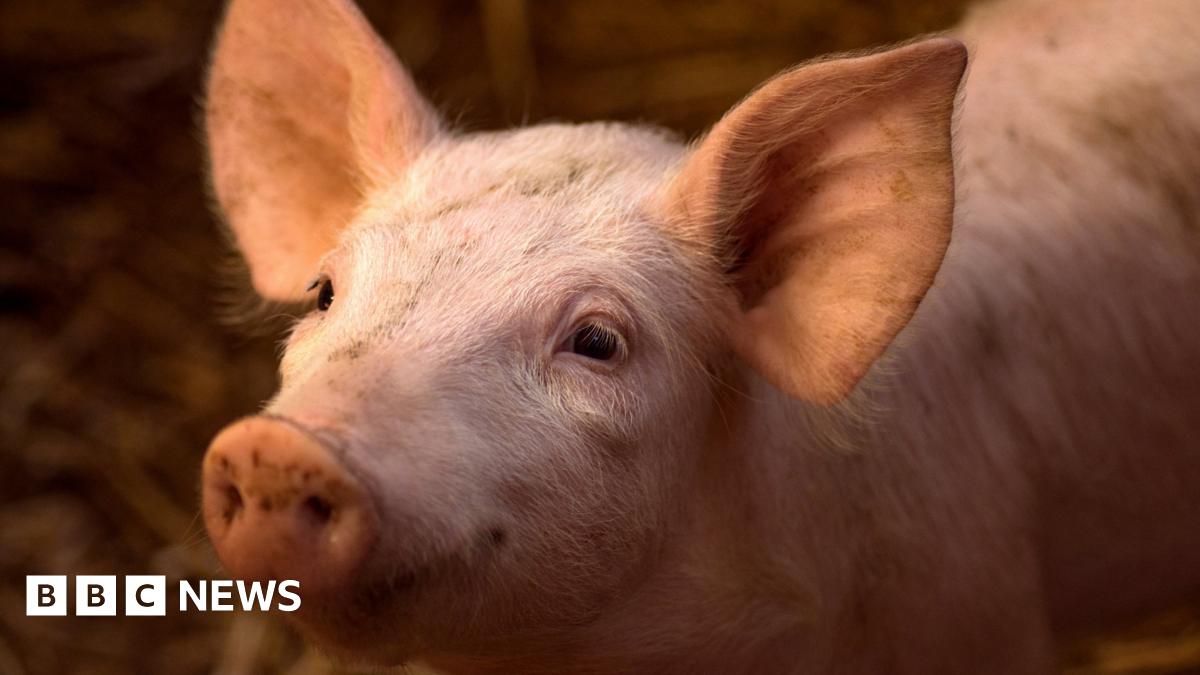
Pig brains partially revived four hours after death
The study could aid medical research and fuel debate about the difference between life and death.
BBC News
176 points · by sjcsjc · 7y ago · 195 comments
> [...] Nevertheless, the development of technology with the potential to support sentient, disembodied organs has broad ethical implications for the welfare of animals and people. “There isn’t really an oversight mechanism in place for worrying about the possible ethical consequences of creating consciousness in something that isn’t a living animal,” says Stephen Latham, a bioethicist at Yale who worked with Sestan’s team. He says that doing so might be ethically justifiable in some cases — for instance, if it enable scientists to test drugs for degenerative brain diseases on the organs, rather than people.
Gauging awareness in a brain outside a body would probably be difficult, given that the organ’s surroundings would differ so radically from its natural environment. “We could imagine that brain could be capable of consciousness,” says George Mashour, a neuroscientist at the University of Michigan in Ann Arbor who studies near-death experiences. “But it’s very interesting to think about what kind of consciousness, in the absence of organs and peripheral stimulation. [...]”
It's also 'very interesting to think' how many more dimensions this could add to torture. This is the end of the article:
> [...] In the meantime, scientists and governments are left to confront the legal and ethical quandaries related to the possibility of creating a conscious brain without a body. “This really is a no-man’s land,” says Koch. “The law will probably have to evolve to keep up.”
Koch wants a broader ethical discussion to take place before any researcher tries to induce awareness in a disembodied brain. “It is a big, big step,” he says. “And once we do it, it’s impossible to reverse it.”
Sobering.
I had no idea humanity achieved synthetic blood. This is from the study:
>a haemoglobin-based, acellular, non-coagulative, echogenic, and cytoprotective perfusate that promotes recovery from anoxia
Am I the only one excited by what viable synthetic blood might mean for blood banks?
Study is here: https://www.nature.com/articles/s41586-019-1099-1
Or you can make it yourself per: http://www.alzet.com/products/guide_to_use/cfs_preparation.h...
Artificial blood is way trickier, but there are a lot of advancements being made. It's really exciting!
"A Living Soul" by P. C. Jersild is amazing sci-fi book exploring this. https://www.amazon.com/Living-Norvik-Press-English-Swedish/d...
Your contribution is not wasted however. First brain that was able to talk to the world and received full human rights was Peter Thiel's brain.
You'd be ok with effectively being blind, deaf, mute, paralyzed, and probably brain damaged, in the name of science?
Or your enemies took power, and when they were going through the vats for payback they picked yours (along with many others). If you think you have no enemies, or that you know them all personally, you are better than me.
I'd rather stay dead.
- Project PYRRHO, Specimen 46, Vat 7
Activity Recorded M.Y. 2302.22467
TERMINATION OF SPECIMEN ADVISED
If specimen 46, Vat 7 experiences a romantic relationship, our corporation will gain valuable research on emotional development past nihilism stage. Suitable partners are: Specimen 114, Vat 7 Specimen 126, Vat 7 Specimen 67, Vat 89 (pending switch)
This game was a treasure trove of thought-provoking quotations, many of which can be found on WikiQuote. [1]
[1] https://en.wikiquote.org/wiki/Sid_Meier%27s_Alpha_Centauri
Code monkey not say this out loud
Code monkey not crazy, just proud
https://www.amazon.com/We-Are-Legion-Bob-Bobiverse/dp/B01L08...
There's a festival every year that is pretty popular in town about 'Frozen Dead Guy'. They have special beer, ice-cream, coffin races, a polar-bear swim, frozen salmon tosses, and a Mr. & Mrs. Dead Guy.
I've done the daytime tour and helped stack dry-ice on the guy. Honestly, he looks like Ötzi the Ice Man now.
https://en.wikipedia.org/wiki/Frozen_Dead_Guy_Days
Your point still stands of course.
Maybe people with locked-in syndrome could provide some reports of what it's like. It's not the exact same, but it may be similar.
All evidence we have regarding long stays in solitary confinement or sensory deprivation indicates everyone trends towards psychosis.
Please make sure I am supplied with some good books to read, if at all possible.
The "what if they wake me up to torture me" scenarios seem like wild catastrophizing to me - if someone has the political power and resources to develop special brain-torture gear, rez me, and keep me alive so they can torture me, they have the political power and resources to kidnap me and torture me with knives and fire as long as they want. It'd probably even be easier for them to do it to my physical body, right here and right now.
It sounds like the real worry is "what if I wake up in a dystopian future". And, of course, once you look at that, the expected value calculation is trivial. Consider the set of futures which have sufficiently-developed research and economy to systematize the operation of and systematically execute on rezzing random frozen brains. Consider the set of futures which have that property but are also dystopian enough to rez brains for the sole purpose of torturing them. Recall that these things are in tension; the kinds of irrationalities that lead a civilization to do that kind of thing will impair them in other ways, sometimes significantly - enmity from less-extreme polities, toxic culture leading to structural inefficiency, etc. You have to reach really far to find that region of the configuration space of possible future worlds.
So look at the expected values. Yes, being tortured for a while would suck. But being alive again, and possibly even biologically immortal, has the expected value of an entire new life. And the probabilities say that being rezzed is far more likely in a good future than a bad future. Literally every stage of the expected-value calculation says that being rezzed can be expected to be a win.
Even if the optimistic scenario is true for your first 100 "rezzes", the 101st civilization that takes over after the 100th collapses might not be so nice.
EDITED TO ADD: Moreover "the kinds of irrationalities that lead a civilization to do that kind of thing" is confusing a value judgment with rationality. An extremely predatory civilization might maintain its edge through cruelty, the same way that cats seem to play with mice before killing them. That would be evil, but rational.
It would be strange to return to your life after dying 10 years ago, but I'd probably take the deal.
I will be curious if they can not only resuscitate but also influence what is left? plus would it matter if your a victim of a seizure? would there be anything left that we see as a human personality to bring back? I ask that from experience of losing a middle aged uncle to a seizure, it raises your body temperature sufficiently to kill/wipe the brain. You can coma them to stop the activity but bringing them back up from that is no guarantee anyone is home
Are you comfortable with the possibility that those who are reviving you might not be doing it for your benefit?
(If they're explicitly trying to cause me pain, that would be a no.)
That is my point.
I imagine that, if this was a possibility, quite a lot of people would be ok (or even demand it) to make available "150 years after natural death" sentences, so that they can apply it to their newly deposed dictator. Then, once the new rulers become entrenched in power and begin to like it, they can start using it on their political opponents. Prisoner exchanges between warring countries could become quite interesting. Quite likely, some people might feel inclined to hang on to their loved ones forever. Remember Terri Schiavo [1]?
Feel free to imagine more interesting scenarios. If you don't start to shudder, you're just not thinking big enough. You can watch this Black Mirror episode [2] to get you started.
This gives a whole new meaning to the expression "killer application".
And the technology is here, it's only a matter of time before this kind of abuse starts happening.
I'm not saying we should not continue researching this, as the possibilities are endless, but let's not put the pitfalls under the rug
(This is a relevant YouTube video to the discussion, not spam.)
Seeing as we don't have full eye transplants yet, it seems possible (at lest with near future tech) that they could resuscitate your brain but not your other I/O peripherals, including your eyes. To misquote Harlan Ellison, you may have no mouth with which to scream.
It seems to me that your average case would involve either total darkness or the worst case of phantom limb ever. Or even worse: they might give you eyes, but no one to turn the pages for you.
I'd imagine that if we do establish "IO" that "text" would be the first/easiest type of data. It might be encoded in a strange way, but, well, I'll have plenty of time to adapt...
The comments in this thread to the tune of "anything is better than being dead" actually kind of took me by surprise.
I can conceive of a point where technology and society has developed to a place where bodies are replaced after death with something that's worth "living" in again, but that's a long way from wanting to be a brain in a vat purely because it means I'm not technically dead.
Without these signals, we have no clue whether you’ll be in immense confusion, anxiety, sadness or bliss. It could very well be much worse than death,
Are you ok with that gamble?
Yes.
The best course of action is to rely on what was previously requested.
Movie title is "Johnny got his gun". No idea how mainstream it is but i suspect not that much.
If you believe nothing could be worse than death, you should consider to watch it.
Rodent studies routinely use whole brain and slice tissues for long term neuro-experimentation [0]. You can keep slices alive for days on end, if you're careful [1]. Is it just that it's a whole pig brain that they used these tried and true techniques with? Ischemia isn't something to laugh at, it's very tough to deal with. But the 'ethical' issues have long been put to bed, we've been doing this since 1951 [2]
[0] https://www.ncbi.nlm.nih.gov/pubmed/28744893
[1] https://www.ncbi.nlm.nih.gov/pubmed/9914290
[2] McIlwain, H., Buchel, L. & Cheshire, J. D. The inorganic phosphate and phosphocreatine of Brain especially during metabolism in vitro. Biochem. J. 48, 12–20 (1951).
Is it this?
_Nature_ overview/discussions: https://www.nature.com/articles/d41586-019-01216-4 https://www.nature.com/articles/d41586-019-01168-9
Who you are must be in chemistry of your brain not in the electricity because you are same person after epileptic seizure as before.
You are same enough for practical purposes like holding relationships and retaining knowledge and skills.
Afaik, ECT therapy has been despised by many folk for making them forget whole weeks of their pasts.
The question is whether the electricity is causing changes or just interrupting existing flow....
"Yeah, we're raising our series A so we can ink a deal with a Chinese morgue for a steady supply of parts to stitch together, and to scale up our electricity generation to the needed amount so we don't have to depend on the odd lightning bolt, which turns out to be really rare here in Palo Alto"
In order for these sorts of experiments to be ethical with an apparent consciousness we definitely need BCI technology that can simulate input / output stimuli, at least reasonably.
Technically, the medical community only considers physical injury with the term 'pain', but there is growing consensus that pain can be more general (especially considering it is often subjective). https://www.ncbi.nlm.nih.gov/pmc/articles/PMC2952112/
"If it seems strange that nerve signals coming from the back can represent vision, bear in mind that your own sense of vision is carried by nothing but millions of nerve signals that just happen to travel along different cables. Your brain is encased in absolute blackness in the vault of your skull. It doesn’t see anything. All it knows are these little signals and nothing else. And yet you perceive the world in shades of brightness and colors. Your brain is in the dark but your mind constructs the light." — David Eagleman in his book Incognito.
Without the nerves connecting your toe to your brain, you are unlikely to feel the otherwise agonizing pain of having had stubbed it against a coffee table.
Think of it as taking a microprocessor in a circuit and disconnecting every one of its pins except those providing power. How would that microprocessor behave? It's various I/O pins aren't gone, their state and response just became somewhat random.
We do not know that simply being severed from your body is simply experiencing no sensory input of any kind, and actually have a lot of reasons to expect that would not be the subjective experience for very long.
(Bizarrely, the dream pain has nothing to do with anything in real life that should have been pain. Apparently my subconscious is fine with dismemberment or stabbing or whatever, but what really bothers it is removing my orthodontic spacer from the roof of my mouth, which apparently it feels is me trying to remove the roof of my mouth. Subconsciouses are weird.)
[1]: https://www.britannica.com/science/phantom-limb-syndrome
Might be, but unlikely. Both our medical and legal (executions) experience shows that most parts of the body can be removed or paralyzed without impacting consciousness. It really seems like the obvious model - that the brain alone is the center of consciousness - is the correct one.