The fight to save coral - Scienceline
Climate change is pushing corals, and the biologists hoping to save them, to their limits.
Scienceline
182 points · by vezycash · 7y ago · 50 comments
To me this means that we should invest a focused effort in planting coral reefs in protected areas (and protecting additional areas for the same.) This would have the effect of creating more marine sanctuaries safe from human fishing pressure, which will seed surrounding fishery areas and become a win-win. New Zealand has done this to great effect (creating protected areas, not planting reefs.)
I think however the typically human reaction is see a coral reef that's dying and try to use re-planting to bring it back to life. Unless that's coupled with re-planting higher-temperature corals, that's neither going to work or be sustainable as the Oceans continue to warm for hundreds of years to come. I would rather see more resistant corals being planted, or coral reefs being planted in colder waters.
Lastly, while it is a great tragedy that the coral reefs are dying, it should be noted that the Earth has been here before and come back from it at the end of the last ice age when sea levels rapidly rose 400 feet and drowned all of Earth's reefs at the time. That doesn't make things any less tragic, or absolve us of the blame, but perhaps helps frame things by remembering that Earth is not a steady-state system but a rather a system of constant flux and adaptation.
I hope that in the same way humans have been having massive negative effects on nature and the climate, we can also pool together and create some equally impressive positive effects on the natural world.
There weren't 7 billion humans back then. My big concern is that we're well above the pre-green-revolution carrying capacity of Earth and it wouldn't take all that much to put us in a position where we can't feed 3 billion people. It's possible that a greenhouse earth will give us more arable land to work with, and we'll be just fine. It's likely that things will become ugly during the transition, as formerly arable land becomes desert, the oceans stop providing food, and mass migration causes global unrest. A lot of people are going to starve.
https://academic.oup.com/bioscience/article/54/3/195/223056
> When taking all studies into account, the best point estimate is 7.7 billion people; the lower and upper bounds, given current technology, are 0.65 billion and 98 billion people, respectively.
The answer is "anywhere from a tenth of the people currently alive to 13.5 times as many as are currently alive." Absolutely useless. A range covering more than two orders of magnitude. May as well say, "We don't know."
Farming is only 0.07% of the US economy. A small increase in food prices would vastly increase supply. Africa would probably be screwed, but that would have nothing to do with our ability to feed them and be solely due to economics not making it profitable.
There were bread and rice riots around the globe just 10 years ago.
https://en.wikipedia.org/wiki/2007%E2%80%9308_world_food_pri...
So the Earth will still come back from it. And even the human species will likely come back from it. But technological society? That's a lot more iffy.
https://www.nytimes.com/2015/03/03/science/earth/study-links...
Nobody's worried the reefs will never come back. They are worried they won't be back anytime soon and we'll have to make do for the next hundred thousand years.
But even then, that's a long time from a human perspective, I think we could re-plant reefs the same way we replant forests on timescales of a couple generations or less.
Edit: obviously it would be better if we didn't have to do that, but that ship has sailed.
I'm not a marine biologist, but from my understanding the big threat to coral reefs is ocean acidification. If this trend continues, we won't be able to do anything to save the reefs. There's no use in re-planting corals if the entire ocean is too acidic for them to survive in, coastal or otherwise.
Apparently this is what happened the last two years. Also, apparently it’s never happened two years in a row before.
Source: Was at the Great Barrier Reef a month ago. The marine biologist on board was very informative.
I just want to point out that the main mechanism of adaptation is that the creatures less suited to survival die out.
The Earth may be effectively eternal (from a human standpoint), but human species is not. More likely, humans will be around, but modern human society would likely suffer an extinction event at some point with our trajectory.
I like your idea of higher-temp corals. Are you aware of efforts to repopulate corals based on varieties that are temperature resistant?
That doesn't mean we can't trash the place or experience massive drops in population.
There does appear to be hope on the higher temperature corals, but I don't know of any plan to actually plant reefs like that. Australia, which benefits economically from tourism to the great barrier reef should take a serious look at it: https://www.theguardian.com/environment/the-coral-triangle/2...
Why are you ruling that scenario out?
No one is seriously arguing that the earth is going to be literally destroyed, despite what anti-science Republicans would lead you to believe.
People are saying "the Earth that we know, love, have co-evolved with will be destroyed, and the assumptions that we built our cities, countries, and societies around will be turned on their heads. This will be replaced with a harsh world with wild extremes, natural disasters in places that aren't built for them, and more intense natural disasters in places that might be used to current, weaker ones.
Perpetuating this willful misinterpretation, even by acknowledging it, is a disservice to the future.
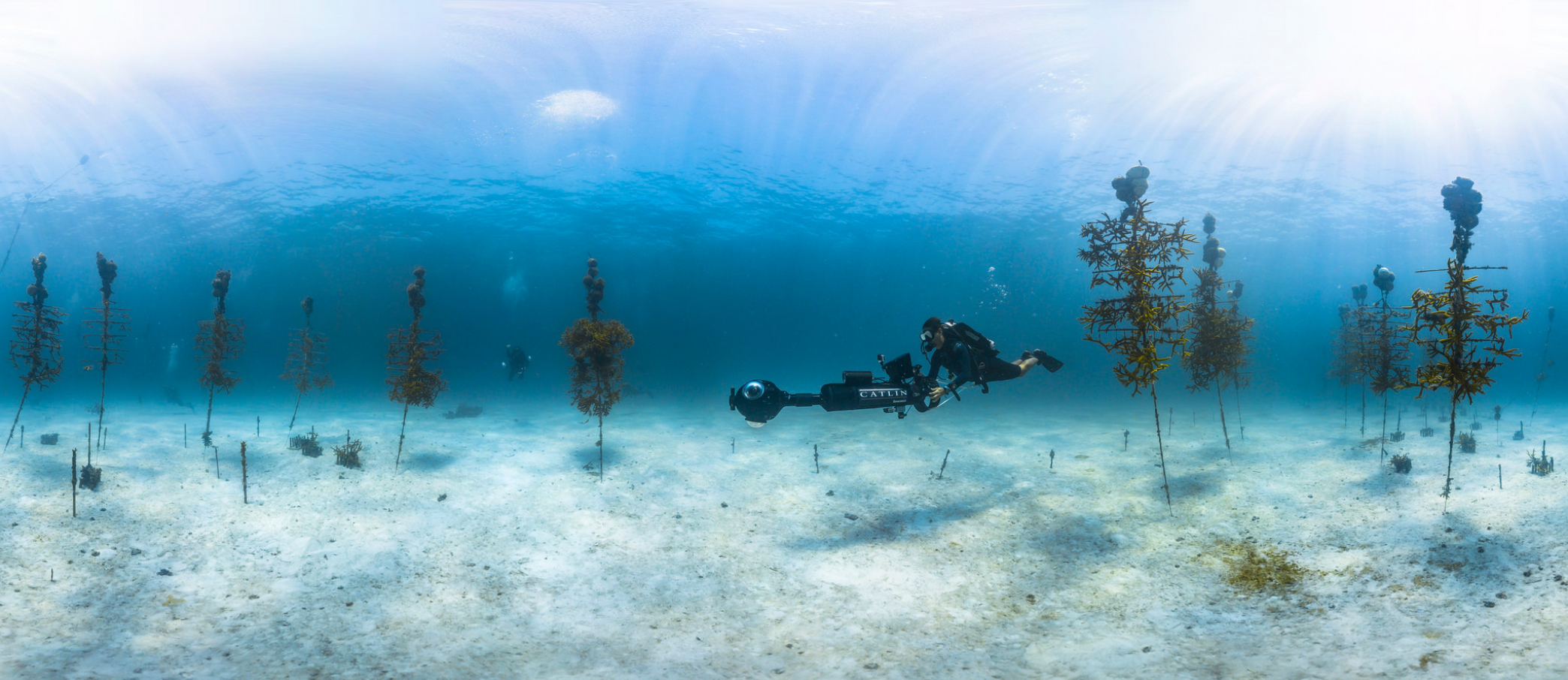
The technique called “microfragmenting” works by essentially cutting living corals into 1-5 smaller polyps using a specialized saw.
From "frag tanks" built wide, long, and shallow to allow light to have an easier time reaching the corals, to "frag plugs" made from ceramics that allow people to glue coral frags to to slot into existing rock, egg crate, etc.
I think maybe the accidental discovery was that the researcher found that this very common procedure to cultivating aquarium corals ended up also promoting the growth speed too.
Plus, Ive been in the hobby for 8 years, and I’ve never heard of purposely placing frags from the same colony next to to each other so they fuse.
I’m unaware of anyone studying the impact of fragging specifically on growth rate in this way.
Edit: I’ve found some discussion of at least one reef hobbyist experimenting with the method based on this research. So yes this was somewhat novel.
https://www.reef2reef.com/threads/my-microfragging-sps-exper...
I think the thing that isn't being covered in these articles is that it's the fusion of these fragments that are what is resulting in the explosive growth. https://www.ncbi.nlm.nih.gov/pmc/articles/PMC4614846/
It sounds like you can fragment a larger coral, put them close together, and as they grow they'll actually fuse together, instead of competing, and becoming sexually mature much sooner.
Typically speaking, and based off a very small amount of experience of my own keeping a nano coral tank years ago, coral of the same type (zoanthids of different colors in my case) would run into each other, compete for the same space, and sometimes kill or drive back the other.
https://www.kqed.org/forum/2010101870644/bay-area-scientists...