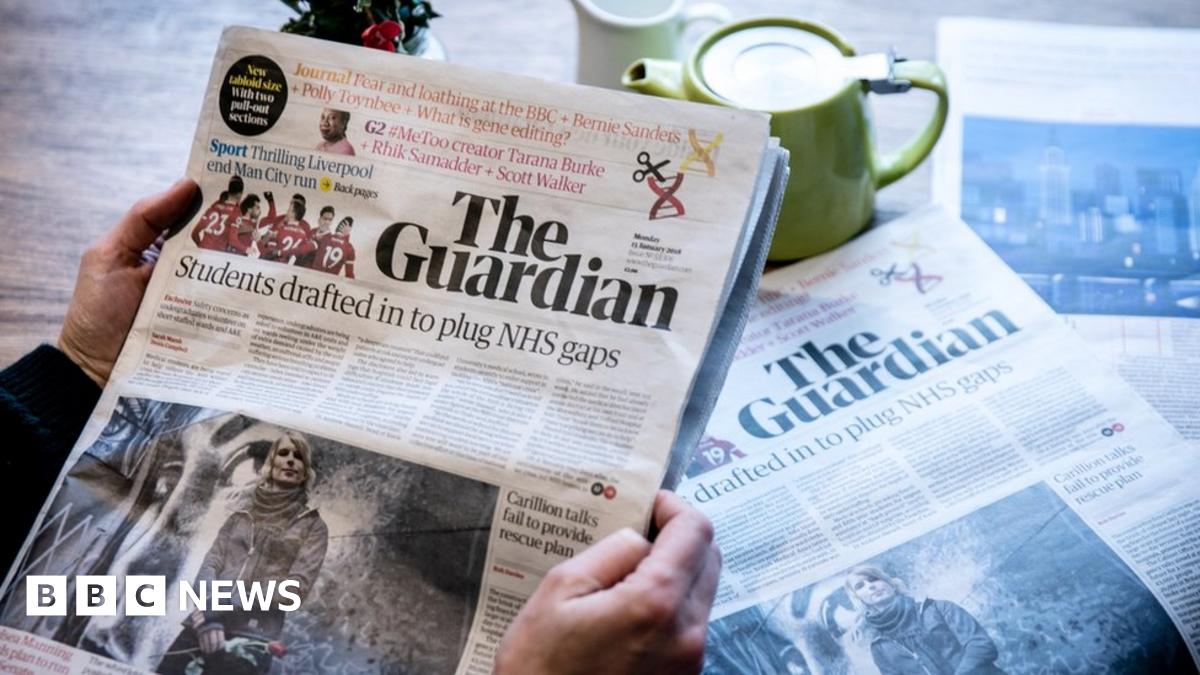
Guardian records first operating profit since 1998
For decades, the British title had a culture that tolerated vast losses. That makes its turnaround remarkable - but will it last?
BBC News
460 points · by laurex · 7y ago · 314 comments
At first, I misinterpreted this to mean they're counting money granted by a wealthy donor as profit. And without that, they would still be losing money. But, as clarified in the comments below, the Guardian is actually paying the Scott Trust. Also the Scott Trust owns The Guardian. Forgive my confusion. This isn't a straightforward relationship.
> Nevertheless, the operating profit marks the completion of a three-year plan that few observers thought likely to succeed, and which leant heavily on a - for British media at least - eccentric business decision to ask readers to contribute financially for something they could get for free.
So the business model is asking users for a donation? This sounds more like a non-profit to me.
I guess this is better than bleeding millions/year but we can hardly call this a good business.
> So the business model is asking users for a donation? This sounds more like a non-profit to me.
It is a non-profit! https://en.m.wikipedia.org/wiki/Scott_Trust_Limited
HSBC and the sham of Guardian's Scott Trust
https://www.jonathan-cook.net/blog/2015-03-03/hsbc-and-the-s...
The following is quoted in the piece:
> The Guardian is not owned by a trust at all. In 2008, “the trust was replaced with a limited company” that was accordingly re-named “The Scott Trust Limited.” Though not a trust at all, but simply a profit-making company, it is still referred to frequently as ‘The Scott Trust,’ promulgating the widely-held but mistaken belief in the Guardian’s inherently benign ownership structure. … The problem, of course, is that the Guardian functions under the same sort of corporate structure as any other major media company.
Technically yes and no. The initial capital amount does not, but its amount gets depreciated/amortized over time.
With people's ever growing concerns about malware, ransomware, privacy invasions and the invasive nature of ads, people are turning to Ad-Blockers so this makes sense. I started using an Ad-Blocker a long time ago and I've always struggled with it because I know it's robbing sites of revenue, and at the same time I felt violated by all the ads I saw whenever I turned it off.
Back in 2017 when the Guardian started showing those big yellow banners at the bottom of articles, I started contributing. If I'm on a site more than a few times a year and they have an option to contribute, I try to.
I really think there's some space for innovation here. I like contributing to journalism and I don't want to setup annual subscriptions for 20 different sites, but I can't easily keep track of which sites I frequent or when I last contributed.
Same here. I recommend it, it feels good.
Also it makes sure I'm not a hypocrite when I speak up against the current advertising and tracking madness.
Haven't used it recently since they hadn't too many of the articles I wanted && I have a sneaking suspicion that refunds aren't as easy anymore.
If I've done it before on The Guardian's site and let it remember my card number, fine, otherwise.. I'm not going through the whole rigamarole for an amount as low as I'd be willing to donate.
I suppose that's what Patreon et al. try to address. Nowhere near the critical mass for it not to be high overhead on average though.
I actually read that as "we are part of a trust that gives 25-30m, and if we didn't need to give these payments we'd be making a profit".
Or simply put: No, they are not counting recieving money, they're actually excluding giving money.
It is worded quite ambiguously, but I think what it actually means is that they receive GBP25-30 million a year from the Scott Trust, which they use for expenses and capital costs.
The article on the same topic in the Guardian itself a couple of day ago states:
"Guardian News & Media is owned by the wider Guardian Media Group, which in turn is controlled by the not-for-profit Scott Trust, named after the newspaper’s former proprietors.
The Scott Trust endowment, built up through the sale of former assets such as AutoTrader, produces an annual return of between £25m and £30m without depleting the main investment, which it allows to be spent by Guardian Media Group to subsidise ongoing operations."
https://www.theguardian.com/media/2019/may/01/guardian-break...
(This isn't meant to mean anything sarcastic, I believe that the humility and cognizance to be able to do something as simply as to say 'whoops my bad let me fix that' publicly is increasingly rare and wish to praise it whenever it happens as a brave and ethical behavior.)
The Scott Trust isn't a wealthy donor. It's the trust that owns the Guardian and The Observer.
Well, in some articles the donation box is bigger than the article itself, so it's apparently an important part of their business model
It is far less annoying than, say, Wikipedia or even NPR. Everyone should be happy about these results, as it is vastly superior to both paywalls and the ad-infestation other free sites have seen.
(I would also guess it’s rare for the box to actually take up more vertical space than the article. Maybe in breaking-news scenarios, where they start with a single-sentence item, then update it)
https://us.macmillan.com/breakingnews/alanrusbridger/9780374...
(Rusbridger was the Guardian’s editor for 20 years, before Viner.)
Maybe real journalism just isn't profitable in a capitalist economy. This model works for organisations like NPR and Propublica.
Owning a monopoly city newspaper in the US, with a captive advertising market, was a lovely business until recently though.
I think the idea is to get enough donations that they're no longer a non-profit.
The number of news reports relative to op-eds continues to shrink, and the op-eds themselves have swung much harder to the left than before.
It's clearly working for them financially, but it's a different beast now altogether.
Bullshit. The Guardian is orders of magnitude a better newspaper than the Daily Mail.
What major stories have the Daily Mail broken in the last 10 years? The Daily Mail is not considered a reliable source on wikipedia, Comparing the Guardian to that is quite the insult
Obtain an issue from even five or six years ago when they were breaking the Citizenfour story and one from this past week.
Is it comparable to the Daily Mail? No. Is it moving in that direction? Demonstrably so.
Read an Owen Jones column or two and tell me it's still a bastion of reasoned perspective.
The Daily Mail is a rag. That the Guardian is trying to become one to get back in the black is tragic.
Speaking as someone on the left in the UK, I can assure you the Guardian has been more and more centrist as time goes on. I think the confusion is that they do in fact publish loony articles sometimes on social issues, because guess what? That's easy to do without really addressing any economic problems.
On the economic front they're as centrist as they get, regularly attacking the likes of Corbyn in ways that the Sun is starting to envy, smearing Assange once they're done profiting off him, printing puff pieces for the Saudi Crown Prince etc. The Guardian is no darling of the (grassroots) left, I can assure you.
The other annoyance - the frivolous clickbait articles.
They have articles on privacy yet have lots of trackers themselves. They're really no better than what they preach, at least the last time I checked.
Still, having said that, I prefer to read a variety of news sources instead of one to hopefully get a more balanced view.
Isn't that a side-effect of having business and editorial separated? The individual journalists don't have any power to change the templates their CMS uses.
I don't disagree! Put an article in front of me on most hot topics and I think I would have difficulty telling you what publication it was from - it's the same cynical, smug, faux-progressive yet in reality complacently bourgeois, finger wagging, 'if you don't agree with us you're wrong/old/racist/uncool' attitude from all of them.
https://en.wikipedia.org/wiki/The_Guardian#Northern_Ireland_...
[Internment was probably one of the daftest ideas implemented by a UK government for a long long time.]
Edit: Note, I am a regular Guardian and Observer buyer - occasionally get the Times for a bit of balance (though still in mild shock over contents of the Telegraph my wife bought at the weekend as everything else was sold out!)
I'm going to cut you some slack and assume you are American, young, or both.. because as a guardian reader from the 1970s onwards I can tell you this is just not correct
Not at all. See The Dangerous Cult of the Guardian by former Guardian journalist Jonathan Cook:
https://www.counterpunch.org/2011/09/28/the-dangerous-cult-o...
> George Monbiot, widely considered to be the Guardian’s most progressive columnist, has used his slot to attack a disparate group on the “left” who also happen to be harsh critics of the Guardian.
Media analysts Media Lens have written a lot on Monbiot too. http://medialens.org/index.php/alerts/alert-archive/search-t...
Support for nationalization is nowadays limited to natural monopolies, and opinion polls show it's quite popular.
EU support isn't traditionally left wing either: historically, the left wing of the Labour Party (e.g. Tony Benn, Michael Foot, Peter Shore, Barbara Castle) all opposed membership. It was a Tory government which took us in, and Margaret Thatcher campaigned for our continued membership.
Ah come on now.
Monbiot is pretty much a social democrat. He may want to nationalise some infrastructure, but he is quite a long way away from being as far left as it gets.
That's the modern left: centrist (or, rather: "establishment corporatist consensus") on economic issues, centrist on societal issues, loony on SJW issues -- and pro-war/imperialism/against enemy-du-jour in establishment millitary-industrial issues.
Basically, I think you're factually wrong. You're reading selectively if you believe this about the graun
But since you mention Aron Banks, he is accused of funneling foreign money into UK elections illegally, and is being investigated for it by the NCA. Is that hounding?
Sections and categories are not new features for newspapers or magazines. Words have meaning—they're not there for no reason.
1. What specific lies has the guardian spread, and what's the truth? 2. Are there news watchdog organizations for this major newspaper company selling actual proven falsities, and is there legal recourse? I'm not familiar if where the Guardian publishes there is a legal mandate to be a newspaper and not disseminate actual lies.
I personally mostly stopped reading The Guardian because for all intents and purposes they have become an American journal. They are obsessed with American social issues and and mostly treat the news from an American point of view. I think it's a clear strategic choice of Viner but it saddens me to see what was a great English paper turn into that.
I won't even talk about the Opinion part of the journal. Describing it as uneven seems charitable.
The effect on Scottish press is even more acute; readerships are tiny.
But, while they do put out a substantial volume of nonsense, the Guardian also does real journalism.
Meanwhile other publications have abandoned that, including the 'balanced' publications.
Reuters still provides plenty of balanced journalism without dipping into fashionable nonsense opinion pieces.
They lost me as a reader sometime in 2017. Thinking about it now, the change likely coincides with this business model.
Ideally, I would be able to set up an all-you-can-eat subscription to a number of well-regarded international newspapers for languages that I am proficient in and access them at will from both a single portal (like Blendle, but absolutely not paying per article) and the newspapers own websites.
In many ways, The Guardian is a remarkable paper. It does not publish falsehoods, or - for the most part - appeal to the worst in people. It is committed to the defence of civil liberties, and to ensuring that journalism is open to everyone, regardless of their income.
But it's coverage of Brexit is highly partisan. It is not unreliable in the sense of being inaccurate; it is simply one side of the conversation.
Of course it's partisan on Brexit (as is The Economist, btw) and of course its general direction has a leftist slant (and why should it not?)
That said, I think it's one of the few remaining quality papers in the UK, which provides overall accurate reporting.
What makes me gag sometimes is some of the writers in The Opinion section. But that's fine too. If it's too crack-pottery I'm alsways free to ignore it.
Their Long Read section[1], though, is fantastic long form journalism and that alone justifies my yearly donation.
[1] https://www.theguardian.com/news/series/the-long-read
EDIT : Slight clarification
Absolutely. Opinion pieces in a newspaper are not meant to represent the view of the paper, or even to pretend to be objective; they are by definition opinionated and form an essential part of the public debate.
A lot of people don't seem to understand the concept of opinion pieces and letters from readers.
A good newspaper balances the opinion pieces placed, and will leave out obvious falsehoods.
Because when you go into every news story already convinced that the left are in the right in a given situation then your reporting is compromised.
I also wonder the free model, dependent on ads and donations are leading the Guardian to have more click-bait articles than would a subscription paper.
Also their football coverage looks as if written by Manchester United fanboys.
> highly partisan
I don't know what anyone means by that anymore. I'll see people cite such things but and then they'll state "look at the front page now" and list articles. As if the front page has to have two or more opposite articles for every topic, or a paper must provide a ying to every yang (and possibly proportionately) like we can't handle it if we don't see our POV explicitly cited anymore...
This is really more of a side rant, for all I know I would entirely agree with your statement if I read the guardian more.
Whenever anyone calls on Jeremy Corbyn and the Labour Party to support a second referendum, they will publish it on the front page of their website. They are trying to amplify those voices which agree with their position - to reverse Brexit, or at least engineer a soft Brexit. They do not give those voices in and around the Labour Party which oppose a second referendum a hearing.
On Falsehoods: as far as I know, Luke Harding's scoop on Manafort meeting Assange at the Ecuadorian embassy has not been stood up, and seems to have gone quiet. While not a deliberate falsehood, this is an embarrassing misfire.
But I do agree it's a remarkable paper, one I'm happy to contribute to.
You can have a political signature, yet perform fairly objective journalism.
I do not agree that there is such a thing as 'objective journalism'. There is accurate journalism: a commitment to not telling falsehoods. But how your select and interpret events is never 'objective' - it is partisan.
There are events that I was either a part of that they have lied about by carefully omitting the truth or using the good old scare quotes. Their opinion pieces are written by awful hypocrites that constantly demand increasing censorship of the internet in the UK.
It looks like their e-begging has worked. I was hoping it was going to go under.
BTW. I generally hate all the press in the UK. This includes both left wing and the right wing rags. They all lie or misrepresent the truth when it suits their narrative.
What are your thoughts on Apple News+?
The Guardian's shameful and biased reporting on Brexit - a very important subject with quite a lot of substance to cover - is exactly why I will not give them money.
If you want someone to tell you 'it's all shambles' - then that's fine, just recognize that's it.
The Guardian has been one of the least reliable and biased news sources on this subject.
1) Their Brexit articles do not contain any technical, economic or otherwise sourced data. It's almost all unsubstantiated opinion. There are more references on HN than in the G on this subject.
The G does not provide one shred of even half-serious information on the economy, job market, currency issues, etc. as it relates to Brexit.
For that we have to visit the FT. We shouln't.
2) They do not provide deep background on other important social and economic activities. For example, they do not send reporters outside of their bubble to talk to various individuals about their situation. They might voice the arbitrary opinion of someone local and like-minded (usually a celebrity), and that's it.
3) Their reporting is mostly political, and mostly one-sided. Consider their coverage of competing pro/remain rallies in London: the data points around crowd sizes were biased, the messaging of anyone not holding their view was totally misrepresented, and the tone was obviously biased.
Unfortunately, there is actually no really good source for Brexit coverage. The BBC is actually light, Telegraph takes 'the other side', the FT stays mostly away and leans Liberal Democrat / pro-business, the rest is political/populist hit and miss without a lot of substance.
You must be associating (lack of) quality with how sensationalist/tabloid-style a publication is, which is more superficial.
> I appreciate being exposed to alternative views that consistently challenge my own
Which is why a publication should aim to challenge its readers with opposing opinion pieces, instead of constantly reinforcing their beliefs (aka "the easy way out").
If you want "unbiased reporting" you get articles like: Angela Merkel ate Aspargus yesterday.
That's unbiased. It's also irrelevant. Anything more interesting will always have a bias as long as it is written by humans.
The Guardian do pretty well: https://mediabiasfactcheck.com/the-guardian/ - but are well known to be left leaning
It's not like all the news articles from before 6 years ago have been lost in a fire. One can still go and read them. Even look at front page snapshots via archive.org. The different is astounding.
While that is technically true, it's also a completely meaningless objection. Like I said, being unbiased is the goal. It's an ideal.
For comparison, even though it may be technically impossible to have zero lead in drinking water, your goal is still to minimize it.
I wonder if you apply your standard for quality to everything you read in an unbiased way?
Let's take global warming. Some people on the right may say it doesn't exist. Some people on the left may say it exists and it is a great danger. The "middle ground" would probably be something like "It exists, but it is not such a great danger". The "unbiased" view would be whatever the science says.
> I wonder if you apply your standard for quality to everything you read in an unbiased way?
No. I don't apply it to HN comments, for instance.
The original source[0] seems to deliberately conflate the two measures: "GNM has achieved its break even goal delivering an operating profit at EBITDA level of £0.8 million"
The BBC article then parroted the 'operating profit' part, leaving out the 'at EBITDA level' qualifier, thus turning a slightly misleading statement into a factually incorrect one.
If you value your privacy and your constitutional rights - please consider donating to the Guardian. They are one of the very few news organizations that are not censored by the US/UK gov't. [0]:https://www.theguardian.com/us-news/the-nsa-files
I'm also interested in hearing how the UK/US government is allegedly censoring news outlets, that's a pretty big claim for a top level comment
This just shows that major news companies are not real companies, but state or systematic enterpises. I can see microsoft or google going out of business sometime in the future. But I can't see the guardian or the nytimes or any of the major news companies going out of business. Because they are part of the system though they claim to be the ones keeping an eye on the system.
If I were a betting man, I'd bet that in 100 years, amazon won't exist. But I'd never bet that the nytimes wouldn't exist. Though amazon may be a trillion dollar company, it's still a company. Whiles the nytimes is more than a system. It's part of the power structure.
I subscribed to it, the cost is reasonable (£5/month) and it was easy to sign up and is easy to cancel.
Recently I wanted to get some news from a more right-wing perspective, so I looked at paying for the The times.
Their site advertises a two month £7.99 subscription, which is fine.
However what you don't find till you go to sign up is after that it's £26/month which isn't cheap and, far worse, to cancel a subscription you have to phone them.
This kind of classic dark pattern (easy to sign-up hard to cancel) was enough for me to cancel out and not complete the sub.
But then, when you subscribe and find you're seeing as many ads as you do with free to view alternatives it's not surprising they are going to rely on keeping you locked in for as long as possible?
Oh right, the UK wants to exit the EU... I wonder why...
I am always interested in looking at cases like these and try to discern why one submission received a lot more attention than another one. I guess it's more haruspex than science.
Media always need resources to get produced, no matter which format. So they are never independent. Whoever provides these resources has the power. But that's not a big deal because it applies to almost everything. And if you say profit is the master ,then you need to do attention whoring and advertisement. If politics is your master then you do propaganda. If a super rich is your master, then you will keep silent about their allys and denounce their enemies. All that is normal. It's not perfect but it can't be improved either. You can only exchange one master for another.
And you also don't have to worry that there won't be a master. Of course there will always be people who want to reach out to N other people for a number of reasons. Some people just like the attention, some use it for power plays, some use it to convince people to do something.
And no matter what's in it, there will also always be consumers. Because they too like a good show and some attention.
So honestly we should simply not mind. If you work in the industry see where things are going and develop skills in that direction. If you own a medium, try to innovate and/or buy developing new media. If you are a consumer simply consume what you like the most.
There’s a big difference between being dependent on (a) a wealthy owner, (b) big advertisers, and (c) readers.
Same for news. There's always an intention. The reporter has an intention, the newspaper/tv-channel/youtuber/instagrammer has an intention, the reader has an intention.
The main idea I want to bring across is that one needs to have another method of consuming. It's always important to read the text and guess the intentions involved.
And actually it's optimistic, because even if newspapers how they exist today die, there will still be news, reporters will still have work, etc. No need of saving anything but the leadership position of the current dominating powers behind the media.
This comment ignores the existence of Owen Jones, of course, but still.
Could be a nice boost to adoption if it's significant, but maybe they want to keep it their secret ...
Why must be dreams only be dreams? Signed, a developer in continental Europe.
Brexit hasn't happened yet
> If you’re an EU, EEA or Swiss citizen, you and your family can apply to the EU Settlement Scheme to continue living in the UK after 30 June 2021. If your application is successful, you’ll get either settled or pre-settled status.
...
## If the UK leaves the EU without a deal
> You will need to be living in the UK before it leaves the EU to apply. The deadline for applying will be 31 December 2020.
https://www.gov.uk/settled-status-eu-citizens-families
If you can afford an adventure: take the plunge! :) and let me know when you get here, we’ll go for a coffee.
> Like walking into a space and suddenly realising everyone there is white. You know that feeling? When you go to a rooftop bar in Peckham and you worry that you’ve inadvertently stumbled into a Klan meeting?
Just imagine the same text with white replaced by black and Klan by gang.
https://www.theguardian.com/commentisfree/2019/apr/22/avenge...
Like walking into a space and suddenly realising everyone there is black. You know that feeling? When you go to a rooftop bar in Peckham and you worry that you’ve inadvertently stumbled into a gang meeting?
Thoughts? Does this sound more or less racist? Or are they both the same level of racism? Does it matter what race the person is who wrote it?
Genuine questions here.
They had sources whom I am sure they trusted and since it happened in 2016 before the change of the Ecuadorian government it's plausible that there was implicit support for the meeting. Assange was hardly some innocent bystander during the last US election so he definitely has form.
Fact is that when you have a situation like this we simply don't know what the truth is so who is it to say that the Guardian is wrong here.