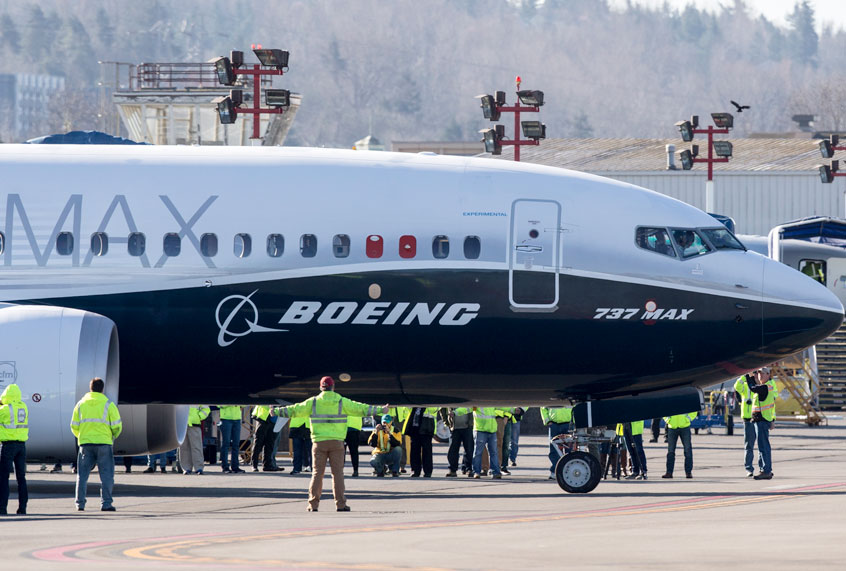
Boeing might represent the greatest indictment of 21st-century capitalism - Salon.com
Packed in the 737 fiasco are all the economic problems we face: crony capitalism, regulatory capture, offshoring...
Salon.com
40 points · by wolfgke · 7y ago · 24 comments
I think it might be profound yet sort of obvious - hierarchical organizations reflect the failings of their heads as their control causes the organizations to reflect their /actual/ values, the ones not on banal mission statements but how they act.
The same already happened with Detroit car companies and how they have often been a joke even domestically.
The real question is how to reform or replace Wall Street Investment "management" as they lead down hill by being too short-termist and bean counter.
They seem somewhat aware of it themselves in some ways with market caps often being higher in tech companies with "executive" shares given disproportionate control value to founders.
Leadership is vision and empowering the leaves, but that takes knowing yourself (to get the vision) and courage (to let the leaves have control). It's easier to act like a boss and give yourself the title of "leader". The only difference between a boss and a dictator is that that a boss controls by economic power and a dictator controls by physical power.
(Of course, most companies and management are somewhere in-between the poles)
The interesting thing to me is that Boeing seems to have completely failed to restrain management pressure to perform economically and went right past the acceptable performance boundary (dynamic safety model).
Even an allegedly high reliability organization was not able to escape bean counting in the end. It would seem that capitalism's typical obsession with profit can't be reconciled with reliability on the long term.
A 737 first off is not a Cessna like the author mentions flying. You do not get to use direct inputs easily nor do you want to have to fight stab trim because the force on the stabilizer control surfaces is muuuch higher than those on a slower flying plane. Because of this, when the 737 came out there were designs for trim systems that can help. These systems work by adjusting the trim settings for pitch using motors (like the author mentioned). However sometimes these systems would give erroneous inputs to the trim. The system might be causing incorrect trim up or down depending on the failure. This is officially known as stabilizer trim runaway. The procedure for this has been well established as a memory item meaning all pilots of 737s must be able to correct this without referencing a checklist since it is so dangerous. And it is HARD to correct because of the aerodynamic forces on the stabilizer. You can find videos of training for it. Now they introduced MCAS. A system designed to adjust trim automatically to compensate for the shift in the moments acting on the plane due to powerplant placement, etc. This adjusts the trim as well to prevent to high of angle of attack that would allow these different moments to introduce a stall situation. So what procedure should you use if it starts giving incorrect inputs? That's right, the stab trim runaway procedures, which again should be a memory item all pilots of these 737s should know and be ready and able to execute. The differences between systems that cause it just means you are taking different systems out of the control loop. This is also why I believe the FAA said it was fine to forego full airframe certification requirements. The procedures for handling the plane just didn't change drastically enough.
Yes there was negligence on Boeing's part, but I also think it's worrying that the reports seemed to indicate that the correct procedures for runaway stab trim were not followed which could have saved lives (e.g. turning MCAS back on while dealing with runaway stab trim). Also something to note is the plane in Ethiopian airways' crash was flying with "unusually high thrust settings". Remember the aerodynamic forces that make runaway stab trim a bitch to deal with? Well those forces get stronger with more speed. People are quick to point the finger at Boeing and surely they ARE at fault in some ways, but what's worrying to me is that there are pilots that are being trained that cannot perform the proper procedures that have been known since way before MCAS. Whats more is that the motors for trim from MCAS is limited to move at a rate of 2.5 degrees over 10 seconds with a pause of 5 seconds before the next adjustment. This is definitely slow enough to give pilots time to catch the runaway trim, cutout the stab trim and regain control. Anyway I am just surprised that the engineer, working for Boeing, couldn't be arsed to also give this info which allows an alternative perspective. It is bad that stab trim runaway is happening more with this system and Boeing acknowledged it and pushed patches. It is worse imo that pilots are forgetting or just not being trained on how to recognize and correct for stab trim.
Edit: Any details or numbers about the systems I got wrong please post a comment so I can correct it.
This was not a mistake, and it's wrong to characterize it as correct procedure not followed.
a. Strictly speaking, MCAS cannot be turned off. Autotrim can be turned off.
b. It's more clear than not, from at least the preliminary report on ET302, that the forces from MCAS induced mistrim at Vno were too high to manually retrim at the altitude they were at. The mistrim recovery maneuver requires releasing back pressure on the yoke to reduce the mistrim force in order for manual retrim to be possible. The transcript fairly clearly (not conclusively) suggests manual trim wheel would not budge. They were already at Vno at a low altitude, and it is reasonable they chose to reenable autotrim in order to gain leverage from the electric motor to overpower the wedged jackscrew.
At 05:43:11 (page 26 of the ET302 preliminary report) you can see two small trim events which are pilot yoke trim toggle switch electric motor assisted trim events; followed ~4 seconds later by an MCAS induced nose down trim that was a complete obscenity.
It was so extreme that the vertical acceleration sensor reports negative values. Only by being strapped in did they not hit the ceiling. That's how aggressive this last nose down MCAS initiation was, and within seconds later they were at 40 degrees nose down. For any automated system to have moved the stabilizer trim this much at Vno is a deeply flawed system. If a human pilot did the same thing in the same situation it would be considered attempted homicide, there is no possible alternative outcome but death for everyone.
You can correctly say: too bad they did not have our extreme mistrust of this MCAS system, too bad they did not realize at the time the extent of the betrayal they were facing. It is more clear than not that they still didn't know the details of how this system worked, that's why they didn't immediately return trim stab to shutoff after their two nose up trims.
It's flat out wrong to say the pilots did not follow proper procedure. They did follow it in the ET302 case. It didn't work. They almost certainly had to reenable stab trim, because the manual trim was stuck due to mistrim forces.
I don't think so, but I'm open to being proved wrong. In that case the root cause of the two crashes is Boeing trying to save money.
I could also ask, would the plane have crashed if it WASNT a max and another stab trim system failed?
It's both. We need to look at everything otherwise we will end up solving only 1 part of the issue.
Edit: To address something you mentioned about root cause (in aviation it's almost never a single root cause and I will give an example that shows such cases here). Let's look at another situation: Assume P&W designs an engine model a plane uses. The plane they are used in has in-air engine fire procedures that must be performed in order to mitigate disaster regardless of the engine model used. Now imagine the new engine design causes more engine fires. If pilots don't manage the problem appropriately when it occurs, what is the root cause? The poor engine design? Improper training from the pilot? In my opinion it's, again, both. Poor training coupled with higher chance of system issues.
If an Automotive OEM released a vehicle with an adaptive cruise control system that refused to disable itself except by the human driver intervening through power cycling the vehicle, while driving, it's difficult to put much warranted blame on the driver. The OEM sold a potentially catastrophically faulty system, irrespective of that the fault can sometimes be managed into a fail-safe condition by the driver.
The reason people put the blame on Boeing is because the system implementation didn't fail, the design did.
Why downvote this? Because it's interrupting a hate-fest on "21st-century capitalism"?
IMO the Salon article itself is pretty worthless; most of the substance comes from the IEEE article that has been already been well-discussed here:
Being "well-written and detailed" doesn't make it correct.
(I didn't vote either way, FWIW).