222 points · by ranvir · 7y ago · 151 comments
This seems to happen whenever there's (a) direct competition (b) the value provided by the winner is very scalable (media, sports, software) and (c) most importantly, it can't be substituted by splitting the job among more people.
So footballers follow this model because you can only have 11 people on the pitch - there's no amount of low-wage non-first-worlders you can replace Ronaldo with. Megastars follow this model; if you want to see Taylor Swift, that doesn't substitute cleanly with Ariana Grande or your local bar band.
And software engineers follow this to some extent because splitting problems up is in itself the difficult bit.
In football, there's only a market for the best. Nobody likes a loser.
It's the same in health. There's no market for mediocre or bad doctors.
Similarly, there's not really a market for software that doesn't work. Writing novel software that solves real problems isn't yet trivial. So there's not a huge market for bad software engineers. And there isn't yet a big enough supply of good ones to meet demand.
See why Google doesn't just lower their bar to hire more candidates. It wouldn't do them any good.
Not sure you and I are in the same market, friend.
Engineers and doctors are highly commoditized compared to professional athletes and celebrity entertainers. We produce a fundamentally fungible good.
If you can pay the market rate, you can find a replacement engineer to work your software. If Taylor Swift's concert is sold out, you cannot see Taylor Swift. If Aaron Rodgers dies, there are how many quarterbacks in the world capable of replacing him?
These are categorically different things with categorically different market dynamics. Approximately no software engineers (or doctors) have a personal brand, nor an objectively superior skillset.
No such mechanism exist for doctors or software engineers. They get rewarded for the value they create, and there can in principle be any number of them, as long as they create additional value.
(Doctors are different, they're not scalable and can only treat whoever's in front of them)
No one needs the exceptional janitor.
Fwiw though, I think there's lots of room for the mediocre software engineer. Enough work requires little to no skill. I've done some of it myself b
Would totally disagree - given the number of football competitions [1], it is obvious that there's a market for anybody who wants to and can kick ball.
Same for software engineers - there are 23 millions of those in 2018 [2] and abundance of body shops, government jobs ("good enough for government work") and various engineering support functions says the opposite of what you're saying.
[1] https://en.wikipedia.org/wiki/List_of_association_football_c...
[2] https://evansdata.com/reports/viewRelease.php?reportID=9
Apart from that it's mostly handwaving and opinion with no actual data. When you don't use data it's unsurprising that your personal experience matches your hypothesis.
And even then, we're ignoring features like internal storage capacity for each phone.
Even if you are making $10 million a year, you split that between your yacht, your car, your mansion, and jewelry for the wifey.
You aren't going to have the biggest mega-yacht and no jewelry for the wifey, so there will be a tapering at the higher end of the demand curve for yachts for people making $10 million a year.
Smartphone prices and city populations are not categorical variables...
To me all these bifurcations seem to me to stem from a change of a world of more evenly distributed wealth (for working, lower middle, and middle class) and one with wild inequality.
It's a world where a 10-20% can afford the "whatever" (e.g. best phone, live in NY/Bay area, university degree, etc) and the rest have to scrap by and increasingly pinch pennies (while still doing some desperate wealth-signalling purchases, like poor urban blacks that buy $200 sneakers to feel like they have something nice and can participate in the kind of society they see in ads).
Back in the 50s and up to the 80s a signle-income middle class household could still send a kid to college, buy a house, and so on. And living in NY or the Bay are was still very affordable (to the point that both areas had large artistic / bohemian communities living there, and not of the latte sipping urban wealth variety, but the penny pinching / stick it to the man / junky variety).
E.g. nobody feels like a champion as a unemployed homeless in LA, or a single mom making ends meet hand-to-mouth, just because 8000 years ago other people lived in caves, died at 30, and where often hunted by wild animals...
The change compared to not-so-distant decades, when a single-income middle class family had a job for life, could afford a house, and college education for their kids -- compared to living paycheck to paycheck is more relevant to whether we enter a world of more inequality, than what they did in the caves or the wild west.
Everyone has a super computer in their pocket, the vast majority of human knowledge is available in your hand for free all the time, you can video chat anyone you want anywhere in the world in HD for free, world-leading educators post hundreds of hours of video lectures online for free. You can get O(every song ever recorded) instantly anywhere you are for $10-$15/month.
In my opinion, what we're seeing is that things split into two categories: generally free or almost free, and expensive enough to be out of reach of most people. The thing that is really exciting is that things are moving from the latter to the former very quickly. The problem specifically with education is that expectations (everyone must have a degree!) Hasn't kept up with reality (degrees are no longer the only/best marker of skill!).
In Manhattan rent in 1980 was around $1200 for a one bedroom, so it’s not even significantly different.
A 1BR in Manhattan is around $3500 now. Have salaries really tripled in that time?
But it does seem to me that rentals in Manhattan have gotten a lot less affordable since 1980. (Manhattan in the 80s was not a particularly posh place, at least not throughout. There was probably more divergence in rents between neighborhoods in the 80s than now). It would take some more specific investigation than national median wages to investigate that. (Note, though, the median income in Manhattan specifically may have outpaced inflation as lower-earners get priced out).
But, as far as inflation and wages, yeah, inflation year after year means salaries in the 80s seem like very low numbers to us now.
> Back in the 50s and up to the 80s a single-income middle class household could still send a kid to college, buy a house, and so on.
Is the right word inequality? There aren't less college places, houses in NY/the Bay, etc in the world than there were in the 80s. By extension, the problem is not enough new wealth creation rather than inequality.
I'm open to being wrong, but at a guess there aren't all that many rich people who consume more than 2 degrees, live in 2 houses, etc. There are those that do, but they are relatively rare. Mostly they just get first pick from the existing stock, except in housing where they buy but then rent out in my experience, so it isn't exactly removing stock from general availability. If the rich disappeared tomorrow, would that free up enough resources that the poor could all have "whatever"?
I've no answer, but rhetorically I doubt it. The rich physically can't consume that many resources in absolute terms.
A wealthy person may have a 2. 5 million mansion and a quarter million dollar vacation home and own 3 rental homes.
They may trivially capture some of the resources available for others housing by buying up the housing supply and renting for more than the cost of the mortgage while fighting to maximize the value of investment by limiting the supply of new housing.
With 40% of their neighbors paying rent to people like them and some living on the street it's hard not to qualify the situation as unequal.
You're focusing on accounting, which is fine and all, but there are two scenarios here:
(1) There are 10 houses, 10 people live in them. Everyone owns their own house.
(2) There are 10 houses. 10 people live in them. All the houses are owned by 1 person. 9 people rent.
From an inequality perspective, obviously one scenario here is grossly less equal than the other. From a what-is-phyiscally-happening perspective, these situations are roughly identical.
The $2.5 million mansion you mention is potentially a nice house that is the same physical size as a $700k house in the country. My point here is although the situation may be grossly unequal, but part of the issue here is what actual, physical resources do we want the rich not to be using?
Eg, do we want to take away vacation homes from people and subdivide it into government housing? How much stock does that create? Is that going to solve housing affordability in, say, SF?
This isn't me being disingenous, I'm just genuinely curious why people think inequality is the problem since I personally favor that wealth creation is being strangled by hostile political forces.
Inequality is a problem; it is a symptom of things going badly wrong. But that doesn't mean that reducing inequality cures the disease - it is easy to reduce inequality by forcing everyone to have nothing. We all want to reduce inequality be creating more wealth. Houses, stuff, fun experiences, etc, etc. Is that possible? Is redistribution a valid route? Maybe. It does work sometimes.
Yes, the right word to describe this bifurcation is inequality. It's correct to note that the absolute number of available housing and students going to university are up, but relatively compared, people are finding harder to do both because the number of available spots has grown slower than population growth.
At first glance, this may seem like an issue with not enough wealth creation: why are there not more houses and universities being built? But when you look at productivity versus income [1], the issue is with the unequal capture of wealth not with its creation.
For some parts of the US, yes, but it would be a generalization error to assume this was a common condition for everyone.
Which is not to say we shouldn't aspire to such a relatively even income/wealth distribution. However, the political will for progressive taxation - which facilitated that level of equality - has been on the wane since the 70's. Possibly related to the extreme American economic dominance in the Post-WWII era, which we shouldn't expect to ever see again.
not so sure about that line. Many of the whatevs are scraping by.
https://www.financialsamurai.com/scraping-by-on-500000-a-yea...
1. The skyrocketing cost of college really does create enormous problems. I'm assuming the family profiled are either doctors or lawyers, because otherwise those $32K/yr payments would only last for a few years at most. (I paid $40K/yr in loans for both my wife and I when I got my first real job, but that happened exactly once... and we weren't buying BMWs or Land Rovers while we were doing it.)
2. Pensions, which have largely eroded away in the private sector, were enormously valuable. The switch from pensions to 401(K)s without a significant corresponding increase in pay is one of the most significant ways in which the real value of take-home pay has declined in the past 30 years.
But everything else could be cut in half, probably without even noticing:
1. $42K/yr on childcare is au pair/"elite" preschool money.
2. $5,000/mo mortgage is pretty high, even for a family of four in a high CoL area.
3. Three vacations a year @ $6,000 a pop. I take more than three vacations a year, but most of them are closer to $500 for a family of 4 (camping/backpacking). The expensive ones never get higher than $3,000. There's "getting away from work for a while" and then there's "flying a family of 4 to Paris a few times a year". The former is not a "luxury" especially for a high stress job, but the latter definitely is.
4. Luxury cars. For $10K they could buy a perfectly functional new car (which would last 10 years) every year. The only way that these are not "luxuries" is if they're required for work.
5. $3K on clothing per year, every year. That's high even for someone who has to dress nicely for work. Yes, nice suits are expensive, but they also last a long time. And your kids definitely don't need "meetings with high value clients" clothing.
6. $1K/mo on "children's lessons". I know how this happens, because I charged up to $100/hr for private tutoring while in grad school. But it's entirely unnecessary. It really is OK for your kid to get a B in an AP course. And if they need $100/hr quality tutoring for every course they're taking, the real world is going to be a rude experience. Also, $1K/mo on "children's lessons" while the kids are also young enough to need childcare is absolutely insane.
In NYC, these fees are necessary if you want to get your child into a "good" public middle and high school. The alternative is to pay $50K/year for private school. So #6 is a valid strategy to cut costs via attending public school--the very opposite of "luxury".
I'll take you task on this one, as a crummy 3 BR apartment in Manhattan is north of $2MM. Interest alone on that is $6700/mo. And I've personally seen number of dispiriting 3 BR's listed for $3MM.
1976 construction, 2000 sqft, 0.2 acre, 5 bed, 3 bath, 2 car garage, average condition, just under $200k.
Glassdoor average salary for "Software Engineer" (not Senior, etc.) in Salt Lake is currently $89k, 14% less than national average. [1]
Single-income house ownership is extremely common here.
[1] https://www.glassdoor.com/Salaries/salt-lake-city-software-e...
And even in some of the "very expensive" housing markets, you can still find homes that are affordable relative to income within 40 minutes of downtown areas. Chicago and Boston both come to mind.
The primary differences, as far as I can tell, are that:
1) Niche senior positions are harder to find in cheaper cities (think "deep hard tech expertise"). For example, nearly all of the major corporate research labs in CS (MSR, Google Brain, Google Research, IBM Research, Oracle Labs, ...) are in or around expensive CoL areas. On the startup side, "hard tech" startups are very often more capital-intensive so are even more attracted to geographic VC bubbles.
2) Moving up within BigCos is sometimes more difficult if you're in a satellite office.
Houses are very affordable in almost every part of the country. Buying a home is really not that difficult.
That tells you something about NYC in 1981!!
Or so I imagine(d). You're probably right that my intended message doesn't exactly reach everyone...
In the US. Meanwhile much of the rest of the world was mired in communism, which created incredible poverty and misery. After the 80-ties when it was finally overthrown for the most part, those billions of people start competing on equal ground with the US, which equalizes the global situation a bit.
Also, those countries are all far better off now.
https://www.cato.org/publications/policy-analysis/25-years-r...
Depends on where of the world.
Most of the rest of the world in the 50s (aside from eastern Europe, USSR and China) was anything but communist.
And even the communist (socialist) parts, where not really about some "incredible poverty" (e.g. in places like Yugoslavia, Czechoslovakia, and so on, just substandard middle/working class existence. Everybody there could get a job, healthcare, college education, and a house, for one.
As for the standard of living, I know the realities of communist Poland:
- The "everybody could get a house" is complete falsehood, at least for Poland. In fact, almost no one lived in a house - people lived in small, overcrowded flats (2 rooms for a family of 6, 1 room for a family of 4 were not uncommon), and even getting those shitty flats in drab housing projects required serious sacrifices and often years of waiting in the queue.
- As for higher education, only around 15% of population attended university, and not for the lack of wanting - it was clear that far from anyone could go.
- Healthcare was bad, but probably on par with the general underdevelopment of the country.
- Throught the fifties, people worked 28 days a month - yep, they only had a couple of Sundays off and that was it. The salary they got for such exertion was barely enough to cover rudimentary living expenses. My grandmother had to take a loan to buy a winter coat (to not freeze, not because it was pretty), and she paid that loan off over months. Over time, the living conditions gradually improved, but even in the eighties it was mandatory to work every second Saturday IIRC.
- What's probably most important and probably unimaginable for some who did not live under communism, were that obtaining just basic consumer goods was a challenge at times. Tens of millions of people at times stood for hours every day after work just to buy toilet paper or meat. It was an unimaginable waste of human time and energy.
I don't see why "poor urban blacks" buying $200 sneakers is a "desperate wealth-singalling purchase". Maybe they just like them. I don't see how its any different that the 10-20% buying the "best phone" when it provides no greater utility than a cheaper model.
> And living in NY or the Bay are was still very affordable (to the point that both areas had large artistic / bohemian communities living there, and not of the latte sipping urban wealth variety, but the penny pinching / stick it to the man / junky variety).
I would think as neighborhoods become safer and more gentrified, the number of people that want to live there increases and naturally the price to live there increases as well. Comparing crime ridden NYC from 50 years ago to NYC today makes no sense.
According to economists Banerjee & Duflo: “The poor are skeptical about their supposed opportunities, and the possibility of any radical change in their lives…Therefore, they focus on the here and now, on living their lives as pleasantly as possible, and on celebrating when the occasion demands it.”
>
I don't see how its any different that the 10-20% buying the "best phone" when it provides no greater utility than a cheaper model.*The difference is that for the 10% that is an insignificant amount, and they still can cover their more basic needs with aplenty left anyway.
Far too often sending the right kind of signal is a required prerequisite[1] to e.g. being granted access to a job that might eventually become a better-than-minimum-wage career. Often wealth isn't the intended signal; it's a presentation of having accepted and converted to a group's culture or beliefs.
[1] https://tressiemc.com/uncategorized/the-logic-of-stupid-poor...
I'm more curious as to _why_ our decisions become dominated by one factor as we approach abundance. It almost seems counter-intuitive: in a world of abundance, wouldn't there be more things we could afford to care about? In a world of scarcity, wouldn't your decision be based mostly by just "does it do what I want it to do"?
Maybe we're just lazy. Maybe it's the other way around: in a world of abundance, we can _afford_ to be _lazy_ and not care about nearly as much, and instead focus on singular values.
In either case, I'm not convinced that decision distribution is a function of scarcity/abundance, but rather some other factor, of which scarcity/abundance contributes to.
Yes but also "can I afford it?", "is it available?", "will it be shipped on time and to my address", etc. When you reach real abundance and everything is at your fingertips, the only factor that matters is whether you want it.
I would speculate that it comes down to the availability of too many different "classes" of products and services, which are often self-exclusive. There is only so much time in a day to consume a limited amount of these products and services. People's time and attention span is the limiting factor.
Let's say that you are in the market for entertaining yourself in some way. You can entertain yourself by riding on a rollercoaster, by watching movies, by driving a sportscar, by hiking, by doing photography. There is too much choice, and you eventually pick only one or two of these activities and they eventually become your "favourites". You become addicted, you prefer buying only high-end, specialised equipment, and you skew the market of that product accordingly.
He doesn't provide any figure, he just says things and consider them to be true.
Similarly, those large cities he lists (LA, New York and San Fran) have relatively low population growth, at 0.67%, 0.25% and 1% respectively [1]. Large cities like Phoenix, and Austin have around 2% growth.
This makes more sense to me. As these cities become crowded and expensive, people will naturally look for a better deal.
These types of articles are just lazy. The author doesn't even seem to bother doing basic research.
[0] http://zindagi.online/2018/12/03/gartner-global-smartphone-s...
(https://www.theatlantic.com/business/archive/2017/04/why-is-...)
The idea that everyone will be riding around in shared cars and live in the LA megalopolis is a tech industry fantasy.
It’s still a reversal of the ‘60s and ‘70s where the cities were being abandoned wholesale.
It's also nowhere near anything TFA says.
What he says is that where people want to live is not very gaussianly (normal) distributed, but there is a peak for major urban centers (LA, NY, SF), and a large plateau of smaller places.
He doesn't say that "everyone has an iPhone or Samsung". Quite the opposite. That there's a large flat base of sub-300 phones, and a 10% (or more, depending on country) of people with high end (say over $800 phones), and not much in between.
No, actually he doesn't say that. He says that people who don't care about their phone will take one for $0, any phone:
> Or, b. you’ve decided that just about every phone out there is ‘good enough’ and is more than adequate for your needs, so you’ll go with whatever one costs $0 with your existing wireless contract.
People buy many different phones (including high-end Android phones, and second-hand iPhones); the reality he describes doesn't seem to exist.
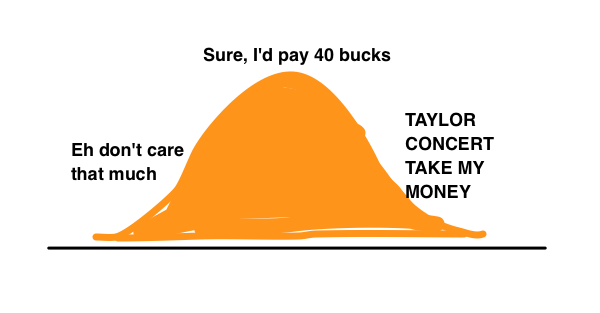
Also, including people who don't care about Taylor Swift in a study of the value of Taylor Swift concert tickets' value, is absurd: that some people (or even most people) don't want something, doesn't have anything to do with the price of goods. What matters is who wants it and how hard they want it.
Some people like Taylor Swift a lot, some like her a little, some like to go to concerts, some like to go out, some are looking for a place to bring a date, etc. etc. The author's binary division is completely artificial.
(Rome and many pre-industrial cities usually had negative population replacement rates because disease was such a problem. People still came.)
A few years ago, a friend gave me his old mid-level Samsung phone for free. It was a piece of garbage, and I hated using it, but I put up with it until it died. Afterwards, I looked around for something decent that wasn't too expensive, and settled on a refurbished iPhone SE. It cost a couple hundred dollars, and still works just fine. It doesn't have all of the latest bells and whistles, but it's good enough, and actually fits in my pocket.
Cars are different. Not everyone buys a Porsche or a Kia.
Cars are perhaps one of the few exceptions, maybe due to sheer price setting hard limits on the high end and basic safety setting limits on the low end.
https://ourworldindata.org/uploads/2013/12/Global-inequality...
However, growth in income is bimodal:
https://commons.wikimedia.org/wiki/File:Global_changes_in_re...
Could that affect the phone market indirectly, by consumer confidence? It's possible, but it's not nearly as clear-cut as human height.
I'm sure part of the reason is that since most carriers (and Apple itself) will finance the phone cheaply, so the practical difference between the cheapest and most expensive phone is $30 a month.
So instead of all floor tickets being $100, there are some floor tickets that are worth way, way more than others. Even "row 1" tickets up in the 3rd deck are more than row 2 tickets in the same section now.
Ticket pricing has evolved to maximize profits at the source. The value of the tickets is very close to their retail price.
So if you ask "how much would you pay for Taylor Swift tickets", the answer is "depends on what row".
It seems perfectly natural that management would be much more selective for permanent employee hires than for contractors.
The fact that there’s a class divide among workers now naturally selects out many workers that otherwise might be incentivized to create more wealth for the company. This could have long term consequences in industries that formerly relied on innovation.
Sometimes this conversation happened during the original job interview. "Would you consider going full time ever?" Good to have that conversation sometimes.
Famously, word usage follows this pattern (Zipf's law). But other things such as wealth accumulation, product usage, celebrity fame, upvotes on Reddit, etc all have this distribution. It's not possible for every person to read every post, evaluate every possible drink, or watch every movie, so they settle on one of the most immediately available options. So they drink a Coke while watching The Avengers and upvote the top-rated comment on Reddit about it.
This doesn't work with everything; for example, I could need access to health care. But for the vast majority of non life-or-death purchases, I'll opt-out.
I don't think I agree with the rationale: the bifurcation is more likely based in economics. Niche appeal at 10x the cost might be more profitable that reasonably priced, mass appeal products. E.g., when it comes to things like Taylor Swift tickets. I'm unwilling to spend a few hundred dollars to see her. These live performances are for people who are.
And for most of the examples given in the OP, I still find myself landing in the middle, between two supposed modes.
So I guess I'm not entirely convinced.