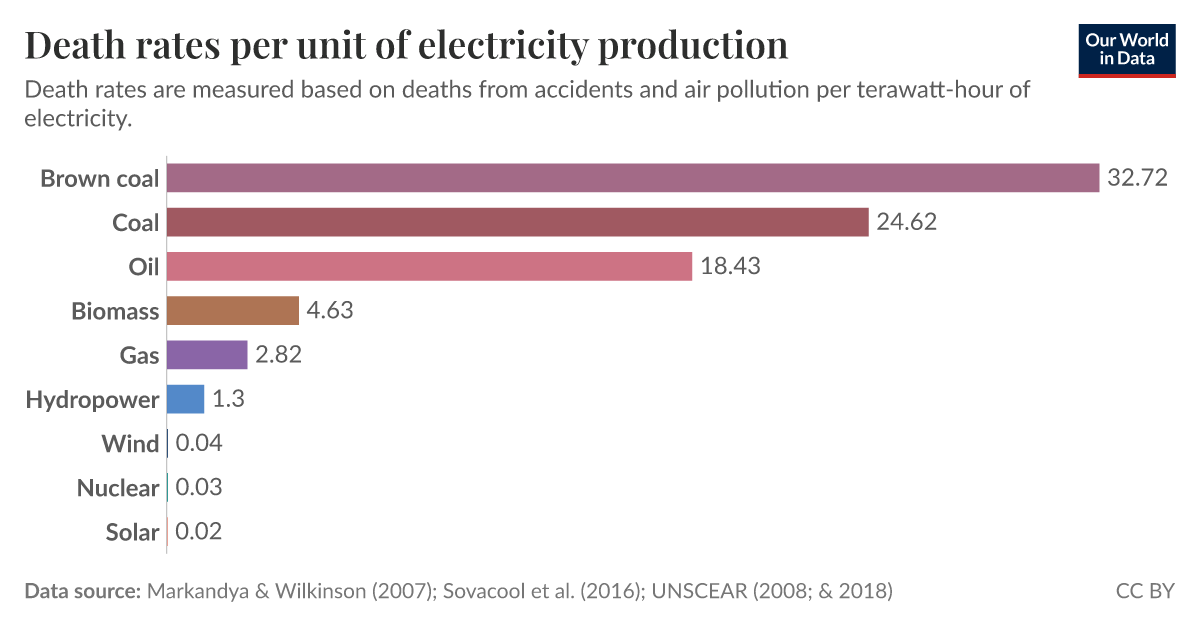
Death rates per unit of electricity production
Death rates are measured based on deaths from accidents and air pollution per terawatt-hour of electricity.
Our World in Data
122 points · by peter_retief · 7y ago · 159 comments
The New York Times published an article that touched on this fairly recently too:
https://www.nytimes.com/2019/04/06/opinion/sunday/climate-ch...
People naturally apply the same heuristics to nuclear fallout for the same reasons. Fallout seems equally bad whether it's a 10 S dose or a 10 uS dose. And just as arsenic poisoning is a real thing that happens, deadly fallout was and remains a very real danger from nuclear war. Any nuke will produce some but if you set a big one off near the ground, such as to hit an ICBM silo or a sub pen or a command bunker, and you'll produce a very large amount. At the height of the Cold War a US first strike on the Soviet block was expected to produce up to 100 million casualties in Western Europe from fallout if the wind was blowing the wrong way.
Given that magnitude of danger it's no wonder people hear "fallout" and think that they're all going to die.
And where are wind and solar?
Wind has a 35% capacity factor in the US, nuclear has 90%. Solar has 25%
Wind and solar capital cost is 4x lower than nuclear right now, thanks to the fact that they're at low generation fractions and have lots of fracked gas and hydro to integrate their variability. As generation fraction goes up, their cost goes up non-linearly. Nuclear cost is terrible right now. Some people are trying to bring it down, but no great progress yet. In 10-20 years when 20 countries have 20% or more variable renewables, nuclear will probably start looking really good again for deeply decarbonizing.
And nuclear roughly as few (and probably a little bit fewer) people than wind and solar per kWh generated, all of which are orders of magnitude safer than fossil. People fall off roofs installing solar panels and wind turbines catch fire and sometimes do ice-throw.
For example, if you look at Cattenom Nuclear Power Plant location on a map and create a 80 km radius exclusion zone, Luxembourg, as a country probably ceases to exist. This is not something that could happen with a catastrophic failure of wind turbines or solar panel.
By definition, nuclear plants are near coastal areas or a river, so prone to ocean rising water (or tsunamis), floods or droughts.
This is something that is harder to evaluate than simply a death count.
I believe this is less relevant for the US, where I assume there is enough space left in sparsely populated areas, but in denser areas like in Europe or South East Asia, it seems to be a bigger factor.
You could even say: "Fear of radiation is more dangerous than radiation itself"
https://aeon.co/ideas/fear-of-radiation-is-more-dangerous-th...
The implication of France having a nuclear accident that causes damage to neighboring Luxembourg is that France is at fault and owes reparation to Luxembourg. Or that France should not be allowed by international law to do something like this that puts Luxembourg at risk.
If that's the case we must also accept the same thinking for the nations affected by climate change against the largest emitters of CO2. Which will put many nations, including Luxembourg which is a huge emitter of CO2 per capita (above the USA) on the hook. Things are complicated.
Not to mention that of the 2 major nuclear disasters we've had, half were caused by a less-than-once-in-a-generation tsunami. If something that disastrous hits Luxembourg ... I dunno, the situation would already be pretty grim. And all this is assuming they actually need to be evacuated, which is debatable in itself.
Fun fact, it is possible to build a world-class city in 40 years [0].
Can you please not blame a technology for the idiocy of a professional liar?
Not always. The Palo Verde nuclear generating station is in the middle of the desert.
(Ok, technically it's near the Gila river, but there's rarely water in that part of the Gila river anymore.)
Edit: it seems to be what mainly contributed to the nuclear numbers: https://www.sciencedirect.com/science/article/pii/S014067360...
> The sources of the effects and indeed the effects themselves for the nuclear fuel cycle are very different from those for the fossil fuel cycles. They can arise from occupational effects (especially from mining), routine radiation during generation, decommissioning, reprocessing, low-level waste disposal, high-level waste disposal, and accidents.
https://news.ycombinator.com/item?id=19905223
I say carbon-free for anything that's under 40 gCO2-eq/kWh (so I can include solar), which is 10x less than natural gas, 20x less than coal. Nuclear is 40x less natural gas! It's the lowest carbon energy source we know, tied with wind.
The heavy equipment is not going to produce enough carbon to be worth measuring on a per kW basis. The energy density of nuclear fuel is just too high.
https://www.newyorker.com/magazine/2017/02/27/why-facts-dont...
Here is the entire data download that is actually included for this chart:
  Entity,Code,Year, (deaths per TWh)
  Biomass,,2014,4.63
  Brown coal,,2014,32.72
  Coal,,2014,24.62
  Gas,,2014,2.821
  Nuclear,,2014,0.074
  Oil,,2014,18.43
For example if weather during Fukushimas accident had blown fallout over Tokyo, or if a reactor anywhere releases similar or greater amounts of fallout anywhere in the world where a large population center is downwind, many thousands of cancers are possible, with children disproportionately affected by radiation exposure. Large areas of land can be made uninhabitable to civilization for decades or more, and depending on future civilizations standards.
https://www.bbc.co.uk/news/resources/idt-sh/moving_to_Cherno...
https://www.nextbigfuture.com/2008/03/deaths-per-twh-for-all...
I don't think that would count natural gas emissions for backing renewables.
Hydro has a pretty terrible track record with regard to safety, most of it because of a single accident: the Banqiao Reservoir Dam failure, which caused 230000 deaths. And even if much less dramatic, dam failure still happen regularly, costing deaths, property and environmental damage.
And while I tend to think of hydro as the ideal energy source (renewable, on demand, with built-in storage), safety is not one of its strong points. Or at least, not with the way it is managed now.
* Can't be built in lots of areas due to geography
* Struggles seriously in droughts
* Large reservoirs emits significant biogenic methane (especially in warm areas) [1], which is a powerful greenhouse gas
* Messes with fish
* Gets scary in major rainfalls
Based on that note it sounds like it might be pretty close to 0.
https://www.forbes.com/sites/jamesconca/2012/06/10/energys-d...
I'd expect it to be quite high (deaths per TWh) while the technology is new or advancing fast, both because the energy production will be low, and because there must be more risk in newer industrial-scale technologies.
Deaths per TWh in Offshore wind vs Onshore wind production would be interesting to see too.
My country invested a lot in wind generated energy in the past decade (and that's a good thing), but the bird populations in those areas clearly suffered for it.
https://www.visualcapitalist.com/worlds-safest-source-energy...
There were lots of deaths from hydro power dam failures.
(Update: fixed typo, thanks :D)
https://ourworldindata.org/what-is-the-safest-form-of-energy
2. Wind is not without issues either: http://www.caithnesswindfarms.co.uk/AccidentStatistics.htm
3. And even more moralities with people falling down their rooftop installing solar panels.
These are things that need to be addressed for these kind of statistics, or you end up comparing apples to oranges.
Still, I think everybody can agree that the death rates for coal and oil are insane. However you compare nuclear vs solar, coal and oil need to go.
A more valid criticism might be to point out that radiation tends to kill slowly, while renewable deaths are fast (falls, drowning, construction accidents). The result is that nuclear accidents can be very disruptive without being directly deadly. (See the 160,000 people evacuated after Fukushima.)
Wind and solar are slightly more dangerous than nuclear, as of this data.
Are the subsidies and taxes (incentives and penalties) rational in light of the relative harms of each form of energy?
"Study: U.S. Fossil Fuel Subsidies Exceed Pentagon Spending" https://www.rollingstone.com/politics/politics-news/fossil-f...
> The IMF found that direct and indirect subsidies for coal, oil and gas in the U.S. reached $649 billion in 2015. Pentagon spending that same year was $599 billion.
> The study defines “subsidy” very broadly, as many economists do. It accounts for the “differences between actual consumer fuel prices and how much consumers would pay if prices fully reflected supply costs plus the taxes needed to reflect environmental costs” and other damage, including premature deaths from air pollution.
IDK whether they've included the costs of responding to requests for help with natural disasters that are more probable due to climate change caused by these "externalties" / "external costs" of fossil fuels.
(Everyone is free to invest in clean energy at any time)
So what we need to ask to be sure nuclear is really as safe as the number makes it appear is... what happens when we scale up and introduce more new employees, and more errors? What is the worst thing that can happen if a new worker makes a bone-headed move and causes an incident?
I honestly don't know the answer, and would be interested in hearing more. But I'm not going to be sold on nuclear safety by a chart, not when I've seen how crazy hard it is to keep a large operations staff in energy plants safety-conscious enough to prevent accidents, injury, and deaths. These are human issues that need to be addressed to be sure safety levels stay on track.
The article says:
> Deaths related to air pollution are dominant, typically accounting for greater than 99% of the total.
I understand that you are talking about a subset of the data the article are talking about. But if 99% is due to pollution then it sounds like your subset is not so relevant.
While that does strengthen the point of the chart, it doesn't invalidate my concerns. It was almost 10 years ago now, but I recall an incident that made national news, when a gas hub in Texas exploded, and there were impressive, but sobering, photos of flames shooting 500 feet into the air from the resulting fire. That is one worst-cases for oil & gas. Some of the spills we've had from tankers are other worst-cases. And they do happen.
So again, I need to know what the worst-case for nuclear is before I'm going to be sold on it. Because if it scales to the capacity of our gas industry... something will happen. And we need to know what it will be and be ready to handle it.
What I think is most interesting is that very few entrepreneurs are talking about the exciting world of a more distributed grid. Distributed Grids running on renewables with backup from a larger centralized grid is a really interesting idea, and it's one where long term servicing costs will be pretty big.
It'd be a good time for folks in SV to think about swinging at the big formerly-state-subsidized behemoth power company. Because the alternative is that they make their case that they need state subsidization while still maintaining autonomy.
I don't really understand why so many folks like to think it's a clever take to say, "Actually Nuclear is quite safe." Even if that's the case, it is dependent on having a centralized power grid (which is very hard to maintain and occasionally causes wildfires), it depends on fuel mining and manufacture (also not a very safe proposition for those involved, uranium mining has similar risks to coal mining), and the proliferation of these fuels also proliferates an important component of the means by which weapons that turn a city to ash in mere moments are manufactured.
Compare this to the plunging cost of solar and wind. It just... doesn't seem very smart except for the most densely stacked industrial regions.
I'm not accusing the authors of doing this because I don't know much about this field, but it's worth being aware that even raw data can be biased.
Good point. And those were interesting omissions, I agree.
Edit: or on desktop. Can you post the link to the article you're seeing please?
But this idea that nuclear power plant disasters cause measurable harm anywhere but Chernobyl is just ignoring every bit of epidemiology I’ve ever seen.
And, even at worst-case-Chernobyl, where they took a terrible design and turned off all the safety features, the idea that negative effects last more than decades is ludicrous. The atoms with short half lives are the dangerous-to-human-health atoms; after decades they’re gone.
I’m with you on centralizing power production having socio-political ramifications, but... we’re going to have a grid any which way. Unless we get Shipstone-level inexpensive batteries, we’re still going to have to maintain an electrical grid.
My anti-nuclear friends hate me for it, but I tend to think if we have any hope of limiting carbon forcing in mid-century, we’re going to need nuclear.
http://www.bbc.com/earth/story/20160421-the-chernobyl-exclus...
Good point. Thanks.
Honestly, I am an anarchist. I detest hierarchy. I don't like centralization. But let us not make a religion out of it. Let us stay rational.
I think nuclear is the safest viable option we have at this moment. It is not perfect, far from it. It also doesn't mean we should stop funding the research of renewable energy and of energy storage. Quite contrary. But let us not fall for wishful thinking --- look at Germany.
Okay, imagined it. If we need that much power in one place then great. We'll work on it then. But for the majority of individuals, they'll never need close to that level of electricity.
> I think nuclear is the safest viable option we have at this moment.
Based off nothing other than handwavey arguments about how, "Look how this system which has been deployed at a tiny fraction of the scale of the other systems has fewer deaths when we specifically cut out fuel procurement but count atmospheric pollution even if that's difficult to avoid confounding?"
This is not a compelling line of argument. No more so than the "what if we suddenly have a fusion breakthrough won't you want thousands of lines of cabling then?"
> It also doesn't mean we should stop funding the research of renewable energy and of energy storage. Quite contrary. But let us not fall for wishful thinking --- look at Germany.
I don't recall us saying science was bad. Rather, it was, "Concentrating capital on ever larger energy ziggurats is not something that makes sense in 2019."
Sure. Let's look at Germany, where they literally have such an abundance of power they can't migrate their grids to use it fast enough so they pay people to use it? Or how they're now investing in inexpensive and locally sourced storage options because they can power over 90% of their peak demand on a good day?
These are "good problems to have." Certainly better than "How do we shield this drone enough that we can make contact with the melted fuel rods at Fukushima."
And solar, wind, hydro-electric, thermo-electric, etc.
But it is very surprising that hydro, wind and solar aren't on this list. It is a non-trivial component of the total power production of both the US and Europe.
Also: the operation error and design flaws at Chernobyl were astounding [2].
Then we had Fukushima, where an earthquake trigggered an automatic shutdown of the reactors, which worked great. Then the tsunami knocked out the backup cooling generators and decay heat melted fuel and released nuclides through an in-tact reactor vessel to the atmosphere. Multiple meltdowns. What does UNSCEAR have to say? 0 deaths from radiation. Some sources say "up to 1 death from radiation".
I think it's really, really hard to postulate millions dying from nuclear.
4 million die per year from air pollution due to non-nuclear energy [3].
[1] https://www.unscear.org/docs/reports/2008/09-86753_Report_20...
[2] https://en.wikipedia.org/wiki/Chernobyl_accident#Accident
From the data in this link, we can infer that historically this adds up to 467 times nuclear.
[1] https://www.who.int/gho/phe/outdoor_air_pollution/burden_tex...
I can't. Care to share?
https://ourworldindata.org/what-was-the-death-toll-from-cher...
The numbers already round to 0 when compared to pretty much any other industrial process we undertake. Then on top of that the model used is the LNT. That model needs extraordinary evidence to support its wild assumptions. I haven't been able to find a source for that evidence yet.
LNT is a paranoid model. Under the LNT, building with granite is killing people through increased radiation. The airplane industry has probably killed more people with radiation under the LNT model than Chernobyl has. We have yet to picket airports for their radiation risk.
The unproovable deaths from Chernobyl may as well be ignored. We don't count that sort of statistical hypothesizing for any other anything that is comparable to building a power plant.
https://en.wikipedia.org/wiki/Deaths_due_to_the_Chernobyl_di...
[1] https://www.unscear.org/docs/reports/2008/09-86753_Report_20...
If you're going to say stuff, please provide credible references. There are some whackjob studies that say 1000000 died from Chernobyl, but they've been discredited by the scientists of the UN working groups. Even Greenpeace doesn't believe that number. UNSCEAR is the Chernobyl equivalent of today's IPCC for climate change.
And also, the land is not permanently uninhabitable. You have to postulate that living things have no tolerance above background radiation to say that. But there are lots of reasons to think that's not true at all. For instance, places like Ramsar, Iran have background levels 80x normal and there's no sign of decreased lifespan or other health impacts.
Also, checkout this wildlife around Chernobyl: https://thoughtscapism.com/2019/05/08/what-about-radioactive...
Give me a proper plan and I'd be fully behind nuclear (well - if it was self funding - currently hugely subsidised and still one of the most expensive ways to make power).
That said - my alternative isn't 'more coal' - it is a combination of renewables and trying to reduce our energy usage. But I know that both of these won't be the breakthrough that we need without cheap storage.
Here's my buddy Jim standing in a parking lot full of decades worth of nuclear waste [1].
The Finns decided to solve their nuclear waste issues and have a repository under construction. [2]
Meanwhile, millions die per year from air pollution and carbon concentration just peaked 415 ppm. I think nuclear waste is honestly a tiny concern compared to those things.
Nuclear operations are not hugely subsidized in the US. They get about 1% of the tax subsidies given to energy sources. They are struggling economically because fracked natural gas pulled the floor out of electricity prices, and nuclear O&M can't just reduce itself with lower fossil prices. In France, where natural gas is more expensive, their nuclear fleet is 20% cheaper than gas.
[1] https://www.youtube.com/watch?v=EUvvIzH2W6g
[2] https://en.wikipedia.org/wiki/Onkalo_spent_nuclear_fuel_repo...
A plan based on tech which either isn't created or not yet deployable is a little too handwavy for me.
(Also, the breeder reactors only use spent fuel - most "waste" by volume is lower level waste of various kinds. Especially from decommissioning.)
> Many UN and US agencies warn that building more nuclear reactors unavoidably increases nuclear proliferation risks.
> Canada sold India the reactor on the condition that the reactor and any by-products would be "employed for peaceful purposes only.". Similarly, the United States sold India heavy water for use in the reactor "only... in connection with research into and the use of atomic energy for peaceful purposes". India, in violation of these agreements, used the Canadian-supplied reactor and American-supplied heavy water to produce plutonium for their first nuclear explosion, Smiling Buddha.
By the way, why are solar panels and wind turbines missing in the list? It's awfully misleading.
--
Edit due to downvotes:
As an example, here's a study that came to the conclusion that leucemia is twice as common as normal among small children growing up near nuclear plants in Germany: http://doris.bfs.de/jspui/handle/urn:nbn:de:0221-20100317939 Why is noone counting the resulting deaths in these statistics for nuclear energy?
Outside of direct exposure to radioactive material there isn't much going to kill you.
The very big difference is that a functioning nuclear plant doesn't kill people whereas the oil/gas industry kills by default even in the best case scenario.
[0] https://en.wikipedia.org/wiki/Deaths_due_to_the_Chernobyl_di...
Of course nobody uses age adjusted metrics because you can't make grandiose "bazillions of lives lost" claims using them.
> 91% of the world population live in area where air quality exceeds WHO guideline [0]
If I had the choice I'd go for a < 0.01% chance of dying of radiation related death over a 100% chance of slowly but surely destroying my respiratory system.
And let's be real, accident related deaths are a drop in the bucket.
For example the rate of leucemia among small children living near nuclear plants in Germany is twice as high as average (see https://www.bfs.de/DE/bfs/wissenschaft-forschung/ergebnisse/... )
In any case, the millions of tons of coal that Germany burns instead, thanks to German "greens", will cause a lot more death and suffering.
Here is a 2013 British study, where kids born in the vicinity of British nuclear power plants, have less leukemia:
https://www.nature.com/articles/bjc2013560
Here is a 2011 article that claims that the 2008 German study did not correct for confounding factors such as socioeconomic status:
https://www.nature.com/news/2011/110506/full/news.2011.275.h...
Fukushima has one official dead person from radiation. But what about the 1% increased cancer risk? Has noone dead from this cancer? Is noone going to die from it in the future?
The normal rate of Thyroid cancer among children in Japan is 0.35 per 100,000. In Fukushima the rate is now 13.4 children per 100,000. [1]
--
[1] http://www.ippnw.de/atomenergie/gesundheit/artikel/de/schild...
The number of kids who get thyroid cancer from nuclear, however, is almost insignificant compared to the number of children who currently die from air pollution, not to mention the ones who will die from CO2 emissions causing global warming. Everything has risks. The risks from nuclear are exceedingly low.