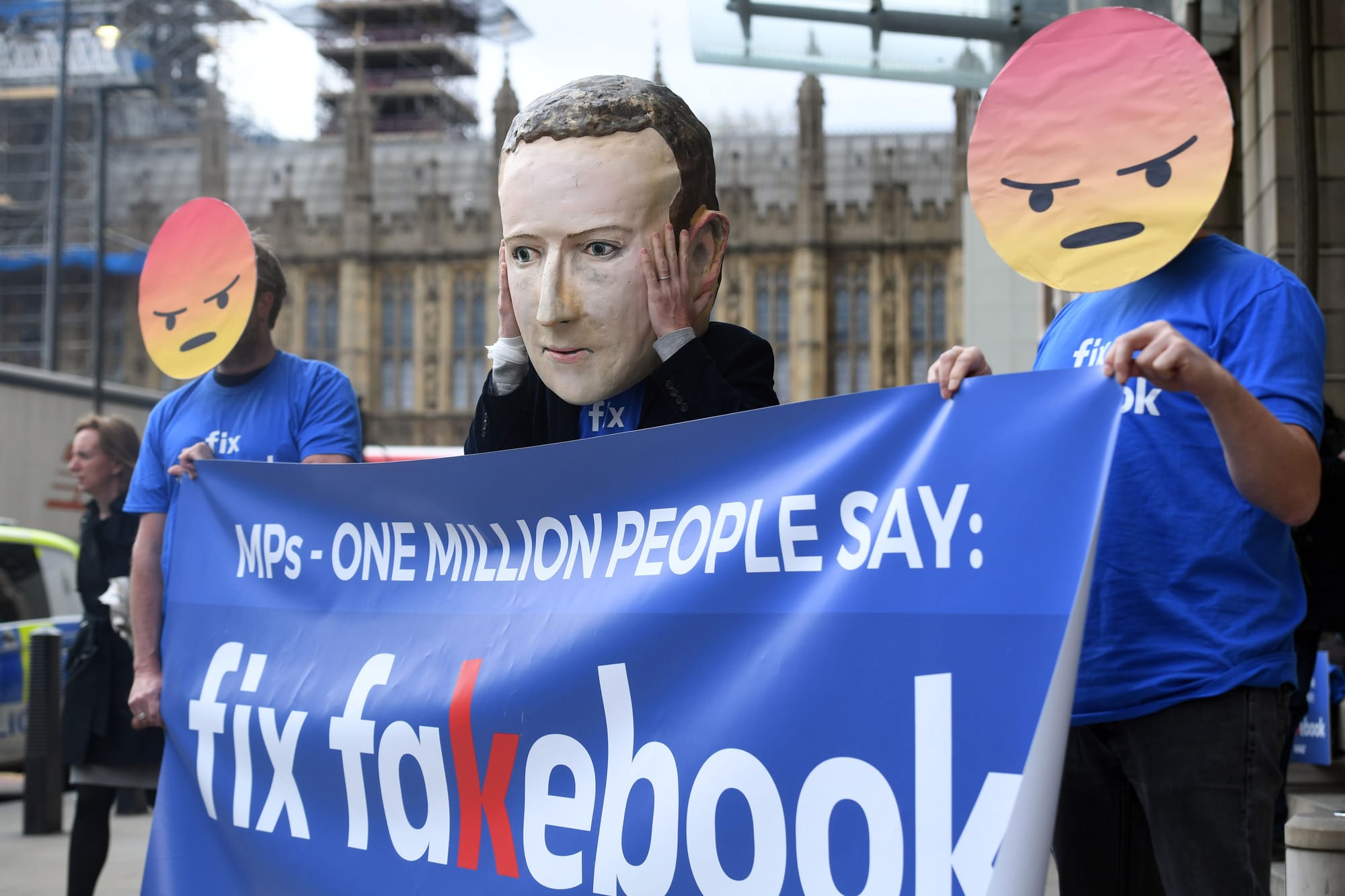
Facebook and Google pressured EU experts to soften fake news regulations, say insiders
On the eve of European elections, the tech giants stand accused of sabotaging the European Union’s fight against disinformation.
openDemocracy
236 points · by okket · 7y ago · 144 comments
I hope young people who are familiar with "fake news" but not necessarily as familiar with the history of propaganda and censorship will study that history.
The big issue is there is enthusiasm for censorship, and the problem with censorship is who gets to decide what is real information and what is fake. The interests with the most power will have more control over information as censorship increases.
Because the same power that is supposedly only used to suppress propaganda from some other country is used to suppress internal dissent or criticism.
This is actually very dangerous for multiple reasons. One big reason is that propaganda (internal to the country, i.e. by the same people who will be deciding what is fake news) is usually critical in terms of jump-starting and maintaining enthusiasm for wars.
1° detect abuse, propaganda and "fake news" 2° remove it automatically.
So they're handed altogether the power of police, jury and executioner. They're already much too powerful, and they were just given much more power for free. What will become of free speech under these conditions? Do you think Twitter will flag Macron's tweets when he spouts out blatant lies, which is actually quite often?
I have that on any given site I make by default.
Later this week, in European elections, prepare to see a landslide of far-right parties of various racist, xenophobic flavours in all countries. A slippery slope? Looks like an oily slide into chaos indeed.
What inspired me to learn about it was none other than a youtube video title "Rule From the Shadows: The Psychology of Control". Sure, it sounds like it'd be a conspiracy theory video, but it's far from it, listed all sources, and recommended books which were discussed.
Those books being: The Crowd by Gustave Le Bon, Crystallizing Public Opinion, and Propaganda by Edward Bernays, Sigmund Freud's nephew.
That video on youtube really changed the way I view the world, especially media and "groups" of people, like antifa, the alt-right, or what have you. When you see the words of Le Bon or Bernays in action, it sends a shiver down your back. The downside being that most people will assume you're crazy or paranoid if you start talking about Bernays or Le Bon.
"The conscious and intelligent manipulation of the organized habits and opinions of the masses is an important element in democratic society." - Edward Bernays
Facebook has clearly failed to take responsibility to combat fake news, as some of the most serious solutions to the problem pose existential threats to their entire business.
On top of that, we're also seeing high-profile figures and politicians pushing propaganda successfully without the need for censorship (the Obama birtherism conspiracy, the Jade Helm conspiracy, etc.) Whether or not they're willingly doing so is up for debate, but some of the conspiracies being pushed are inflammatory, ridiculous, and damaging to our civil discourse.
The heads of major political parties get to decide what is real information and what is fake now; they don't need censorship to do this.
Look at how many plainly absurd lies this administration has pushed about the most inane things (the inauguration attendance) to the most serious things (Trump dictating the false statement on the June 2016 meeting, etc.)
There's just no longer an incentive to have a good-faith debate on anything.
I don't need a car to get to work. I've got a bicycle and five miles on a bike is nothing. But the car sure as hell makes it easier.
In either case, our discourse continues to suffer. So what choice do we have? Maintain the current system and watch our process devolve slowly, or permit regulation which runs the risk of creating a power vacuum?
Our system suffers in either case. We're talking about damage control at this point; not actually fixing the problem.
"Monique Goyens – director-general of BEUC, which is also known as The European Consumer Association – is blunter. 'We were blackmailed,' she says. [...]
Facebook’s chief lobbyist, Richard Allan – another member of the expert group – said [...] to another group member: 'He threatened that if we did not stop talking about competition tools, Facebook would stop its support for journalistic and academic projects.'"
> According to Frau-Meigs, independent funding for academics as well as journalists is extremely important. “Google and Facebook are paying these partnerships from their direct marketing arm, not through more neutral foundations,” she says.
This seems to be implying that Facebook and Google are paying these partnerships partly or mainly to coopt the researchers in order to avoid public relations or regulatory issues.
Blackmailing is telling people that you're been doing something illegal or immoral if you don't meet demands. Is the BEUC admitting here that they were doing something illegal or immoral?
I’m not sure if this is legal and I think it varies by jurisdiction. For example, in the US I don’t think it’s actually legal to give donations to political offices contingent on them passing certain policies. You can, however, donate freely, imply you favor certain policies, show them more stacks of cash in your future lobbying fund, and wink.
Now the gifts themselves are a conflict of interest so they should never be allowed. Show of EU hands, who wants to outlaw all FB/GOOG gifts?
This is a case of wanting to bite the hand that feeds you and then whine when the hand yanks back the handouts too. Sure FB/GOOG plays a little dirty, but all corps/political states play this game.
Compromising information could be information of various kinds, not all of that evidence of illegal or immoral deeds.
Pointless nitpicking and wasting our time.
Blackmail implies they were doing something illegal or immoral - extortion implies they were innocent and threatened.
I don't see a downside.
Hm. It's not immediately clear to me why fake news regulation would require Google and FB to share more information about their business models with the EU.
I also feel that in the wake of a large number of EU fines, laws, decisions etc that specifically attack FB and Google, it's perhaps not unreasonable that there might be some scepticism that the EU would not abuse this information to levy yet further fines.
Some reasonable people might argue that a number of the EU fines have been justified - possibly in isolation I might agree with one or two - but there are also less defensible examples, such as defining "free mobile operating systems" as a market sector separate from all other operating systems and platforms, to allow them to find Google guilty of a monopoly.
I feel like the EU is trying to have it both ways here - it seems unreasonable for the EU to spend so much time attacking big tech firms and then to expect them to welcome further regulation.
The answer is buried in paragraph 28 of the article: advertisement
European Commission... acknowledged the need to improve the scrutiny of advertisement placements
> Last year, for example, the British music industry association UK Music calculated that Google had spent almost €31 million to lobby against a stricter copyright law.
Here is what I found:
https://corporateeurope.org/en/2018/12/copyright-directive-h...
> UK Music simply took the entire lobby budget declared by Google in 2017, €6 million, and added to that the budgets of all the organisations and think tanks it is a member of, declaring that the “The combined value of Google’s indirect lobbying of the EU amounts to €25.5m”.
For example, 1.75m from Konrad Adenauer-Stiftung, which is a think tank closely related to the party of the rapporteur responsible for the copyright directive. If they were engaged in lobbying related to the copyright directive, they most certainly would not align with google's interests. If you take a look at the transparency register (http://ec.europa.eu/transparencyregister/public/consultation...), you'll find that almost their entire budget for the declared activities comes from two german federal agencies.
That being said, this kind of sponsored opinions is kind what of the EU does. NGOs get grants, EU asks NGOs opinions on legislation. It can all be fare and right but it sure looks like the same.
They are destroying us as a civilization by spreading bullshit and making us believe that the current world is shit.
They pay lip service to regulations when they're faced with public scrutiny or calls to be broken up. But when we actually try to regulate, they reveal how they truly feel.
[1] https://www.businessinsider.com/facebook-says-break-up-not-t...
I don't see why they shouldn't have a right to earn money or should be obligated to hire journalists. That's like saying social media shouldn't be allowed to compete with traditional news media.
Technological change is about disruption and this is just disruption. To oppose it is to oppose technological progress in order to protect incumbents' market shares.
Sorry, that is not correct. That is one of many reasons to oppose technological change. Some technological change introduces undesirable side-effects, like pollution. Can we not oppose that change on the basis of its pollution?
People are trying to disrupt the automobile and trucking industries with autonomous vehicles. If they are in the habit of killing their drivers or pedestrians, can we not raise our hand and say, "Whoa, not so fast, let's make sure they're safe?"
There are many reasons why people might oppose a particular disruptor, it may be that as a side-effect of their opposition that the incumbent is favoured, but that isn't necessarily why they oppose the disruptor, and the disruptor doesn't get a pass on their concerns just because we bow to the almighty God Of Technological Progress.
Addressing people's needs is progress, too.
Social media companies could be allowed to compete with traditional news media, if they were obliged to abide by the same standards, principles and legal regulations that apply to traditional news media companies.
In most EU countries, any newspaper spreading the kind of garbage you see on Facebook could (and probably would) be called to a public hearing in parliament and risk being shut down, and further legal action, if it was proven that it was publishing stories without doing proper due diligence.
Can you give some evidence for this? Because I see media in the EU lying through their teeth sometimes. We all know about the daily mail and its ilk, yet they've existed for many years as news organizations. I've not heard of these kinds of limitations you're talking about.
Do I take it you are in favor of Sci-hub and against Elsevier's efforts to protect its market share?
After all, what could be a greater disruption than using zero-marginal cost data to do an end run around a publisher restricting access to journal articles?
That isn't complaining about corporate influence but about who is winning essentially and sounds a lot like the agenda of angry old media that the world changed on them.
This will only remain an advantage as long as we expect messages to contain verifiable facts.
We are in a transition period right now, and seem to be headed towards a post truth era, one where we will no longer agree upon a set of basic facts about the world, and where everything is merely opinion.
Once this transition is complete, then there will be no such thing as fake news, because all news will have become spin.
In a way, many traditional reputable news organizations are guilty of perpetuating this lack of expectations among readers. It's still common, in this age of hypertext, to see major news organizations publishing stories online that don't have hyperlinks to the source documents. Presumably this is motivated by money; they don't want to send people away from their site, or an old newspaper mentality where hyperlinks didn't exist at all, but it's inexcusable in the modern digital era.
When reputable news organizations neglect to link to source documents, it provides cover for fake news organizations who also don't link to source documents by normalizing the appearance of articles that do not link to sources.
Here is a counterexample, of the NYTs actually doing the right thing: https://www.nytimes.com/2019/05/13/us/politics/supreme-court... In the first sentence you have a hyperlink to the pdf on supremecourt.gov. This should be the standard for modern reporting, but it seems to still be the exception rather than the rule.
On the other hand here you've got a New Yorker article talking about the same SCOTUS decision that contains no hyperlink to supremecourt.gov: https://www.newyorker.com/magazine/2019/05/27/the-abortion-f... Arguably in this case it's because they're stuck in a print mindset, but frankly I don't think that's a good excuse.
Your positing that its about money might be correct, but for different reasons than you suggest. News and magazine publications often do link to a number of different documents. Many articles published are written pretty quickly and cheaply these days due to the demands of "no paywalls" and advertising that doesn't pay enough.
The situation isn't so black and white.
The reason modern actors are suddenly so upset about it is that the state-media complex in Western countries had, briefly, an unusual amount of control and wherewithal to spread their preferred propaganda thanks to the consolidation of media networks and television.
Go back to the Constitutional Convention and a major concern was rumors spread by ‘designing men’ who were subverting the government, and they had real-world examples there were referring to. Go back to Rome, where fake news sometimes got a lot of people killed, and changed the whole course of history. Go back to the 1940s when the British government spent a lot of time in money on a massive, secret campaign to crush US isolationism in our elections and spread propaganda that would ensure US intervention in WWII.
This is not a new justification for censorship. It’s a very, very old one.
Unlike news providers (who write the stories, and pay the writers) Facebook is giving it's customers a platform to speak from. If they muzzle the story providers, they are muzzling their own customers.
I agree Facebook is part of the puzzle, but it probably has to be approached from a different angle.
Aggressive filtering of what people see in their feeds is not a solution. What do all those able to discern bullshit from factual content have in common? Exercise for the reader as I don't have a definitive answer. A proper education can be thrown away or ignored when convenient; some people just seem to have a good nose for bs. I dunno.
Don't fall for it.