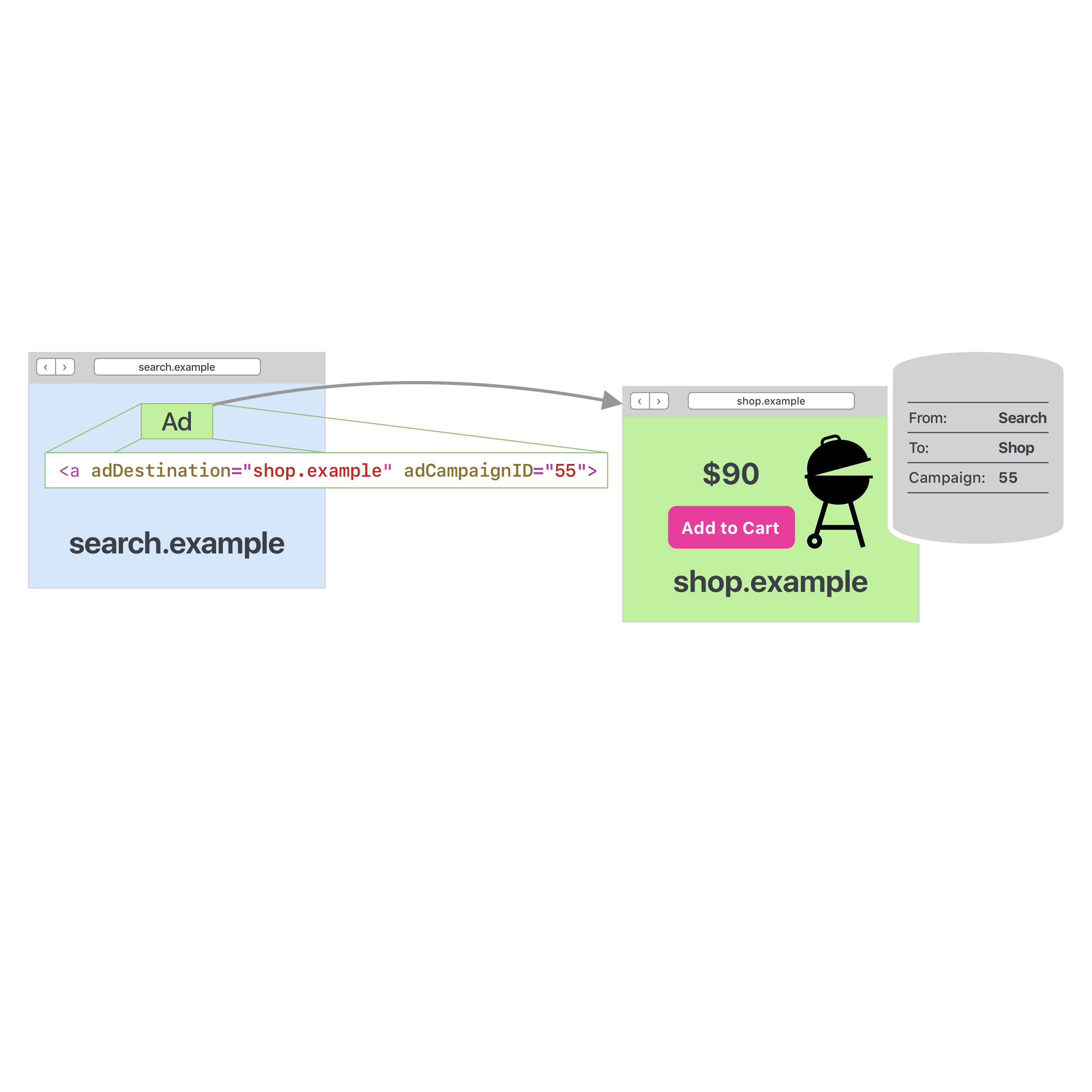
Privacy Preserving Ad Click Attribution For the Web
A typical website is made of numerous components coming from a wide variety of sources.
WebKit
199 points · by sytse · 7y ago · 188 comments
Now, if someone could come up with a privacy-preserving solution to advertisers quality assurance problem of buying advertisements on the internet, that would be big business.
In the podcasting industry, referral codes are used specifically so that advertisers can figure out how many conversions are coming from the podcast -- it's not enough to tell them, "X people heard the thing." They want to know whether or not it's worth advertising based on concrete user acquisition numbers.
AT&T recently put out an interview about their advertising strategy as a content company. The quote from that piece[0]:
> "Regardless of how you see a directed car ad, say, AT&T can then use geolocation data from your phone to see if you went to a dealership and possibly use data from the automaker to see if you signed up for a test-drive—and then tell the automaker, “Here’s the specific ROI on that advertising,” says Lesser. AT&T claims marketers are paying four times the usual rate for that kind of advertising."
And on a more fundamental level, it doesn't make sense to me why targeted ads would even be such a profitable industry in the first place if advertisers didn't care about increasing ROI per ad -- and that means improving click-through rates and conversion rates. I don't see how I wouldn't want attribution stats per-campaign if I was trying to improve my ad targeting, or doing AB tests on different marketing styles.
It is entirely possible that I don't understand the advertising industry very well, but from everything I've seen, advertisers do seem to care about attribution, a lot. Maybe click-through isn't the best way to measure that, but I don't see strong evidence that brand recognition or exposure is a more valuable target for advertisers to be pursuing than direct revenue impact.
The old-school method of this was to have unique response numbers. It's why you see phone numbers like "800-555-1212 extension 37." When you call the number and ask for extension 37, the person on the horn says, "Yes, this is extension 37..." and begins their pitch while noting that affiliate 37 gets the conversion credit.
It's similar to TV commercials you see that tell you to "Go to example.com/TV37."
Some lead generators are willing to splash out extra money on specific phone numbers without extensions because they believe they convert better. It's why toll free phone numbers expanded so rapidly from just 800 and 888 to 877, 866, 855, and 844.
I might be mis-reading this but isn't Adwords model specifically disruptive because it charged per click and not per view. It's why when you click on a search ad you see ?gclid=... appended to the end of a URL so that the ad you clicked gets credit... I am confused or missing the reason for your statement about impressions being more important than a click?
I didn't know about "gclid=...", and "fbid=..." in URLS. After reading your post, I found an extension to remove them:
https://github.com/jparise/chrome-utm-stripper
With easily installable packages available for Chromium and Firefox:
https://chrome.google.com/webstore/detail/tracking-token-str...
https://addons.mozilla.org/en-US/firefox/addon/utm-tracking-...
I assume you have:
* Browser data (UAS, screen size, network speed, localStorage)
* IP data (therefore some proxy of geographic data)
* Third party data (eg. Google Analytics demographic data)
* Odd click patterns (eg. from the same IP, bursts within a short window)
* Finally you can see who is benefiting from the clicks (eg. certain publishers) and suspend their account
I feel like all this data would generate a substantial click "footprint" that you could run through an ML model. At worst, these third-party advertising companies can suspend whoever is benefiting from the clicks if they gather enough suspicious evidence.
Behavior tracking is difficult since it's hard to say that a legitimate user will never do something. E.g. large ISP NATs thwart IP tracking by giving many customers the same IP. Safari blocks 3rd party cookies.
Google has a somewhat well known bot countermeasure called botguard that does a decent job proving that you are probably running an entire browser, but that only marginally increases the cost of fraud to running a browser instance per-bot. Increasing per-impression cost for fraudsters can put them out of business, but increasing per-impression cost to detect fraudsters can put advertisers out of business.
Also, ad-targeting is often a realtime problem. You have to decide what ad, if any, to show within milliseconds. Do you never show ads to unrecognized users? How much turnaround time will you need before you can precompute a profile and start showing ads to a legitimate user? How much turnaround time do you need for detecting and blocking fraud?
Unfortunately, specific countermeasures aren't often publicly published since one of the greatest costs of ad fraud is figuring out and then circumventing countermeasures. E.g. you might have a hard time reverse engineering something faster than it's being engineered by 20 people at Google.
[1] https://www.buzzfeednews.com/article/craigsilverman/porn-run...
If this is true, it sounds like the internet really isn't well-suited for advertising.1
How have certain companies become so enriched by selling something that has such a high risk of not delivering value? If what you say is true, it stands to reason that many clients are getting ripped off.
1 I still find it interesting that the web/mobile ad industry almost always relies on web browsers/apps to make ads workable. These programs must process what is returned from a request for content, auto-load resources from third party hosts, and often interpret and execute Javascript code to make additional resource requests. A user can successfully request the content from a web page with a single domain name, DNS lookup and HTTP request, the basic functionality of the internet and web, without using a web browser, but that alone does not suffice to deliver ads.
This does not sound correct to me. (I was in the digital ad industry.) The interest in conversion counting is not just because you can't trust views/clicks. It's because conversions are the most useful event to track. You might be paying for views, but your conversions are your best proxy for ROI on one ad campaign vs. another.
I agree with your prior point that the first party who is selling ad space doesn't want to think about it. That part is entirely true.
aren't facebook and google ads cost per click rather than cost per impression?
Attribution exists because there has been in the past few years a major pressure from advertisers to relate actual sales with digital media investments.
If you go some years back a lot of major brands cut on their digital media investment because they weren't seeing a return when compared to other medium - like TV.
>They are only interested with selling their product. They contract out to third party companies specifically to not have to deal with those attribution issues.
They are interested in sales, branding and customer service. Some brands work hand-in-hand with media agencies - agencies who do the buying, manage and optimize all the media budget. These agencies have the technical know-how for campaign setup, automation, tracking, etc. It's not because they don't want to deal with it, it's because they would have to make a huge investment in human resources and tech. Some brands did/do move all of this in-house, or outsource it to agencies with exclusive, or with high FTAs.
> The reason those third parties have to resort to tracking is because advertising fraud is rampant on the internet and the first party advertisers want some assurance that they aren't just throwing money away.
Tracking is used to measure the performance of the campaigns - delivery itself, plus the results on the advertiser side. Ad fraud is indeed rampant, that's why there has been a lot of development to mitigate this issue (like viewability).
> In the traditional advertising world, they can see the ad on TV or printed somewhere and know they aren't getting ripped off. There is absolutely no assurance on the internet that anyone is seeing your ad. So this proposal is saying that the advertiser should be in the business of assuring that their ads are being seen and delivering value, but it still doesn't solve the problem that the advertiser wants to be sure how many of their ads are being seen.
There's no way to know if an ad was seen on any media. TV campaigns are measured with a sample of the population with a device that tracks what's being viewed - but you don't know if a person is using their smartphone when your ad is running. The problem with the internet is that there's no filtering between what's being done by a machine and by a human when it comes to the campaign delivery - and that's directly attached to the buying model for the advertiser. They wouldn't care about wastage if they didn't have to pay for it.
> Advertisers are paying for the number of times and ad is shown not the number of times it is clicked (this isn't the year 2000), so this proposal gives the advertisers more work to do without actually solving their real problem. I don't foresee any significant adoption of this proposal from advertisers.
Advertisers pay for a lot of things, for reach, for views, for clicks, for seconds of audio, for grids of outdoors, the list goes on, so you can't just say they aren't paying for clicks - hell Amazon is the new big boy in advertising and you pay per click.
The golden goose of attribution is to connect from the point of contact in advertising, all the way to the post-sale (the so called customer loyalty programs). If you can tell someone who saw an ad on Youtube, and when he went to a shop out of the shelf (where you have a 15% share of shelf), bought your product, and came to the social media saying how damn great that cookie is.
Any step closer to that is a win for advertisers.
Why oh why would you want to normalize anything about online advertising by standardizing it as an HTML property? Why does anyone think it is the browser's responsibility to support this?
If ad companies are having trouble "attributing their campaigns" or whatever - that's tough? It's their responsibility to figure it out, not browser vendors, who should be on the user's side here (c.f. user agent).
This is a terrible idea, breaks the abstraction between markup and application, and should definitely not be added to HTML standard.
The context for this proposal is Apple has already been rolling out privacy protections for Safari and iOS, other players (like Big G) have had complaints, and this proposal undercuts those complaints. It's a negotiating tool, effectively.
Apple's privacy protections have made life harder for Google and other folks in the advertising space. Apple has basically tried to make it hard or impossible for anyone to stitch together user activity across different sites and build a profile of that user.
Advertisers have complained about losing ad attribution, and that complaint is legitimate. But, the existing techniques that are used to measure ad attribution also allow a excessive amount of additional data to be collected. Arguably, the ad attribution angle is just a PR-friendly fig leaf over what they're really worried about, which is user profiling.
So, Apple's counter-proposal: Here is a way to get ad attribution! Also, by the way, it doesn't allow user profiling, but that's ok, right? Of course it is. And now, ideally, we get to watch advertisers squirm as they try to come up with outlandish attribution scenarios that justify the collection of profiling data, while struggling to not admit what types of profiling they actually do and what fraction of their valuation that comprises.
That is the basis of a good law (prohibit a specific behavior, not the implementation thereof). In that lens though, Apple's proposal is a solution in search of legislation, which screams "regulatory capture" to me - another reason I'm against it.
But the simple act of "I placed an ad on this site, is that ad driving sales?" is perfectly benign, and if we can enable that use-case without enabling any privacy leakage, that's unambiguously a good thing because making the privacy-conscious approach easy and reliable means people will use it and won't resort to the more privacy-invasive techniques.
This is the same underlying justification as the "ping" attribute, which is basically, it enables in a privacy-conscious manner the basic functionality people want, and which they already have other less-privacy-conscious means to get, so let's make the most user-positive option the simplest and most reliable.
Also by standardizing how this works it enables content blockers to block these requests. This ad click attribute proposal even explicitly listed this as a feature. If you don't want ad click attribution, use a content blocker that blocks /.well-known/ad-click-attribution/ and you're done.
They want 2 billion in revenue from advertising by 2020.
They are testing the waters, and there's no doubt a faction within the company that believes that in the long term, getting a slice of the firehose of ad revenue is worth a small loss in revenue from opinionated anti-ads users[1] leaving their ecosystem.
The best part about the Apple walled garden is that once ads become an important part of their revenue stream, they'll be able to ban ad-blockers on their platform.
[1] What are they going to do, switch to Android? Communicate by carrier pigeon?
Ummm, no it’s not. My browser is my user agent, and I couldn’t care less about advertisers’ woes.
You know what makes attribution even harder? Ad blockers.
It's not legitimate at all.
No more legit than a ransomware author complaining that a Windows patch destroyed their revenue source.
A standardized, privacy-centric method for companies to accomplish attribution will help end the arms race and move back to a more consumer-friendly model. Small edges are worth a fortune in Ads. This is like the war on drugs. Clamping down and assuming ad companies will walk away is way too optimistic. Instead, they will move deeper into the shadows at whatever the cost.
And I still don't think it's the browser's responsibility to help the ad company. This kind of stuff just doesn't belong in a markup standard. If ad company cannot exist with the way they currently track users due to GDPR or other regulations, and "need" some standard way for "privacy preserving tracking" - they can write their own browser that does it and give people incentives to use it.
By making it a standard that actually solves the needs of advertisers, the willingness to adopt it will increase because it's simpler.
That said, I think this proposal falls short of solving current tracking problems.
This can be addressed in law, but technical alternatives should exist. The alternative existing will also make it easier to pass it in law.
It's infected our news media, with ads masquerading as real news articles and news providers dripping with desperation to keep you frightened of the BREAKING IMPORTANT NEWS you MUST KNOW ABOUT right after this attempt to sell you razor blades.
It's infected our social media, where avatars that bear only the slightest of photoshopped similarity to the person they claim to be pretend to live a high-life, hiding their broke reality while trying to sell you herbal detox teas produced by failing corporations.
It's infected our telephone system, spammers trying to sell you a new rate on your student loan debt calling you 100 times more often than your own mother.
It's infected our email system, where no client without robust spam filtering is even usable, and you will delete 100 times more emails you never wanted to get than you will receive from your best friend.
Text messages. The postal system. Light polluting billboards on highways. You name it, if advertising has gotten its claws in it, it has either ruined or is ruining it.
Selling ads and selling users' PII are the two primary methods by which a website makes money. Both need to die.
Billions of dollars are at stake for companies that need to understand how their ads are working across ecosystems and to realize the value (or lack thereof) for media buys. Many of the sites that place media also are doing so to offset the costs for users.
There are few ways to toss a grenade in this complex room that does not harm all parties and force each to defend their own needs/wants.
If they really wanted to standardize something, why not make a Privacy Preserving Tracking as a Service endpoint and hit it with standard snippets of JS, instead of baking this controversial junk into the browser's core.
What should replace internet advertising as a way of funding content? This is not an advertising industry problem -- it also affects publishers. Will they have to start charging everyone micropayments to view their content? How will this affect the ability of third parties to index and archive content?
Apple, Microsoft and Mozilla do have advertising elements but are a very minor part of their business.
I certainly have never wanted my browser to report ad click attribution.
The alternative is a browser breaking all the tracking mechanisms and then getting blocked because it’s “blocking ads”.
This provides an API that allows ads to work, while also allowing a browser to block all the tracking techniques currently being used.
That way web sites can have a revenue stream without gratuitously violating their reader’s privacy.
Until browsers get blocked for being anonymous, this is never in the interest of the user.
And if a site doesn’t work unless I turn off adblock / switch browser, then it’s most likely bad on multiple levels.
That's fine. That's the browser I want. If a website doesn't want me to visit, that's fine. I won't.
Of course they wouldn't. It betrays almost the entire foundation of marketing and advertising itself. Building brand recognition, forming brand opinion, encouraging new social and personal practices, etc are big parts of advertising. And now because the Internet is around, we're just supposed to give companies all of that brand building and everything else completely for free, only having them pay for specific sales funneled directly and provably through an advertisement? Can I get an ad played during the Super Bowl and only pay the TV networks when someone can provide proof the ad was the cause of their purchase? Can I get an ad in the newspaper like that? Radio? Roadside billboards? Where? Where else do I get to just rob the person hosting the advertisements of basically all advantages of advertisement and only rarely pay them for providing the venue?
Aparently it was shut down? I wonder what happened.
Edit: it looks like they were focused on independent blogs and since those have far less traffic now they couldn’t afford to stay open. That really sucks, at least it’s a good example of how the web is a much worse place when it becomes centralized.
So if a browser does want to protect its users it is necessary to provide a fallback to allow site operators to make revenue from ads.
Hence this proposal: provide a system that allows the necessary steps for ads to work, without violating user privacy. Then browsers can start more aggressively blocking trackers.
DRM support in the browser allowed video on demand in a way that video providers were okay with. It ended the content war for video.
If you don't want to be tracked, then don't click on the ads.
You could potentially stop their code from running on your computer, but you can't stop them from running code on their servers, and if you make yourself hard enough to fingerprint, CAPTCHAs become impossibly difficult.
Plain old cookies and unique url parameters are the bread and butter of ad tracking. It is a much more accurate and practical way of tracking you.
this, i suppose, assumes that the browser is active at the time, but at any rate, it will screw with attribution windows pretty hard. advertisers will definitely be very happy to now see conversion numbers which could have happened at any time and are unverified
Clicks are not tracked via cookies but via urls. The search engine in this example would send the user to someshop.com/someproduct?clickid=7e82jv927x748342
They say nothing about how they want to prevent this and other tracking mechanisms. Yet, they propose an overly complex system to send even more data to advertisers.
Also they do not say anthing about the ip that their additional ping will send out. I definitely do not want my browser to communicate with an advertiser days later and without my consent.
Also, click tracking is not even a big problem in the first place. Tracking you wherever you go is. Even if you do not click on any ads.
I don't think people care that Amazon (for example) suggests things to them based on previous purchases because they have a first party relationship with Amazon. Likewise, when I search for "honda" I'm okay with Google showing related ads to the right of my search results. Targeting isn't bad.
The concern is when user data is shared with third parties.
It is clear that browsers are doing everything they can to prevent user abuse. So let’s imagine they succeed.
Imagine what happens to the current advertising model if browsers completely break cross origin tracking. That means you can’t link purchases to the original ads, and so the compensation model no longer works at all.
This provides a mechanism to do the required attribution without also tracking or compromising a user’s privacy. Without that, there isn’t a way for the current ad model to work.
If that was true in general, my browser would block all cookies and all content from third party domains by default. It would systematically misreport Referer and User-Agent. It would disable APIs typically used for fingerprinting. It would disable all redirect-through-advertiser links. All managed by a simple and unintrusive whitelist (per first party, per third party or temporarily for a whole browser session or for a site session) so that you can opt in to these things where there is a legitimate use.
It isn't because it has a much greater interest in browsing being a seamless experience and the web being a powerful application platform, and actual privacy measures are buried in some configuration menu or in third party plugins so that whiny power users can enjoy privacy while the unwashed masses go about their browsing as though the web standards aren't completely messed up from a privacy perspective.
> This provides a mechanism to do the required attribution without also tracking or compromising a user’s privacy. Without that, there isn’t a way for the current ad model to work.
Is that a good or bad thing?
The user agent string does not provide as much information as people seem to believe.
Whitelists aren’t usable, and don’t work at scale.
The whole point of breaking tracking in general is so that the “unwashed masses” get privacy. Every study and survey has found that users value their privacy, but have been told (by advertisers and I assume you) that privacy is dead, or that they cannot have the internet without it. It is absolutely not something that just “power users” care about. It’s just power users are the only ones who currently get any.
Finally, the attribution isn’t attributing to a specific user - the entropy is heavily limited, the reporting is time delayed by a random amount, and is made with a stateless session so there isn’t any way to directly tie it to a single specific user, leaving just the IP address, which is now typically shared, and frequently changes.
You said browsers in plural, though.
* >The user agent string does not provide as much information as people seem to believe.*
How much information do people seem to believe that it provides?
> Whitelists aren’t usable, and don’t work at scale.
I don't need it to "work at scale". I need to be able to turn blocking off occasionally. Also, "at scale" and "usable" are vague to the point of meaninglessness. Why aren't they usable? What scale does a whitelist need to work at that makes you say that it can't?
> Every study and survey has found that users value their privacy, but have been told (by advertisers and I assume you) that privacy is dead, or that they cannot have the internet without it. It is absolutely not something that just “power users” care about. It’s just power users are the only ones who currently get any.
That's my point exactly, because privacy isn't the browser vendors' top priority, nor are they generally doing "everything they can" to improve it. The standards don't even allow it.
> Finally, the attribution isn’t attributing to a specific user - the entropy is heavily limited, the reporting is time delayed by a random amount, and is made with a stateless session so there isn’t any way to directly tie it to a single specific user leaving just the IP address, which is now typically shared, and frequently changes.
"It's not so bad, really, for most users" is not the same thing as "browsers are doing everything they can to prevent user abuse."
Add, I don't know, User-Agent and Referer to the mix to more reliably track different sessions on the same address. My address doesn't change frequently. I'm on a temporary lease but when it expires I get the same IP again or at least have since I started my account. This is not uncommon for a broadband connection in my whole country.
If you consider tracking individual users' behavior for ads user abuse, let me remind you that one of the largest perpetrators of that are working on their own browser and regularly get a say in how the web works.
It's also a way more practical way to buy ads, because you know exactly what you're paying for and can measure your P&L in near realtime.
While I am not super enthused about the idea of my browser being the one that reports this data (Actively), due to the current state of ads on the web this feels better than the alternatives.
We have already seen the effects of websites trying to get away with no ads and switching to a paid model. How often do we see complaints from users of sites like the Washington Post or the NYT that they can't read their news article. For the most part, attempts to get money from uses (who are at this point used to a "Free" web) has not seen great success. I would also argue that every site turning into asking for money is very problematic for anyone but the biggest players. Just saying that using ad blockers really is not a solution, if everyone used ad blockers we probably start to see issues with the available content on the internet.
I don't really know how I feel about this yet. It will be interesting to see if Microsoft and Mozilla (I doubt Google will jump on this one, at least not quickly) will get involved in this. If so, it might actually see some good adoption.
Of course the small publishers could let the ads networks host their content (in an iframe?) to recapture that revenue, but then we end up in a worse privacy position -- as there only end up being a few hundred first party hosts on the web that host all of the content and can track you with first party cookies!
The stated goal of untrackability by timestamp matching is simply not achieved with just 12 to 24 temporal dithering for anything, but biggest websites on the planet.
They say it is privacy preserving, then, 5m minute into the text it comes out that it is nothing like that at all.
It is the next "do not track" header.
But to me it feels to be Apple's first "carrot and stick" step to chip away at Google walled garden.
See: few month ago they launched both a ad cookie killer, and a 3rd party cookie firewall by default. Clearly, there was a huge net loss of ad money nearly momentarily, they clearly wanted it to be a surprise, to push ad businesses into panic. Now they come with a stick: play our walled garden, and you get your ad cookie back.
In other news, people were noticing that Apple was hiring senior Ad tech people for quite some time now.
We welcome issues on possible limits of the privacy protections though.
2. Apple become a gatekeeper for an AD revenue from Apple devices, being able to "switch lights off" on anybody with a single browser autoupdate.
To any business person, it looks like a very clear ultimatum
The comparison to DNT is not reasonable: DNT was a proposal the originated in the ad industry in response to a government inquiry into their gross abuse of consumers. It was positioned to head off actual regulation, despite all browser vendors knowing it would not actually work.
The Ad industry killed DNT when they announced that they would no longer recognize it (and were in fact using it for tracking) despite them positioning it as the “solution” to their own abuses.
Once that occurred it became clear that the only solution is for browsers to break all tracking directly. This is merely something that would allow the ad ecosystem to still function in the absence of tracking.
This is the answer to (1) - it’s not a matter of advertisers adopting it, if a browser vendor blocks tracking then advertising based on tracking is broken. So all that happens is those users are not tracked, and also don’t produce revenue.
Web content costs money to create and host. The alternatives are:
-Most content being paid -Ads we really don't want to see. Without some sort of user tracking, ads would just be random -Wealthy people will be subsidizing lots of content for political gain (a method of getting funding) -Many smaller companies get pushed out in favor of large corps and much more difficult for a startup to survive.
Pretty much all of these have happened to some degree in the last 5 years and with the opposition to ads/many people installing ad blocking software, it's only going to get worse.
In the early days of AdWords the ads weren’t based on tracking but on page content (much more useful IMO). Nowadays there is this bizarre belief that somehow knowing everyone’s intimate details means your random context-free ad will result in someone buying something.
The problem with the gratuitous tracking is that people cannot opt out of it. I don’t have a FB account, I don’t go to Facebook.com, yet I know Facebook has a profile built up because of those abusive like buttons.
Similarly if I go to an online store, and buy something, there is an additional invisible tax I am being charged: the ads on the store pages feed multiple ad networks my personal info. Despite me literally paying them money.
Maybe it is fine to consider it a tax, another way to look at it is you are being paid on content and access on various sites (including sites where you make a purchase at a price that is fair for the product AND this information) for your information.
Either way, if you want to jump ship from that arrangement -- it should be just as protected that accessing that content is now a violation of TOS or a liability to you that can be resolved with (at the site owners prerogative) hard costs to you for that content or service.
One time I needed to buy a new washer+dryer. I did so, but I continued to get aggressively targeted washer/dryer ads for months, maybe a year.
Similar for furniture.
I am not a closet deck chair collector, but adtech decided I was.
In your opinion? On what grounds can you make this claim, as if there didn't exist a multi-billion dollar industry focused on maximizing ad-targeting usefulness, as if ad companies haven't tried context-based targeting and just decided to do something else that apparently makes them less money by being less useful.
Do you have any serious evidence that "knowing everyone’s intimate details means your random context-free ad will result in someone buying something" is a bizarre belief instead of a fact that a capitalist market has settled on?
Edited for clarity
So I’m basically in on every attempt to kill the online ad industry even if it kills 99% of the “free” content I read and enjoy. I no longer think a convenient micro transaction system will come along to disrupt the status quo, I now think it can only rise from the ashes of the 2000-2020 web.
I also realize that in this process, at least for a transition period, we will kill a lot more small players than big ones, and quite possibly create a web where google, Facebook et.al. are the only ones to profit. Again, don’t care.
As to your points, though, paid content is great. If people won't pay for it, they probably don't actually want or need it.
I don't want to see any ads. No ad is relevant to me, so all ads, even supposedly targeted ads are random. In 30 years of using the web, I have literally never once intentionally clicked on an ad. So better tracking for ads gets me nothing and loses me a lot.
Wealthy people already subsidize lots of content for political gain, so nothing is changed by having it be targeted ad supported or not.
Most small companies cannot use the legitimate ad networks because they don't have enough volume. So this is a non-issue.
Ads provide a lot of exposure instead of just eliciting a direct response. Better tracking for ads benefits content publishers and service providers, many of which users enjoy. You don't have to click on an ad for ads to have value.
Magazines, radio, and television are all tracked in different ways. When were ads not tracking users? On stone tablets?
"Wealthy people already subsidize lots of content for political gain, so nothing is changed by having it be targeted ad supported or not."
They do, but it would be a much smaller percentage if the content creators had a way to monetize it.
"Most small companies cannot use the legitimate ad networks because they don't have enough volume. So this is a non-issue."
How is it a 'non-issue'? Many startups, especially here on HN, rely on advertising as a business model.
But, there's little evidence that targeted ads are more effective than normal ads based on rough guesses (e.g., The Verge is largely read by tech-savvy young and middle-aged men and you don't need tracking to figure that out). Their marginal increase in effectiveness is probably outweighed by the cost of administering them, not to mention to social cost of privacy erosion.
The sooner the tech industry stops pretending that ad targeting is anything other than a scam to trick advertisers, the better.
This also wouldn't work on things like Google Adwords.
- tracked link must not be in an iframe, which is how basically all ads are served
- only 64 campaign_ids. what about tracking individual ads? i need to optimize which ads perform the best, what targeting is converting, and more
- delayed conversion POST, 7 day window. What if a user makes purchase and then doesn't open safari again during the 7 day window? since POST is delayed wont arrive. also what about 30d windows?
- what about view conversions? and other non-last click attribution?
- when combined with ITP, how do they propose updating audience/targeting? I often see complains of people seeing retarget ads for products they already purchased.
- no tracked link, iframe or not
- no campaign ids
- no conversion POST at all
- no view converstions, no non-last-click attributions
In that scenario, is this proposal an improvement? It sounds like an improvement. It's certainly more than the nothing that anyone will get from Apple's users without it. They didn't have to throw anyone a bone here, and they're going to take massive flak from a few users for doing so at all.
I imagine Apple would be thrilled if advertisers chose the destruction of the tracking-based advertising industry over using this offering. Perhaps advertisers will learn from the music industry's experiences trying to bury their head in the sand re: iTunes and pay attention and participate in designing this system. Perhaps they will not.
If the goal is to stop all tracking why create this (bad) plan in the first place?
The goal is to stop the tracking of individuals by advertisers, without stopping the tracking of ad views by advertisers.
My comment was about the two approaches in the absence of client-side defenses.
Just because we got here via ads, doesn't mean we couldn't have gotten here without them. And that's even assuming that where we currently are is an optimum state we should shoot for.
Users.
> Because quite a lot of the Internet couldn't exist in its current state without ads.
Let's not underestimate people's creativity. Let's kill ads completely, and see what creative solutions emerge.
After people realize that ads no longer work, I look forward to seeing what happens when they take several giant steps away from adtech and start building real alternatives.
This isn't a terribly meaningful statement, though. Just because the ad industry managed to dominate the web doesn't mean it had to be that way or that there are no other ways.
Also, in my opinion, advertising is doing more harm than good in the web overall.
I don't care for this attempt at redefining what privacy is. I could go step-by-step with this article, but I don't care to. These cretins want to track people more and more and we're all asked to voluntarily make concessions for their benefit; I disagree.
I'll continue blocking JavaScript and performing almost all of my WWW browsing through Tor; I won't weep for these advertisers; they're owed nothing.