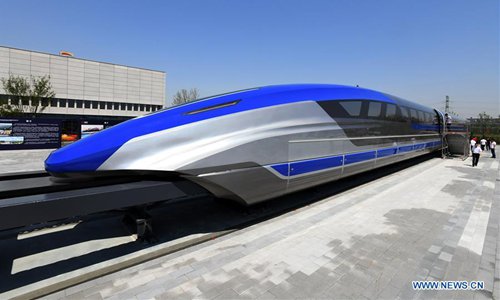
China unveils 600 kph maglev train prototype
China on Thursday rolled off the production line a prototype magnetic-levitation train with a designed top speed of 600 km per hour in the eastern city of Qingdao.
globaltimes.cn
124 points · by mparramon · 7y ago · 181 comments
Don't get me wrong, I still find this project impressive.
But there's a fair amount of boasting going on as well. For example the French TGV boasted a measured record of 574 km/h. But that's on a (modified) test unit and a test track. Operational speed is about 320 km/h on most tracks.
Perhaps they simply haven't gotten to the testing/benchmark phase yet.
My car could probably hit 160+ but I don’t drive it over 130.
It makes me wonder why not get rid of them all together and make the cabin like a tank. To get some sunlight perhaps?
I think the windows on trains generally serve to give situational awareness at the station, once you are up to speed reacting to unexpected impediments isn't so time critical since the train isn't likely to stop fast enough anyway.
I think that raises a question of: what is the point of having a driver on the train? Why not have people in a control room drive the trains, coordinating the system as a whole? Arguably this is already the case, with some trains automatically stopping in cases of signal violation. Maybe the reason is simply that passengers would rather trust a driver whose life is invested along with theirs.
These are not things the train driver would react to. There will be a signal protecting the switch, which won't be "green" until the change is successful. If the driver tries to pass a red signal (or exceed the speed limit), the emergency brake is applied automatically.
The driver needs to react to unexpected events -- which might mean applying the emergency brake on their own train and maybe pressing the emergency button to stop all trains in the area. Possibilities:
- their own train has a serious mechanical failure
- something falls of their train, like a container or (somehow) a passenger
- the track has a serious failure (flooding, damaged rail, nearby fire)
- foreign objects are on the track (cars, trees, people)
Other trains will react automatically as necessary. The driver is then there to deal with the situation, which might include proceeding at slow speed, reversing, or waiting for assistance while keeping passengers informed.
> some trains automatically stopping in cases of signal violation.
On high-speed trains like this, all of these safety systems you've heard about are standard, and most of them are considered critical for normal operation.
> what is the point of having a driver on the train?
A better question is why does the driver actually drive the train? (Why do they control the speed?) I think that's to help maintain situational awareness in case there is a problem they can react to.
Almost certainly not. Open windows are terrible for aerodynamics. Even in normal cars they can cause a noticable reduction in fuel efficiency. I'd imagine the effect would be much worse at these speeds.
This would make sense along coasts though but you wouldn't be able to cross the country from sea to sea in a few hours of course.
What's good with trains is that you can hop in at the very last moment (when the bell rings, happened to me a couple times) and the train stops in the center of cities, instead of the suburbs. This is the main reason why high speed train in France can compete with airplanes when crossing the country. By plane I must first reach the airport (30 mins), have some time ahead before embarking (30 mins), the flight is 1 hour long but the time to actually take off and pick back your luggages it's almost 2 hours long, and then you have to reach the center of your destination city (30 mins). By my generous estimates, it takes 3h30 to travel by plane North/South in France vs 4 hours by train.
And because currently not every railroad segment can support high speed trains going at full velocity (but work is in progress) it could take 3 hours. 300 km/h
Also note that Amdahl's law [1] applies in this context (there are diminishing returns in optimizing the speed of only one segment of the full path) and travelling the last kilometers accounts for a significant portion of the travel time.
For instance the TGV has to slow down when entering cities (because of the noise) and at some point in the development of the high speed rail network, it might become more interesting to dig long tunnels under cities for these trains rather than increasing the train's maximum speed.
The distances are (as the crow flies): Melbourne-Albury: 260km Albury-Canberra: 219km Canberra-Sydney: 247km Sydney-Newcastle: 117km Newcastle-Tamworth: 219km Tamworth-Brisbane: 450km
That last leg might need another break in it.
But at 300kph average speed that's 2.5 hours Melbourne - Sydney (CBD-CBD), say 3.5 hours with stopovers.
To get to Sydney for a 9:00 start in the CBD from Melbourne now takes (CBD - CBD): Taxi: 30m + 1hr check in + 1.5 hour flight + 30m taxi: 3.5 hours.
I'd take the train any day. Space, able to work, sleep, dining car etc. Not affected by weather or other airport backlogs. You still get up at a god-awful time of the morning, but the actual travel would be much more tolerable.
I agree with your judgement in general, nonetheless.
Edit: last hour is not high speed because the rails are regular ones (the train adapts in a ten minutes stop) so the high speed interval went from 4.5 down to 3.
If anyone asks me how long will it take to build the Melbourne to Sydney high speed rail, my honest answer would be 30-50 years.
That’s actually part of what the Stuttgart 21 project is doing, and why it’s so expensive (it’s not just a train station): https://en.wikipedia.org/wiki/Stuttgart_21
They’re building several massive tunnels below the city and through the surrounding mountains to put the entire station and all rails underground, which also improves travel times on the Paris—Vienna magistrale.
Being one of the first major projects of that kind in Germany, it has to deal with massive budget overruns and delays.
It’s the same size as the United States, which is about the size of Australia. There are only 25 million people in Australia though.
There are a "couple" more million people in France, and there are many areas in the US and Europe which much higher population than Australia, and a fraction of its size.
Just seeing this stuff in other countries really makes me sad about how my countries technological developments have been left to rot.
That system was dug in the 1800s, when light-bulbs and bicycles were still in beta. Over 150 years later, a project like that is out of reach for nearly all western cities. It's like the "we can't go to the moon anymore." It just offends my/our intuition about progress.
London-Edinburgh is old and goes at about 125mph/200kmh. London-Glasgow is slightly-less old (in terms of trains) and does 120mph/225kmh).
Suburban trains are slower of course, but they stop pretty frequently anyway.
tl;dr - its not terrible. Prices are high though so flying is often orders of magnitude cheaper, even in the "door to door" time is about the same or slightly less by train.
1 - https://en.wikipedia.org/wiki/High_Speed_1 2 - https://en.wikipedia.org/wiki/High_Speed_2
It has to slow down anyway if it wants to stop.
South Korea built >50 km tunnel out of Seoul for this reason. It opened in 2016.
And then there is the inevitable delays before the plane will be allowed to take off and if you're lucky the same before you're allowed to land.
And in NL, if you land on Schiphol if you're particularly unlucky they will land the plane on the 5th strip which is more accurately located in Haarlem and it takes about 15 minutes to taxi to the gate.
Security involves putting your bags on a conveyor that goes through an x-ray machine but no one actually has their bags opened so it moves quickly. Boarding is much quicker because a train has a lot more doors than an airplane.
However the queues to get to the metro/subway/underground system can indeed be horrifically long.
This is also why’s hSR is so that impressive in China, they had none of those advantages sand had to keep blasting through mountains.
Ultimately though, these routes are pretty well serviced by flights. These trains are pretty amazing, but not cheaper or faster than flights.
Why is it boarding a train is 10x easier than on a plane?
I think I have seen this before in videogames maybe. Is it an US-only thing?
> Internationally, km/h is the most commonly used unit of speed on traffic signs and speedometers
kph isn't incorrect, but it's not as commonly used.
The correct way is km/h, or (occasionally, for mathematicians or scientists) km·h⁻¹ or km h⁻¹.
I may have seen 'gms', but I can't think when.
I have seen kmph before, but not for several years.
'Kph' it's definitely current in spoken language, but increasingly rare in written form.
I don't know, but it's particularly common with construction materials. You can search "mts" and see many sites using the abbreviation.
Further, there is also a lot of shit tier technology in Germany. https://en.wikipedia.org/wiki/H-Bahn
Siemens is actually still offering that system. If you ride it, you will wonder how it was possible to combine all disadvantages of all existing people mover rail technology and to produce that.
I have heard about a lot of issues with many kinds of rolling stock, but so far I haven’t heard anything negative about the DB Br 407. The Br 412/812? yeah, that one’s fucked, but so far I’ve heard few complaints about the Br 407 (and personally, the Br 407 is probably the smoothest ride there is)
Could you describe some of the issues you’ve had with the ICE 3 (MS)?
The best Pictures can be seen here
http://www.xinhuanet.com/english/2019-05/23/c_138082738.htm
whereby the third is the most interesting to me, because it allows comparing whith the existing pictures of the Transrapids "Track-Train-Interface" (for lack of a better term). It looks similar, but not exactly. Would it matter? Who really cares?
What i do care about is how "real" this thing is. Because for all we know this just a mockup on stilts. There is nothing wrong with mockups as such. Except for this mockup on stilts there is no footage to be found which shows this thing on a longer test track, or this thing on a test stand where at least it is levitating in the configuration like shown in the press. Any footage, if existing at all shows different systems. Furthermore neither
nor
https://goo.gl/maps/h687Cptq2U4kH2Pm9
show any signs of testing track at the factory, or its surroundings.
So until further notice i consider this as a notion of intent to build, but far from ready. As i said, for all we know, the "production rollout" is that of the modelmaker without the real innards.
Btw.: Anybody remembering
https://en.wikipedia.org/wiki/Transit_Elevated_Bus ?
https://www.youtube.com/watch?v=9aPPXB7gqYU
( first 12 seconds only ^v^ )
https://osm.org/go/5yfE0BZx--?m=
THAT looked interesting, especially with the stationlike structure at the end. But level crossings like can be seen on gmaps? Doesn't look like separate/different track at all.
Correct me, if i'm wrong.
Mysteriously the end of the branch/spur about a mile to the SW is not visible there. Anyways, doesn't look different to what's visible in gmaps, looks all like conventional tracks.
Note: this is also not a proposed route map, but it is probably bleedin’ obvious that some major cities lend themselves to being high speed rail hubs more than others, because they were and/or are historical rail hubs.
I tried to cover the entire lower 48 and the a good portion of Canada and a small part of Mexico so that hopefully most everyone in the US sees a possible line in the data that would 1. Interest them and 2. Give them a sense of scale as to how far two points of interest really are and 3. Imagine how long it would take to get from one point of interest to another along a 600 kph railway.
- Seattle to Portland: 280 kilometers
- Seattle to Spokane: 449 kilometers
- Seattle to Fargo: 2296 kilometers
- Seattle to Minneapolis: 2666 kilometers
- Seattle to Chicago: 3322 kilometers
- San Francisco to Los Angeles: 617 kilometers
- San Francisco to San Diego: 807 kilometers
- San Francisco to Ensenada, Baja California: 937 kilometers
- San Francisco to Cabo San Lucas, Baja California Sur: 2456 Baja California Sur (from San Diego: 1654 kilometers)
- San Francisco to Reno: 352 kilometers
- San Francisco to Sacramento: 141 kilometers
- San Francisco to Salt Lake City: 1184 kilometers
- San Francisco to Chicago: 3426 kilometers
- San Francisco to Portland: 1022 kilometers
- San Francisco to Seattle: 1300 kilometers
- San Francisco to Vancouver, British Columbia: 1529 kilometers
- Los Angeles to Las Vegas: 435 kilometers
- Los Angeles to Phoenix: 600 Kilometers
- Los Angeles to Salt Lake City: 1108 kilometers
- Los Angeles to Denver: 1635 kilometers
- Los Angeles to Chicago: 3244 kilometers
- San Diego to Mexicali: 198 kilometers
- San Diego to Tucson: 655 kilometers
- San Diego to El Paso: 1165 kilometers
- San Diego to Houston: 2366 kilometers
- San Diego to New Orleans: 2922 kilometers
- Dallas to Corpus Christi: 662 kilometers
- Houston to Austin: 266 kilometers
- Houston to San Antonio: 317 kilometers
- Houston to El Paso: 1199 kilometers
- Houston to Dallas: 385 kilometers
- Houston to Corpus Christi: 334 kilometers
- Houston to New Orleans: 560 kilometers
- Houston to Tallahassee: 1141 kilometers
- Houston to Miami: 1911 kilometers
- Houston to Denver: 1656 kilometers
- Houston to Oklahoma City: 716 kilometers
- Houston to Kansas City: 1198 kilometers
- Houston to St. Louis: 1253 kilometers
- (Trans-Missouri Express! Kansas City to St. Louis: 399 kilometers)
- Houston to Chicago: 1741 kilometers
- Houston to Nashville: 1253 kilometers
- Houston to Atlanta: 1276 kilometers
- Houston to Charleston: 1756 kilometers
- Houston to Charlotte: 1668 kilometers
- Houston to Washington: 2270 kilometers
- Chicago to Winnipeg: 1392 kilometers
- Chicago to Saskatoon: 2109 kilometers
- Chicago to Edmonton: 2633 kilometers
- Chicago to Calgary: 2570 kilometers
- Chicago to Milwaukee: 148 kilometers
- Chicago to Minneapolis: 657 kilometers
- Chicago to Des Moines: 537 kilometers
- Chicago to Lincoln: 841 kilometers
- Chicago to Denver: 1617 kilometers
- Chicago to Kansas City: 820 kilometers
- Chicago to St. Louis: 503 kilometers
- Chicago to Memphis: 850 kilometers
- Chicago to Indianapolis: 292 kilometers
- Chicago to Nashville: 757 kilometers
- Chicago to Louisville: 476 kilometers
- Chicago to Washington: 1124 Kilometers
- Chicago to Philadelphia: 1221 kilometers
- Chicago to New York: 1270 kilometers
- Chicago to Detroit: 453 kilometers
- Chicago to London, Ontario: 648 kilometers
- Chicago to Toronto: 835 kilometers
- Chicago to Ottawa: 1271 kilometers
- Chicago to Montreal: 1363 kilometers
- Chicago to Boston: 1581 kilometers
- Chicago to Portland, Maine: 1740 kilometers
- Boston to Portland, Maine: 180 kilometers
- Boston to New York: 353 kilometers
- New York to Albany: 249 kilometers
- New York to Syracuse: 397 kilometers
- New York to Montreal: 596 kilometers
- New York to Montauk: 190 kilometers
- New York to New Haven: 130 kilometers
- New York to Buffalo: 600 kilometers
- New York to Philadelphia: 151 kilometers
- New York to Washington: 364 kilometers
- New York to Raleigh: 811 kilometers
- New York to Charleston: 1219 kilometers
- New York to Atlanta: 1390 kilometers
- New York to Miami: 2059 kilometers
- Miami to Orlando: 380 kilometers
- Miami to Jacksonville: 558 kilometers
- Miami to Savannah: 783 kilometers
- Miami to Tampa: 454 kilometers
- Miami to Tallahassee: 777 kilometers
China has been using maglevs for a long time.
The low-medium maglevs seem quite useful too:
https://www.cnn.com/travel/article/china-driverless-maglev-t...
Someday they’ll probably replace their 19,000 miles (soon 25,000) of high-speed rail with maglevs.
In the United States, people couldn’t be convinced to build high-speed rail and now the land is expensive.
Not necessarily and definitely not soon. Maglev isn't strictly better (unless it's also suitable for cargo trains or China doesn't use their high-speed rail for cargo at all -- not even at night). Replacing high-speed rail by maglev means that you're basically replacing high-speed rail with somewhat higher-speed rail at the cost of (almost[1]) completely new infrastructure. And during the transition, you basically have two independent railway networks. It's like having two railway gauges in a country, but even worse. Every piece of rolling stock can only run on one network. That's inflexible, increasing costs and/or reducing reliability. It also necessitates additional transfers.
[1] You can reuse station and other buildings, maybe platforms too. I can't think of anything else.
I didn’t say it would be easy or cheap. I’m sure there are lots of details to consider.
China, however, has no problem doing large infrastructure projects.
Edit: so all the rumors about stealing are not true. The knowledge is handed over
http://fortune.com/2013/04/15/did-china-steal-japans-high-sp...