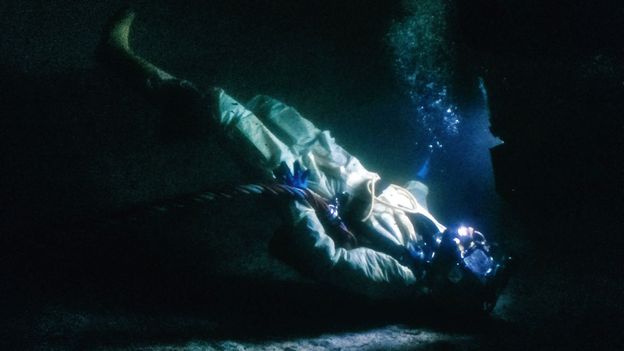
How long can you survive if you run out of air?
Science tells us the human body can only survive for a few minutes without oxygen. But some people are defying this accepted truth.
bbc.com
394 points · by acdanger · 7y ago · 170 comments
Tech and commercial divers breathe exotic air mixtures which are hypoxic and include helium to mitigate this.
Dive science is pretty fascinating and is still a developing field.
https://en.wikipedia.org/wiki/Oxygen_toxicity
Nitrogen becomes narcotic at high pressure; breathing normal air at 30m is like being tipsy, but below 90m it can be fatal.
I've seen and heard many stories of experienced divers that would do silly things due this effect; that is why you always have to have partner with you and the rest of the crew near by.
This effect is highly dependent of person and I've seen guys goes beyond 40m without getting this at all.
For deep dives I really enjoy the planning phase, it requires a high degree of technical expertise and a thorough understand of your bodies physical limits.
Wow, I actually didn't know this until now. Is this method used anywhere in medical procedures to resuscitate or prolong life?
https://en.wikipedia.org/wiki/Targeted_temperature_managemen...
https://en.wikipedia.org/wiki/Deep_hypothermic_circulatory_a...
See for example https://www.ncbi.nlm.nih.gov/pubmed/24882104, which states ”the longest time from cardiac arrest to return of spontaneous circulation was 6 h and 52 min”
Notably, her body was cooled down significantly to reduce her metabolic rate down to nothing.
She survived several years, although she never quite recovered fully after that...
By the way this story is a must read.
[1]https://www.thestar.com/news/insight/2017/02/19/this-queens-...
I think they had mixed results, and I haven't seen them or their competitors launch their products.
It works though, but it seems very difficult to cool the brain without chilling the whole body.
Overall it seems it's just a matter of waiting for technology to advance to the point where we can very move a 150 pound 2-meter-tall 1-foot-deep object from 98 degrees to 30 degrees, and at that point the science fiction will become reality.
[0]: https://web.archive.org/web/20120111233417/http://www.biotec...
Now the method of achieving vitrification involves pumping the body full of toxic antifreeze. But in principle it's easier to flush the antifreeze out when warming than to reverse ice crystal damage, though the techniques have not yet been worked out.
Thankfully it's not necessary for the reversal procedure to exist now for cryonics to be successfully used in preservation for the future.
If we ever do crewed interstellar travel, even if we can get the trip time down to 50 years or so, we’ll probably want something like this. But it’s useful even for Mars trips since you can fit a LOT more people in the same space.
Wonder if that's just because it's not viewed as important?
The thing that bothered me that they resumed to do the same dive 3 weeks after the accident - it doesn't sound like enough time to setup protocols to prevent the same accident from occurring again. Also it was very weird to hear that they don't have checklist to follow when they ships's dynamic position system fails...They were essentially trying to control the ship by whatever they can think of for over 20 min while somebody is suffocating on the ocean floor.
Now I'm watching it :)
Curious why they don't have emergency unmanned drones with the crew or why they don't have emergency tanks at their work site (which he was able to get back to)
(1) - Not sure how well it has aged (https://en.wikipedia.org/wiki/The_Abyss)
There was a UUV in the water, which helped to locate the casualty but wasn't capable of performing a rescue.
Bailing out to open-circuit SCUBA doesn't help for very long, because of the immense pressures involved. As you go deeper, you need more pressure to inflate your lungs. A cylinder that lasts for an hour near the surface will only last for a couple of minutes at 100m. Tethered divers do carry bailout gas cylinders, but they're very much a temporary fix for brief losses of gas supply.
There are major logistical problems with portering dozens of gas cylinders to a job site that may actually increase the overall risk, because of the far greater time spent in the water. That pile of cylinders won't help you a jot if you lose the job site or you're incapacitated. Saturation divers are increasingly switching to closed-circuit rebreather bailout systems, which recirculate the breathing gas and so are far less affected by depth.
Even that is only a partial help because of the effects of hypothermia - if you lose your umbilical, you lose the warm water supply that stops you from freezing to death. You also lose your lighting and communications, which substantially impedes your ability to self-rescue.
https://www.jfdglobal.com/products/commercial-divers-equipme...
And unfortunately for saturation divers, you can't pressurize cylinders on-site to make up for the difference.
Pressurizing your tank to 210 bar (which puts the same stress on the cylinder walls as 200 bar at the surface) doesn't change the factor-of-10 increase on the other side of your P1V1=P2V2 balance.
Not to mention that you need even more air for decompression time...
fun facts about the abysss.
1. it's a version of the divine comedy, particularly the inferno.
2. the set still exists as of a several years ago
https://io9.gizmodo.com/take-a-tour-of-the-abandoned-remains...
Also, it's staggering how much oxygen can be dissolved into your system at depth. The Navy did some experiments where they put pigs in a chamber, pressurized them to something obscene, like 300 feet, and replaced their blood with water. The oxygen diffused so well the pigs were still conscious and walking around. Source: I work with a lot of Navy dive medicine officers.
I was just saying though, if he did have more oxygen down there he would have had to be awake for that freezing experience...
Having gone through a depressurisation chamber as part of my flight training, at 35,000 feet (the normal cruising altitude for most passenger aircraft), it isn't actually hard to breathe. In fact, it feels quite normal. Your body just doesn't get enough oxygen into the bloodstream because the density of O2 in the stuff you are breathing in is so low, which causes onset of hypoxia.
The very reason why we do the sessions in the chamber - so that we can detect the symptoms of hypoxia particular to our own bodies, because there is normally no way to tell that you are no longer in an O2 rich atmosphere until you notice your fingernails turning blue and flashes of lights on your retina as well as feeling slightly tipsy (my own symptoms).
At higher altitudes (50,000 feet and up), then yes, there are issues because your diaphragm cannot create enough pressure differential against the outside air pressure to make you inhale and fill your lungs. My flight instructor was a test pilot in the 50's and 60's and he said when they were at that altitude, they were literally force fed liquid oxygen through their masks. They couldn't breathe it in, so they just had to open their mouths every few seconds and LOX would be shoved in (at freezing temperatures too, which used to dry out their nose, mouth and throats according to him).
Destin of SmarterEveryDay (with astronaut Don Pettit) recorded his experience with that training, which included a demonstration of the effects of hypoxia on his decision making ability. He doesn't notice the rapidly increasing symptoms:
>> [Destin fails child's shape toy test, saying the cross was a square] "Alright you're starting to have a little shake there, you know from your lack of oxygen. You need to start thinking about getting back on oxygen now Destin."
>> "How would you correct for that? Can you correct for hypoxia for me?" [Destin just sits looking confused] "Alright sir if you don't get on oxygen, you're going to die. Go to your regulator, get all three switches on your regulator..." [Destin looking even more confused: "I don't want to die"]
>> [they get him back on O2, fixing everything in seconds]
We were told that we could possibly make it 3 to 4 minutes at FL250 before having to go back onto oxygen. I managed to get to 5 minutes, but was was pretty much useless after the 3rd minute. I started to feel a real out of body experience, and it was like I was watching my own body do stuff but I couldn't really control it. I managed to get my own mask on and gangload the 3 switches, but I remember watching my colleagues in the chamber struggle and they had to be assisted by the RAAF team. The guys outside the chamber kept a hawk eye watch on all of us, and the guy in the chamber were quick to assist those of us who were in trouble.
What amazed me was as soon as we 'gangloaded' the switches to go back on full O2 with the masks on, recovery to full lucidity was super quick - within 1 or 2 seconds. It wasn't gradual, it was as if someone just whipped a heavy blanket off your brain!
Side story - before we went into the chamber, we had to be fitted for our helmets and masks, and I was seated in the 'fitting chair' in the crew room as 3 RAAF specialists slapped a bone dome and mask on me. Unbeknownst to them, that mask had just come back from a test facility, and thus it still had the wax seal on the end of the O2 hose to the mask.
Normally, there is no seal, so when the mask is clipped on during a test, you can still breathe normally as the valve at the open end just opens and shuts with your lung pressure. With the wax seal on it though, NO air gets through.
It was a few seconds of odd feeling when they snapped the mask on and I tried to breathe in but nothing happened. I remember feeling really freaked out at the sensation of wanting to breathe, but feeling and experiencing absolutely nothing. I started to grapple with the mask release, but they thought I was just uncomfortable with the fit and they kept slapping my hands away and adjusting the side straps.
I went into panic mode, and I am not sure what prompted me, but I started reeling in the trailing hose from my mask and lifted it up to see the seal on the end. One of the crew saw it and exclaimed before grabbing the hose and ripping the seal off. I gulped down lungfuls of air. Not the best start to my first chamber session!
This quote got me. All because of compression & decompression.
> “It is quicker to get back from the Moon than it is from the depths of the sea in some ways.”
It's a great series about exploring Antartica, where the title came from the fact that it takes longer to reach Antartica than to reach space.
> How many atmospheres of pressure can the ship take?
> Well, it's a space ship, so I'd say anywhere between zero and one.
https://www.worldatlas.com/articles/what-is-the-difference-b...
https://worldrecordacademy.com/stunts/longest_breath-holding...
Which is probably already broken:
https://www.reddit.com/r/IAmA/comments/132l2v/i_hold_the_gui...
http://www.guinnessworldrecords.com/world-records/longest-ti...
While extreme/traumatic, I think it could be more reliable as other factors below neck are taken out if equation to dramatically increase chance to survive. Other methods rely on hoping the body isn't too broken to recover. Ie restarting heart, etc then literally giving up as the brain dies from lack of blood flow.
A lite version of above is cutting the veins in neck and attaching a dialysis. Would this lite method work?
Source: Hearsay reports of moving lips from beheaded woman was literally inspiration for this idea, not futurama heads.
Edit: https://theconversation.com/did-anne-boleyn-really-try-to-sp...
One problem at a time.
Head transplantation is still too "out there."
Thence it is not only a problem of oxygenation of brain tissue.
If I needed to, I would definitely choose a new body over a new head.
an extracorporeal technique of providing prolonged cardiac and respiratory support to persons whose heart and lungs are unable to provide an adequate amount of gas exchange or perfusion to sustain life. The technology for ECMO is largely derived from cardiopulmonary bypass, which provides shorter-term support with arrested native circulation.
Glad to see the change, but why even carry a tank with 5 minutes of reserve? Might as well just plan on holding your breath in that case.
Also somewhat related, the deeper you go the less time your tank lasts. From what I remember, at 100m, a "5 minute tank" is probably similar in size to a standard scuba tank.
The limiting factor in ascent (and therefore the reason for the recreational dive limit of 60 feet) is the risk of decompression sickness. If it weren't for that, a diver at arbitrary depth could ascend on a single breath.
Most don't as this is not a very effective or safe way of getting up once you get bellow a few M of water.
Most agency's will teach you to do an Alternate Source assent where you come up breathing of your buddy's air source, as this allows you to come up at a safer and more controlled rate.
Wow, 66 minutes! Amazing.
This has a huge effect on organ donation rates. For my medical emergency thank god I live in the US or my organs would have been donated already.
some places may have a policy for either 'respiratory arrest or cardiac arrest after x period' to be considered clinically dead. If I had been in one of those countries my organs would be in many different people's bodies.
I thank god every day that I was born in the US.
I have a higher likelihood of suffering a stroke in my 30s due to the fake blood injections.
My roommate was paid to keep watch while the offender tried to suffocate me. While transported to the hospital i lost consciousness for a long time. The hospital pretended like they had consent to inject me with the fake blood. The hospital covered up the rohypnol in my system. The nurse there assumed i tried to slip a gril a roofied drink and failed. The college buried the report, blaming it all on me. My parents were shamed. My girlfriend ended up dating the offender for 2 years due to violent threats on family. The offender got away with sexual assault against me (buck breaking). The offender stuck his dick up my ass so I wouldn't tell anyone of the event (i am male and it almost worked). The only reason I survived is that I pretended to die (thanks burn notice) only for the offender to realize he didn't want to kill anyone. I had a brown-out of the events for about 1.5 weeks after. This will be my greatest shame for the rest of my life not trying harder to prosecute the incident.
I just think that in this case, while they (ostensibly) want to promote a documentary, they're presenting it in an honestly compelling way. That's about as much as I could ask for, I think, and I wish others would reimagine how they sell products to align more with this strategy.