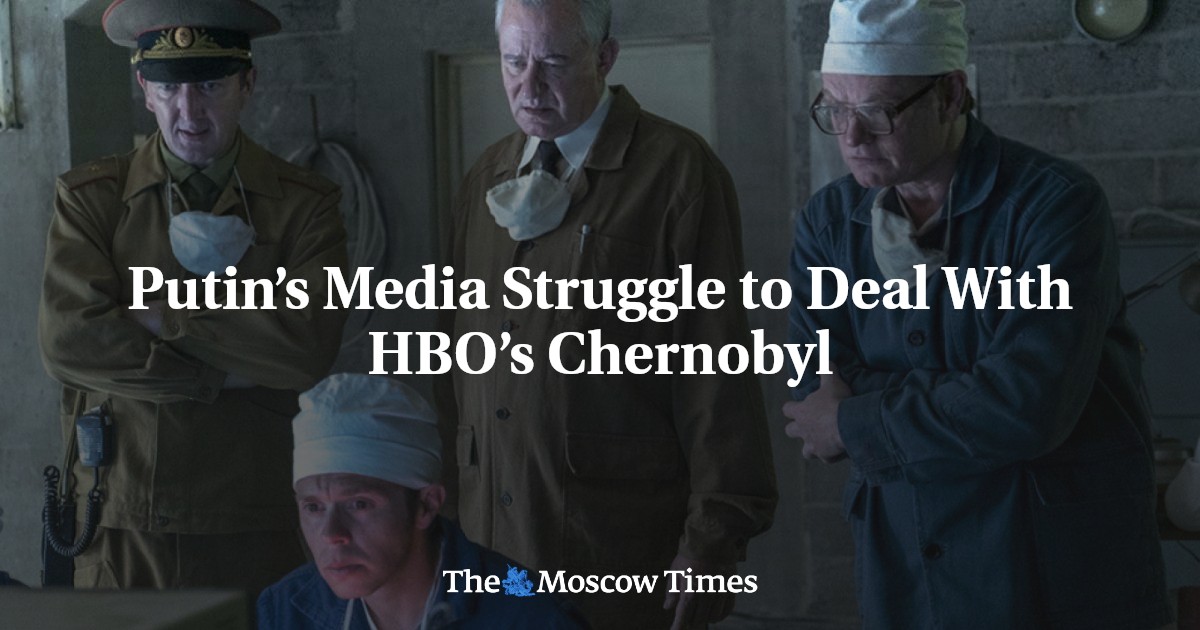
Putin’s Media Struggle to Deal With HBO’s Chernobyl
The fact that an American, not a Russian, TV channel told the story about our own heroes is a source of shame for pro-Kremlin media.
The Moscow Times
199 points · by okket · 7y ago · 148 comments
It is unquestionably the case that Soviet authoritarianism and disregard for safety is to blame for what happened. But one thing that is often forgotten, but I think the show highlights, is how well the aftermath was handled.
Yes, Pripyat should have been evacuated earlier, and yes, they should probably have notified the rest of the world sooner. But think of this: the Soviet Union mobilized 500,000-750,000 people to clean up the enormous exclusion zone. They got thousands of men to don full lead suits (that could only be used once) to run out on a roof for 90 seconds each to throw off radioactive rocks one at a time. They built the enormous containment structure in just a few months, arguably the greatest feat of civil engineering in history. One of my favorite scenes in the show is when Legasov says he immediately needs 5,000 tons of sand and boron to cover the core, and Scherbina basically just walks off and gets it for him (along with a full fleet of helicopters to drop it).
All of this was necessary, and they did all of it, no matter the cost. This was unquestionably a real strength of the Soviet Union. Can you imagine that the US would have been able to respond like this? Either today or in the 80s? I can't. With the exception of wartime mobilization, I can think of almost nothing else that even compares. There are few (if any) societies in history that could have done what the Soviet Union did in response to Chernobyl. In a way, the world is lucky it happened there and not somewhere else.
That's the beauty of authoritarian state - people who did the job had no choice, authority who ordered had no sympathy. E.g. helicopter pilots summoned from Baltic states didn't even know where they were flying or what will be the task. And even if they knew, do you think they could argue not to participate? In this sense slavery could be called "strength" of some country because it allows unprecedented workforce mobilization.
https://en.wikipedia.org/wiki/The_Ghost_of_the_Executed_Engi...
>Joseph Stalin had an ideological outlook for economic advancement in the Soviet Union that set unrealistic goals that required massive human effort. Stalin emphasized that all industrial establishments should be of great size (preferable the largest in the world). This came to be known as "gigantomania" by the Western observers. The results of taking on these astronomical industrial establishments were high accident rates and shoddy production. The high death rate and exposure to disease was an acceptable cost for Stalin. Stalin's motto was that "technology decides everything" no matter at what cost. After Peter's death, in 1929 the Soviet Union launched the first five-year plan, a list of economic goals that was designed to strengthen the economy.
>Three of the monumental projects in the early Five-Year Plans were the building of the world's largest hydroelectric plant on the Dnieper River, the construction of the world's largest steel plant (Magnitogorski) and the digging of the White Sea Canal. These Soviet industrialization projects were greatly flawed and wasteful, costing many people who worked both voluntarily and involuntarily their lives.
>Many engineers, including Peter Palchinsky warned the USSR not to rush and go ahead with the building of the dam. They argued that the water flow was ultimately going to be too slow and no good studies had been made of the flow patterns of surface and underground water in the area. Ultimately, 10,000 farmers were forced out of their farmland with little or no compensation
>Construction began in 1929 at the site of one of the country's richest iron deposits, known as Magnetic Mountain. Peter Palchinsky published articles in 1926 and 1927 complaining that the Soviet government was going ahead with plans for the construction of the mining plant without adequate studies of geological resources, availability of labor, economics of transportation and supplying proper housing for the work force.
From Wikipedia:
The official contaminated zones became stage to a massive clean-up effort lasting seven months.[71]:177–183 The official reason for such early (and dangerous) decontamination efforts, rather than allowing time for natural decay, was that the land must be re-peopled and brought back into cultivation. ... Yet this land was of marginal agricultural value. According to historian David Marples, the administration had a psychological purpose for the clean-up: they wished to forestall panic regarding nuclear energy, and even to restart the Chernobyl power station.
Its a mixed bag, while that might be true its important also to remember that kind of accident could have really only occurred in the USSR. Western countries simply couldnt muster the political support to build reactors with that lack of concern for safety, or those kind of design flams. The USSR? No problem.
Just wow to think they build power reactors without even a containment structure.
Cockcroft had also insisted that the chimneys at Windscale be fitted with expensive scrubbing equipment, which everyone thought was idiotic until the fire. Not exactly "relaxed safety" there.
EDIT: The medal awarded for participation in the clean-up can be seen in the below link. The page has more information on it that details the many pecularities of this medal and it's true uniqueness in world history (hopefully forever). Wikipedia has a good overview of the liquidators and their efforts and their subsequent lives. I've also included the wiki article on the Fukushima 50.
Aside: Though nuclear power is, to me, a God-send for human energy woes, I cannot look away from the horrible cost that these heroes paid for our energy future. Nuclear power plants must be considered after a careful reading of the liquidator's sacfifices to determine the depths of risk to our neighbors and ourselves. Though deaths per thousand may be less overall, we should soberly study those deaths and decide if we want to risk that sort of trade-off.
http://collectinghistory.net/chernobyl/index.html
It’s one of the reasons that I’m a firm believer that the US Navy should be the primary operators of government funded nuclear facilities.
It also has repeatably failed to stabilize several middle eastern countries - In about a year, adults born after the start of the Afghanistan war will be eligible to serve in it.
And on the "cyber" front it repeatedly gets caught flat-footed by smaller, less funded operations in Russia and China and has to go to congress, hat-in-hand, asking for more money while the cyber command budget is already 10x the rest of the globe's.
I didn’t say the military would be good at everything, but when you need massive coordinated response to an emergency, the military is the absolute best equipped to do it from a capability and coordination standpoint.
They already do tons of work for major mobile disaster relief.
https://www.popularmechanics.com/military/weapons/a23232/nav...
It's normal for Soviet Union and modern Russia, they don't care about people in general, just use them. Conflicts in Georgia, Ukraine and Syria shows it pretty well too.
I understood your comment to reflect decisiveness in responding to a crisis, but just on a loosely related tangent, with nuclear issues NIMBY standards fall apart.
In Germany, hunters are required to take boars they shot to get tested for radiation - direct result of Chernobyl's aftermath. Over a third of them are over the radiation limit. Same thing is happening in Japan right now. Even if they could kill off all the animals, there's the problem of disposal.
[1]: https://www.telegraph.co.uk/news/worldnews/europe/germany/11...
[2]: https://www.washingtonpost.com/news/morning-mix/wp/2016/04/1...
The linear no-threshold model of radiation at super low levels is unsupported by any evidence. The terrifying death rate numbers people calculate are like saying that since CO2 can suffocate someone at a certain level, millions of people die suffocating on low levels of CO2. It's really wild.
[1] https://www.forbes.com/sites/jamesconca/2014/09/05/germans-b...
And yes, I put my money where my mouth is, literally, by eating game meats in Ukraine.
Taking this into account, I would like to know how the "same low-level radioactive effects as" claim was calculated.
https://www.researchgate.net/publication/275270427_The_radio...
Activity of boar meat varies greatly, in some regions they found meat with 10x the acceptable activity.
I'm no expert in radiation but it's a field that has no definitive point what is harmful and what isn't harmful.
A physics teacher of mine wasn't as easy going as you and said to us to be careful.
Served on a plate, cooked just right. With a side dish of sauteed mushrooms from the area?
There were no inspections at gunpoint - people went to certain death to save lives of others. Knowingly. This is Cold War's 80s, even schoolchildren knew dangers of radiation, including symptoms of radiation sickness etc.
Evacuation started as soon as disaster recovery team got evidence of dangerous levels of radiation, there were sanitary norms and pre-planned measures for any kind of problem at the station.
And yet crowds of schoolchildren were made to March in Kyiv for International Workers' Day right after the disaster, where they were exposed to radiation. Had Soviet society really been aware of the dangers, and leadership truly concerned with the welfare of the local people, that march would have never happened.
Pretty bad record for the USSR government, and pretty well depicted in the series.
I find it more fascinating to presume the comments are made by someone in good faith, who simply may be misinformed on some topics due to persistent exposure to their State’s propaganda.
I particularly liked the comment about not needing permission to protest. No, no, in Russia you do not need permission, but if your chosen time and place is not available the State will kindly select a suitable alternative for you!
Reminds me of some college campuses.
Luckily, it is a pretty recent period of history and many witnesses of it are still alive or died in recent past. You may be interested to see explaination from Dyatlov at first hand: https://www.youtube.com/watch?v=IVthWR4cR1g This interview has been recorded in 1994, year before he died, but I'm not sure if there are English subtitles for it.
In one of the US nuclear incidents people died while evacuating in panic though no one got hurt at the power plant .
Btw japan
> There are few (if any) societies in history that could have done what the Soviet Union did in response to Chernobyl.
I completely disagree. Soviet Union handled the Chernobyl disaster very poorly. It's too bad the show gave you the opposite impression.
If things deteriorated even further, a mega-disaster couldn't have been averted since the Japanese wouldn't have sent people to die to do what had to be done.
You see this in the U.S. too with police officers. At Parkland and at the Pulse nightclub, police prioritized "officer safety" over public safety. People just want to follow a fixed rulebook about what is an acceptable risk, when in certain situations, an abnormally great threat justifies abnormal risks to avert it. This used to be understood intuitively.
You are exactly right:
U.S. put nuclear waste under a dome on a Pacific island. Now it’s cracking open (washingtonpost.com)
I have no prior for themoscowtimes.com. When I googled for corroboration (as a non-Russian speaker) all I found was blogspam citing this article.
It gives me pause because, as reported, it seems almost comically reactionary. "We're going to make our own Chernobyl show but with CIA saboteurs because some historians don't say it didn't happen." From the article:
> Still, an attempt will be made to put an entirely different spin on those events. Russia’s NTV channel has already announced that it is shooting its own “Chernobyl” series based on the premise that the CIA sent an agent to the Chernobyl zone to carry out acts of sabotage.
Can someone with access to Russian media corroborate this or provide insight?
"The series was commissioned by NTV, a top free-to-air network, owned by Gazprom Media, the media arm of the natural gas giant Gazprom. It was partially financed by the culture ministry, which provided 30 million rubles ($460,000). The total budget has not been made public."
That number is not something the Moscow Times reported on, so it looks like corroboration: https://www.hollywoodreporter.com/news/russia-making-own-tv-...
Additionally, this claim makes it seem they hurried to catch up - "Principal photography was done last year in neighboring Belarus and the series is currently in postproduction."
These days, I don't think that's enough of a guarantee.
Thankfully it doesn't matter; if there really is going to be a Russian version of Chernobyl it will be awful and everyone except the inveterate whataboutists will point and laugh. That is a metaphysical certitude.
Also, set design is stunningly truthful to the soviet era, I've seen quite a few comments after the first episodes about how familiar it looks, and can testify so myself. Also, the Kremlin corridors look exactly like they did in reality, despite some critics. The only thing, sometimes the apartments and material things look a little bit too nice for the era, may be.
I know that it's most likely a PR stunt, and there's probably not going to be any movie made, and the money grant from the government will be gone and not accounted for, and yet. And yet. How ironic that in attempt to whitewash the national disaster portrayed in this mini-series, Russia is doing what has been presented in this show as a main cause of the Chernobyl incident.
https://www.newyorker.com/news/our-columnists/what-hbos-cher...
I do have a problem where the important reality of how the scientic problems were solved by a large team working together is reshaped into single superwoman who works weekends and sleeps at her desk in a continuation of our bullshit work myths. How teams work successfully is much more valuable thing to dramatically explore.
And ultimately, I am skeptical about the popular framing that this was a "could only happen to Soviets" disaster. Western governments/companies have lengthy history of suppressing profound chemical disasters causing mass cancers (tobacco, roundup etc.), suppressing information about known safety problems allowing more people to die (Boeing), putting a brave face on a crisis using their own family (BSE and John Gummer) and being slow/callous about the health of civilians in a crisis response (Katrina) and suffering nuclear safety accidents due to contravening procedures e.g. Los Alamos is being shutdown due to it's poor safety culture.
I see the root causes as fundamentally human and not unique to the Soviet system but people are not taking that message. Instead it's being used to stir up anti-Soviet sentiment in the current and absurd Cold War II that we are currently brewing. Sigh.
That said, great series, loved it!
No doubt that callousness towards humanity abounds throughout the world, and of course in the US and the rest of the west. Soviet/Russian socioeconomics are so fascinating because they are a superpower on a budget. Callousness + shoddiness + scale, in my eyes, make this disaster uniquely Soviet. While your examples show profound inhumanity, their scale pales compared to Chernobyl.
From what I gather from the New Yorker piece, this mini-series is ok as long as one takes into consideration that it's a historical drama, not documentary?
[1] https://www.forbes.com/sites/michaelshellenberger/2019/06/06...
This is the line being pushed by pro-nuclear people every time this show comes up on social media. Thankfully we have better sources than a random person's blog on Forbes!
Let's take a look at https://en.wikipedia.org/wiki/Deaths_due_to_the_Chernobyl_di...
"an April 2006 special report in the peer-reviewed, scientific journal Nature detailed in response—the accuracy and precision of this United Nations-led joint group's projected death toll of 4,000 were immediately contested, with several of the very scientists, physicians, and biomedical consortia whose work the joint group had cited alleging publicly that the joint group had either misrepresented their work or interpreted it out of context"
"By 2016, some Ukranian and Belarussian physicians charged with treating large numbers of former liquidators in the decades since the accident were calling for more comprehensive studies and urging that the IAEA's estimated toll of disaster-related deaths from long-latency diseases be revised upwards"
I was fine with the creative liberties the show takes. You have to. Otherwise you should just have people read five books on the subject. But books don’t reach as many people and television is a strong medium in its own right. A lot of the criticism feels like “the book was better than the movie” arguments. For the most well rounded impression of actual events, do both! Read the books, and watch the drama.
But keep in mind that humans are driven by stories and narrative. The “official” events are a narrative, as is the reporting, the opinion columns, and yes, the show too.
It's very unusual to see a western show that would so truthfully depict a societal story, instead of slipping to the usual level of character-driven drama.
Also, Chernobyl is a great show!
It was nowhere near as dire or blatant as Chernobyl, but some issues were definitely things I felt like we had learned about these types of disaster by 2011.
https://en.wikipedia.org/wiki/Fukushima_Daiichi_nuclear_disa...
https://en.wikipedia.org/wiki/Investigations_into_the_Fukush...
It's also important to remember that the rest of the world is one unfortunate incident away from nuclear disaster, you only need to look at Japan's Fukushima [1]. There was also the plutonium rods picture near disaster [2]. We all need to learn from these lessons.
[1] https://en.wikipedia.org/wiki/Fukushima_Daiichi_nuclear_disa...
[2] https://apps.publicintegrity.org/nuclear-negligence/near-dis...
All criticism or compliment about anyone Russian, dead or alive, doesn't have to be contextualized into a salvo of a propaganda war that imperils or emboldens Putin. Or maybe it does, for clicks.
The fact that HBO was able to create such a believable depiction of the Soviet reality, shatters the simplistic propaganda message of "We are good, they are bad". It shows that UK and US people can tell a story that hits so close to home for every Russian person, and no official historical Russian movie of recent time was able to do anything remotely close. People who are tired of the propaganda message, seek the truth, and the contrast between Chernobyl and propaganda movies is striking.
It is hard to demonize the West, if the West tells you such a realistic story of your own past.
My point is that the West was able to make a more humane and relatable movie about USSR than what all modern Russian propaganda tried and failed to do. This series is shattering the "us vs them" mentality the Russian media tries to instill.
Putin is pro-Soviet and views any insult against the USSR as an insult against Russia itself. He has said that the collapse of the USSR was a great catastrophe and given an option to change anything in history he would bring back the Soviet Union. He has also played a large part in the revival and rehabilitation of Stalin in modern Russia
https://www.tfp.org/the-errors-of-russia/
https://www.bbc.com/news/world-europe-47975704
https://www.washingtonpost.com/news/worldviews/wp/2018/03/03...
https://en.wikipedia.org/wiki/Russia_under_Vladimir_Putin#So...
A whole part of dealing with Russians as well as a large part of how their policies are shaped can be understood through culture. The characteristic bent in mannerisms that value "honor", "masculinity", less emphasis on the exact and more on "estimates" while working through problems etc. Most people who've dealt with the Russians will agree, that this series came across as British propaganda, badly inserting their societal structures to communicate the events flowing in another, completely different structure. The main character looked like a poor Austin Powers impersonator playing a Russian.
As an example, the Female Scientist, Ulana . . i have no problem with the producers exercising creative freedom to designate her character as the substitute for the hundreds of other scientists who worked on the project, but in doing so, wildly misrepresented the role of women in Russian society during those times.
The choice of English as a language itself . . fine. What the producers can't seem to grasp is the delivery of Russian is aggressive. You don't make statements in tense situations with the British smooth tongue. That does not serve the understanding of the situations during those times very well.
I could go on about the sheer lack of patriotism displayed by any of the main characters to the point where it felt as though it was forbidden when in reality, anyone who's lived through those times and interacted informally with these people knows the opposite is true, but i repeat myself.
Women were better represented in USSR's STEM fields that in the US. For example, Between 1962 and 1964, women were awarded 40 percent of the chemistry PhD, while in the US that number was five percent [1].
I recently went to see my grandmother, and she showed me her Physics collage graduation pics - there was only one man in their class of ten students. And no, it was not due to WWII raising women/men ratio - born in the 30-ies her generation was too young to be drafted.
[1]: https://www.smithsonianmag.com/smart-news/soviet-russia-had-...
This is splitting hairs, especially considering Ukraine still wasn't a country yet.
Sure it was.
https://en.wikipedia.org/wiki/Ukrainian_Soviet_Socialist_Rep...
> The Ukrainian Soviet Socialist Republic was a Founding Member of the UN. On 24 August 1991, Ukrainian Soviet Socialist Republic informed the UN that it had changed its name to Ukraine; see the Historical Information from the UN Treaty Collection.
But you're really wrong about the representation of women; sure the social norms were very conservative towards women, but they were very well represented in male-dominated fields.
As one of those Slavs, it's not some inherent cultural strain, it's just the result of hardheaded authoritarianism and the rigidity of authoritarian systems when faced with the reality that they are wrong.