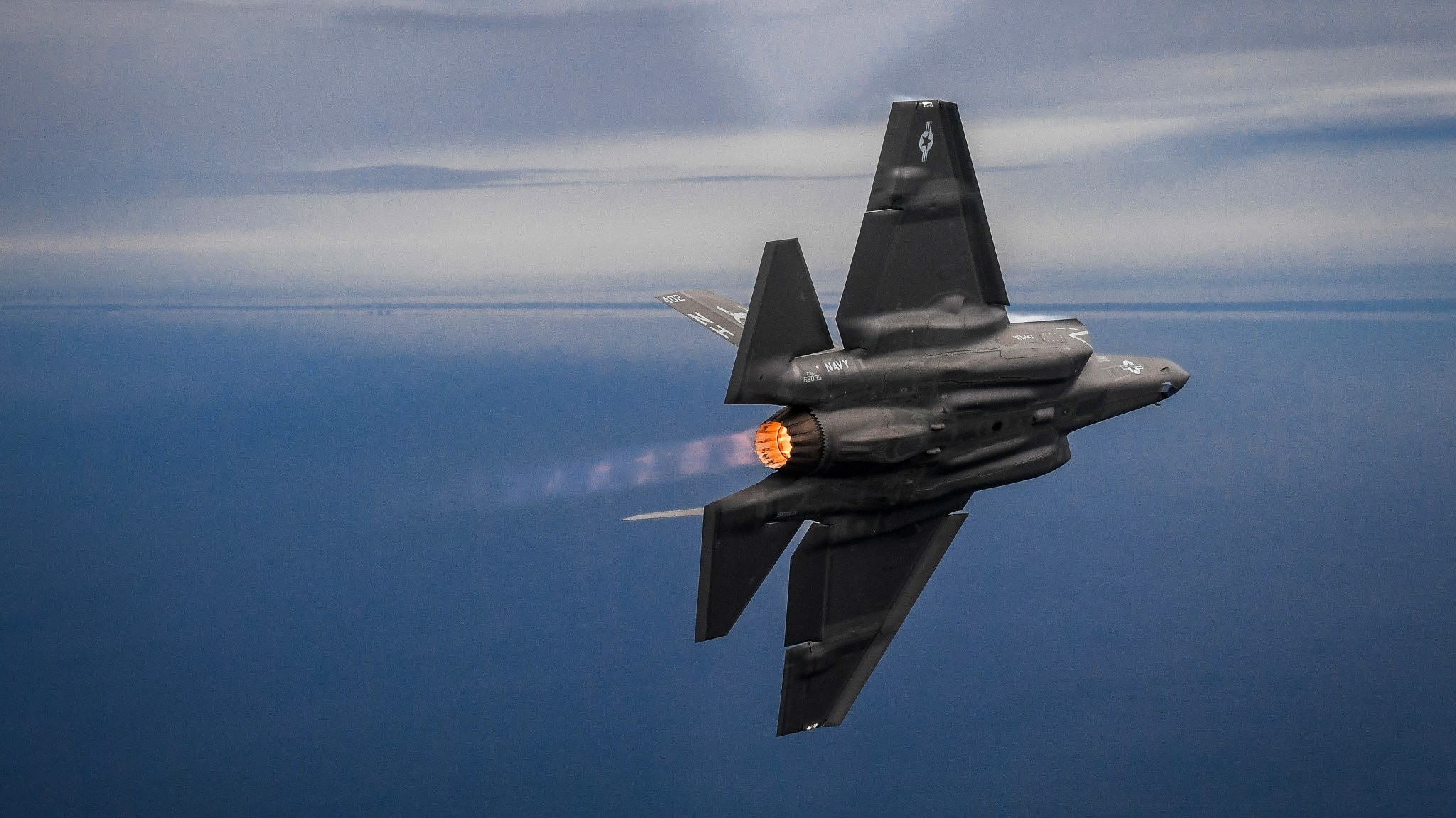
The Pentagon is battling the clock to fix serious, unreported F-35 problems
Defense News exclusively obtained documents detailing the F-35 jet's most serious deficiencies.
Defense News
201 points · by smacktoward · 7y ago · 385 comments
I marvel at how foreign buyers of something as complex as stealth aircraft can have any confidence that the system is not riddled with back doors, remote control capability, "phoning home", surveillance, and kill switches. How would you prove to a foreign buyer that your F-35 would not:
- upload all your secret flight data to a tire pressure monitor every time a maintenance worker checks the tires with the special gauge he has to use, which then retransmits the data when the gauge is put back in the hanger, without needing any cooperation from the maintenance worker
- cause all your F-35s to fall out of sky everywhere in the world when the GPS satellites transmit an extra 64-bit coded message that cause fuel actuators to shut off
- put your F-35 under remote control when a coded microwave message is transmitted directly to the plane during combat or a close encounter
Even children's toys and home appliances are routinely discovered to be phoning home and doing sneaky unexpected things. I'm going to hazard a guess that all large weapons systems are compromised —— perhaps by more than one nation simultaneously since parts and expertise come from hundreds of contractors and many different countries. I'm not aware of any revelations of weapon-system backdoors yet, but we might hear about some of them in the aftermath of the next major war.
All of which means that it's more or less impossible to buy a weapon from a foreign power without opening yourself up wide to that power. You have to let their military advisors onto your bases, to train your troops on the doctrines that go with the weapon. You have to let their logistical specialists into your inventory systems, so they can hook you into the pipelines through which the spare parts and ammo flow. Any of these people could be using their access to snoop on you or worse, but there's not much you can do about that because without them all you've bought is a $100 million paperweight.
If you're the buyer, yes, that absolutely sucks. But, unless you're willing to spend vast amounts of money you don't have to build up your own domestic military-industrial complex, you don't have a lot of alternatives. You either buy into one of the existing ecosystems (American, Russian, European or Chinese), or get curb-stomped by a neighbor who did. Once you're bought into one of those ecosystems you're effectively at the mercy of the state that operates it, of course, but hey, you do what you've gotta do. As the saying goes, the strong do what they will, and the weak suffer what they must.
It's pretty telling to see Germany refusing to buy F-35 or Hungary buying ones in order to piss off Sweden.
For the F-35, other countries were asked to pay into the R&D budget, with the promise that large contributors could obtain exclusive manufacturing rights to certain components. I've seen a lot of grumbling about this, with people claiming it traded cost savings for a military risk that the planes will be useless (or at least lack spares) if things go wrong for those suppliers.
This is sort of true, but the missing insight is that the dependency is also a goal. It's not going to allay fears that F-35s are calling home with telemetry or have compromised software, but it does help create reciprocal interests in the same way as inviting in a foreign military base.
I once heard unsourced speculation that the French might have given the British the scoop on how to sabotage incoming missiles.
One hit the HMS Sheffield, two hit the merchant ship Atlantic Conveyor, and one hit the destroyer HMS Glamorgan. So that's 4 of the 5.
I think they just ran out of missiles.
AFTER the loss of sheffield, the policy was changed such that each class 42 was escorted by a class 22 (with sea wolfs).
The Argentian navy did hit Glamorgan with an exocet after that, but Glamorgan wasn't anywhere near anything with Sea Wolf defenses at the time.
The 'friendly' aspect is likely apocryphal, and possibly based on the fact that the Glamorgan and Antrim were both exocet missile destroyers themselves, and might thus have had issues with targetting a missile of the same type. But since neither of them had any point-defence systems it was moot.
edit: or it may be from the fact that Broadsword's sea wolf system 'locked up' during the sinking of Coventry, and was unable to attack the inbound A4s that bombed Coventry. But from what I can see, the prevailing belief was that it was unable to lock on for the same reason Sea Dart on Coventry wouldn't - it couldn't discriminate the A4s from the land behind them.
Joking aside, I would assume current IFF systems let you define anything not explicitly friendly as hostile - what with shifting alliances, armament development consolidation &c - the issue being how many backdoors there are. I take it as a given no US-made missile can kill a US-operated aircraft, regardless of what the operator of the missile desires. (Same goes for French, British, Russian &c)
Edit: Note that I’m working off of very old memories, and the 60 minutes reports may not have been accurate.
reminded by association - in the new Russian&Serbian movie https://en.wikipedia.org/wiki/The_Balkan_Line released for the 20th anniversary of the war there is a scene with the French bomb dropped on a house in Serbia and which didn't explode because it was intentionally sabotaged. Doesn’t seem to have propaganda value, and I’m wondering whether it is a play on real facts or just an artistic reference to the French resistance to the NATO bombing of civilian targets.
How would you prove to a foreign buyer that your F-35 is not backdoored? You wouldn't. You sell them the plane and then they have the best cybersecurity experts the market can provide go into the hangar and completely tear the whole thing apart, inspecting every on board computer, dumping assembly code, inspecting circuit boards, etc. These are being bought by nation states, not Grandma who doesn't know her router has an admin interface with a default password.
Any attempt to backdoor that gets discovered would be an international incident and severely strain diplomatic relations between the U.S. and all of its allies. At the very least, anyone looking for nextgen fighters now would look somewhere else now knowing that we have no qualms with screwing with their defenses.
It's more like eventual own, depending on your time frame. If someone wants to to to lengths to physically secure something, it can probably withstand 1 seconds of intrusion time. It has closer to zero chance of withstanding 36000 seconds, and very close to zero chance of withstanding 360000 seconds.
Germany was supposed to be a closed ally, but Merkel wasn't that happy when she realized that the USA is spying on her.
It looks like the governments are starting to be less friendly towards eachother as the currencies in the world are collapsing.
This is very close to a plot point from Battlestar galactica (2004). I don't know of a way off the top of my head to detect back doors other than manually reviewing code.
A large company which has a database of many back doors might be able to train an AI to find them. I'm going to guess that someone, somewhere is trying to do this, somehow.
I can't imagine there are many airframes that are pushing the technological boundaries as the F-35, aren't bleeding edge products prone to difficult development?
I don't see how this wont be worth it in the long run in terms of getting ahead in an arms race as a superpower.
It seems as though this is probably the hardest thing to get industry insight into given the secret nature of it all.
To a great extent, that's the fundamental problem with the F-35 program - it's a technological showcase first and a useful weapons system second. It has been designed and commissioned by people who believe that "most advanced" necessarily means "best" and who are indifferent to the actual tactical and strategic requirements.
The Army and Marines have been crying out for years for a suitable replacement for the ageing A-10. It's the finest close support aircraft ever made, it has a legendary reputation among infantrymen who served in Afghanistan and Iraq, but the USAF are still planning on retiring it in favour of the F-35, an aircraft that is simply incapable of performing the same role. Even if the F-35 were inarguably an excellent aircraft, it's the wrong aircraft for a vitally important job.
The F-35 helmet is a $400,000 showcase of AR technology, capable of providing unprecedented levels of data to a pilot. It's also really bad at being a helmet - it's so heavy that it could literally break the neck of smaller pilots during ejection and so bulky that it limits visibility. Test pilots have mixed views on the usefulness of the AR cameras, but they all want the ability to look over their shoulder. It's maybe possibly better at doing a thing that nobody asked for, but it's demonstrably worse at being a helmet.
Servicemen don't want cutting-edge innovation - they want weapons systems that work reliably in the field and provide useful combat capabilities. That's what you need to keep in mind when you hear the DoD hype the F-35. We know it's a hell of a lot less reliable than existing US aircraft and competing foreign aircraft. We know that the one-airframe-to-rule-them-all model is deeply flawed and leaves serious gaps in the combat capability of the US military. What does the F-35 actually offer in the field that couldn't be provided by a cheaper, simpler, more reliable weapons system? I've yet to hear a good answer to that question.
It offers Lockheed Martin one-point-five trillion dollars, much of which will be spent in key Congressional districts.
That's all.
I suspect that those responsible for making decisions about the F-35 are perfectly fine with this. Rhetoric aside, our government and military appear to think they exist in a world where direct Great Power military conflict is not a possibility. The F-35 seems perfectly adequate to swiftly wreck anywhere on Earth that is not Europe, China, Japan, Russia or India. And that seems to be our actual goal in terms of capabilities for the immediate future.
But, seriously, I’ve walked through some of these subcontractors sites. They’re often small businesses run by a politically connected ex-officer, a few revolving door phds (to establish their R&D creds), a disabled (or minority) vet, and a mass of warm bodies to pump money into the local economy. (Ironically most of the money goes to Walmart and eventually goes overseas).
Corruption conquers countries more often than war.
sucks to be an early adopter, but this is no different than a gen0 Apple hardware, to draw some parallels.
what really gets me is that because of rules upon rules on acquisition, making such thing and marketing them as they really are (tech demonstrator, prototypes, unrefined products, whatever you want to call them) would never fly. you have to twist those as great budgeting opportunities, inflate the earning options of export versions etc etc.
it's like generations of rotten politics coming into play, portraying it as a greedy company and some unscrupulous congressmen is not wrong per se but a little reductive.
A buddy of mine is actually flying the jet. He said helmet is cool to wear first time but quickly wears out in real flies and is even worse in combat. A lieutenant that first flew it many years ago called it "karate mirror"; he explained it must have been designed by someone who never fought a fight, but somewhat was stubborn enough to assume when you fight karate you would love to have a back mirror to see whats happening behind.
They military argues with contractors atm to actually come back to a regular helmet, because there is really no added value in flying Mach 1 and engage in fight in front of you and having ability to see behind or even under, when you have all sort of warning systems that monitors your surrounding and allows you enough time to alter your direction before you get hit.
What the others didn't really point out is that the F-35 is definitely capable of what the A-10 does and more. It is faster, brings a drone-like attack platform, and can engage from much higher altitudes.
And this is coming from someone (see my other comments) that doesn't particularly care for the JSF/F-35. The A-10 needs to go away, and the F-35 will be a more than capable replacement for it.
Now, the other F-35 roles...
Flying at higher altitude is also not necessarily safer - it puts you out of reach of MANPADS, but in clear view of larger SAMs. Evasive flying generally involves nap-of-the-earth flying, which hides from larger SAMs in radar cover and provides MANPADS and AA artillery with short engagement times. The A-10 is also built heavy and robust enough that MANPADS often aren't enough to bring it down - only vehicle-mounted or static air defense systems have big enough warheads.
If anything, the problem with the A-10 is that it's overbuilt. Its cannon is built to take down tanks in an era when air-carried cannons probably can't get through modern tank armor, and is heavier than is strictly necessary for an anti-infantry role. The air force is looking at much lighter planes like the A-29 and AT-6B for low-threat environments, but could perhaps field a plane with similar loiter-time and survivability characteristics to the A-10 with less weight wasted on that ridiculous cannon.
[qoute]The Serbs quickly learned that opening fire on Hogs with AAA or SAMs made them both obvious and high-priority targets. Serb air defenses attempted to plan their missile and AAA shots to maximize the chances of hitting an A-10 while minimizing their own risks. The “SAM bush” was one such tactic. The Serbs would first fire AAA to make the A-10 jink. When they thought they had the pilot’s attention focused, they launched one or more SAMs in the hopes of scoring a hit. The SAM-bush had zero success, and often the A-10s made the Serbs regret they tried it.[/quote]
[quote]On average, Serb antiaircraft missiles and AAA engaged each 40th EOG pilot about six times—several pilots were shot at much more often... One A-10 AFAC point of pride was that, even though we often took aimed fire in daylight, none of the hundreds of strikers whose attacks we controlled were ever hit...[/quote]
from A10s Over Kosovo
https://media.defense.gov/2017/Mar/31/2001724978/-1/-1/0/B_0...
I think this line of criticism stems from confusing two mission types which are superficially similar, but actually have very different requirements:
- Attack missions like Close Air Support involve hitting enemy tactical targets on or near the battlefield. In recent conflicts the US has been involved in, these have mostly been in very permissive environments (limited defenses except MANPADs). This is the mission most people are thinking of when they talk about how great the A-10 is, or suggest buying the A-29.
- Strike missions involve hitting targets that might be deep behind enemy lines, protected by multiple layers of radar, air defenses, etc. This is much more difficult to do, and is getting harder as radar, fighter aircraft, and AA missiles improve. Doing it successfully against even a moderately equipped enemy requires aircraft with higher-end and more specialized capabilities than you would need for typical "Attack" roles.
You might notice that Strike is the second word in Joint Strike Fighter. That's not a coincidence - the strike capability is the major distinguishing feature of the aircraft, and what drives a lot of its requirements (stealth, decoys, etc.) The fact that it can also do a decent job at Attack missions is a bonus, but the US has a lot of F-15s, F-16s, and F-18s who can also handle that role in a permissive environment for the foreseeable future.
This blog post explains the distinction in more detail than I'd be able to: https://www.navalgazing.net/Strike-Warfare
What you'll earn by having this probably-prototype put into production is tons of valuable data about what works in production, what to improve, what components fails first, how that single-airframe stuff can be made cheaper and more reliable etc. Based on this data nobody else will have, engineers will be able to design weapon systems (think even ML-asysted design based of v2.0 based on telemetric data gathered over decades etc.) nobody else will be able to compete with even if F-35 is a flop. I imagine this is why people fret about the Turkey thing, all this is about the data (that you wouldn't want Russian systems to get a copy of) not about the flying brick.
Overall, putting boring reliable tech in production does not generate much useful data. Putting unreliable prototypes does. And it's all about techno-military supremacy long-term game here, not losing or winning one little war in a country you don't care about.
Now about the pilots and soldiers... yeah, you're doing R&D in "production" (where "production" == "warfare" here), (the wrong) people will be killed, there will be a blood price paid for all this technological advancement, but in the end you'll benefit from it.
...only thing I find slightly horrifying is that this mindset (of "screw the 'client', let'd do some R&D in production to get unique insights and special competitive advantage from it" - that has already sipped into commercial hardware and software for a long time btw), creates an incentive to "gather more and better data" and when this translate to "wage more war" it doesn't bode well...
And regarding the stealth and other tech stuff, well, I'm not sure about that. During the last ILA the F-35 didn't fly because some company, Hensold if I remember well, had some fancy new radar tech on-site. They only flew when the radar was removed from the premises, even then rumor at the time was Hensold could pinpoint the F-35 reasonably well.
If you ask me, the F-35 was a shot at a NATO monopoly on combat aircraft including a decade long support market and de-facto last word on operations regardless of operator. Seems it didn't work out as planned so far with Germany and France as well as the UK looking at home-grown Gen5+ fighters.
Good luck keeping it secure!
They said the exact same thing about the F-15. And the F-18. Both of which went on to spectacular success - the F-15 in particular has never once been bested in air to air combat, while claiming 105 enemy kills (including MiG-29s). It's able to do that due to its big sexy radar and complicated electronics and all the other techno-gadgets that people like Pierre Sprey decried every step of the way because he still thinks we live in 1967.
On the ground, there is less room for innovation. Guns are a mature technology. The primary concern in 2019 are things like reliability and cost, because the difference between an AK47 and an M16 is not that big. They both shoot bullets, they both are capable of full-auto, they both are light. To the soldier holding them, big difference of course - but from the 10,000 mile perspective they're basically doing the same job in the same way. It doesn't make much difference if I'm a general planning strategies whether my rifleman are holding M4s or M16s or AK47s.
Air combat is different, technology is still radically changing things every generation. And if you're caught a generation behind it's hard to make a fight of it. We have jet engines, and our enemies don't. We have solid state avionics, our enemies don't. We have AESA radar, our enemies don't. And now? We have all those advanced technologies in the F-35, like production line stealth, that no other peer enemy yet has deployed on the field. Certainly technology is not everything, you also need training, tactics, support systems. But it is undeniably a massive advantage, and one that's worth a little teething to get.
>The Army and Marines have been crying out for years for a suitable replacement for the ageing A-10. It's the finest close support aircraft ever made, it has a legendary reputation among infantrymen who served in Afghanistan and Iraq, but the USAF are still planning on retiring it in favour of the F-35, an aircraft that is simply incapable of performing the same role. Even if the F-35 were inarguably an excellent aircraft, it's the wrong aircraft for a vitally important job.
The A-10 is a really awful CAS platform. It's ungodly slow and so takes forever to get on station, the cannon is horrendously inaccurate, it's got a low mission capability rating and the entire concept of its design (low-flying ruggedness) was rendered obsolete with the invention of the manpad. I mean this is the platform that flew the least number of CAS missions of any capable airframe in Iraq 2, yet had the highest number of friendly fire incidents in absolute terms. If you're curious how, the cannon. All the other platforms are using fancy sensors and PGMs, while the A-10 is often going on gun runs with the Mk-1 human eye. The A-10's only two numerical advantages are loiter time and cost per flight hour, but drones exist now so it doesn't even have those unique positives anymore.
The fact that soldiers love the A-10 is meaningless - sailors loved battleships too, even after they were turned into big metal deathtraps by airplanes. The troops just really like giant cannons, even when they're not actually useful anymore.
>Servicemen don't want cutting-edge innovation - they want weapons systems that work reliably in the field and provide useful combat capabilities.
Soviet jets could handle pebbles being blown into their air in takes. They could handle smacking down onto the tarmarc at a velocity that would cripple any modern American jet. They could be nearly shaken apart, but were just built so robustly they'd still make it home. Comparatively American jets were fragile prima donnas who needed huge amounts of maintenance and could only be flown on the most pristine of air fields.
But once they were in the air? USAF planes showed exactly why all that TLC were more than worth it. I'd rather be sitting in an F-15 than any Soviet fighter ever put in the sky. At the risk of repeating myself, the ground pounder ideology of "rugged, reliable, lowest-possible-tech" is suicide in the air. In the air, technology advantages still play a huge role and so suffering a low mission capability rating is quite possibly worth it if you get a massive return on power (within reason of course).
In the same vein, the US developed upgraded Sherman tanks with a bigger, higher velocity 76mm cannon and produced them in mass quantities, but they left them behind during the first weeks and months of the invasion. The men didn't want the new tanks because they hadn't yet experienced a situation where they were woefully inadequate, and the older 75mm guns performed better against soft targets like buildings. Don't fix what ain't broke, and so forth.
Which was a serious mistake. The situation had changed, and the 75mm guns were no longer sufficient to fight more heavily armored Tiger and Panther tanks from longer engagement ranges than they experienced in Italy. They would have fared better had they been forced into using the upgraded equipment that already existed.
The A-10C is a terrible CAS platform these days thanks to MANPADs. The gun isn’t as accurate or effective as just firing a Maverick or dropping a JDAM/LGB, and those have the distinct advantage of being able to be done with seven or eight miles of vertical altitude between you and the target, rendering pretty much any surface threat completely meaningless.
The F-35’s sensor suite (and altitude) also provides an enormous advantage in situational awareness, which is probably the most important factor in combat operations.
Er, citation required. I dont remember those kinds of complaints. F-16, sure, and theyd be right.
> And the F-18
Well, that depends on if you mean the F, or the A part. Many thought the F-14 was a way better fighter and had better legs. For attack, we ended up with an a/c with less range and payload capability. Which just makes it more acceptable to replace it with something with even less range. All of which reduces the strike bubble of a carrier group.
High tech can easily lead to winning the battle but losing the war. You can have an aircraft that wins every fight that it gets into, but the price of that technological superiority might be that you can't afford to deploy them where they're needed, or can't afford to go to war at all.
The Sri Lankan air force wasn't able to control their airspace in the civil war because their fighters were too fast. I'm sure the F-35's high technology will be well-suited to fighting the Soviet Union. I'm less sure that it will help achieve a successful outcome in the next Iraq, or even the next Vietnam.
It's all about cyber war, foreign agents supposedly manipulating (US) elections without repercussions, espionage and manipulation of networks and devices on all levels.
This reality requires a complete rebuild of relevant networks, software and hardware, a large "cyber force" of people who have skills that right now only a handful of experts have, and fundamental changes in how society communicates and deals with information.
While your post was entertaining, to me it is about as relevant as a discussion how to breed and train horses for cavalry.
Look at the exhaust, which is where the heat comes from. Nearly all MANPADS are infrared guided. The A-10 hides the engine exhaust by surrounding it with the aircraft's tail. An F-35 doesn't even try to be stealth at the rear, with a great big round hot orifice.
The A-10 can frequently survive MANPADS. It has two engines, physically separated on pods. The F-35 will crash if that single engine gets hit.
Tow a decoy if you want more protection.
I'm actually quite happy that they are focusing on theoretical weapon F35, not a practical upgrade to a practical weapon.
I'm hoping theoretical weapon will be used less. I think modern weaponary is so muderous that we should be focusing more on its role as a deterrent (in which being hyperadvanced might help) not the practical aspects (how efficiently it helps people to kill people when in use).
But it’s beyond time for this meme to die.
The A-10C just isn’t suitable for this task any more. Low and slow just doesn’t cut it. It’s slow to respond due to a cruise speed of 200-220KIAS (compared to 550-575KIAS for an F-15E). Having to get to within 1.0–1.2nm to employ the famed GAU-8/A Avenger (or rockets) makes it a MANPAD and AAA magnet. The gun is limited in the types of targets it’s effective against nowadays as well. And if you aren’t using the gun or rockets, you’re dropping JDAMs (GPS and laser-guided bombs) or firing air-to-ground missiles like Mavericks. If you’re using these, you’d rather do so high and fast: you get both increased effective range and more forgiving margins of error during weapon release.
And if you’re doing this, you might as well just put them on an F-15E which outclasses the A-10C in terms of carrying capacity, response time, survivability (unsurprisingly, not getting hit because you’re at 600KIAS at 30,000ft is better than surviving being hit because you were flying 250KIAS at 500ft), weapons availability, and virtually any other trait you can imagine other than “loiter time”.
And response time trumps loiter time hands-down, especially when loitering dramatically increases the odds of losing the pilot and/or airframe to surface fire. On top of this, if you're in permissive airspace there's always a tanker nearby to extend your ability to loiter (and if you're not in permissive airspace, your A-10C fleet is grounded anyway).
The A-10C is lauded, and rightfully so, because it was such an effective CAS platform. But it’s not any more. All of the praise you hear about it it real and deserved, but comes from the perspective of people who saw it in action because that’s the plane that filled the role and so that’s the plane they saw in action. With other planes now filling that role, you will hear the similar praise about those planes for pretty much the same reason. The people who aren’t singing its praises are the commanders who see the frightening number of lost or damaged airframes and see how poorly it stacks up against other planes readily available in our fleet.
Edit: And I have to respond to this point.
> We know it's a hell of a lot less reliable than existing US aircraft and competing foreign aircraft.
The F-35 is literally one of the most reliable aircraft we have ever flown (second only to the F-22). Since 2006 (thirteen years), we've had four losses. For the F-22, it's four losses in twenty-two years. The F-15? 46 were lost from 1972–1985. And nearly twenty-five percent of our F-14 fleet has been lost in non-combat accidents.
Loiter time is extremely important for ground support. Otherwise the enemy just waits for the F-35 to fly over.
And reliable means dispatch rate, not losses, especially for tiny fleets (under 200) like the F-22.
Ah great some first-hand military combat experience here for once!
> in sims as part of a realism-based squadron
Ah, ok then... a computer game...
How many F-35s were operational in that time? Without that information, the number is meaningless.
Nearly all MANPADS are infrared guided. The A-10 hides the engine exhaust by surrounding it with the aircraft's tail. This is better than the F-35 and F-22, and about as good as the YF-23 or F-117.
Any of those aircraft can be additionally protected by a towed decoy.
YES?
"... in sims"
Doh.
https://www.defenseworld.net/news/24744/China_Unveils_New_Ar...
Basically, software, of which there's a ton to say regarding F-35 development. All the features required and component integration required them to adopt an agile methodology, moving away from the Ada-style development processes and, arguably hacking things together until they kinda worked. The predictable result is a long-tail of bugs that may never be fully eradicated.
AR, not VR, right? Pretty sure they were doing that in helicopters years ago. Doesn't the Apache have a 30mm autocannon slaved to the pilot's helmet display, such that it shoots where the pilot looks? I'm no helmet geek, but I think that stuff came out in the 80s.
I suppose the F-35's implementation is cooler, on account of being newer, but it doesn't seem earth shattering to me.
But next time I talk to my CEO I will try this with 'we do some crazy networking'.
https://www.wired.com/2016/06/course-f-35-comes-400000-augme...
They may not be firsts overall, but it seems like a pretty complicated environment to perform testing and development in.
I have to wonder what getting a software build out for a fighter jet must be like, and getting someone up in the air in different environments to test it must make the testing process daunting.
For it's faults, the F-35 is a weapon that can be configured and deployed at the drop of a hat for just about anything. That's a very powerful capability to have as a defensive and offensive weapon.
Yes. The military has tried the multi service aircraft idea in the past, wasted a lot of money, and failed completely to develop one of the desired variants. That was the F-111, which was supposed to have a Navy and Air Force version.
The F-35 was supposed to feature 80% parts commonality between the Air Force, Navy, and Marine Corps versions. Instead, it ended up being 20%.
With that little parts commonality, the different services should've just developed their own planes. All three services would've ended up with a more capable aircraft for their requirements that wasn't so heavily compromised. And it in all likelihood would have been cheaper.
> For it's faults, the F-35 is a weapon that can be configured and deployed at the drop of a hat for just about anything. That's a very powerful capability to have as a defensive and offensive weapon
It can fly a multitude of roles but it is not as good at many of them as a more focused aircraft would be. Considering the massive costs it was a bad trade off.
When on a bombing run radar stealth and bomb load matters, but acrobatic agility and VTOL / STOL doesn't. On a carrier, durability matters every time you slap the deck and VTOL /STOL might be very handy, but stealth or high altitude capability, not as much.
Designing a fighter/bomber to please every service is like training every soldier, sailor, airman, and marine to have the same fighting skills. It's going to get them all killed.
> at the drop of a hat
Ha! There are still multiple variants, and you cannot reconfigure instances of one variant to be instances of another, and certainly not at the drop of a hat.
Ultimately yes.
You can be much more agile when you aren't trying to satisfy a large collection of armed services, nations, and mission roles many of whom are mostly interested in putting their mark on something instead of making it better.
>And would it be as effective?
Not if your definition of effective is ability of one aircraft to do everything. If your definition of effective is forces ability to achieve goals, then yes a set of aircraft specialists can be better than one generalist.
Quick turnaround is something yiu get from Soviets/Russians or Swedes, where the doctrines involved make it priority feature.
The Russian Su-57 is plagued with the same kind of issues, made much worse by the fact that Russia is no longer the superpower it was. The difference between the US and a superpower in actual decline is that the US can throw almost unlimited funds at the F-35 program and Russia can't. The real mark of a superpower isn't that it makes clever things but that it can afford making stupid things.
The Russian approach to their defense industry is pretty rational IMO: they do small batches of extremely high-tech stuff mostly to keep their engineers active and to improve their institutional knowledge. Then they spin off iterative improvements and upgrades to the bulk of their legacy military hardware. Perfect examples are the T-72B3M and the Su-35. Hell, the Su-57 itself, if you look carefully, is basically a heavily-stealthed Su-27 planform.[1]
And they can do this because their MISSILE tech is absolutely first-rate. Russia understood the "payloads over platforms" mentality long before the US did. And their national defense posture is basically "We have nukes to deter anyone who is an existential threat, and everyone else can be beaten by our leftover Soviet stuff."
[1]https://migflug.com/jetflights/wp-content/uploads/sites/4/20...
The main problem to me is the F-35 is three airframes with three different sets of (competing) requirements, trying to save cost by keeping as much similar between them as possible. I don't know in the end if we would have just been better off with three purpose-built aircraft.
We've tried this in the past and failed to control costs spectacularly. The JSF/F-35 project is an insane boondoggle but it seems unlikely that the alternative of splitting them out would have been better.
We all know what should have been done by this point, which is... not the JSF. But we're pretty far down this road and we do need to modernize the current air superiority weapons we have, so... eh. It looks like we're stuck.
If it had been split out into three separate programs, we'd probably have two aircraft that were "good enough" and one that was behind schedule or deficient in some way.
I'll take that over one "no, really, we have just one more round of changes to make, and then it'll be ready to satisfy everyone" fighter.
What, specifically?
While we're in a speculative mood, just what kind of planes do you think are needed to be a superpower nowadays? Seems to me that a plausible answer is drones, lots of drones, and missiles, with a EW / networking / stealth focused plane to forward-position a human to coordinate them. The F-35 seems to fit that role like a glove.
ICBMs are another potential answer but I have a hard time being angry at war toys that provide intermediate options between "peace" and "destroy the world."
I believe the same would be true for tanks. Lots of small and nimble tanklets remotely operated from stand-off mobile c&c centers.
Of course, no one knows that the next war is going to look like until it happens; speculation on what mix of weapons will be most effective is fruitless without combat experience, and we haven't had symmetrical wars with the latest technology since... what, 1973?
In case you need to assert air superiority over a better armed adversary then you would need the best fighter planes possible and this F35 will probably not pass the mark.
Meantime military technology and requirements evolve constantly. They don't wait for F-35 to be ready.
The result has been expensive retrofits to the fleet as more and more defects have been found.
There is definitely a "targeting the down market" aspect to the productization.
Every-time I pass this gentleman's desk, I see him playing solitaire on this computer. Defense contractors are adult daycare.
Government is the one funding this guy’s adventures in Solitaire. What makes you think Government can do anything efficiently, let alone reduce poverty?
As a human, when I consider all of the ways that governments could be inept, killing humans tops the list of my favorites.
I only worry because I doubt that feature creep is handicapping other governments as well as it's handicapping mine.
Laws about keeping your dog on a leash only work if both dogs are leashed.
Go to 28:30 (actual flight helmet recording) https://drive.google.com/file/d/0B30EHgj_ikFIOTlEeGh6UHFPOTQ...
”Use the force, Luke.”
(the google drive never loaded for me)
Not only that, but a large component of the Joint Strike Fighter program was selling it to allied militaries. It would be silly to trash the aircraft publicly if you want a dozen other nations to buy it.
You'd think people in software would be more familiar with having defects in your product not meaning doom or incompetence.
Full report here: https://www.dote.osd.mil/pub/reports/FY2018/pdf/dod/2018f35j...
Article summarizing it here: https://www.flightglobal.com/news/articles/dote-delivers-ano...
If the F35 fucks up, people can die, international relations can be harmed, etc etc etc
The US's 'black' planes have been remarkably successful, though that might be due to the fact that we never see their development and testing phase.
Disaster possibility 2 is that the original bid is met... but one critical feature is left out of the contract (overlooked) and is thus not in the result.
Disaster possibility 3 is that the company does go bankrupt. Uh, oops, we needed that company. Now we can't get parts for other products. This could be fixed via a huge bailout.
There needs to be a decision making process that can guide the R&D project.
Unless of course goals, progress, etc. can somehow be quantified. (But these are complex projects, complex goals, even coming up with relevant metrics is hard, and somehow coming up with one utility function is kind of impossible - without spending a lot of money on R&D for that, but then you're back to square one.)
That said, yes, risk should be better spread, but also the following are all critically related to public spending/procurement: Personal accountability and motivation, too big to fail, cartel/oligopoly, agent-principal problems, corruption, institutional deadlock, too much bureaucracy, bad responsibility-authority allocation, etc.
Air craft carriers are obsolete, the same way the carrier made the battleship obsolete in the second World War, but nations were slow to realize it. Missiles make the carrier obsolete today. If you look at China's fast missile boats, they know this already. However it's quite handy still for projecting air power against much weaker foes - which to be fair is what the USA does today.
Human planes are just silly though. Make drones, work on improving the ability to control then accurately remotely. They can out fly and out manoeuvre piloted planes at a fraction of the cost without risking the pilot's lives.
I also agree that the aircraft carrier will be supplanted at some point because of sophisticated anti ship missiles. But, if carriers can launch drones from much greater distances it will allow carriers to extend their usefulness for quite some time.
Jamming remotely piloted drones is a good point. A backup autonomous system can help there. But I don't understand enough about how easy it is to jam signals designed to work through jamming would be.
I think looking at Russian commitment to EW is one of the possibilities of next step. Imagine war with no gps, barely functional coms etc. Basically go back 40+ years that is war vs adversary with good EW.
Now the counter is killing EW platforms as they necessarily emit.. so emit less or communicate less to not get fixed and pounded into the ground etc.
Manned platforms are not going anywhere any time soon. Humans are just too clever and adaptable
Wow.
That ends up meaning that all intelligence that other countries intelligence-agencies end up collecting are available to the US.
Drone warfare really is the next step and having full jets that appear to be piloted but are actually completely autonomous would put the US ahead by decades.
Moving to something lighter or more aerodynamic becomes a lot easier after that. If you look at the Boeing Airpower/Loyal Wingman UAV, it looks like its based on this concept quite closely.
As for remotely controlled drones, that suffers from jamming.
Another major design constraint difference between "unmanned fighter" and "cruise missile" would be the deployment and reusability goals. Cruise missiles tend to need to fit in launch tubes or under wings, while presumably an unmanned fighter would not be so constrained (and thus be able to use larger wings). And while cruise missiles are very single use, the sensors on an unmanned fighter may make it too expensive to discard that way.
If we get real self driving cars how long till someone figures what you need to plaster on a tree to fool ML into crashing a car :) now imagine full nation state behind such effort. The risk of not having human in the loop is just too great.
You also just can’t do anything limited. I mean you can have even now fighter jet just kill anything it finds that does not transmit id, good in war maybe not so good at other times. Aegis is old tech and it is automated to kill anything that looks like a missile in full auto mode.
Iron dome probably same thing, engages and fires on full auto. Now imagine you hook it up to some automated 155mm battery, the moment missile get painted, it would start counter battery, I am guessing the round would land in Gaza before the rocket hits Israel. Now how many people would be ok with this is another question.
I mean, the benefits of a pilotless fighter jet are pretty significant: more maneuverable, faster, easier to design, and probably cheaper. I'm especially curious about fighter pilots' opinions about this.
What if airplanes had to be cranked out at a rate like the WWII Merchant Marine Liberty Ships: 2,700 of them from 1941-1945? (There's a restored one, SS Jeremiah O'Brien, at pier 45 in San Francisco.)
Are these machines so complex now that it necessarily must take a generation to develop a new one?
Sounds good on paper, disaster in practice.
Between the F-35, the ethiopian crash, and plenty other related topics, I’m amazed at the quantity and quality of the comments.
I would expect this topic to be kind of niche, and not attract >100 comments everytime!
I recall the MCAS issue being discussed here well before governments grounded the 737max. The FAA being one of the last to ground.
The F-35 issues appear to share those common in engineering. Over promising, over spending and not able to deliver on those promises, because no solution can satisfy all wants/requirements.
In my explicitly unqualified view, the F-35 tries to be everything to all services, yet my limited understanding on aeronautics is (similar to marine engineering); is the best designs are those that focus on a specific task.
it's of course possible to make a new jet fighter/bomber/thing that satisfies all of the requirements. The issue is cost and time.
The F35 is a classic mega-R&D project. Like going to the Moon, fusion, self-driving cars, XUV litography [or the whole process/node change from 10nm to 7 or 5nm]. Costs are enormous, lifetime TCO is also very high. It's so complex and funding is so far from infinite, that it is and will be never "done".
We know these. Just as you can always tweak a nuclear reactor or atomic bomb design, just as you can always make better microchips, you can always make better jets.
It's also very similar to the JWST (James Webb Space Telescope) - the goal/design is pretty straightforward, just the engineering way to get there, is not. It calls for "tech" that's simply does not exist, and calls for systems integration of that tech on a level that simply cannot be adequately estimated/planned.
Fusion, the JWST and the F-35 have different principal constraints (the JWST seems the simplest, it is simply cost constrained - every part of the R&D/assembly/verification process seems so underfunded that all the other parts/participants have to wait for each other - and downtime is not cheap either, specialists can't just go and have a gig while they wait for others/testing/manufacturing; the F-35 is probably very bureaucratically constrained, a bit like ITER [the big international fusion project] - everyone has a small part in it, so there's is lots and lots and even more back and forth between everybody, problems are discovered, tweaking needs discussions, discussions with many parties are a nightmare, everything needs paperwork, because it's public money after all, etc.)
This does not make the F35 "bad", but of course begs the question of spending efficacy. Was there really no better way to spend all this money and achieve very similar goals? There probably was.
But. Usually these projects are a success even if the end result is useless. Because they fund R&D in many places.
For example a good overview of how mega-R&D translates into tangible innovations is the W7X brochure: https://www.ipp.mpg.de/987655/w7x_and_industry_en.pdf (Germany spent a few hundred millions euros, and most of that went to small shops iterating on their tech - which of course helps Germany remain competitive on the global markets).
Lots of HN comments pretend to know everything about depression and its cures despite posting totally incorrect information on the subject.
People here tend to speak with authority on many things they actually know next to nothing about.
How do you measure the quality if you are not an expert?
Surely many are an enthusiast in aeronautics. There are plenty of documentaries and incredibly lots of information on the internet about aeronautics. And I believe that's still just some shallow information.
Geeking out about this kind of topic is routine for people with an interest in engineering. And let's be clear: it really is just a matter of geeking out, people getting a thrill out of playing at "appearing to really know their stuff".
That, and I think tons of tech-oriented people love flying machines, and a good exit or a fat Google salary makes it much more realistic to exercise that passion in real life.
Are they? How do you know that?
If you read the actual article, you'll see that most problems are either fixed already or aren't as severe the headline would make you believe. But nobody really reads the articles.
Uhm what? Presumably no pilot will fly into terrain if in control.
That whole thing just reads like a nightmare project
Flying limited visibility or with horizon obscured is a typical scenario for controlled flight into ground. Some pilots will also feel less confident with a particular implementation of the artificial horizon.
Then there are transition states between particular instrument assisted flight modes (“autopilot”) and manual flight modes, as well as assisted flight modes where the pilot and the computers disagree on the appropriate course of action (similar to, say, automatic trim of horizontal stabiliser in aircraft with engines slung under the wing). The pilot might switch modes and assume control over pitch and yaw but the computer was handing over control of throttle. So the pilot ends up fighting the computer for control rather than actually flying the aircraft.
Labelling it “pilot error” can cause investigators to stop looking for the root cause. “Controlled flight into ground” leads to the question “why would an otherwise competent pilot do what this pilot did?”
In this case, though, it seems to be used incorrectly because it's being applied to a problem that causes the aircraft to be difficult to control. A plane that is too hard to fly isn't the pilot's mistake.
The history of flight has many instance where this has happened.
A very common cause is bad visibility mixed in with mountainous terrain.
Ground warning sensors and training are better now so there's less of it, but you still get it from time to time.
Even if defense is a necessary evil, it should be obvious by now that electronic (cyber - forgive me) warfare is the future of military.
Why attack with physical weapons when you can literally shut down the power to an entire country? Or jam its communications en masse. Or cripple its transportation infrastructure.
When guns came out, they said it would be the end of warfare. Instead of spending years training archers, you could pull farmers from the fields, put together huge armies almost overnight. When machine guns came out, it was the end of warfare. How could massed formations fight against so many rounds going downrange at the same time?
This continued on with aircraft, aircraft carriers, nuclear weapons, missiles, and so forth. Nuclear weapons are especially interesting because instead of eliminating war, it looks like they eliminated formal war, pushing all that conflict down into police actions and non-state actors.
All those other things stuck around. What became really tough is that you had to integrate all of those other things together so that you use that right tools in the right way, almost like putting together a symphony. Cyber is the same way. What we're seeing now -- and I'm a firm believer we are currently in a cyber war -- are a lot of different actors seeing how hard they can push things. It's a war without any conventions about what "fighting fair" means. Bad place for us to be.
I think the F-35 has been a giant disaster, but that's part of a different discussion about military priorities versus strategic planning.
If the point were actually about defending one's country, then there are surely more effective ways to spend the money.
By all appearances, the modern military is just a convoluted way to funnel public money into the pockets of a few contractors and corporations (whose investors and shareholders win). It's an immensely inefficient way to skim money from the general population.
One might say the modern military is more precise, suggesting that we care about avoiding civilian casualties. However, the US drone use blows that theory.
If the goal were to defend a country from terrorists (modern invaders), then we would be concerned with right wing extremism which is responsible for more deaths than foreign "terrorists".
Lastly, if we were just concerned with human lives and longer lifespans, we would be putting most of our money into combating heart disease.
I completely agree. I think at the heart of the United States is a terrible vagueness and corrupt idea of why we have a military.
They to call it the War Department. While that certainly doesn't sound very nice, it cut to the direct point in having a military: fighting a war. That made it a lot easier to reason about.
So what's a war? A war is when people are doing something you don't like and you want them to stop. You have tried talking and reasoning with them and that didn't work. So you have to figure out other ways of making them stop fighting you.
That's it. You don't need guns, tanks, or even explosives. If you can make those other people over there stop fighting you, they surrender, you win.
At some point, probably around the time of WWI, mission creep started taking us into all kinds of places that either wasn't a war or we didn't like admitting was a war. So we started changing the language, setting up all sorts of units and programs that were only tangentially-related to war, and so forth. I read at some point when Bush was president we had military operations in over 80 countries.
Now most of those operations were peaceful: medic clinics, training, and so forth. You could argue that they were strategically fighting a war -- happy, trained people tend to be happier. But that sure looks like social programs, diplomacy, and police action than war. Don't get me wrong: these may be great things to do. My point is that if you stretch the language so far, then pretty much any damned thing you want to can be considered part of the military. Or a war, for that matter.
Based on this, and the ton of inertia and corruption that's been associated with war fighting since forever, I really don't think we can expect the Department of Defense to act in a sane manner. My gut tells me that we built the F-35 because we thought that's what we were supposed to do: come up with new, expensive tech that's better than the other guys.
We're going to need to get back to funding DoD to fight wars: real, live, in-person conflicts where the other guys need to be convinced to stop fighting us. That's going to take a ton of re-organization and strategic planning that I don't see happening any time soon. (Also, agreed with your statement about tunneling money to contractors, and defending the country. We've come a long, terrible way from the idea of a citizen soldier defending his home.)
You can disrupt 50s utility equipment with radio/em. You don't need a trillion dollar jet for that.
I'm just saying that we're spending money on the wrong stuff. And we're doing it in a HUGE way. There's a reason we do that, and it's not because of defense concerns...
Now where have we heard that before. Software patches to fix inherently unstable hardware. Move fast and break shit.
Newer designs are only stable when their attitude is constantly monitored and adjusted by control software. (To continue the metaphor, imagine a Segway or a pogo stick, more agile than a car)
The benefit you get from giving up passive stability is increased maneuverability in the case of fighters.
https://wikipedia.org/wiki/Central_Air_Data_Computer
They had flight computers that did ultimately actuate the control surfaces.
A stable plane can fly with a stick controlling surfaces. Just like an ordinary cessna does. An unstable plane has to fly by wire, where a person moves a stick to ask the computer to tell the computer to roll the plane, and the computers calculate the necessary control surface movements and tells the servos to move.
More importantly, the computer tells the servos to move the surfaces many times per second just to keep the plane straight, because it's not stable. Looking at a modern jet fighter from the outside it's hard to see just how unstable in they are. You can get some idea by looking at where the weight is (in an empty plane) vs where the surfaces are. They are built like a dart, but with the wing in the front and the weight in the back. Look at where the engine (the thing that weighs a lot in an empty fighter built from composites) starts in this cutaway: right under the tail! It's a backwards dart. https://www.slideshare.net/SaabGroup/saab-gripen-3d-cutaway
Ironically, also a core fighter pilot mantra to the detriment of flightline maintainers and field support engineers alike...you might call it a symbiotic relationship.
[1]: https://www.military.com/daily-news/2015/01/28/pentagon-tell...
I suppose in your eyes, 'need' is a loaded term. Maslow's hierarchy of needs, while subject to some debate, has become a popular consensus on what the term means. Many socialist policies are in favor of universal health-care, food and housing programs etc. which sit at the foundation of the hierarchy.
Got any examples?