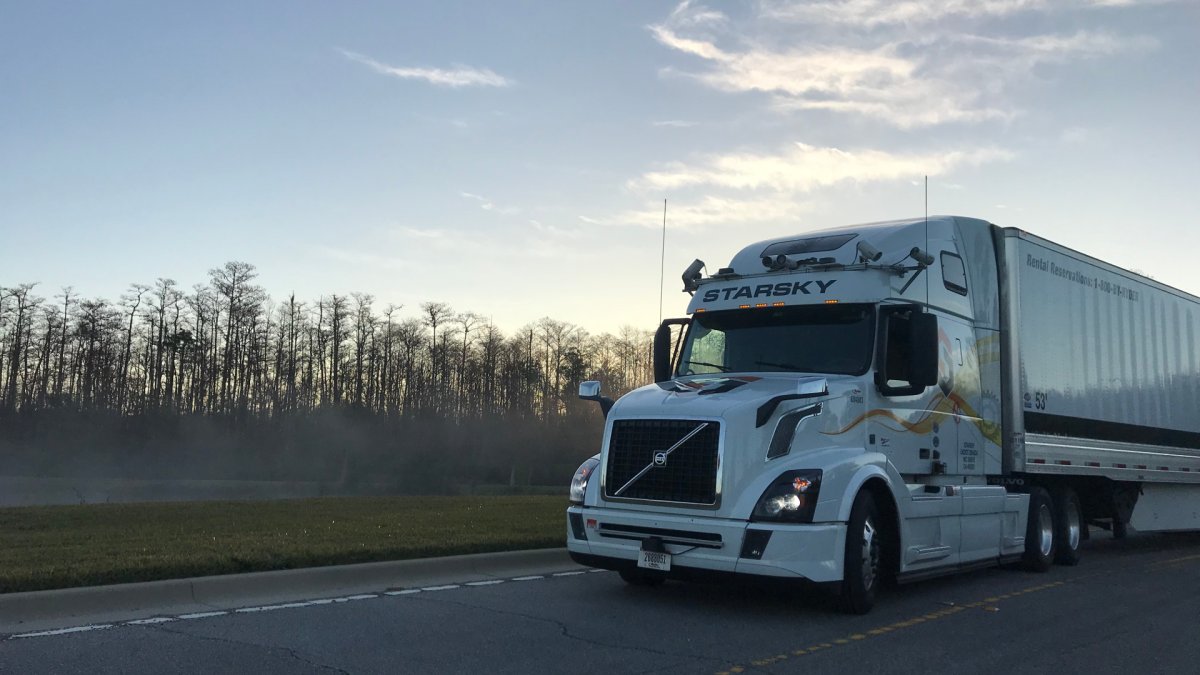
Starsky Robotics Becomes First Uncrewed Truck To Hit 55 MPH
To the best of our knowledge, this is the fastest an uncrewed road-legal vehicle has ever driven.
The Drive
143 points · by DanFeldman · 7y ago · 120 comments
"Unlike some other "driverless" truck companies, Starsky isn't building a completely autonomous solution. Instead, it uses teleoperation to remotely drive the truck between freight depots and the freeway where a highway-only automated driving system takes over."
Starsky is doing really impressive work, but the trucks aren't designed to be 100% autonomous 100% of the time. I think this is a great solution to the last-mile problem for freight logistics, however.
If Starsky is successful, I suspect this will be used a lot of places. For instance:
Image vision detects a police officer. Maybe a police officer doing hand signals. Immediately switches to teleop (with last several seconds replayed) if in a safe situation to do so. Corner case: solved.
The problem with remote assistance is it's only useful for static scenarios, like getting a vehicle unstuck. It can't help you make a left turn due to lag (cellular networks are not reliable for real-time safety critical systems), but it can tell you whether or not you can proceed after stopping for a paper bag in the middle of the road.
I'd wager that a primary motivator for self-driving+teleoperation is increasing the amount of time that trucks can be hauling, not necessarily making them safer than existing trucks.
Happy to answer any questions
Link below is a dramatized account of the events, couldn't find anything less editorialized, sorry!
[1] https://www.caranddriver.com/news/a19177797/self-driving-tru...
https://uploads-ssl.webflow.com/599d39e79f59ae00017e2107/5c1...
I'm curious as to the ways that the self driving problems in trucks might be different to the problems of self driving cars. For example, with heavy trucks, your braking distance must be a lot larger than a normal car. So things like following distance must be different. Also having to worry about skidding and the direction the trailer might move.
Also, I imagine that you have to be pretty careful about cars cutting you off. It seems to happen all the time on the road, and is more dangerous than people give it credit for.
Right on the money. If you slam on the brakes on a truck, you and your trailer can jack-knife, sending the trailer the wrong direction. It's a more complicated controls problem than in a car as well!
> Also, I imagine that you have to be pretty careful about cars cutting you off. It seems to happen all the time on the road, and is more dangerous than people give it credit for.
I've spent hundreds of hours in our truck over the last 3 years and my god drivers are absolutely terrible around trucks. You have an incredible view of the road from up on high in a semi, and the spatial awareness compared to a sedan is way better, so the crazy maneuvers happening around us seem a lot crazier. In California trucks can only go 55 mph, so we get a lot of folks (even in normal driving) trying to speed around us during merges on/off highways.
Are you free to talk about liability concerns? Is there a consensus on how unmanned vehicle will affect the outcome of a suit arising from any accident. I assume these trucks have more than every angle covered to protect against false claims
lol :)
That's a blurry line.
We think of it like a spectrum running from hands-on-the-wheel, manual actuation of the brake/throttle/etc. to full autonomy. The middle parts are "supervision" where the human isn't manually pushing the pedals, but might, for instance, tell the truck to take an exit, or slow down, and the truck can do all the acceleration/braking, lane changes, etc on its own.
This pattern of "supervised autonomy", where you automate the low-level (and safety critical) parts, but leave the higher-level decision-making up to humans, has surprisingly broad applicability. That's part of why I'm excited to work here.
Multiple on-board backup locations of numerous video sensors means unless the entire vehicle is torched (and even then), some evidence of the people who carried out the theft will probably survive.
When talking about autonomous platforms, a jammer might no longer be sufficient. If communication is lost, how hard is it to launch a drone (or multiple) whose job it is to keep visual contact with the vehicle while increasing distance, and relay the feed up when communication is re-established (how large an area does a jammer affect?).
There are ways to mitigate these defenses/logging (reduce all unique visuals, stop vehicle in tunnel), but also ways to minimize those mitigations.
I'm not sure it's any easier than when a human is present to defend the goods.
That's no fun for the ICE 20 miles out.
It certainly is something that I think of, but safety engineering requires simpler processes (because simpler means less things need to go right, which is good when things are breaking). I'd rather pay more for cargo insurance than have more complicated logic that causes more accidents with people.
It's pretty easy for a carrier like ourselves to decide how to manage this business process, so we have carte blanche to work with our shipping partners on novel solutions. They're also interested in transparency and speed of transaction, and especially interested in being able to work with a truck that is easily traceable. There are modern shipping depots that have robotic unloading, but also a significant portion of freight is unloaded by the people manning the shipping/receiving offices of our freights' end destination.
[1] https://www.freightwaves.com/news/starsky-robotics-sees-truc...
I'm not entirely familiar with the industry and day-to-day of a trucker, but I'd imagine you'd need some "on the ground" personnel, at least initially, to perform tasks such as fueling on long hauls.
Aside from this, it'd be interesting to see how quickly you can go coast-to-coast without a human needing a break/sleep.
With regards to fueling, there are a good amount of fuel stops around the country that will do "concierge" services for fueling up the truck, giving it a wash, etc. There's some infrastructure in place for when we need to get there.
IANAL, however, a lot of road activity is regulated state-to-state in the US. It turns out to be a really fascinating regulatory problem.
To get a flavor of what we're dealing with, we've had some concerns from law enforcement officials that our tele-op drivers need to be sober, and that officers need some mechanism for administering a field sobriety test to someone who may not even be in the jurisdiction.
IMHO, there needs to be a federal solution to some of this. If it becomes common that vehicles and equipment are operated across state lines, it will become increasingly difficult to comply with every state's rules. That said, unlike some other companies, we are very committed to honoring both the letter and spirit of the law. Our view is that this is an important moment for US civic engagement where industry, labor, insurance, vehicle manufacturers, and the public need to come together and work it out. We explicitly are not taking a "move fast and break things" attitude toward legal compliance.
I wouldn't be surprised if you eventually have to end up getting police to stay on site with the drivers for this scenario.
Sobriety tests not withstanding, your non-security staff probably won't go tackle a teleoperator if they cause a bad accident and try to flee.
Have you experimented with stereo cameras for telepresence? How does it compare with multiple fixed cameras?
An automation/teleoperation seems like a great solution for this problem.
Why aren't more teams doing that ?
What does the interface look like? 2D screens (no depth perception), or something more VR-like with stereoscopic vision and head tracking?
Excuse the mood lighting, we're experimenting with eye-strain on the remote drivers.
I'm currently (this afternoon) working on driving the latency of the communication in this system down even further by stripping it down to bare socket programming. We'd love to meet anyone who's done RTS games, first-person shooters, or anything else that involves keeping moderate amounts of state synchronized over medium-latency networks. :)
The video is nice to see a professional driver even in his orange vest driving truck ten thausand miles away. And once he is done he shuts down his laptop and walks to the room next door, where his wife cooks dinner to play with their kid. Right?
If reality of automatization learnt us anything so far, is that all these people will be fired almost overnight, and the huge hangar of $2/hour Phillipino “drivers” will be hired to most drive most likely multiple trucks at once, because why the hell not to divide screen in four.
The only good thing is that we are some 10-15 years away from full implementation, but if I were you I would not look for long and prosperous career as a truck driver.
(I work at Starsky)
That's one way to say it. Another is that the industry is suffering from a major lack of qualified drivers. Earlier this week, we announced our operation of a commercial trucking company in addition to our autonomous R&D group. We're getting better-than-average employee retention by offering employee-drivers a career path out of long-haul driving if they want it. Even so, we've heard tons of stories from our drivers about poor working conditions at other companies, and people quitting after only 3-4 months.
For whatever reason, trucking skews older. Younger people just don't want to do it. Which is fine, except that groceries, diapers, and everything you order from Amazon won't get delivered by itself.
This will cut jobs, yes, but as a latency/redundancy sensitive application jobs servicing this will be geolocked to 'hubs' of some form. Like air traffic control, but for trucks.
The problem is not automation, it's the expectation that without a high-paying job you need to work 40 I mean 50 I mean 60 hours to make a living.
Driving is a very tactile activity, but I'd also worry about lag, network congestion, network outages, &c.
Even if the company just serves long-haul routes from depots in less congested areas very close to freeway on-ramps, that's still a huge market, and the labor cost savings would likely be huge if humans are just driving from the depot to the freeway.
Related, I was thinking about the idea of teleoperation for drone deliveries recently as well. The same kind of "last mile" problem exists for landing cargo from a drone. Have the drone fly from the warehouse to the customer location, and then pass it over to someone sitting in their house with a joystick to control landing and delivery of the cargo. Once the delivery is complete and the drone is airborne again, have it fly autonomously back to the depot. Pay people $1/landing or something like that.
The last mile is going to be the hardest part of any of these autonomous businesses. The hybrid teleoperation model where the computer handles the relatively easy (but mundane) parts makes total sense.
That doesn't solve the "hand-over" problem --- which I already mentioned in another comment here --- if you were suddenly given control of a moving car headed in a dangerous direction, how long would it take to assess the situation enough to make a decision on what to do? You have to be already paying attention to react in reasonable amount of time.
Of course there is the "workaround" of having multiple (alert) drivers per vehicle, but that seems more trouble than it's worth just to avoid putting a single driver in a vehicle. (In addition, as all the stories about self-driving-car accidents have shown, even when people are in the vehicle itself, they don't tend to pay as much attention if they already have the "someone/thing else is driving" notion anyway.)
Then again based on those pictures the operates have far better views around their truck then you would sitting in it.
But then again the UX of looking around vs a computer screen has to be another hurtle.
The parking cameras on high-end cars have already evolved from a simple top-down view (which is now an option even on entry-level cars) to a 3rd person perspective 3D view, complete with a little 3D model of the car https://i.ytimg.com/vi/FyjVphbHAL0/maxresdefault.jpg
https://jalopnik.com/the-2020-range-rover-evoque-lets-you-se...
The video hints at "lane keeping." How much automation is involved?
However much it is, it's not hard to imagine a smooth transition between remote operation and autonomous driving over time. Each iteration would eliminate one more thing the driver needs to be concerned with until nothing is left.
level 2!