'We all suffer': why San Francisco techies hate the city they transformed | Cities | The Guardian
Amid a homelessness crisis, sky-high rent and a surplus of rich people, insiders bemoan the effects of their own industry
the Guardian
86 points · by _0o6v · 7y ago · 125 comments
Similar things are certainly true for other technology, even for the (tolerated) side products of said technology. Is any single person at fault here? Probably not. They mostly acted rationally within their small horizon, but together they created a problem, even for themselves.
We have similar problems when it comes to markets and global warming. Many individually rational decisions can lead to negative outcomes for the whole.
There is a very good episode on the Omega Tau Podcast on precisely that problem: https://pca.st/t8Yd
The interviewed Scientist Dr. Igor Nikolic focused on the design of a co-evolutionary method for constructing Agent Based Models of the evolution of Large Scale Socio-Technical systems in the TU Delft in the Netherlands and tries to tackle problems like these, where you'd be lost without a more systemic view of the problem.
Increasing the housing supply, if there's room for that, seems like a no-brainer.
This quote totally confounded me. Why is it a given that their kids have to go to private school? If you're optimizing your budget for home-ownership, why not just send your kids to the schools your taxes are paying for?
Two major points are Prop-13 and the LCFF (Local Control Funding Formula):
Property taxes only re-assess upon the sale of a house (kinda, it's complicated [1]). As such, only ~25% of the budget comes from property taxes [2].
The LCFF is such that Sacremento controls the funding for schools[2]. Essentially, the money comes out of the state and does not stay in the local area. How that money is divied out is, again, really complex.
So, your taxes don't pay for your local school, they pay for the state as a whole (again, kinda, its complicated).
[0] http://www.sfusd.edu/en/about-sfusd/budget/faq-budget.html
Because thanks to massive underfunding US public education is ... not exactly what one can expect from a first world country. In some areas children actually only have four days of school because of underfunding (http://www.ladbible.com/news/news-school-switches-to-four-da...).
OECD Data [2] indicates that overall the US spends on average $13,084 per pupil on secondary education. This is ahead of 31 of the other OECD countries. Only 4 OECD countries spend more than the US per pupil, and only 3 OECD countries (Norway, Austria, and Luxembourg) spend more than San Francisco per pupil.
Several other sources of analysis of per pupil spending are included below.
[1] https://ballotpedia.org/Analysis_of_spending_in_America%27s_...
[2] https://data.oecd.org/eduresource/education-spending.htm
[3] https://www.politifact.com/florida/statements/2015/apr/21/je...
[4] https://www.theguardian.com/us-news/2018/sep/07/us-education...
"The United States spent $12,800 per FTE student at the elementary/secondary level, which was 35 percent higher than the average3 of $9,500 for OECD member countries reporting data."
I'd be interested if that figure included funding for competitive sports teams.
Often due to the ubiquity of private schools, property taxes aren't funneled effectively to public schools. So funding can be very patchy.
Moving specifically back to SF, the system is also a lottery[1].
1: https://www.kqed.org/news/11641238/how-the-san-francisco-sch...
As a European, I slowly wonder if there's any public service in the US that meets the "first-world country" standard. Not education. Certainly not healthcare. Infrastructure is also crumbling from what I hear.
(Especially please avoid generic tangents on flamewar topics like the superiority or inferiority of nations.)
The only OECD country to spend more per student than the US is Norway.
https://nces.ed.gov/programs/coe/indicator_cmd.asp
San Francisco is not on the high end in the US, but it is suffering largely because of increasing pension and salary requirements. I assume the latter (and likely both) is itself caused by the extreme cost of living in the area.
https://www.sfexaminer.com/news/sfusd-expects-budget-cuts-de...
But the private services can be top notch if you've got the cash.
To be honest this also plagues Europe - all the way from Romania (https://www.romania-insider.com/romanian-entrepreneur-one-me...) over Italy (https://www.theguardian.com/world/2018/aug/17/italys-crumbli...) to Germany (https://www.dw.com/en/germany-tries-to-close-infrastructure-...).
The root cause here is that "thanks" to decades of neoliberalism and privatizations tax revenue and thus the financial base for investments has eroded.
Sadly most kids wouldn't "enjoy their childhood" without school. Schools aren't just about useless assignments, it's a social framework that prepare you for life; learning, the scientific method, living/working with people you don't agree with, doing tasks you don't want to right know but which end up beneficial in the mid/long term, entering a community, &c.
You need a minimum set of tools to be able to navigate in life and most people aren't going to learn these by themselves. Some people have great families/local communities which can play this role but I doubt it's the majority.
None of that needs to happen in a $50k/yr private school though.
  Is that so bad? Schooling is
  a waste of time anyway
Universal public education is one of America’s greatest achievements and a tremendous equalizer. At school children learn to socialize, and history, and the arts. They play sports, and get in trouble, put on plays and sign yearbooks.
And it’s a tremendous thing we do that should be encouraged and valued.
I've been mostly happy on the east coast, but gentrification's steady gears are erasing local culture here too. I'm pretty sick of cities now - the noise, crime, filth, expense, lack of green space and clean air. But terrible public transportation outside of cities requires paying the ecological, monetary, and in-convenience costs of cars. Suburbia has its own negative effect on society, by drawing away tax revenue from cities and abandoning small businesses. 'Escaping' would come with its own costs, and only help myself.
I don't see a clear solution, but it has to start with a focus on improving society as a whole. More and better public transportation, housing, food, and education will greatly help things, but it needs to be integrated everywhere; not doled out like alms, or in whatever the highest taxed county is. We need a balance between the selfish act of consumption and the hard work of improving society for other people, which will actually benefit us more in the long run.
Just beware that it is a pretty run down and dirty city. The streets downtown are full of homeless people who seem to be not all there. I've never felt as unsafe in any city as when walking in downtown SF in the evening, it's very counterintuitive if you're used to downtown areas in Europe. Also avoid public transit at night.
Mountain roads with nice view on top:
https://www.google.com/maps/dir/37.5880399,-121.8692997/37.4...
Nice road in the woods:
https://www.google.com/maps/dir/37.5880399,-121.8692997/37.4...
Small twisty road to santa cruz:
https://www.google.com/maps/dir/37.5880399,-121.8692997/37.4...
I also remember remote hiking trails going up the hills south of mountain view but I can't place them on the map. They were always empty, best place to chill and get out of the stressful environment.
Yosemite, Sequoia, John Muir Woods, Death Valley! All around there is Arches, Glacier, canyons, deserts, forests, and more.
SV is really just office buildings. They don't have formal tours for visiting engineers or anything like that. Most of the campuses don't even have a visitor center.
As a tourist SF you get to avoid most of the really bad aspects of SF a bit but I don't really think it's a good tourist city. There's just not a whole lot to see that you can't see anywhere else.
To counter some of the suggestions elsewhere:
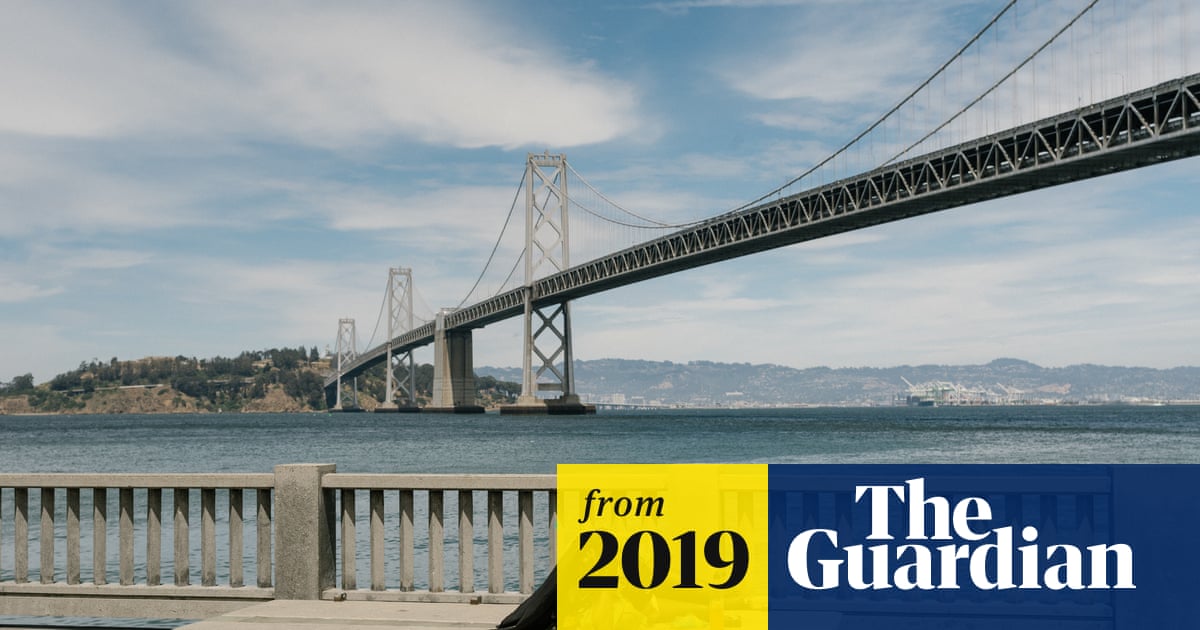
- The bridge is just a somewhat visually appealing bridge and it's often difficult to see due to fog.
- Muir Woods is a nice place but it's so heavily trafficked it feels more like a garden than a forest.
- Land's End is mainly special for its' view of the bridge I think.
I'm being a bit negative but these aren't bad sights and I don't regret going there as a bay area resident, I just don't think they're special enough to take a substantial amount of time out of an international trip.
I'd suggest: If you're after cities, head to the bigger ones like LA, New York or Chicago. If you're after culture and/or history go to the east coast (I think DC is probably the best place, it has the Smithsonian after all). If you want food, go south. If you're after natural beauty, the best places are pretty far from major cities (e.g. mountains, grand canyon, yellowstone).
The wealth inequality and housing crises don't make it a bad place to visit any more than New York, London, or any of the great cities.
People wouldn't complain about the changes in their home regions if they didn't love those places. There are many things about SF and the South Bay that make them really wonderful places: climate, natural attractions, cultural attractions, etc. And those things are very much available to tourists. The dystopia only starts when you try to find an apartment.
I can’t name a neighborhood like the tenderloin.
That being said, I don’t feel particularly threatened generally (although I am a tall man), but it is depressing.
In NYC I don’t mind tossing out a buck here or there, but in San Francisco it just feels too innumerable to even start.
* Land's End (just outside the city) is beautiful, and worth a visit
* The Palace of Fine Arts Theater (not a theater, rather a sort of "monument" made to look like old-world ruins) is very pleasant, and in a pretty area.
* I've heard the Presidio in general is really nice, but I haven't gotten a chance to go there.
After that, I recommend hopping in a car, and driving away from San Francisco along the Pacific Coast Highway. You've seen the best parts, and hopefully avoided the various near-stabbings or human-excrement-piled sidewalks that are emblematic of the city's current state. It's basically a corporate monument to income inequality, on its way to being transformed into some version of an 80s-future dystopia.
So an endless parade of soup kitchens it is.
It's not the case that Daly City, Mountain View, Pleasanton etc, have all solved the problem without telling SF how to do it. In reality, the surrounding cities simply don't have the problem for various reasons and environmental factors, so they don't need to solve the problem in the first place.
Since piles of people dead from exposure isn't a risk, the city doesn't have the same motivation to build shelters like a New York does, so they kick it to the side.
The citizenry gets concerned with poop on the street, but once it's bodies, they really expect the government to do something.
3 part answer:
1) my understanding of the political lean of the city is that the government is the great social savior.
2) most private groups who take care of the homeless and otherwise destitute havehistorically had a religious affiliation.
3) private groups have to deal with the same real estate prices as everyone else, and because of 1 and 2 and the general skepticism of religion by the citizenry, they won't be given any tax breaks or land price cuts, meaning they simply cannot afford to setup service.
It really is a self feeding system of misery-but-not-enough-to-kill-you all the way around.
This does not appear to be true for San Francisco.
Hot weather and good infrastructures so you can live in the street.
Liberal so you are not bashed out by the cops.
Rich so you can beg for money.
Many water points.
Strength in number.
What's it like to dumpster dive in the city with the most billionaires per capita?
OTOH, drug dealers, too, obtain economies of scale by concentrating drug users in close physical proximity (and vice versa). It seems to be plausible to assume that the easy availability of drugs is itself causally contributing to drug use and drug addiction.
[1] A. Badiani, Is a 'general' theory of addiction possible? A commentary on: a multistep general theory of transition to addiction. https://www.ncbi.nlm.nih.gov/pubmed/24888430
Um, how is she not exactly that? Except that she is a girl, so I guess not a bro. What would you say to girls? "Tech chick"? Or just "Tech sis"?
"It’s just not sustainable for a couple to live here"
Then don't? I write this as somebody who also moved away from his hometown and now can't afford to go back.
"she says she is terrified to walk at night."
And how exactly did Tech workers cause that?
Is there even data showing the homeless and drug addicts are former residents of SF, who were then displaced by rising housing costs because of tech workers?
I don't know why SF with all its money can't get a grip on the problem. But it also seems likely to me that many homeless were simply attracted by the rich people, who can donate more than people elsewhere?
EDIT for clarity: What percentage of those responsible for the horrible laws there were actually techies?