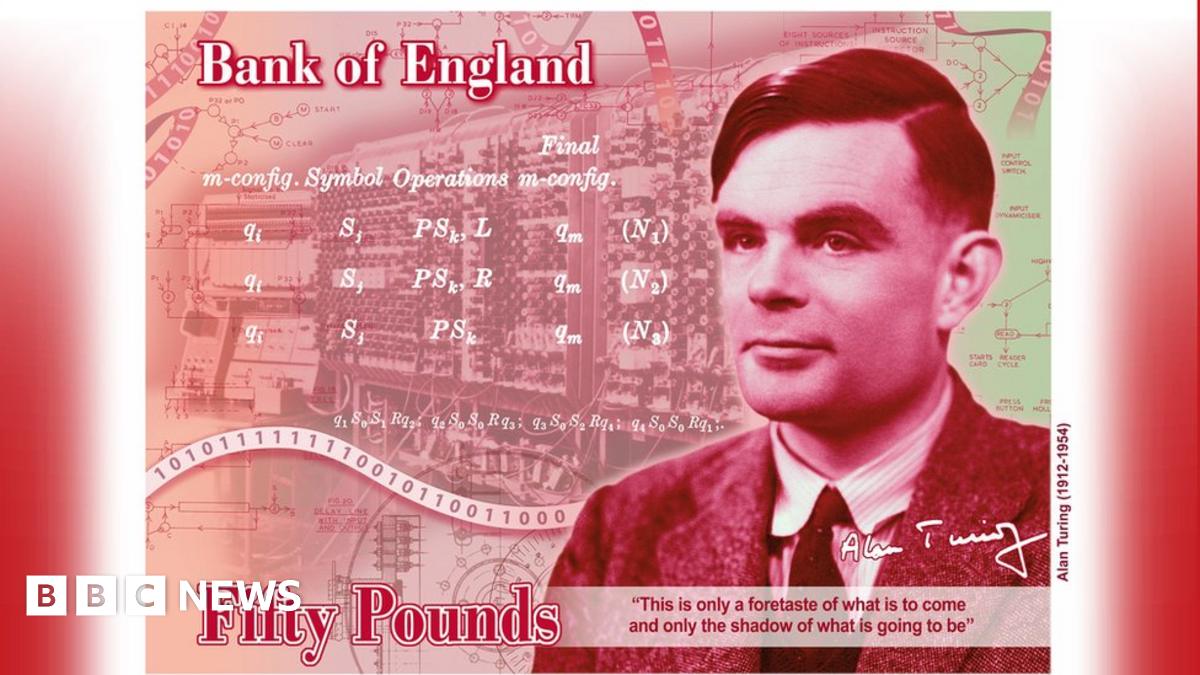
New face of the Bank of England's £50 note is revealed as Alan Turing
The note - once called the currency of corrupt elites - gets a makeover with the image of a computer pioneer.
BBC News
664 points · by hanoz · 7y ago · 298 comments
Chuang Tzu held his bamboo pole still.Watching the Pu river, he said:“I am told there is a sacred tortoise offered and canonized three thousand years ago,venerated by the prince, wrapped in silk,in a precious shrine on an altar in the temple.
What do you think? Is it better to give up one’s life and leave a sacred shell as an object of cult in a cloud of incense for three thousand years,or to live as a plain turtle dragging its tail in the mud?”
“For the turtle”, said the vice-chancellor,“better to live and drag its tail in the mud!”
“Go home!”, said Chuang Tzu.“Leave me here to drag my tail in the mud.”
Unless inherited guilt is your thing.
Ultimately, Carney made this call. Thanks!
I will say Stephen Hawking absolutely deserves it, one day, but I feel like the notable person should be dead for a certain period before we throw them on currency (certainly longer than a year). Conceptually I like the "50 year rule." Helps mitigate populism or overly politicizing it.
That results in the Queen (or King) being a remark on today, and the Scientist or other note-worthy contributor being a remark on our history (and values?).
Of all the expected paper eliminations to come, this is possibly the most important one... and the most important one to get right.
(Why am I getting downvoted?)
Alan Turing was truly a great man.
Could you point me towards some more info please, I was entirely unaware of this.
I recently dealt with a 1000 CHF (= £811 = $1018) banknote in Switzerland. It's not very commonly used, but it exists.
I would routinely pay for things (groceries, electronics, etc.) with 100CHF and 200CHF notes without the cashiers batting an eye, while I used the 1000CHF note once or twice for large purchases.
Another interesting point around the money laundering aspects, he was talking with one of the central bankers and it was now considered unpalatable to introduce any bigger sized notes. My friend's point was that when the 1000CHF note was introduced in the early 1900s, adjusting for inflation it was worth a lot lot more.
People [wrongly] get called a paedophile for such behaviour and get pilloried in the social press.
Aside: it always seemed like the simplest explanation for the strangeness around his arrest was that he was compromised (in the national security sense).
Of course none of that relates to his fantastic achievements in computing.
Fry (Christian fundamentalist) and Newton ( Christian fundamentalist writer) -- both of whom have been on bank notes -- probably wouldn't fair well in the court of public opinion nowadays either. Not sure Churchill would make it on anymore either tbh.
You can call it whatever you'd like, but this isn't illegal today.
I've never seen anyone being accused of being a paedophile for having sex with a 19-year-old. Do you have an example? This frankly seems like a backhanded slur on Turing.
> Not sure Churchill would make it on anymore either tbh.
Churchill was added to a bank note a mere three years ago.
Churchill was a drinker. There's plenty of evidence into the 21st century that functioning alcoholics are able to maintain status in most walks of life including politics. Or were you thinking of something else?
His order to bomb Dresden [2]
[1]https://en.wikipedia.org/wiki/Bengal_famine_of_1943#Debate_a...
[2] https://en.wikipedia.org/wiki/Bombing_of_Dresden_in_World_Wa...
Churchill was added to the note quite recently. Unfortunately, most British people seem to have a nearly uniformly positive opinion of Churchill, despite the unconscionable atrocities he committed.
No, you're still wrong -- and spreading an awful lot of misinformation in this thread. The age of consent for straight sex was 17 when Turing was convicted. There was no "age of consent" for gay sex as gay sex was illegal at the time. When gay sex was legalized in 1967 (long after Turing was convicted), the age of consent was set to 21 for gay sex and remained at 17 for straight sex. See https://en.wikipedia.org/wiki/Age_of_consent_reform_in_the_U...
It's so easy to find this stuff out that I have to wonder if you have some kind of agenda here.
[1] https://www.bankofengland.co.uk/news/2019/july/50-pound-bank...
$100 bills are more than common, for example, and similar (actually quite a bit more) in value.
Makes sense to have ones and zeros for the father of electric computers...
I'm curious about other countries now because I never really gave that a thought. I was surprised though when I was in China for the first time and learned the largest one is 100rmb which was around 10€ at that point. It's now more like 15€ and China is rapidly changing to a completely cashless society anyways but it was really weird back then; since using the ATM included a fee, you would get like 4000 bucks at once (depending on how long you stayed) and run around with 40 bills in your pocket.
In the U.K. it’s almost at the point of being cashless - indeed I ate at a restaurant on Saturday night which didn’t accept cash.
In Germany it’s like going back to the UK in the early 90s in that regard. Charges to withdraw money from ATMs, the newly built canteen at the office of a large experiment doesn’t accept card, but also wouldn’t take a €50, which was also what the ATM gave me!
It's frustrating.
(Paying a fixed amount to the bank was a thing in Germany like 10 or 20 years ago.)
Can't be said enough, cash is king in Germany. Go north or east (Poland not so much but Lithuania+) and cash is only useful for tips.
In a part of London with many tourists, I saw them used by people ahead of me in the queue daily. There are some cash machines somewhere in London that dispense them -- possibly in Canary Wharf, I forget.
Conversely, I don't think I've seen a cash machine with fivers.
https://imgur.com/a/sJu9y (cash machine showing it has £20s and £50s).
I remember seeing a preview of the redesigned £5/£10 notes a few years ago and thinking exactly the same thing — seeing Trebuchet MS on a bank note was a bit of a surprise, but thankfully the end result looked far better.
https://www.bankofengland.co.uk/banknotes/withdrawn-banknote...
There’s larger note for which you could be receiving it as change.
I know people who get out their cash for the month from a branch and do get 50s.
(Used to be around $80 a few years ago. Thanks Brexit!)
What you want, IIRC, is known as an "uncirculated proof note" - at least, that's what I know it as when it comes to US currency.
They are fairly easy to get from the US Treasury, I believe - as they will typically sell low-denomination proof sets (with coins too) as "collectibles". Whether other countries do the same or not, I am not sure.
If you go to the Bank of England's website:
https://www.bankofengland.co.uk/
There's a contact link at the top - I believe they are the organization that releases Britain's currency, so I would contact them to find out how you can obtain such an uncirculated note.
Indeed, I want to do the same, and that's where I plan to start. Hopefully, we can get it for the face value (about $63.00 USD at current exchange rates), plus maybe a tad more for shipping, handling, it being uncirculated, etc. I'm expecting - well, hoping - to not pay more than $100.00 USD for the note.
Seems a bit crazy, but then again, I've paid a lot of real money for a fake money note (it was something shot out as "confetti" into the crowd of a concert, and it was in great condition - I never went to that concert because I didn't know the band then - plus I doubt I would have been in the pit where those notes landed - price and danger (mosh) would have deterred my older self).
There might be a nice little side-business for somebody that wants to get fresh new notes and sell them to people like us.
Doesn't seem possible.
I mean - could you potentially get 50 pounds worth of physical British currency at the current exchange rate from a US bank? Certainly - but it won't be proof condition - not by a longshot.
I think if you wanted proof condition (uncirculated) for any note, you have to contact the treasury of that country - which I believe (and correct me if I am wrong) for the 50 pound note, is going to be the Bank of England (I've linked to it above in another reply).
In the US, I believe you have to contact the US Treasury Department; but you could probably just go to a bank for such a note (or an entire filled band if you wanted it) - but for certain things you would likely need to contact them directly I think.
For instance, you used to be able to get uncut bills; IIRC, one of the Steves of Apple fame used to pay things as a joke with these, in the one dollar denomination - he would get the sheets, then have them professionally perforated, and then punched to put them in a binder, and when he'd pay for stuff, he'd open the binder, and tear out the money - it was perfectly legitimate cash, but it threw a lot of people for a loop - I believe it was Woz who did this; Jobs was a bit uptight for that kind of hack - which is what made them a perfect pair - it's just too bad that Woz didn't get to really share in the "fame" of Apple (I think that was his choice, though - from what I know of him, that's how he is mostly).
To get those uncut bills, though, I think you had to travel to the US Treasury and purchase/pick-up in person; it wasn't something you could just easily grab at your bank. Today, they don't sell them at all, probably due to counterfeiting (bleach the paper and re-print higher-denomination bills all at one shot).
It might have been a big amount of money 20/30 yrs ago but today it's a bit weird that's the biggest denomination.
Alternatively, there are a lot more £10 notes in circulation, and the previous £10 note had Charles Darwin.
It's more likely a concern about a counterfeit note, although I've never had that problem with a €50.
That problems happen if you try to use the 100EUR one and obove.
Having said that, when I have friends visit from Singapore, they often seem to carry £50 notes... and most places seem to accept them (although maybe this is less true outside London).
What a great quote.
As for a society honouring it's heroes, it rings a bit hollow when it through persecution killed said heroes. Being honoured when you're dead does you very little good.
I’d rather not have every single bit of communication contain a reminder of some past horror.
Perhaps some people feel “empowered” by a victim mentality, but that doesn’t seem very socially progressive to me.
I would hope they're doing this to honor Turing, not to apologize for what they did to him. Face on a bill is nice, but doesn't make up for ruining some one's life, so it would be a lousy apology any way. So I kind of hope the media more covers what Turing accomplished than the things Engkand did.
I bet you want an editorial (and I bet you want one that mirrors your own beliefs and is a bit preachy about it). That's not what this article is for.
Yeah I agree, I assume this is actually the main reason he is so well known and celebrated today. Mere obsession with computers would make Godel, Alonso Church, and others with equivalent models of computation just as famous.
I absolutely disagree.
For one thing, Turing didn't just invent a model of computation - he invented what is seen, in some sense, to be the precursor to the actual, physical computer (the Turing Machine).
But more importantly, in addition to doing that, he actually built one of the first actual computers. And he did that in order to break the German encryption in WW2.
I am a huge fan of Godel's work, don't get me wrong, but Alan Turing was far more important in world history, and indeed in math/science history (though Godel is of course hugely important too).
* https://en.wikipedia.org/wiki/W._T._Tutte#Second_World_War
* https://en.wikipedia.org/wiki/Cryptanalysis_of_the_Lorenz_ci...
Everyone talks about Enigma during WW2, but the Poles had mostly figured things out pre-War (for which they're generally forgotten), and it was largely a matter of brute forcing things during the War IMHO.
Not quite. He built the Bombe, which was not a computer. Elsewhere at Bletchley Park, other people built Colossus, one of the earliest electronic computing machines - but still not a computer, really, as it had no program.
After the war, the first computer was built in Manchester, and although Turing was around, and it was clearly based in part on his ideas, my understanding is that he wasn't directly involved with building it.
I think it's Turing's dual role in laying the theoretical foundation of computing and winning World War 2 that made him famous.
I don't think his tragic death has made him more famous; if anything, it delayed his fame - imagine how well-known he would have been if he'd lived on into the computer age! Not a BBC documentary would go by without photos of Turing looking seriously at an ICL 2900, Turing sat at a BBC Model B, an elderly Turing and a thirtysomething Tim Berners-Lee mugging at the camera, etc.
So while it may not be true that the lurid nature of his demise is the reason in a "people like to rubberneck" kind of way, his death at an early age is likely part of why the world knows of his work. Many crypto experts worked secretly for the government and lived and died in obscurity.
Being famous for your work (while still working) and doing secret work tend to be mutually exclusive.
The Turing Machine is something else he is known for (as an aside for his contributions during WW2) but I suspect if you were to ask the average person, they'd suggestion foremostly he cracked German transmissions not built the precursor to the computer.
Perhaps more recently he will have been known to be gay and had committed suicide, because in recent years there has been a lot more about him in the media.
I've got to confess I didn't know much about his later life and suicide for a long time and only really knew of him in regards to WW2 and his part played in computing history.
Thanks for helping win that war.. shame about your sexuality tho