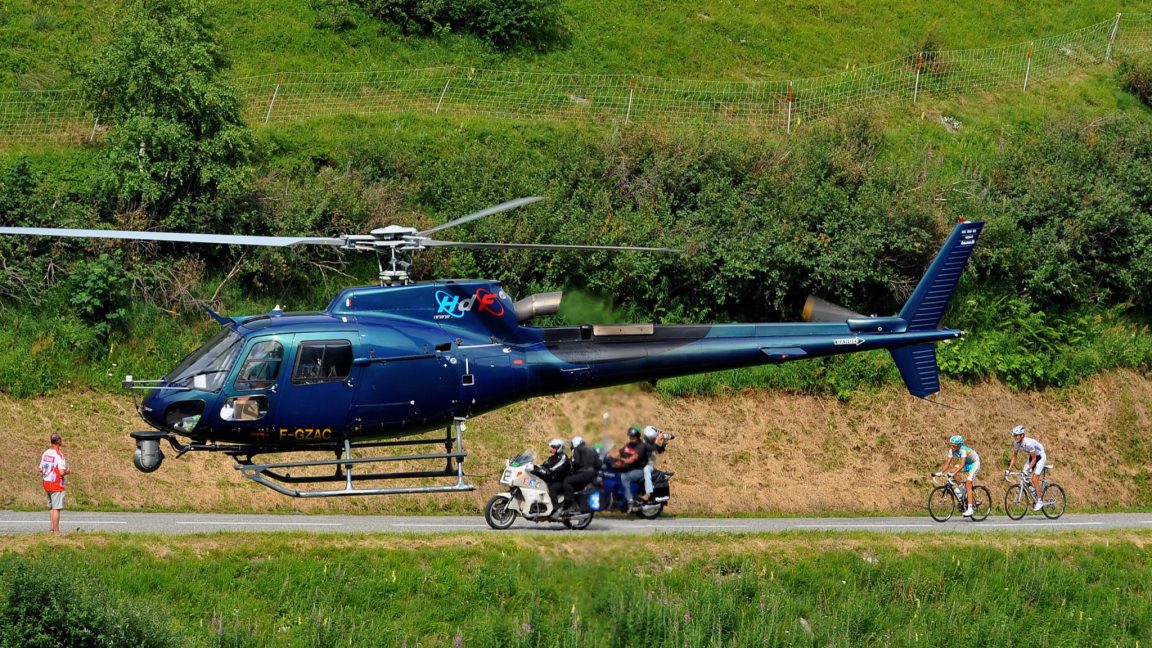
The helicopter team that films the Tour de France is one of a kind
When filming this race, 500 feet is considered high altitude.
Ars Technica
263 points · by mhb · 7y ago · 119 comments
https://www.flightradar24.com/blog/how-the-tour-de-france-go...
This was the most interesting part. It makes sense you’d have to use a plane at such long distances as you need a perfect feed.
I’m curious what other sports have a plane following them.
They have automatic camera tracking and stabilization, estimated speeds and road maps super-imposed in the live feed while the pursuit is taking place. All this from a helicopter that circles above for several hours sometimes. They even have specialized live commentators like Stu Mundel and specific lingo: 't-boned', 'pit-maneuver', and my favorite 'suspect is traveling at a high rate of speed' eg: https://www.youtube.com/watch?v=7K3dZmrcriU
Despite the fact that I find it disgusting that live-crime is an entertainment genre, I guess it's also sort of useful? Do police forces utilise news helicopters as part of their operations? Can the footage be used as evidence in court?
Amazingly, they have a code of conduct. If shots are fired they quickly zoom out so viewers don't get to see people getting shot.
The crazy part is when viewers watching the TV coverage in their homes come out onto the streets to cheer the suspects driving through their neighborhood trying to get away from the cops. In a way, just like the Tour de France!
If you haven't, I recommend seeking out the opportunity to go for a helicopter ride or to try your hand at one. They're really interesting aircraft. One of the tidbits I got is that they're far safer in normal operation than the numbers suggest, because they're often flown into the most challenging rescue situations where nothing else will do.
I remember watching the first US Grand Prix in Austin a few years back, and the commentators were specifically talking about how great the helicopter pilot was. I happened to be there for the race, but as it was my first F1 race, I didn't know if all the pilots got that low and aggressive, or if this was unique.
Another tidbit that sadly sticks in my mind is hearing about ex-Vietnam pilots flying over New Zealand while sharpshooters culled (invasive, non-native) deer.
Here's a rare survivable crash from low altitude[1]. The passengers still suffered serious injuries. Here is an autorotation training landing[2]. How often will this be possible in real life when something is broken? Here's a failed autorotation with RPMs too low like might be encountered with engine power loss [3].
1 https://www.youtube.com/watch?v=Y0YcTJNL368
Helicopters are more dangerous than other aircraft:
The crash rate for helicopters alone is 9.84 per 100,000 hours. That means helicopters crash about 35 percent more often per hour in the air than your average aircraft
But have a lower fatality rate:
The fatality rate in helicopter crashes is 1.3 deaths per 100,000 flight hours versus 1.4 deaths for aircraft in general.
https://slate.com/news-and-politics/2009/10/why-are-helicopt...
You can Heli-Hunt invasive feral hogs in Texas for ~5k/person
There's something about being able to have that precision, getting close to the ground while maintaining velocity which is mind boggling.
Originally, they'd use helicopters to drop hunters off on foot, who'd then shoot deer, collect them, and wait for pickup. Then they figured they may as well shoot them from the helicopter.
It's crazy stuff, they basically fly right through a valley, shooting all the deer they can with with an assault rifle. Swiss army surplus SiG rifles were very popular, because they ejected the spent cartridges downwards, reducing the risky of ejecting brass into the helicopter blades. They'd then fly back, and pick up all the carcasses, drop them off in a truck, and repeat. They were then butchered and exported.
In 1969, deer farming was made legal, so they switched from hunting to live deer recovery. They'd chase deer with a helicopter, and a bloke would literally jump out of the moving helicopter onto the deer, tackle it to the ground, and tie its legs up so they could lift it with the chopper. They eventually moved onto using net guns and tranquilliser guns as they were more effective.
Te Ara (the NZ encyclopedia) has a really good online writeup about it all [2].
Most of the pilots weren't Vietnam vets, as NZ didn't field helicopters in Vietnam. They were home-grown civilian pilots. The people down south are a special breed, the most foolhardy, tough people you'll ever meet. It will be sub-zero and snowing, and they'll still be wearing shorts. Nicest people you'll ever meet though, we fucked a wheel 4wd-ing up a river once, and the cocky just lent us a wheel and asked us to return it whenever, the bloke had never met us before and didn't ask for any sort of security at all.
As for Tim Wallis himself, the man's larger than life. He survived a helicopter crash in 1968 that broke his back (and escaped from hospital to go to the pub). He was an avid collector of old warbirds, owning several Spitfire, P-51 Mustangs, and Russian Polikarpovs and started the Warbirds over Wanaka airshow. He ended up crashing these several times, and unfortunately in 1996 had a crash on take-off that left him several injured and brain damaged.
Tragically, he lost two of his sons in 2018 to two separate helicopter crashes. Bush flying is incredibly dangerous, they say there are old pilots and there are brave pilots, but no old brave pilots. Some of the situations I've seen helicopter pilots flying in are just straight reckless. I've seen pilots with a slung load underneath, flying probably 50 feet above the ground, through winding river valleys with hillsides less than 100 feet away on each side. If they had any mechanical issues at all, they'd be dead.
Sadly this kind of "she'll be right" attitude is incredible common in New Zealand, it seems everyone knows at least one or two people who have died in aviation accidents. I knew a guy who passed away recently in a microlight crash (unknown circumstances), and he'd commonly drop down to 100 ft over land or water (which is illegal), often to buzz a friends house or boat. One time I was with him and we shot straight past another microlight (less than 500 ft, technically a near miss and very illegal) and did a barrel roll in front of them for a laugh. Were were at probably 1000 ft at the time, which is also under 3000 ft minimum for aerobatics. Over the course of the afternoon we probably managed to break at least half a dozen aviation laws, we almost landed on a close airfield (2 weeks after he copped a fine for doing the same) until I reminded him it was closed.
> Circling at 2,000 feet (600m), the relay helo takes camera feeds and sends them to a fixed-wing aircraft flying higher at 10,000 to 25,000 feet (3,000-7,600m), depending on weather.
> The airplane sends the combined feeds back down to two receive trucks located along the race course. The trucks act like signal repeaters, the first sending video to a satellite that sends it back to the second truck further along the course, which finally forwards the signal to the town where the finish line is located.
> With stages of varying terrain up to 140 miles (225km) long, this hop-skip method ensures the best video fidelity with the least time-lag.
Knowing next to nothing about production video transmission, this seems overly complicated to me with several points of failure. I wonder how much of this article is editorialized and mixing up backup/redundant methods vs actual implementation?
The part about relaying between trucks using satellites seems especially strange, if the goal is to reduce time lag. Why are trucks needed to relay a satellite signal at all? Why can't the video-copters send direct to the fixed wing aircraft, or to the satellites? Why can't the fixed wing aircraft be used as a single hop?
If this is accurate, it makes me wonder how much of this setup is "we've been doing it this way for x years, and it works, so don't we mess with it" vs how it would be done with a modern, best-practices design. Anyone that's done this kind of work care to weigh in?
It's very challenging to establish high-bandwidth satellite links from a helicopter due to the rotor blades. I'm guessing VHF is used to avoid line-of-sight transmission at an angle that can avoid the blades.
It's however quite possible to establish satellite links from fixed-wing aircraft. The speed is a direct function of available satellite bandwidth (ie. money).
BUT, high throughput satellite systems (HTS), are a relatively new marvel of technology and are very costly to retrofit on airplanes because no airplane maker will want to allow a new hole on the aircraft's body.
So I'm assuming the fixed-wing aircraft lacks the required satellite equipment (as well as broadcast-management equipment typically found in live-action-reporting trucks) hence the beaming back to trucks.
Almost all of the television/radio broadcasting stations have their own uplink trucks (and directing rooms for their own camera's) on site. My guess is they send it there to allow the stations to intermix their own signals before sending it out, as well as to give the live reporters (which are at the finish) to view the most recent image without going though satellite delays.
My thinking is they are significantly cheaper to buy and fly, and presumably much safer for pedestrians too. Maybe they could also form a mesh network to avoid a single point of failure.
If you want a drone that's safer than the average helicopter, you're going to be paying a lot of money.
I think you can do the math from there.
[edit]Communication between aircraft is a mix of RF and microwave, likely.[/edit] With regards to the camera helo -> relay helo -> fixed wing -> truck workflow, it's likely based on the ability for the camera helos not being able to 'see' the fixed wing aircraft. For instance, since the tour goes into mountainous areas, the camera helos may go down into a valley or be occluded from the fixed wing air craft at various points in time. Using the relay helo allows the fixed wing to fly a less complex flight plan, reducing potential issues with its link to the trucks.
Finally, having all of this operated by professionals who have many years of experience is required for live production. You just can't tolerate any outages, so things like drones, etc, which require longer iteration cycles for updates in flight plan, etc become less of an option.
The two camera helicopters do need to remain within range of a relay airplane at all times. This is often tricky in mountainous areas, as you’ve correctly identified. A camera helicopter losing sight of its airplane relay is the most frequent source of signal dropouts.
The relay helicopters are only used to relay the motorcyles’ signals, not the camera helicopters’ signals. The helicopter relays travel freely up and down the route, depending on where the motorcycles are located.
It goes something like this:
Moto cameras 1-5 -> Helicopter relay -> Plane relay -> Roadside HF/Sat relay -> Finish line compound
Heli cameras 1-2 -> Plane relay -> Roadside HF/Sat relay -> Finish line compound
For context, this is the sort of satellite truck you see used for live video broadcast of most sporting events. It looks like it might be difficult to mount the same hardware on a helicopter.
https://www.instagram.com/p/BonJyZZBzBP/?igshid=16sn4ax1pq66...
While there are multiple HF relays, there is only one satellite relay truck per stage, located at a geographically convenient location at roughly mid-point through the route. Its role is to pick up all the HF signals, multiplex them, and uplink them to a satellite for downlink by the Euro Media¹ HF trucks back at the finish line. It also works the other way round, in order to relay signals originating at the finish line, such as the director’s orders, back to the crews covering the race.
This satellite relay stops being used as soon as the riders have passed the midway point; from that point on, the two planes and relay helicopters are linked to the finish line solely via HF and microwave. Shorter routes like the time-trial stages don’t require a satellite relay at all.
Another use of satellite uplinks is the midway sprint location, which is covered by a fixed camera on a crane. It is relayed back to the finish line independently of the HF relays, by a regular SNG truck.
¹ Euro Media is the outfit tasked with coordinating all the HF feeds, for delivery to the (adjacent) France Télévisions production trucks which are, in turn, responsible for producing the international and domestic TV broadcasts.
I think most of complications come from the varying terrains blocking the signal path to the producers at the finish line.
Then the two trucks are simply relay points for the satellite.
on the relay plane: https://youtu.be/6by7a6FPZ58?t=14
>For six months, the pilots train for the routes, maneuvers, emergency procedures, and camera positioning required by the director for the most effective, picturesque coverage. Their filming missions are literally scripted to the minute by the TV director, leaving little room for improvised maneuvering.
6 months seems satisfactory!
[1] curiously enough one of the pilots for the Giro d'Italia has been for years Gianni Bugno, who won the actual race in 1990, here is an interview (Italian, but not too bad via Google translate):
http://www.manualedivolo.it/index.php?option=com_content&vie...
In the original article it seems like the importance of the safety procedures were minor compared to the director's needs.
As a side-side note, several years ago I happened to be involved in a couple "normal" projects (construction) involving transporting machinery and materials via helicopter, and the guys doing the actual work, besides the helicopters pilots, the ones hooking/unhooking the loads (that we provided) followed (understandably) much, much more strict safety rules than "common" building crane operators and workers, including (much like - say - firefighters do) exercising on things like quick load release, communication (via radio), ropes/belts checks, etc.
It's risky business.
Let’s say 10 top pilots, each a year’s wages, additional costs for flying, etc. 10 to 20 million euro?
The TdF doesn’t sell tickets, but the organizer makes a healthy profit (https://inrng.com/2017/11/amaury-sport-accounts-finances/, of which likely half or thereabouts from the Tour de France.
(aside: ASO is a for-profit, and looks at the short term, to the detriment of the ever more popular women’s cycling. Earlier this year, they decided to move down two major women’s races (Flèche Wallonne and Liège-Bastogne-Liège) from the top flight level because they didn’t want to spend the money on broadcasting them that the international cycling union requires for top flight races (https://www.outsideonline.com/2397117/aso-bumps-marquee-wome...) )
Only as a data point the Italian TV valued in 2017 8.5 millions Euro for 4 years[1] (again Italian but not too bad via google translate):
https://www.repubblica.it/tecnologia/2017/01/08/news/elicott...
[1] Covering, beside the Giro d'Italia, also a few other national cyclism events.
It sounds like NBC doesn't even make money off their re-broadcast of it: https://www.velonews.com/2019/07/from-the-mag/inside-nbcs-to...
there's a whole lot of television markets out there that have very different tastes to US audiences.
Slightly weird at one point as I was looking down at a flying helicopter.
Fortunately that practice has been nixed for good. Now the helicopter shots are only mixed with the (real) sounds captured by the motorcycles.
All around, helicopters are still the better option right now. I guess they could/do use drones for some specific sections: climbs with a lot of public and similar where endurance/speed is less an issue and you can go much closer.
2) Its ~30 12 hour days of racing, I am not sure drones have that kind of capacity. Would need many many drones and some complex rotations.
Regardless, good engineering dictates that one shouldn't change a working system.
http://www.cyclingnews.com/news/riders-cry-foul-at-tour-de-f...
http://www.cyclingnews.com/news/motorbike-driver-ejected-fro...
Edited for grammar.
Not sure about the claim that the moto crews are former pros. This was stated a few days ago on /r/peloton, but in a kind of hand-wavy way.
The guy featured in the article above does not seem to be an ex-pro, at least he has no profile on PCS. And there is this quote, although it refers to a photographer's rider: "With such potential for accidents, you might think that there would be a rigourous set of qualifications for motorcycle riders before they can share asphalt with the pros in the Tour. Not so, says Evans, who got his slot because his photographer ‘saw me riding through town traffic with a fairly exuberant riding style’."
The defense I've heard is that televising is essential to the business model of cycling. Hence, some effect should be accepted.
The dramatic pictures in the article are certainly misleading, shot with a long tele from a clever angle. 500 feet lateral separation (to a mountain road I assume) is still crazy close by non-emergency aviation standards.
I find that “scripted to the minute” hard to believe. The “advertisement detours” (where a village pays them to fly around a castle, church, or mountain top) likely are scripted because they _have_ to be shown for the contracted number of seconds (and they will be shown, even if there’s a significant development in the race that the helicopters miss as a result), but it remains a race, where one cannot know beforehand how fast the riders will ride.
⇒ The route flown may be fairly rigid, but the timing can’t be.
With caveats :D
They do know the expected expected min, max speeds of the riders, and the most likely time.
I assume that when they file their flight authorisations long in advance that they are declaring the time slots that they will need over airspace, and probably do have scripts for those min/max rider speeds so that they know +/- some margin of error the earliest and latest the helicopters should be anywhere.
Although I'm personally more interested in the plane circling above them for 4 hours :) It makes sense to have it, and has anyone a link to one of it's daily routes?
The helicopter shots are always live.¹ There is however some prerecorded drone footage, filmed earlier in the year, that gets shown alongside landmarks of particular interest.
Whether or not you get to see this prerecorded footage depends on which feed your broadcaster is picking up. Domestic audiences watching on France Télévisions get to see all of it, but international broadcasters are given a feed with fewer prerecorded “heritage shots” (as well as a feed with no prerecorded material at all).
¹ The director can cheat once in a while, opting to time-shift a particularly beautiful landmark shot by a couple of minutes, but only if it would otherwise go unseen due to race action taking precedence.
That's what they use in sailing races
I am hoping for something like the MacOS screensavers that I can just leave running ...