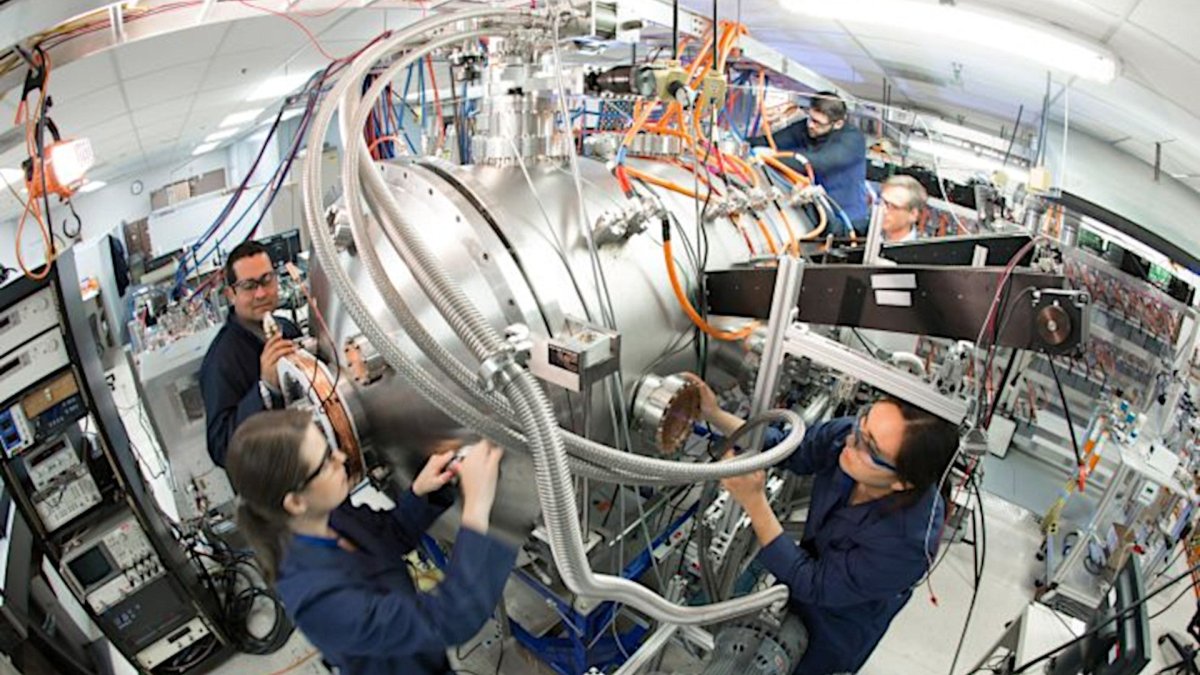
Skunk Works' Exotic Fusion Reactor Program Moves Forward With Larger, More Powerful Design
This will be the company's fifth major design iteration as it pushes ahead toward building a potentially revolutionary practical prototype.
TWZ
175 points · by SEJeff · 7y ago · 122 comments
Not really. Our sun is fueled mainly by the proton-proton chain reaction, which produces no neutrons. This reaction is very very slow and happens at comparatively low temperatures. The large power output of the sun is because the sun is huge.
Useful fusion reactors need to use much faster reactions and require temperatures several times higher than the sun’s core.
(Genuinely curious since I’ve spent the day doing math adjacent to this one)
The sun releases 3.846×10²⁶ watts. The sun has a volume of 1.4×10²⁷ cubic meters.
Therefore the sun releases less than one watt per cubic meter.
Scanning a 2010 article: Energy from Waste: Reuse of Compost Heat as a Source of Renewable Energy it looks like composting facilities make about 1 to 10 megajoules/kilogram over a fortnight. At 10⁶ seconds per fortnight gets us 1 to 10 watts per kilogram of compost. At a minimum of 100kg/heap (anything less is a pile, a mess, or a spill) it is a trivial exercise to show that compost is orders of magnitude more energetic than the sun.
Now if Hacker News would just allow stick figure cartoons maybe we could lure Randall Munroe into answering these questions for us.
On the other hand, the sun is a cosmic compost heap. ;-)
The core inside 0.20 of the solar radius contains 34% of the Sun's mass, but only 3.4% of the Sun's volume. Inside the 0.24 solar radius is the core which generates 99% of the fusion power of the Sun.
In contrast, the power density of a PWR primary reactor vessel is 20 MW/m^3 (and of the core alone, 100 MW/m^3). How exactly is fusion supposed to be cheaper than this, when the reactors are both so much larger and so much more complex? Saving on fuel is irrelevant, as fuel is only a small part of the cost of running a fission reactor.
It's the short-term handling of fission products (that eventually cool off and become nuclear waste) that makes fission expensive. Since fusion products are much less radioactive than fission products, fusion has a major advantage over fission in terms of worrying about containing radioactive material. To contain it in fission reactors, we have lots of redundant cooling systems, control systems, instruments. We have a powerful regulator checking everything, and requesting major changes. We have teams of people planning maintenance work to minimize dose to the workers. We have big 50km radius emergency planning zones with sirens and drills and all that.
Nuclear fusion is the dream energy source because it has all the positive elements of fission (24/7, zero-carbon, can build anywhere, tiny fuel requirements b/c nuclear) without the major downside of radioactive fission products and transuranics.
I got into the nuclear industry specifically to help solve climate change with fusion, but I got distracted by advanced Gen-IV fission reactors for now, assuming they'd be shorter-term developments. Fusion is still the dream though, for sure.
It's an example of not focusing your problem solving on the actual problem.
0.5 MW capacity costs around $1M with solar, so if 0.5 MW of fusion power takes up a cubic meter that doesn't seem like a deal breaker.
The difference between fission and solar is that solar lacks many systems (like, turbines and generators) that fission and fusion would need.
More fundamentally, solar is distributed (even on a large solar farm), so there's a lack of coupling between elements that makes everything easy to assemble and very fault tolerant. In fission and fusion plants, the intricate dependencies mean everything has to be highly reliable. Safety (for fission) and the extreme difficulty of repair of activated structures (for fusion) also drive this very expensive reliability.
A number of fission designs have this property, too. Most operational fission reactors are from 1960s to 1980s, and indeed are capable of a meltdown.
Don't get me wrong, happy to see fusion advancing. But we need lots of power, today, market-ready, outside the lab. No, not the US or Europe. China, India, Africa. They want to grow, now, and we don't want them to use coal/oil, nor outdated PWR/LWR/HWR.
If fusion is 20y and $1T away, and we can have hundreds of MSR/LFTR 1GWe plants by investing $1B over 10y years, desalinating water, making aviation fuel out of sea water, and recycling fission waste from older reactors, I'd stick with fission for now.
Lithium doesn't seem a whole lot safer.. but I don't think a fusion power plant could be water free. As far as I'm aware there is no more efficient method of using heat to spin a generator than a steam turbine. A lithium/water heat exchanger seems pretty frightening. Do they have a better plan for that?
Edit to expand; having now looked it seems some of the intermediate loop designs have the SAME material (e.g. sodium). This at least means the loop at risk of mixing with water is isolated from the core (where an explosion is difficult to manage). I thought I'd seen other designs, just can't find them now.
But this is largely moot, as lithium in salt form (Li+) does not react with water. I would be more concerned about the beryllium salt dissolving in water and escaping. Beryllium is nasty.
The inner wall of the reactor is 3-D printed, and the reactor uses jointed superconducting tape that allows it to be opened up annually to replace the inner wall.
"The most important neutron absorber is B [boron] as B4C [boron carbide] in control rods, or boric acid as a coolant water additive in PWRs. Other important neutron absorbers that are used in nuclear reactors are xenon, cadmium, hafnium, gadolinium, cobalt, samarium, titanium, dysprosium, erbium, europium, molybdenum and ytterbium; all of which usually consist of mixtures of various isotopes—some of which are excellent neutron-absorbers."
By the way, boron carbide [2] has an extraordinarily high melting point (2763 C), maybe this could be handy if one wants to convert the thermal energy of neutrons into electricity.
[1] https://en.wikipedia.org/wiki/Neutron_capture#Neutron_absorb...
However by the sounds of it, a reasonable fraction of the output power is in the form of neutrons. If you had no lithium blanket and just concrete, the energy of the neutrons would go into heating the concrete, where it would either be wasted, or require the concrete to be actively cooled which would be difficult as concrete is not a great conductor.
[1] https://f4e.europa.eu/mediacorner/newsview.aspx?content=941
Layman here, but surely they must interact or bond with something? Perhaps to produce something else that could be used.
Compact or not, clever neutron handling or not, integrated tritium-breeding or not, break-even is the minimum bar to cross, and no one has crossed it outside of fission-triggered bombs. That must be the focus. Once that is achieved, there will be plenty of resources to solve the myriad of other problems, but until break-even is achieved (by ANY means other than fission trigger), solving those other problems just doesn’t matter.
If the engineering and economic issues are showstoppers, then focusing on breakeven is simply wasting money. It's almost a canonical example of shortsightedness.
For what it is worth, fission also suffers this problem. A promptly critical fission reaction is possible, indeed quite easy to achieve, and very undesirable. All fission technology is dedicated to keeping the reaction just barely critical.
Broad observation: Physical science research was a sleepy area until The Bomb. Then supposedly Ike with J. Conant, et al., said, IRCC, "Never again will US academics operate independent of the US military." Then the US Congress via the NSF and DoD went to the leading US research universities and "made them an offer they couldn't refuse" -- accept the grant money or cease to be a leading research university. And, oh, BTW, you can take 60% or so as overhead for the English department, the string quartet concerts, the little theater production, the glossy alumni magazine, the new front gate to the campus with the big, round fountain just inside, the new art gallery, a new, on campus, 6000 square foot Georgian house for the president with, of course, a black limo. Or some such!!!!
Then the bio-medical sciences mentioned to Congress that a big fraction of Members of Congress are old and need medical care for heart disease, cancer, other diseases of aging, etc. so should have, say, the NIH to do for bio-medical what the NSF does for the STEM fields. Congress went along.
Ultimately, physics showstoppers matter more than any others.
Edit: I should mention that it is about Wendelstein 7-X.
https://omegataupodcast.net/312-the-wendelstein-7-x-fusion-e...
I give this scheme very little chance of being workable.
who make lots of reports and thus, are interesting to follow. However, I've no idea how serious they are...
I mean on the one hand this is the story of fusion. On the other they should have preempted that by being extra pessimistic, so was extra pessimism built in? Did they guess they were going to be perennially 5 years away when in fact they're 10 years away. Or did they think the project would be done in 18 months, and is still 10 years away? Any bets on what the predicted timeframe will be in 10 years time?
https://news.ycombinator.com/item?id=5323504
The original article is gone, but the click-bait title of that HN post was "Lockheed's Skunk Works: fusion power in four years?"
It did end in a question mark, I guess.
If they think they can get a working fusion reactor capable of powering 80,000 homes into a shipping container, I'd suggest not building them any bigger. Being able to scale in container sized units over time via the existing transport links sounds just peachy. Is quite a big 'if' there.
Not sure how much maintenance will factor in, but a reactor that size sounds already practical.
There is now a new theory to handle this, which is to build smaller reactors and put them on barges or railcars. Then you can mass produce them in one place with one regulatory approval and the time it takes to go from there to supplying power to a new city is the 24 hours it takes to tow in the barge. Which deprives NIMBYs of one of their most annoying obstruction methods -- raising construction costs through intentional red tape and changing requirements after construction has already begun. That can't happen if you can go from local approval of operations to selling power in the course of an afternoon. And then you can't lose your investment due to an unfavorable or changing regulatory environment because in the worst case you tow the barge to some other place with lower hostility.
Hopefully that will work better.
https://spectrum.ieee.org/tech-history/heroic-failures/the-f...
McMurdo ice camp in Antarctica briefly was run via contained nuclear reactor.
I also wouldn't call it a Nimby issue. If a disaffected terrorist decided to blow up a small nuclear unit the issues would be considerable. Currently nuclear power plants are guarded like wartime POW camps.
The army did also try to build portable nuclear power generators
This is the real reason why fission reactors are either large, or military. The organisational capabilities that are required to manage them safely require scale and funding.
One might be able to evade that if one could have a large number of tiny, or at least thin, reactors sharing a common blanket, much as the fuel rods of fission reactor share a common moderator. However, it's still likely to be inferior to a fission reactor in power density, as these tiny reactors would irradiate each other.
Beyond that, there's the need to confine the plasma to these very small reactors. Even in complete absence of plasma instability and turbulence, ions will scatter off each other and diffuse out and be lost. This classic diffusion takes time proportional to the square of the minimum reactor dimension / ion gyroradius.
Can anyone correct me on this?