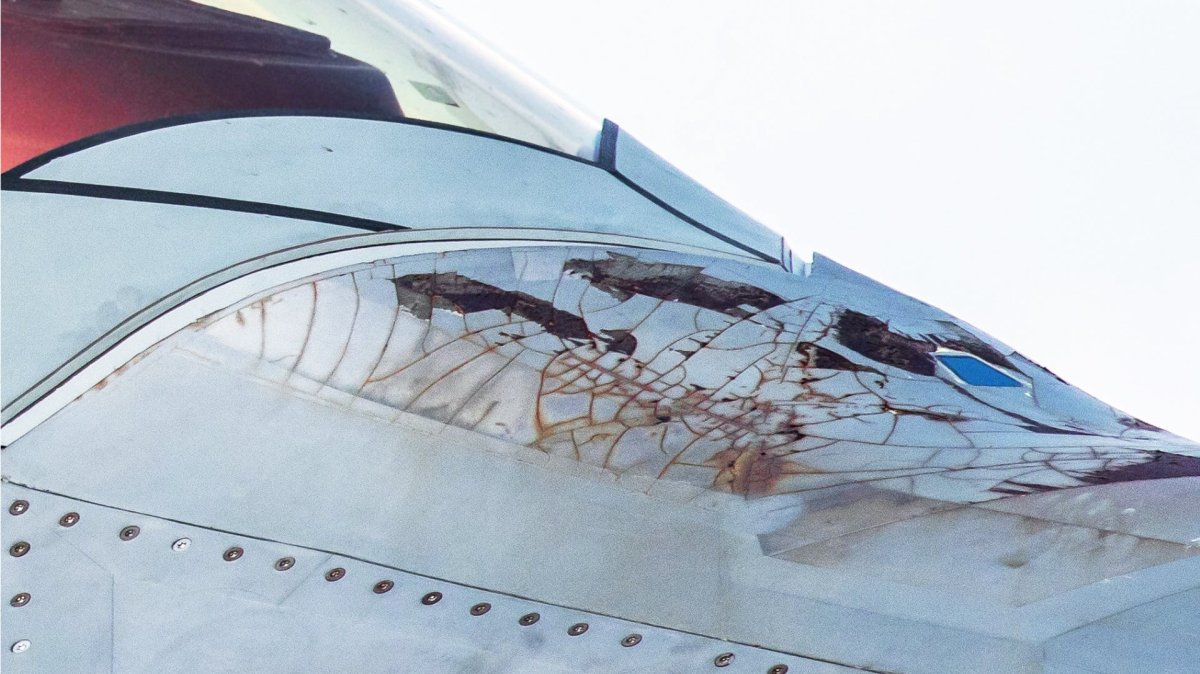
These Images Of An F-22 Raptor's Crumbling Radar Absorbent Skin Are Fascinating
The photos are a reminder of just how much work goes into keeping the F-22's skin ready for combat and the amazing science behind its stealthy design.
TWZ
194 points · by Alupis · 7y ago · 238 comments
https://nationalinterest.org/blog/the-buzz/solution-americas...
I'm genuinely fascinated by this, but haven't been able to find more information. Was there an investigation? Did the tooling just get sent to the scrap heap? Who signed off on empty storage containers?
>Moreover, the Air Force is auditing the Sierra Army Depot to make sure that the F-22 manufacturing tooling is secure—and thus far everything is in order. The audit is 85 percent complete and thus far all of the tooling has been found. Earlier, some Air Force officials had expressed concerns that the equipment had been misplaced—however, those concerns were unfounded as it turns out.[1]
[1]https://nationalinterest.org/blog/the-buzz/the-us-air-forces...
The second type of radar has an extremely narrow beam and is for targeting. This is the radar that locks onto a plane to direct missiles at it to shoot it down. This is the one that stealth aircraft pretty much entirely defeat. So in short, they can see the planes on occasion, and try to lock, but can't get a target lock. When they try, the stealth airplanes will often release rf tracking missiles and blow them up.
I was a UAV (civilian term: "drone") pilot of the Shadow 200 TUAV in the US Army circa 2001-2005 and Iraq 2003-2004. The Shadow 200 TUAV was what was deemed "effective stealth" in that it had composite material with low radar signature and radar absorbing paint. The exhaust was dampened and came out about 1" from the propeller on the top so unless you were flying above, the thermal footprint was miniscule. We did some drills with our own Patriot air defense units and they said they had to set their radars so low they were picking up big birds. They also told us that simply wasn't possible to do in wartime.
Systems like the Sx00 are very useful if there are multiple rings of them surrounding a static high-value target and you want to defeat a fleet of B-52s (or certain types of ballistic missiles) that are approaching.
They are borderline useless against any adversary that has low observability aircraft and a modern suppression of enemy air defenses (SEAD) capability.
Israel has demonstrated this repeatedly, but Russian marketing is very good and (mainly Middle Eastern) countries are still pumping wasted dollars into buying air defense systems.
In years of conflict Israel has launched thousands (2,000 in 2018 alone) of missiles at Syrian targets, and a grand total of one (1) F-16I has been shot down, and that was because the pilots were cocky (both survived) and they were loitering at high altitude doing battle damage assessments.
In response to the shoot-down, the launchers that fired the missile were destroyed the same day. Not only do the Russian missiles keep missing, but Israel keeps using their anti-missile missiles to shoot down the Russian missiles before they can fall on populated areas after missing their targets.
"He who lights up first gets smoked"
As in, once you turn on your tracking radar, you effectively shine a really bright beacon for anyone to see. If you are the ground station trying to get a lock on the thing that the long-range area radar saw, suddenly you are the brightest target in the area. You might have a few seconds before the plane you are trying to hit sends a missile right down your beam. Same for a pilot if he tries to scan for a target.
Is it pretty low key compared to an 0311? How high quality are the controls/cameras? Is it high def or kinda grainy?
Like walk us through a typical day, I’m sure many of us would find it fascinating
Part of an 0311's job is kicking in doors and detaining bad guys. When there are bad guys sniping at them on the roof, they have a bad day. The UAV above them tells them "sniper on the SSW (south south west) quandrant of building 3, hit them" and then does instant BDA (battle damage assessment) to let them know the threat is neutralized or not. Those infantryman came back to the FOB that night and thanked us profusely. We helped them all come back alive.
The most boring part of the job is probably road searches. On the way out to every mission and the way back (as you're flying to the mission coordinates handed down to you by the mission commander) you just look at the main roads. For every 10 hours of looking at roads, you'll see 1 guy digging a hole and emplacing an IED or burying wire under the road. Those "side quest" missions save a lot of soldiers. Additionally, we tend to fly ahead of most convoys if the timing lines up and give them a heads up of upcoming situations. From ~7500ft above sea level, we could roughly read a license plate a mile away. We gave them situational awareness on neighborhoods to go out of their way and just avoid. Things like that.
For every 100 hours of relatively mundane stuff, you get a few really special missions. One of those special missions was when a Kiowa scout helicopter took an RPG to the tail rotor and crashed in Tal'Afar. Most missions I was the AVO (Aerial Vehicle Operator aka pilot), but this was one of the few where I was the MPO (Mission Payload Operator aka camera dude). We saw this as a literal clone of the most infamous Operation Gothic Serpent (Blackhawk down) and all said, "Not on our watch!". And in the end, they made our video a lot less clear and put some parts of it in a Military Channel Special: https://www.imdb.com/title/tt0845577/
TL;DNR: UAV Operator is nothing at all like an 0311, but they love us because we do a dang good job of saving their lives. In return, they watch our backs.
You should check out the book "Drone Warrior," by Brett Velicovich,
https://www.amazon.com/Drone-Warrior-Soldiers-Americas-Dange...
Which is a great book, by a drone operator/warrior.
> An aircraft-mounted control unit sends the specific signals to the decoy over a fiber-optic line. Once at the decoy, those signals are translated into radio frequency emissions. [...] For instance, the decoy can first try to generally jam a radar that is in search mode, then it can try to attack it directly to break its lock once it locks on. Then, if a missile locks on in flight, the decoy can instantly turn into a juicy target, or even targets, misdirecting the missile away from the aircraft.
https://www.thedrive.com/the-war-zone/27185/f-35s-most-sinis...
I wonder if anyone has ever accidentally radar-locked a missile onto a bird and shot it down.
This is probably not really in your area of expertise, but do you know why they can't design a system to pick up everything larger than a sparrow and going faster than 50 mph? What about wartime makes this harder? Thanks much.
The talking heads from the military may talk about 'invisibility', but they are full of shit. Just propaganda for the tax payer.
The problem is the physical size of the jet. In order to absorb the radar the material needs to be the proper size in relation to the wavelength. A B-2 bomber is large enough to absorb useful radar frequencies, but F-35 or F-22 isn't.
What the F-35/F-22 stealth does get, however, is invisibility in the XHF and higher frequency ranges, which is what is used for radar guided missiles. So they will have a major advantage against ground and air launched long range missiles.
The F-22 also has good infrared suppression, which protects it against infrared guided missiles. F-35s have a large IR signature, so they are probably not much better then other US jets. Traditionally speaking it's IR weapons that have caused losses for USA airplanes in modern times.
At VHF and lower frequencies the F-22 and F-35 can be detected, but those radars don't offer enough resolution to make them particularly useful for missiles. People suspect that with multiple angles and computer algorithms it may be possible to target a jet that way, but who knows.
So if you were Russia and you detected something with VHF long range radar and then you pointed a shorter range XHF radard at it... and nothing shows up then you can be reasonably certain that it's a American stealth fighter jet. That doesn't mean they can do much about it, though.
    To combat this it is suspected that Americans use a
    technique that involves 'ghosting' commercial airliner
    traffic to mask the signatures of their jets against
    the lower frequency, longer range, radar.
You mean flying under commercial traffic? That's what was likely the cause of French jets downing a civilian plane over Italy in 1980 - while trying to hit a Lybian MIG "hidden" under it. Reportedly, Lybian planes routinely did that in order to reach their servicing bases in Yugoslavia.
Note that the event is heavily disputed. The British Air Accidents Investigation Board claims that a missile strike does not match the wreckage analysis; instead stating a explosive device in the rear bathroom was the only possible cause.
American also used this technique to fly military aircraft above french airspace while France was not part of NATO, it is only in 2007 with Sarkozy that France entered NATO (one of his many stupid move if you ask me)
I think a distinction needs to be made between proverbial "invisibility" and stealth, and the technical definition. If general conversations included, say, backscatter coefficients you'd start seeing glazed eyes. Or perhaps area equivalence (square-footage? square-metrage?).
> The problem is the physical size of the jet.
Also: vertical stabilizers.
To combat this it is suspected that Americans use a
technique that involves 'ghosting' commercial airliner
traffic to mask the signatures of their jets against
the lower frequency, longer range, radar.
https://en.wikipedia.org/wiki/Digital_radio_frequency_memory
https://www.militaryaerospace.com/computers/article/16726118...
https://www.c4isrnet.com/electronic-warfare/2019/05/15/can-n...
A much more probable scenario would be of its airfield being blown up by something like Tochka or Luna even before most of the planes will have a chance to sortie.
This is why there is a natural scepticism of airforce centric warfare: a tank will not fall out of the sky the moment its logistic supply is cut.
Unless that is your point of course
https://en.wikipedia.org/wiki/List_of_aircraft_shootdowns#Ir...
The only stealth plane shot down that I am aware of was a F-117 shot down by short range SAM in the Kosovo war in 1999. It was a older 1960's missile design. Probably due to a large part of combination of dumb luck on the side of the SAM operator and the Airforce being lazy and having the jet fly predictable routine routes.
Aircraft operating low to the ground and on approach to small airfields, and helicopters, are of course vulnerable to short range rifle fire and MANPADs. There have been losses to that in Afghanistan.
Modern NATO-equipped militaries haven't really encountered a semi modern air defense system since the brief bombing campaign against Serbia, in which they did manage to lose a F117 to a SAM.
One car is painted like a fire truck with reflectors. The other is matte black/gray.
The first one you will be able to spot much earlier and determine things like speed/direction much more clearly. Not to mention that the driver of both cars will see you and your flashlight before you detect them.
It is not that planes are invisible to radar. It is that they can make it much more difficult for that radar flashlight to detect them at long range and/or determine their exact speed and heading.
(ATC relies on secondary radar - that is, transponders)
The heat signature of what, the exhaust? That's very low density, so emissions from the exhaust itself will be negligible.
The plane itself will emit black-body radiation, but that is based on the skin temperature, not the temperature of any interior engine parts.
In the meantime, all of this is for passive detection, so at a distance you'd be asking for the detector to pick an at-best-tiny signal out of the entire sky. Moreover, clouds are opaque.
I guess you have flares, but now its an "AI" problem of choosing the right target.
Generally, it also helps to fly toward the enemy. This is a bit of extra incentive to not wimp out and flee. :-)
The F-35 is a bit of a failure with the heat signature. The tail heats up from the engine exhaust. There are prohibited maneuvers that damage the tail due to heat.
Aircraft don't have to be perfect about heat signatures. They aren't in a cold vacuum, and the enemy isn't flying the James Webb Space Telescope.
I'm not an expert. I really want to hear the opinions of experts on this topic.
Hacker News is the worst place for this kind of topic. Have you noticed that no-one applies formulas and calculations of any type in this particular discussion yet? Physically you can calculate the radar profile of all of these types of planes, and there are engineering spec sheets (albeit some are classified, but there's enough data out there for educated estimates)
But everyone is talking in terms of "like a bird" or "almost like background radiation" etc.
I'd suggest going elsewhere to engage experts on this topic.
https://en.wikipedia.org/wiki/Suppression_of_Enemy_Air_Defen...
The description of the internal structure also seems to be quite similar to other RADOME even marine ones.
I bet there are a bunch of polymer chemists who know exactly what's going on.
1) The plastics might need to be made out of a very specific material which might not be very stable in the long term.
2) RADARs get freaking bloody hot and even a few % of absorption might be enough to essentially make them into a microwave oven.
I'm guessing some combination of the material, pure heat and radiation might be the cause of these plastics breaking down but I'm not a material engineer however this is something that I've also encountered.
I have had experience with SAR pods and their RADOMEs have had to be constantly replaced due to degradation as well.
In fact in spot/strip mode it wouldn't be uncommon to see actual discoloration of the RADOME after a few flights.
My working hypothesis is more in line with your (1), that plasticizer is the major absorbing component of the plastic, so to make RADOME plastic you just leave out the plasticizer and live with crumbly plastic. But I'm no polymer chemist, so that's really just speculation.
http://www.f22fighter.com/f22cutaway.jpg
whereas the cracking appears to be on the skin covering avionics.
Pod based MLDS systems are essentially made from the same materials as RADOMEs for this reason.
This made me wonder how many disposable small drones could be mass produced for that price. Like in the "slaughterbots" video, or the "hated in the nation" bee drones.
That's a pretty dishonest take. Those drones are incredibly complex.
It used to be the defense industry produced equipment worth having, just wastefully. Now we can't even produce properly designed planes.
This doesn't look like the master of the skies to me. It looks like decadence of the military industrial complex, and bad use of $400 millions of taxpayer money. It looks like the most inefficient way of financing jobs across a country ever...
I would be surprised if any credible source claimed that there was something better than the F-22. The possible competitors are either not in the same ballpark or not really ready for anything other than airshows.
You mean many of the elite militaries on the planet? Israel for example is not known for buying non-working trash as a primary to defend its skies with. Over time the majority of the best militaries will all fly the F35.
Turkey must be a joke according to your premise, that's why they're so eager to get their hands on the F35. No, in fact Turkey has a top ~20 military in capability.
"Australia, Canada, Denmark, Italy, the Netherlands, Norway, Turkey and the United Kingdom currently are in formal partnership with the United States on the F-35 program. Israel, Japan and South Korea have made orders through the foreign military sales process. Belgium also recently signed on to purchase platforms." [1]
The F35 is the second best fighter that can be purchased, behind the F22. Its technology platform is superior to the F22 and far beyond anything anyone else has. Russia can't get their 5th gen planes to operate properly or get them into volume production (despite numerous failed declarations of such, and 20 years of development). China hasn't demonstrated that capability yet either. They're both two decades behind the US in 5th gen planes. The other European powers aren't even on the map when it comes to producing domestic 5th gen, they can't step up to that level at all.
[1] https://www.nationaldefensemagazine.org/articles/2019/5/24/i...
It's all about context. Find a stealth fighter that can best an F-22, until then, it's the top of the top.
Surely its better to invest in SEAD (AA suppression) and better counter measures like lasers?
Not sure that would quality as being ready as needed.
Dude, an F-5 would be enough for most of us. These aircraft are amazing.
SEE YOU IN HELL, B*TCH.
Given the effects of UV can be most damaging and aircraft would as higher elevation be at an increased risk of higher UV levels than you would at ground level.