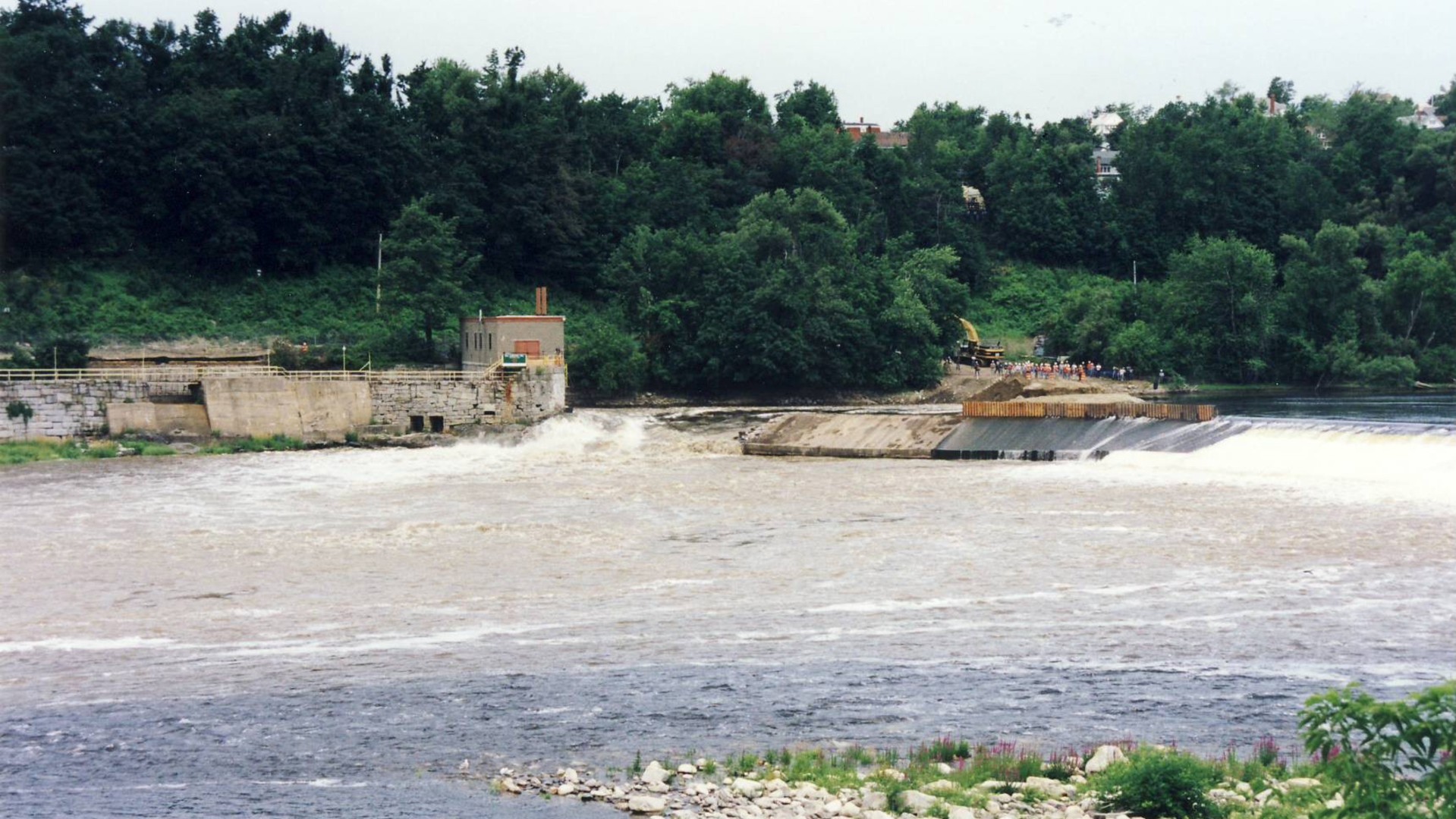
How Removing One Maine Dam 20 Years Ago Changed Everything • The Revelator
The removal of the Edwards Dam on Maine’s Kennebec River helped river conservationists reimagine what’s possible.
The Revelator
180 points · by howard941 · 7y ago · 96 comments
BTW... try to remember this when someone criticizes hunting / fishing. A major part of sustainable hunting and fishing is making sure we have an environment that actually produces quality fish and game.
Most people DO NOT give a shit about trout for example
I'm a trout fisherman and think they're an insanely beautiful species. When I flew into Montana my trout stamp was like $150... non-trivial amount but absolutely worth it.
fun fact: in a pinch if all you have is a little bit of pringles shake them up into little crumbs, prepare the fish, sprinkle the pringles crumbles inside the fish, cook wrapped in tin foil near a fire's embers and you have some good eating with a bit of seasoning.
Not saying it's bad, I've done it. Chips are a great substitute for bread crumbs.
Sure, most people do not give a shit about trout, fisherman and hunters included.
I wouldn't consider myself a hunter or fisherman (but I have fished occasionally and the implication that people like me don't care about the environment is frankly insulting.
For somebody who cares about 'sustainable hunting and fishing', you sure do like to pollute the environment just for the pleasure of getting to fish.
Why then, should others make the sacrifice to their lifestyle for the purpose of sustaining the environment when you are not willing to?
"The dam produced only 3.5 megawatts of power, providing less than 0.1 percent of Maine’s electricity. It employed only a few people and was aging and unsafe, having been breached numerous times. It blocked critical upstream fish habitat, including the migration of endangered sturgeon."
Especially in light of how breaching the dam did, in fact, bring the hoped-for environmental benefits and more, getting rid of it was the right thing from a cost/benefit perspective.
The impact is harder to quantify than with other forms of power and is ignored due to that.
Now, I'm not advocating against all hydro power, I think it's especially important in a pumped storage/peaking capacity.
The projects definitely need to be analyzed on a cost/benefit analysis and as this points out, 3.5MW of power is just trivial and not worth it.
As an aside, there are a number of dam removal videos on YouTube which are fun to watch: https://www.youtube.com/watch?v=2yM5m5-1-I0
It's not entirely an either/or situation, and there are interesting, growing workarounds such as hatchery creeks and salmon cannons. But yes, building new hydro power should always have a strong ecological assessment done before proceeding, and taking the trade-offs into account.
(Disclaimer: I've been working on stream restoration software, but am not a domain expert, don't speak for my employer, and mostly am only commenting because I find it really interesting stuff because I've been working adjacent to it and hearing cool stories about it. Always fun when it comes up on the HN front page.)
If you accept that human are a part of the environment, and that we are going to have some level of impact on it, then as you said, you can look at the RoI/impact of decisions and their alternatives, and come a conclusion that reduces impact. But if your standard is green/not green, then you’re never going to be able to solve any problems.
This is precisely my point of view.
You must consider the full lifecycle ROI.
I'm a particularly big fan of nuclear for that reason.
I served on an endorsement committee. We made recommendations (or note) to the membership to support candidates, initiatives, referendum, etc.
The last big internal food fight was over a levy to renew K-12 school funding. These are usually narrowly won ballot measures. Because some people think taxes is theft, government is evil, yadda yadda. This time something like $100m / year was at stake.
Three board members strenuously argued against endorsement. They are local leaders in education policy. Our usual "go to" experts. Committed, knowledgeable, experienced, in the fight. The biggest education boosters you can imagine.
The sticking point was ~$55k / year that could potentially be used by charter schools. For something like vans to transport kids to after school care. I don't remember the exact details, but you get the gist.
--
I had no idea who Mark Jacobsen is. Okay, he's an influential expert. Being called to task for a report first written in 2009. His cohort is in a pissing match with another led by Ken Caldeira. Some fun.
Going out on a limb here: There will be no new dam construction in North America in my life time. Like our current nuclear tech, the (financial) costs are too high, and the timelines are too long. (Wikipedia says we could maybe add power generation to existing unpowered dams, which could be cool.)
New Green Deal, or something like it, has to happen. Spoiler alert: You're not going to like most of it.
Focus on the positive. Please.
If you have to trade support for building some dams (that will never happen) in order to get the programs you support, please just do it.
It's hard to argue that we shouldn't have done any of the big dams out west. But there's at least a good argument against the Glen Canyon. And, especially with the benefit of hindsight, the seriously proposed dam sites in the Grand Canyon would have been very not good.
In the east the proposed Tocks Island Dam was pursued for a long time. Again, especially with the benefit of hindsight, this was also pretty clearly not good.
Silicon Valley would die, though. Where on earth does its water come from? Yes, 85% of the water from Lake Mead. The Los Angeles basin is built up far beyond its natural sustainable water capacity. Unless there is a great leap forward in desalination technology some dams remain a rather necessary evil.
I guess it's also sobering to think that most all major rivers in the USA are damned up. I think, without looking, save the Yellowstone River.
That's it.
Interestingly enough, it was Thoreau's inventory of species in these very streams and tributaries as documented in _The Maine Woods_, which can tell us how we're doing with the restoration of the waterways today. Thoreau's book was comprised of notes from three visits in 1846, 1853, and 1857, and he had a pretty early and close insight as to how bad the damage was from the get-go.
At the end of the book, in the appendix, he noted several introduced species. Since he often used "Indian" guides to help him navigate upstream, he also had the opportunity to learn a bit about what species were native and what were brought in by the newcomers. (Disclaimer: my mother was one-quarter indigenous to one of the tribes Thoreau mentions, so I've studied these texts pretty thoroughly).
Several interesting musings on the encroachment of the white man into these lands; this one especially:
> Tahmunt said that he traded at Quebec, my companion inquired the meaning of the word Quebec, about which there has been so much question. He did not know, but began to conjecture. He asked what those great ships were called . that carried soldiers. " Men-of-war," we answered. " Well," he said, " when the English ships came up the river, they could not go any farther, it was so narrow there ; they must go back, go-back, that 's Que-bec." I mention this to show the value of his authority in the other cases.
[146 THE MAINE WOODS: https://archive.org/stream/mainewoods00thorrich/mainewoods00...]
Further the 99% green electricity is causing a lot of big clouds data centers to be located here. But the clouds run on water power.
In the case of Niagra Falls, its presence isolates the Great Lakes ecosystem from the Atlantic Ocean. During many millennia a unique ecosystem developed. When the canal was built to allow ship traffic from the ocean into the Great Lakes, it caused a sequence of ecological disasters due to invasive species.
The lesson: Don't screw around with mother nature (adding or subtracting)
So you propose blowing a big hole around the niagra rock shelf. What effect will that have? It's not going to restore any ecosystems that we value, obviously, as those never existed. It would also flood a bunch of exurban/suburban Buffalo and Toronto, which (Bills fans notwithstanding) we do value.
I vote no, obviously. I genuinely don't understand why you think this is an interesting question.
But wouldn't new ones be created? I think that's what the parent poster is getting at - teasing out if this isn't just a common case of reactionary environmentalism and anti-human bias, where the criteria for finding that a certain construction is harmful is not applied to natural features, revealing the whole reasoning to be hypocritical, and not the real reason why it's the argument is being made.
Of course. Do anything and you create new ecosystems. Building the Maine dam in the first place created new ecosystems. They just aren't (1) beneficial to us in any meaningful way and (2) represent notable loss of a pre-existing ecosystem we value and want to preserve.
I don't see the hypocrisy there. You're trying to treat this as an absolutist thing (e.g. "riparian environments must be maximized at all costs") and color it as "reactionary environmentalism", when the truth is that it's a value judgement with specific evidence (e.g. "we fucked up the Kennebec river and we should fix that shit"[1]).
[1] More properly, given the article that no one here seems actually interested in reading: "We fixed that shit 20 years ago and, wow! It's fixed even better than we hoped!"
but I wish someone would think of something to "Change Everything" so that one day we'll see fewer clickbaity article titles.