365 points · by ingve · 7y ago · 174 comments
For instance, if they released the new object tracking tag with iPhone 11's, it would be a bad user experience because U1 is not spread out. Better to wait until the U1 geographically saturates to their standards before releasing it.
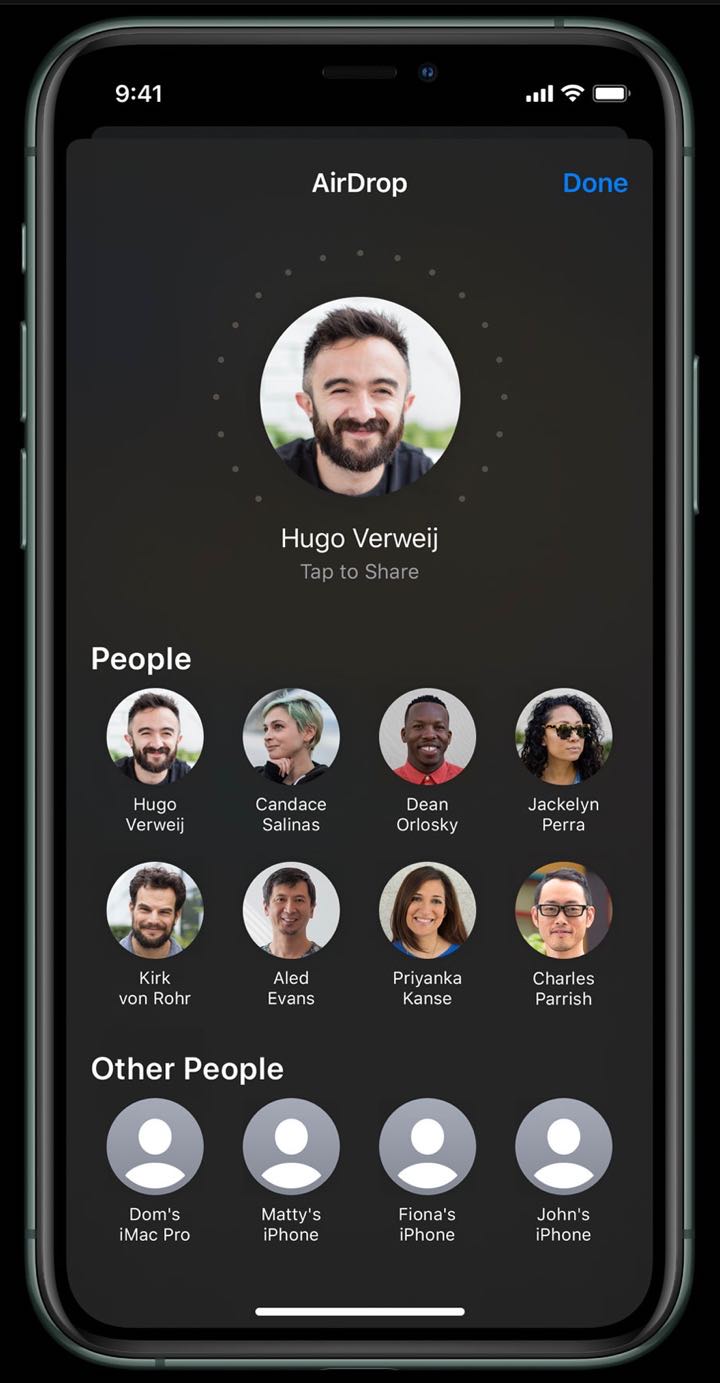
They can still talk about U1 in regards to e.g. new AirDrop capabilities, and in other marketing-level generalities.
The Xcode GM points towards an Apple AR devices. I think there could have been a "One More thing" in the Keynote, but it was pulled out in the last min along with All U1 announcement. They simply don't want Another AirPower to happen.
And it might have something to do with whether the software is ready for it as well, iOS 13.1 coming 10 - 14 days after the release of iOS 13.0. With quite a lot of features promised in WWDC missing, when was the last time we had something like this?
And may be they decided to save it for October event. After all we are still missing new MacBook Pro, New iPad Pro, Mac Pro update, and may be new iMac Pro?
At WWDC this year, Apple announced that all iOS devices would begin reporting nearby devices' locations back to Apple. U1 probably only works at relatively close range, so they want to wait until their "crowdsourcing network" includes enough devices for long-range tracking to work. (IIRC they aren't going to let users prevent their devices from contributing to the network, so it's just a matter of waiting until everyone has the latest iOS update.)
Just to clarify for others - its not that all iOS devices will report the location of all other devices, but rather "lost" devices will emit a (BLE?) signal, which nearby Apple devices will report its location back to Apple.
How would a lost device know it was lost? The Wired piece on this suggests that all devices are always broadcasting their location:
https://www.wired.com/story/apple-find-my-cryptography-bluet...
[1] Right now I can't really see a killer app for AR, something that would make you super-human enough to want a layer of abstraction between you and the real world. However if I could remotely interact with objects through walls, like turning off a lamp in a bedroom or seeing where my wife is and opening up a audio chat with her so that we're not yelling to hear each other, all of a sudden the trade off of having to charge and wear another device seems less annoying. All of a sudden you have powers not unlike a sorcerer.
For me the key uses of AR technology would mostly have to do with abstracting input and output (mostly) away from the actual physical devices involved, which would benefit from UWB for certain cases but really wouldn't hinge on it.
For a simple example: Sitting in an airline seat, and having a virtual 'big screen' to watch a movie - but having it anchored to a certain relative position, so I can still look left and talk to a cabin stewart without removing AR glasses (and still have the film playing in my peripheral).
Another simple example would be providing a GPS 'HUD' when driving, similar in result to physical devices you can currently get that project onto windshields. UWB stuff might benefit here by providing a reference point to anchor virtual objects to (e.g. saving a position and orientation relative to the physical chip in the car).
But sometimes it'd be pleasant to sit outside. Or useful to work while in transit. I can do all those, but they involve smaller screens, more cramped keyboards, and the hassle of dealing with gear.
Having it all in AR would be very cool.
Arguably an invasion of privacy, but it turns fellow commuters into DJs. I’ve discovered some good music this way.
Also lots of static.
Nice try, Yagami. But I’ll still take half your life for it.
-Ryuk
Centralized face recognition where a single entity knows everybody a la Facebook would be a dystopian nightmare. Personalized face recognition where everyone has their own instance trained purely on the data they have access to (e.g. Apple's existing Photos face recognition) and only linking that face to the user's Contacts entry for the recognized person, that's not a privacy violation because that's just offloading information from my brain into my personal digital assistant.
Autoworkers can have parts deep in the engine glow for them to see, plumbers can see through walls, doctors can see where major arteries normally run before they make an incision.
It's stuff like that, not turning on a lamp, that will push AR initially.
Talk to Microsoft, there is a killer app being put together for the DOD:
www.theverge.com/platform/amp/2019/4/6/18298335/microsoft-hololens-us-military-version
vehicle maintenance
medical procedures
circuit diagnoses (schematic overlay on pcb)
but UWB is irrelevant. those apps can easily work with wired connection.
...Security agents, recognizing faces at the entrance of a night club. Using the human only for his muscle.
But really, enough people have inagined usecases. If an obvious one didn’t surface now, it’s because it triggers the imagination without actual usecases. I live in an almost entirely virtual world, have fewer and fewer friends, am online 70% of the time whether home, at work, on holidays or in conferences, yet I feel no need for AR glasses. Though I do feel the lack of long-term friends though ;)
Something, something faster horses.
The fact that so many people don’t see any use for AR and that the people who think they do are so spectacularly wrong are what make me excited for AR.
I want to see what nobody has thought of yet and Apple is the only company that I think is capable of that.
Then put pokemon GO into the mix and it'd be really fun.
For scooter rental, it'll be way smoother than opening an app and scanning a QR code. You can just step on the scooter and go.
(My wife hates the QR-code scooter app experience so much that I generally unlock both scooters under my own ID when we're going around together. Fun fact: there are geocoded low-speed zones in Paris, where it limits the scooter to 10 kph in some crowded pedestrian areas. Fine. But when you unlock two scooters with the same phone, it uses the GPS location of the phone to decide when to limit or un-limit the speed. And a lost Bluetooth connection can leave it stuck at low speed. But I digress.)
UWB will also improve the ergonomics of contactless payment. With the current system, you have to hold your phone really close to the reader for a few seconds. UWB could allow an instant gesture.
EDIT: removed fatuous intro
The radio technology involved should have almost nothing to do with the ability to perform a relay attack. There are two straightforward mitigations:
1. Timing. The two parties confirm that a message can round trip in a specified, very short time T. This proves that the distance between the parties is T/2c or less.
To be useful, T should be, say, 20ns or less, which requires a bit of clever crypto to make the actual exchange fast enough.
2. The transmitter attempts to localize itself, using GPS or other technologies, and refuses to authenticate unless it’s near the receiver.
There is reason to believe that UWB will help with localization. I see no reason it would be any better than any other technology for time-of-flight measurements unless sub-nanosecond resolution is needed.
I don't think you even need crypto on the actual exchange.
The car and the key fob could negotiate a pair of random values, R1 and R2, using an encrypted protocol so that eavesdroppers cannot figure out R1 and R2. This negotiation does not have to be particularly fast, so no need for anything clever. This is also where you would do authentication to prove to the car that it is talking to an authorized key fob.
For the actual distance measurement, the car sends a message containing R1 and the key fob responds with a message containing R2. Each R1/R2 pair would only be good for one try, so it doesn't matter if an eavesdropper sees the distance measurement attempt.
An attacker can relay all but the last n of R1 and guess the last n bits. With probability 2^-n, the guess is correct, and the attacker learns R2 n*10 ns early. If the attacker can attempt the attack a few times, then getting a 60ns advantage is entirely reasonable and is enough to break some use cases.
So some more cleverness really is needed.
It fits easily in the bandwidth of UWB. AirPods are ideal candidates for better locating ability. I can’t say for certain but a rough googling suggests that the radio accounts for the bulk of the energy used in an AirPod, and UWB appears to have better efficiency per bit.
So what's missing in your scooter use case is a loyalty mechanism rather than a lack of payment technology.
QR codes are highly backwards compatible
Doesn’t preclude a NFC improvement, but my experience with Scan QR to Unlock has been very good, point the phone at the bike, bike unlocks, not much to improve
This is a security feature, intentionally.....
Isn't this used for Animoji as well?
I'm pretty sure that's what they're doing with the macOS Apple Watch unlock.
Angle of Arrival/Angle of Departure mitigates this. Attempting to relay will screw up the phase relationships.
UWB is basically Time of Flight.
You do? Mine is almost scarily eager to pay the bill.
> Imagine a whole-home audio system moving music playback through multiple rooms based on the location of an individual listener.
Hell, why stop there? Imagine that same audio system not only activating different rooms as you move through them, but also adding the appropriate delays to each audio channel to make sure they arrive at your ears in sync. That'd be pretty neat.
https://www.digitaltrends.com/home/the-awesome-technology-in...
The problem is that apple is playing both sides. It wants things to be attractive and convenient for both users and businesses.
For example, although they are a privacy company, they don't advertise bluetooth beacons and deep linking to their users.
Any solutions have to be software-side, like an external indicator light when images are saved in some form. I think Google Glass attempted that too.
1/ The first concern pops into my head is having a recording device nearly always on. In reality, there is no way you can prevent people to take photos and/or videos using smartphone when something interesting is happening in the public. It takes less than 5 seconds for people to take the phone out of their pockets and start recording. Then what's the real difference between camera on the face or camera in the pocket?
2/ The Glass-Hole issue. People always blame the camera as the ultimate evil. I'm not that sure. Remember, the original Google Glass was basically a piece of not-that-useful-to-put-it-nicely gadget that costs $1500. Honestly, back then, I thought whoever is buying those stuff that just overpaid nerdy douchebags (I'm thinking that way mainly because I cannot afford it). I'm not sure having a camera is the biggest issue; but having a camera is probably the biggest issue that you can publicly talk about.
3/ Trust issue, i.e. whether Google/Apple/FB are secretively collecting those video feed. Or even worse: what if the business model of future AR products depending on collecting those video feed.
That’s very different from an accessory like glasses, which are typically on somebody’s face all the time, whether or not they’re being used for photo functionality, with a hidden camera constantly pointed at whoever they’re talking to or whatever they’re looking at. You may never know that a photo or video or other recordings of you, of your property, of your company secrets, of national security, etc are imminent or already taking place.
“What’s the real difference” is kind of absurdly obvious, yes?
C'mon, y'all are using credit cards, cell phones, Google, smart speakers, etc. You'll be wearing always-on cameras soon enough.
[1] https://www.digikey.com/product-detail/en/decawave-limited/D...
To quote from the iPhone 11 page:
> The new Apple‑designed U1 chip uses Ultra Wideband technology for spatial awareness — allowing iPhone 11 to understand its precise location relative to other nearby U1‑equipped Apple devices.
this reminds me a bit of how VORs work https://en.wikipedia.org/wiki/VHF_omnidirectional_range
(Signed: someone whose spouse "can't find my airpods, I was sure they were in this bag …")
Thereafter: full inventory control and location of all your e-waste-to-be?
https://www.macrumors.com/2019/09/03/lost-airpods-nyc-subway...
However.
The range finding is accurate.
So long as one is dealing with a few devices, it is incredibly effective. It's not going to be GPS for the house, but it does make proximity triggers reliable.
With indoor positioning, the anchors aren't positioned as precisely as GPS satellites, nor do they have the same quality clocks. Thus time of flight is done with a call and response per device.
It was hard to setup positioning for more than 1x device... remember that 1x device is range finding to 4x anchors.
Am sure these problems can be solved, but in the near term think this is more about precise distance rather than position.