432 points · by ph0rque · 7y ago · 327 comments
This is a thought fallacy that leads us nowhere, it's a complex problem with many causes and lots of moving parts.
We can't just plant a bunch of trees and keep living like before, growing to 10 billions and beyond.
We need to plant a bunch of trees AND reduce traveling AND stop eating so much meat, AND stop fishing so much, AND stop creating to much waste, AND keep the world population under control, etc. It's not OR, its AND.
Thinking "Oh well someone is just going to plant a bunch of trees and fix it, I'll just back to eating my cheeseburger" is not a productive message at this point in time, when so much is still to be done to convince the general public that lifestyle changes are urgently needed.
The vast majority (~80%, [1]) of the greenhouse gas emissions do not come from "lifestyle" choices such as eating meat, but from transportation, industrial use and electrical production. These require changes at the policy level that individuals can't create by themselves but only by calling for action by legislators. Planting more trees on a national scale can absolutely be one of the many policy changes that we call for to help balance the scales, because we will never get those three sectors down to zero.
As for the specific question of meat, it would undoubtably help for everyone to eat less meat, but in fact if every single person in the US went vegetarian, it's estimated that it would only reduce the US's CO2 output by about 5%. [2]
1. https://www.epa.gov/ghgemissions/sources-greenhouse-gas-emis...
2. https://www.nytimes.com/2019/08/21/climate/what-if-we-all-at...
But the reason we use so much transportation, industry, and electricity is due to lifestyle choices. Meat requires feed which is transported, and then the animals are transported, and then the meat itself is also transported. Industry makes those iPhones you buy a new model of every other year. Etc.
> As for the specific question of meat, it would undoubtably help for everyone to eat less meat, but in fact if every single person in the US went vegetarian, it's estimated that it would only reduce the US's CO2 output by about 5%
5% is nothing to sneeze at. Eating less meat alone won't stop climate change, it's true, but in combination with other sacrifices?
Here's my problem with the people who make arguments like you're making: I feel like you're unwilling to make sacrifices and are using this argument to justify how you can claim to care about the environment while also doing basically nothing to improve the situation. You'll say "well, one person isn't going to make a difference", yes, in the same way a raindrop does not consider itself responsible for the flood. If we are so unwilling to make sacrifices for ourselves, why should we believe that other people will make any? Why will they vote against their interests? Pay lip service to the idea in a public forum and then explain away your own contribution to the problem as being but one drop in the flood, voting is secret. Someone says "we should eat less meat", an objectively helpful thing to do by your own metric, and you say "No, no. It's a small thing, we should focus on something less important to me!".
It's frankly quite frustrating to see. Short of some miracle techology, I'm pretty sure this kind of thing is the reason we won't be able to avoid the worst case scenarios of climate change and future generations will look back on us with well deserved disgust.
You're right, and it drives me mad. There's also the other side of it, when someone really does live off the grid, eat vegan etc. "Ugh who wants to live like that?"
> The vast majority (~80%, [1]) of the greenhouse gas emissions do not come from "lifestyle" choices such as eating meat, but from transportation, industrial use and electrical production
1. These industries don't generate emissions for the heck of it - they do it to satisfy consumer demand.
2. To force industries to change their ways of doing business, there's not many options beyond carbon taxes. Which will result in some changes - in manufacturing techniques, costs, end product - that are hard to predict now. Some may be for the better, and some, for the worse.
Given these facts canny businesses will almost always successfully lobby against climate regulation and taxes with appeals like "bad for jobs! no more cheeseburgers! they're taking away your SUVs!" to the electorate. But if people are OK with more expensive cheeseburgers or SUVs, these appeals have less purchase. You're not going to get everyone to give up these things, but at least they'll realize their true cost.
> if every single person in the US went vegetarian, it's estimated that it would only reduce the US's CO2 output by about 5%.
And that's exactly what GP was getting at. There isn't one single solution that will fix 90% of the problem. This type of thinking introduces complacency - "They'll fix it before it gets really bad. I heard you just have to plant a bunch of trees/drop some rocks in the ocean/run a carbon capture machine."
Our economy is a leaky pipe, with carbon dripping out all along its length and breadth. The solution to climate change is a bunch of 2-5% solutions.
They buy gas guzzling cars. They stay in huge houses with massive heating bills. They endorse sparse suburban housing too.
I am also not a huge fan of those advocating for complete veganism in the name of climate change. (not those who make an individual choice mind you. That I respect). Ingredients like fish sauce, worcestershire and the like have trace contributions to climate change, and make it incredibly difficult to cook certain cuisines without. Fish, chicken and to an extent milk products make minuscule contributions to climate change and are still lumped together with red meat.
Some peer review & published studies [1][2] believe that total US veganism will lead to only a 2% decrease in GHG emissions in the US.
[1] https://www.pnas.org/content/114/48/E10301 [2] https://theconversation.com/yes-eating-meat-affects-the-envi...
IMO, the most effective move would be to move to low meat cuisines. Stir frys, curries, brothy soups and the like use a lot less meat than burgers or steak. Some of those work perfectly fine with zero meat (minus meat derived spices/sauces). Feel like the current trend with veganism is a stop gap until we figure out hoew to lag grow our meat anyways.
Sure, they may require systemic changes, but certain people have to then get out of the way, like stop resisting things like traffic calming and bike lanes and dense housing development near their workplaces that allow people to change their consumption in the first place.
I do think that all options should be on the table, and moving the needle is an overall good. For the upper-mid US, a couple more nuclear power plants. For the mid-west, more wind. Southwest, more solar. Continued support for electric tax credits. Expansion of efforts to increase forests in terms of trade policy. Reducing/elimination of farming subsidies to large mono-crop farming, especially where using patented seed. Nutrition policy based on science, not religion.
Reduction of pollution as a primary focus would help a lot as well. Abusing pollution and climate change to push a political agenda brings out a lot of resistance. It also shows that most of those screaming the loudest really don't care as much about it as they claim.
> Agriculture, Forestry, and Other Land Use (24% of 2010 global greenhouse gas emissions): Greenhouse gas emissions from this sector come mostly from agriculture (cultivation of crops and livestock) and deforestation. This estimate does not include the CO2 that ecosystems remove from the atmosphere by sequestering carbon in biomass, dead organic matter, and soils, which offset approximately 20% of emissions from this sector.[1]
Plus, as other comments have pointed out, transportation and the rest are closely related to our lifestyles.
[1] https://www.epa.gov/ghgemissions/global-greenhouse-gas-emiss...
Bitcoin, for 2019, is another Denmark in CO2 production (34,730,000,000 kg this year alone) due to the amount of electricity it burns. This data compiled by digiconomist. https://digiconomist.net/bitcoin-energy-consumption
Mind you, there are universities and critics that claim digiconomist understates the amount of power consumed by Bitcoin. I also think their average .49 kg of CO2 produced per kWh is a bit too low. Even when weighing for renewables on the average grid. Also, this doesn't take into account cooling costs. But at these numbers, it takes about 1.9 billion trees to neutralize the excess CO2 produced by Bitcoin, alone. There are other coins red lining computers as well.
Certain lifestyles as a target are silly when there's some others that are much easier low hanging fruit to deal with.
The non-cynical intepretation is that people focus on lifestyle changes because those are the ones they are personally able to do.
Edit: here https://academic.oup.com/ajcn/article/78/3/660S/4690010
Transportation, industrial use, and electrical production are all directly related to lifestyle choices.
Transportation is affected both by personal choices in accepting mass transit, using one's car, etc. Transportation of products is fueled by mass demand for new products built in far away lands, as well as cheap produce.
Industrial uses are usually in supply chains for goods people do not strictly need, but want for convenience.
Electricity production is either used directly as a consumer or to support that which the consumer would like to buy.
The greatest myth that has been fed to us in the climate change 'debate' is that there are large corporations out there polluting and burning fossil fuels for fun.
Why did you exclude transportation and electrical production from "lifestyle choices" since lifestyle choices can reduce both of those? And it doesn't even have to be a large change in lifestyle -- do you really need that 18mpg full size SUV/truck, or would a 29 mpg car suffice for your daily needs and you can hire a truck when you actually need to haul stuff?
Humans do not have a great track record of predicting the secondary effects of their actions on the earth.
Meanwhile our society is incredibly wasteful of energy, and has a ton of low hanging fruit via reduction and efficiencies. The less emissions we produce now, the less we have to clean up with solutions like the linked above.
I'll also repeat this again because it's a common accusation leveled on HN. Most people interested in addressing environmental issues are not doing it to "virtue signal" or impose arbitrary values but because they want a healthier environment and to make the world sustainable for future generations.
But it seems to me it’s more than that: there’s also a lot of that age old instinct of trying to control others behavior... There’s a lot of talk about “we cannot keep...” and “the fallacy of never ending economic growth”. To me that just sounds simplistic and ideologically motivated.
When the world turns away from science and innovation, towards dogma and social control, it rarely ends well...
The alternative, lifestyle changes, is better understood and the effects of which are easily predicted, but is only effective if done in a unified manner at a scale that current human nature will not allow. We can’t even figure out how to cure hunger and poverty in a world of plenty, good luck getting everyone to make the dramatic changes to even get us to stabilize at mostly broken planet.
The real answer is that beyond a deus ex machina there is no answer and that the inevitable easily and indisputably modeled result of the current situation is dramatic near-term biosphere changes, ecosystems collapse and likely the end of most advanced human civilization within a couple centuries, conservatively.
It must be a weird time to be a climate scientists, with the best computer models that have ever existed essentially returning a result that ends the world within a half dozen generations.
2. They are proven to reduce your impact at a level that most consider manageable
3. The other poster said AND - eat less meat AND get involved in other mechanisms for change
I dont have any interest in virtue or signalling: i just want people to impact the planet less so we dont trigger any unwanted changes. Is that a valid enough reason to ask everyone to try their best or do we keep having to have philosophical arguments about how individual free choice (shaped often by the corporations themselves!) trumps any imperative to collectively sacrifice?
For example, we can plant as many trees as we want but if population grows even at the current rate we are gonna need another planet. So what’s wrong in saying we need to slow down our own expansion. Same for industrial scale agriculture.
What I always find puzzling in all these conversations is the attachment people have to their lifestyle which probably evolved to where it is only in the last five decades - at most. Meat was never this readily available in history. Neither was energy. These are incredibly recent in our evolutionary period and yet they wreak havoc like nothing else.
In fact, population growth is slowing. [1] Claiming that we need population control is false and IMO extremely damaging to building consensus.
[1] - https://www.pewresearch.org/fact-tank/2019/06/17/worlds-popu...
China's former one-child policy, while reasonably successful, had its own unintended consequences (for one thing, too many people aging out of the workforce with too few to replace them). And even with their relative success, there was still a decent amount of dissent and people secretly working around the rules. And China had an authoritarian government to enforce all this. Do you really expect Western democracies to be able to push through any kind of population controls? Do you really expect, for example, the American public to get behind some kind of limits (even if just socially-enforced limits) on the number of kids they can have? That's just not going to happen.
But if you actually have something that will reduce emissions? Well that's a threat to their plan to get more money and power.
On the other hand, all current IPCC scenarios require both lifestyle changes and a staggering amount of carbon capture, starting from 2030 peaking with up to 20 Gt/CO2/year in 2050 for the worst scenario (which we are very much on track for) [0]. (Current emissions are around 40 Gt/CO2/year. [1])
Nobody knows how, and especially not how without side effects. That does not mean we should not try - we need to - but that means we have to pull all the stops, now.
Look at those plots, this is a desperate situation, and the IPCC reports are actually optimistic. [2]/[3]
[0] https://www.ipcc.ch/site/assets/uploads/sites/2/2019/02/SPM3...
[1] https://www.ipcc.ch/site/assets/uploads/sites/2/2019/02/SPM1...
[2] https://www.ipcc.ch/site/assets/uploads/2018/02/FigSPM-10.jp...
Some geoengineering solutions don't seem to be all that expensive (e.g. spraying sulfur dioxide into the stratosphere), and if things get really bad in some particularly hot places, somebody (India?) may decide to apply them unilaterally. Will we be happy about that?
If things get bad enough we'll get forced into geo-engineering, but as you said, unilateral action could complicate things in unforeseen ways.
Read about TWR (Traveling Wave Reactor) designed by these guys, financed by Bill Gates. It runs on depleted uranium, not enriched uranium. It's amazing how it works.
There's so many solutions being developed like this on so many fronts. But we're not doing any of them. I don't understand it. Government is not even being asked to finance this, but yet they won't approve it because of politics.
That's the problem with all these "We'd have cheap safe nuclear power if it wasn't for those stupid treehuggers" arguments - if nobody is doing it, not even in countries that are pretty reckless and unregulated like China, maybe the problem isn't regulation.
Overall our atmospheric models are not yet mature, which make carbon-trapping mechanisms from the atmostphere hard to gauge. Easier if we reduce or trap carbon emissions before it is spread into the atmosphere.
Please also consider we will eventually run out of fuel/oil/gas/coal; carbon dioxide savings is the long term strategy.
Project Vesta hasn't proved efficacy or ability to scale. It's reminiscent of the "solar roadways" hype from earlier this decade.
Most greenhouse gas emissions come from industry and transportation of goods.
It's less politically expedient to blame entrenched powers for their hand in climate change than it is to blame Joe Nobody for driving instead of walking to work.
So yes, I am a part of the problem. But we've gotten into this mess with technology; why can't we use technology to get out of it? Part of the problem is that, in taking part in these activities that increase our carbon footprint, we're not actually paying for the true impact of our actions. I'd be fine with paying more for my plane tickets if I knew that extra money was going toward carbon capture, or other technologies that are in development to reduce the impact of these -- by now very common -- activities.
I'm reminded of the checkbox memes; "You are attempting to apply an X solution to Y. Your idea will not work because:" -- one of my favorite checkboxes on those, was always "You are attempting to change the behavior of everyone, which does not work". I feel like this applies to most climate issues.
Implementing worldwide population controls is a non-starter. Implementing restrictions on air travel is a non-starter. Outlawing meat consumption is a non-starter. I love that companies like Beyond Meat and Impossible Foods are trying to come up with more sustainable meat substitutes. I think they have a ways to go, but I'd be happy to switch over to them at some point. That's a great example of using technology to reduce carbon footprint, while still allowing people to have the same (or nearly the same) experiences. Can't we do more of this?
At the end of the day, people are going to do what they're going to do, as long as they can (financially) afford it. Cultural/societal change on this level, in the time frame necessary, just isn't realistic.
We have no idea how that further manipulation would affect the environment, in a thousand unforeseen ways that would only be apparent decades down the line.
Half of the earth habitable area is used for animal agriculture, so that should be the first part being reforested, meaning less cattle feed, meaning less meat.
So we cover the surface of the earth with crop fields, plant a bunch of trees on the other and everything is going to be all right? Of course not, it's just not that simple.
Scientists simply cannot predict how the ecosystem would respond, the models are too simple for something so complex as the Earth.
We need to stop using so many resources, continuing to increase the rate of consumption while waiting for some miracle technical silver bullet solution is just suicidal as a species.
Coal is such a huge contributor to the problem that you can almost say that climate change is a coal problem. Not quite, but you're not wrong. I am deeply puzzled by anyone discussing climate change who doesn't bring up coal first, yet I see tons of discussion where coal is not even mentioned.
https://www.eia.gov/energyexplained/index.php?page=environme...
I'm not saying it's the best or only way to address climate change but it does seem consistent with addressing how it started.
A volume of 7 cubic miles (11 km^3) of olivine, or around 30 Gigatons, is needed each year. This is less than half the volume of construction materials and less than that of fossil fuel equivalents mined yearly.
That's gigantic, how can they sustain that 30 gigatons a year ?
It’s insane to want to suppress good ideas, i’m not sure you’d accomplishing what you intend with your criticism
EDIT: if you don’t like the title, criticize the title. Titles are written by clickbait artists, not the authors
They are criticizing this wording. This won't stop the climate crisis but sounds like a great first step.
I prefer solutions that involve changing the least number of stubborn and uneducated minds, and offer the most upside. Like industries that are run by professionals and are already accustomed to high regulatory requirements. Energy and construction industries seem like there's a lot of low-hanging fruit there, just for starters.
First, there's no harm in the fact that we need to plant more trees. Would we ever achieve the amount needed as stated here? Hell no. But it at least shows we do need to be serious and replant trees.
Edit: For the most part there's no harm in planting trees as long as they're appropriate for the ecosystem, both type and density. One thing the article doesn't talk about, an Amazon forest can be denser per acre while a pacific northwest forest has to be thinner. Due to both pests and wildfire management. I also figure soil fertility too, but I don't have the data for that one.
I think the most valuable take away, the amount of trees needed is a good way to visualize the extent of the problem. Mentioning that we pump however many billion pounds of, essentially "smoke", is meaningless to most people. To be fair, it's hard to wrap your head around the weight of a gas for 80% of the population, let alone how much is bad.
But 80% of people can understand, we fucked so bad, we need to plant an extra 1 trillion plus trees to start fixing those problems. That's somewhat easier to understand. It's just more tangible for people to think about. Super accurate, no. But it's more about getting people's head around the problem to understand the extent of work needed.
"Wow, 1 trillion trees. That's a lot. Is there anything we can do that's easier, but can lower that by 1 billion trees?"
"Why yes, we can do..."
"What else can we do so we don't have to plant another 1 billion?"
So we need to plant more trees, but it goes beyond 'appropriate for the ecosystem', we have to consider very many factors to anticipate whether the trees we're planting will be a nuisance or even a hazard in 10 years and whether they will even survive to sink carbon. We need to make sure we plant a good mix of native species to ensure that they'll survive diseases and shifts in weather, but also deal with the fact that not every species grows at the same speed somehow. Forests are complex ecosystems and we basically have to build new ones from scratch to really have an impact here, and that's more complex than just planting some trees.
I used to be a big fan of Just Plant Some Trees but after seeing the impact of the two things I cite below I've developed some skepticism of the idea that we can just apply Tree Planting as a blunt-force instrument to compensate for all the damage we're inflicting on existing trees.
1: https://www.kqed.org/science/4209/eucalyptus-california-icon...
2: https://www.cbc.ca/news/canada/british-columbia/flexibility-...
Not really, as long as the lumber is used for durable purposes and the trees are replanted after cutting.
Okay, but removing 2/3rds of the excess CO2 in the atmosphere strikes me as a damn good start.
edit: just to add some numbers for the context.
> Once mature, these new forests could store 205 billion tonnes of carbon: about two thirds of the 300 billion tonnes of carbon that has been released into the atmosphere as a result of human activity since the Industrial Revolution.
Given the current emissions rate of ~10Gt (assuming no increase), the amount captured by these new trees will be re-added in just 20 years, and will keep growing afterwords.
OR eliminate coal as a source of energy.
Coal is the #1 source of manmade CO2 by far. Just switching from coal to natural gas reduces CO2 per kWh generated by 50%. Obviously putting any solar or wind alongside that natural gas cuts much more deeply.
By contrast the airline industry only accounts for a few percent of global CO2 emission. Why even bring up air travel at this point?
I feel like there's this perhaps subconscious desire to bring moralism into it by shaming people for consumption. The "problem" is that coal can be replaced with almost no impact to our lifestyle, and so getting rid of coal doesn't involve enough sacrifice. The narrative of redemption through sacrifice is deeply woven into not just Western culture but most human cultures really.
At the cost of increased methane emissions due to leakages from natural gas infrastructure that makes it far worse than coal since methane is a much more potent GHG.
Sources:
https://www.nrdc.org/onearth/natural-gas-industry-has-methan...
https://www.ucsusa.org/clean-energy/coal-and-other-fossil-fu...
Just a question: why should we?
Personally, I prefer global warming with the life quality of modern middle class rather than the wheather of 300 years ago with the life quality of ancient aristocracy.
If you want to go back to stone age, please feel free to go: I'm not retaining you.
On the other side, if we can discuss about how to improve quality of life for everybody, I'm in! And if we manage to solve global warming without impacting life quality, even better!
I think there's a latent suggestion in your language that reducing consumption discards all of the technological social progress of the past three centuries, while climate change presents a negotiable inconvenience. The balance is quite the opposite. You can keep cellphones, the internet, food security, modern medicine, and clean, running water. If anything, many of these advances are secured, rather than threatened, by curbing human-driven climate change.
>If you want to go back to stone age, please feel free to go: I'm not retaining you.
Beyond misjudging the gravity of the problem at hand, I think this comment is also a little short-sighted in appreciating the nature of the problem and our collective responsibility for it. The choices we make as consumers, designers, and voters have impacts that affect the whole world, including populations with clear stake but no voice in those decisions. It's particularly callous to tell someone whose island will be washed away by rising sea levels that they're free to eschew any technology they want to curb ecological impact while our own emissions (by absolute value or per capita) far exceed their own contribution to atmospheric CO2 levels.
I don't agree. I think you are seriously misjudging the actual possibility to convince billions of people to give up quality life in order to, maybe, have some positive return on climate.
I've just found a last minute offer for a nice weekend, but I have to fly to get there. Sure, I could skip my flight and those islanders will be happier. But no, they won't be any happier, unless enough people skip their flight for the flight to be cancelled. And even if this flight is cancelled, those islanders will not notice, unless a good fraction of the flights are cancelled, and for most of the year, and for several years. And still, they will not notice, unless most cars get converted to bycicles and heavy industry gets severely reduced or regulated worldwide, which means every object will become more expensive. And finally, in a couple of decades, those islanders may notice a difference... You know what, I'll hop on my plane! I'm really sorry for those islanders and for everybody who suffers for global warming (which includes me) but I don't have the power to make a dent into the problem.
"Tragedy of the commons" works against us, I'm sorry!
What you are proposing is simply unattainable given human nature. I am proposing a more pragmatic vision: global warming is true and it is here to stay. Let's learn how to cope with it, and in the meanwhile let's keep looking for solutions which do not impact quality of life, if any exist.
Consumers.
https://www.menshealth.com/nutrition/a20950388/cockroach-mil...
Oddly though, ground beef and chicken are the two substances that are the easiest to replace. There's almost nothing that doesn't taste a little like chicken once properly prepared. Similarly, there are plenty of ground up things that can substitute for ground beef. Then you can go into cost and life cycle. The cost of chicken is lower because of cycle cycle. The cost of ground beef is lower because it's low quality.
I'm fairly certain it's not the ground beef and chicken industry that are holding up the meat industry on the whole.
In this case you should spend more money on less meat. Just saying 'spend less money' continues to ignore the enternatilies that make meat production such a driver of climate change.
I started to simply collect seeds along hike paths and public spaces, where they wouldn't have the opportunity to grow, and either throw them or plant them farther where vegetation is more poor, dry, and decreasing year after year
That can be oak, hackberry, pine, fig trees seeds or cuttings. I clear up the ground around, uprooting a few weeds, and leaving them at the top with dead branches under, I think it helps keeping moisture, and hope it'll grow. I'll monitor the results
Also I eat a lot of fruits (bought at supermarket, produced in France or Italy), I keep their pits and seeds (peaches, apricots, clementines, mandarines, oranges, lemon, peppers, and other green garbage, and bury them in those places (instead of throwing them away in the garbage bin). They might not be able to grow, but at least it should be interesting for the soil life and it saves up garbage bins weight, etc..
I mean we could all live like caged hens and keep adding to our numbers for a while longer, but eventually there are going to be some hard limits to how many people the ecosystem can actually hold.
[1] - https://news.mongabay.com/2011/01/how-genghis-khan-cooled-th...
And Climate Crisis is just one of the symptoms. World's ecosystem is a multifaceted, wastly complex, richly interconnected and very reactive structure.
We as species WILL NOT get away with having power of a bulldozer and mind of a dragonfly[1].
A question: Considering human biology and mind, can human species ever collaborate and act together for a logical cause? I have almost lost all my confidence that we have that ability/function. I really would like to hear your perspective on this.
We should at least address the elephant in the room.
For centuries the west (including me) has consumed the planet resources while colonizing the rest of the world.
Now that poor countries started having access to the same kind of benefits we have, we tell them that they should stop doing it.
It's not gonna happen, so we.better start thinking about what we will do when the oceans levels will rise.
Hopefully for me living in the Mediterranean sea will make the catastrophe bearable.
Do you really think any country or society is "living like" before? Climate consciousness has come a long way. We are getting better in every aspect, though population growth will be an ongoing issue.
It will be impossible to progress if every time we try something or suggest something people shout "not good enough!"
That said, population is already leveling off. The main cause of population growth now is not high birth rates, but rather increased lifespans and lower infant mortality rates. By the end of the century, population will have leveled off and may even start shrinking some.
Plant 100,000 trees in a summer though and you’ve more or less offset your life’s consumption - cheeseburgers or no.
The Canadian approach however is tree farming. Workers plant 75k trees each per summer and make about $60k in three months. The trees are later cut down and made into lumber. This is actually more ideal than letting the trees age-out provided the lumber isn’t later burnt.
I agree we need people to be more conscious of waste and to reduce excessive consumption, but at the same time, we need easy solutions for people to contribute.
I like the dual strategy of Project Wren (https://projectwren.com/) that encourages lifestyle changes and buying carbon offsets at the same time.
You can already see this happening with the Green New Deal and Global Climate Strikes. The Green New Deal has turned into a jobs program. (Which is deeply ironic, because the Soviet Union was immensely energy inefficient and polluting, as a result of populist measures such as subsidized energy. Increasing middle class prosperity is inherently incompatible with reducing carbon output.) The Green New Deal, together with the climate strikes have become vehicles for socialist ideology. For example, despite experts broadly agreeing that we need things like carbon taxes, the Global Climate Strike platform categorically rejects market mechanisms to address climate change.
Carbon capture and cheap nuclear power can solve climate change, and we can do it without world government. (To many people, that second part is a downside, I think, which is why technological solutions to climate change get less emphasis than political solutions.)
But your argument is a bit of a straw man -- "do all things" refers to doing all things possible to deal with climate change, i.e. use new technologies that pollute less, engage in direct mitigation (like planting trees), and reducing emissions by changing consumption.
It doesn't necessarily mean implementing the green new deal as proposed, as one could possibly accomplish similar effects with a different set of measures.
But of course, your argument that carbon sequestration and nuclear energy will in effect magically solve this problem without the need for any changes in consumption or pricing effectively is arguing that we should, as a species, continue on our destructive path, because somebody else will come along and just fix the problem for us.
Wrt cheap nuclear solving climate change: Nuclear is currently one of the most expensive forms of energy. How do you propose we make it cheap enough so that we can essentially waste the energy for unburning coal we could have left in the ground by a more aggressive buildout of renewables paired with improving energy efficiency?
You'd better get yourself familiar with facts:
https://en.wikipedia.org/wiki/Energy_returned_on_energy_inve...
Can you share your sources of information?
Almost everything else in the comment after that seems a bit off-kilter to me:
> The Green New Deal has turned into a jobs program
"turned into"? Are you familiar with the "New Deal" of historical note that it's deriving the very name from? It's always been a jobs program. That's part of the point.
> Soviet Union
As sibling commenters have already pointed out, I don't see how this comparison was particularly well-connected or topical.
> Increasing middle class prosperity is inherently incompatible with reducing carbon output.
No?
> The Green New Deal, together with the climate strikes have become vehicles for socialist ideology.
I don't disagree with that; what's your point, though? Are you trying to run with the association that "socialism=bad"?
I'm writing you from fairly-darn-Socialist (and fairly-darn-functional) Norway, so I'm not picking up.
> despite experts broadly agreeing that we need things like carbon taxes, the Global Climate Strike platform categorically rejects market mechanisms to address climate change.
Almost every single person I've talked to who has participated in or associated with the climate strikes has been an advocate for carbon taxes.
So, no. Those people and platforms do not categorically reject market mechanisms. In fact those that I've talked to seem to be essentially _on your side_.
> we can do it without world government
I'm sure that's true, but also, I'm not sure where there's been a suggestion of "world government" that you seem to be responding negatively to. Everything you've mentioned in your own comment is single-government internal proposals, or, groups of people advocating for general directions within their own local governments.
So in total: while I think you and I would agree in many many details about how to plan reactions to climate change, can I council you to polish your message to _focus on that_ and skip the world-socialist-government-conspiracy tinge? It's just not necessary. It seems to be making you believe you disagree with a bunch of people who... by and large agree with you, and are in fact interested in (and pursuing) market-oriented solution paths.
> I'm writing you from fairly-darn-Socialist (and fairly-darn-functional) Norway, so I'm not picking up.
Socialism is bad, but Norway is not socialist. Norway is a market economy with a large welfare state. https://www.heritage.org/index/country/norway. The two things are completely different.
Nearly all the countries that call themselves "democratic socialist" are in fact capitalist, with strong welfare states. Some, like Denmark and Sweden, and to a lesser extent Norway, are among the freest markets in the world. The lynchpin of the "Nordic model" is not socialism, but free markets that generate a large surplus, which is then taxed to provide a strong welfare system. Countries like Sweden have high taxes on individuals, even as they aggressively pursue deregulation and cut corporate taxes.
The Nordic model is a strong contrast from the "New Deal" which was strongly anti-market. It was built on government regulation of the economy, price controls, nationalization of industries, etc. It was an economy where the government decided how much it should cost for a flight from New York to LA. The ends might have been similar to Nordic social democracy (higher social welfare), but the means were wholly different.
Climate justice folks are advocating a return to the New Deal, not a turn to Nordic market-oriented welfare states.
The "Green New Deal" is by its terms about a government takeover of the economy: https://www.foxnews.com/politics/aocs-top-aide-admits-green-...
> It goes on to say that “a new national social, industrial and economic mobilization on a scale not seen since World War II and the New Deal”
See also: https://demandclimatejustice.org
> In mitigation and adaptation (“maladaptation”) such as offsets and carbon trading, marketbased approaches to forests (REDD) and agriculture (“Climate Smart”), soil and water, large-scale geo-engineering, and techno-fixes, nuclear energy, mega hydro dams, agro-fuels, “clean” coal, GMOs, the waste to energy incineration industry, large-scale “re-modeling”;
Also: https://www.peoplesdemands.org (referenced from the Global Climate Strike website)
> 5. Facilitate and support non-market approaches to climate action.
> we must take immediate action, including policies for stopping all new fossil fuel projects, drastically scaling up finance and technology transfer from rich countries to the global South, and eliminating dangerous distractions like carbon market schemes.
> to reject false solutions like carbon markets, bioenergy and techno-fixes
- "The authoritarian infrastructure will be built"
I'd argue it already has been built, by Google, NSA et al. Also, I fail to see why these "high levels of government regulation" would be bad, since we've tried the alternative and it obviously doesn't work..
- "The Green New Deal has turned into a jobs program."
I'm no american, but has this been put into law already?
- "the Soviet Union was immensely energy inefficient and polluting"
I do hear that from time to time but no one can provide any sources for this claim. Can you? Not planning on protecting the ol' USSR, but still seems insincere to just throw this around without attribution.
- "Increasing middle class prosperity is inherently incompatible with reducing carbon output."
That's a pretty flat statement. Why would this be so?
- "the Global Climate Strike platform categorically rejects market mechanisms to address climate change."
We tried this, it hasn't worked (so far). Why should we continue with this measure instead of other approaches?
- "Carbon capture and cheap nuclear power"
both of which do not exist. See my comment about LCOE and the link below for cheap nuclear power. With regards to carbon capture, we have some pilot plants but this technology (or rather mix of technologies) is nowhere near ready for the massive scale of deployment we'd need already. That's why the focus is on political solutions imo.
I don't think that's implied here. Clearly there's a lot to be done, this is just a good place to start.
The title is literally saying exactly that, it's not implied, it's explicitly said:
Scientists Identify How Many Trees to Plant and Where to Stop Climate Crisis
Planting those trees is NOT going to stop the climate crisis, a large number of other things need to be done too.
However, I think it's also true that some of the other solutions are likely to happen "on their own" eventually. E.g. technological advancements in alternative energy and electric cars are likely to eventually allow them to replace alternatives (if the environment survives long enough).
A lot of the other parts of the solutions don't have good ways to accomplish them. For example, I don't see a good way to reduce travel or population growth.
I for one, want to get past this so we can move on to fixing our society.
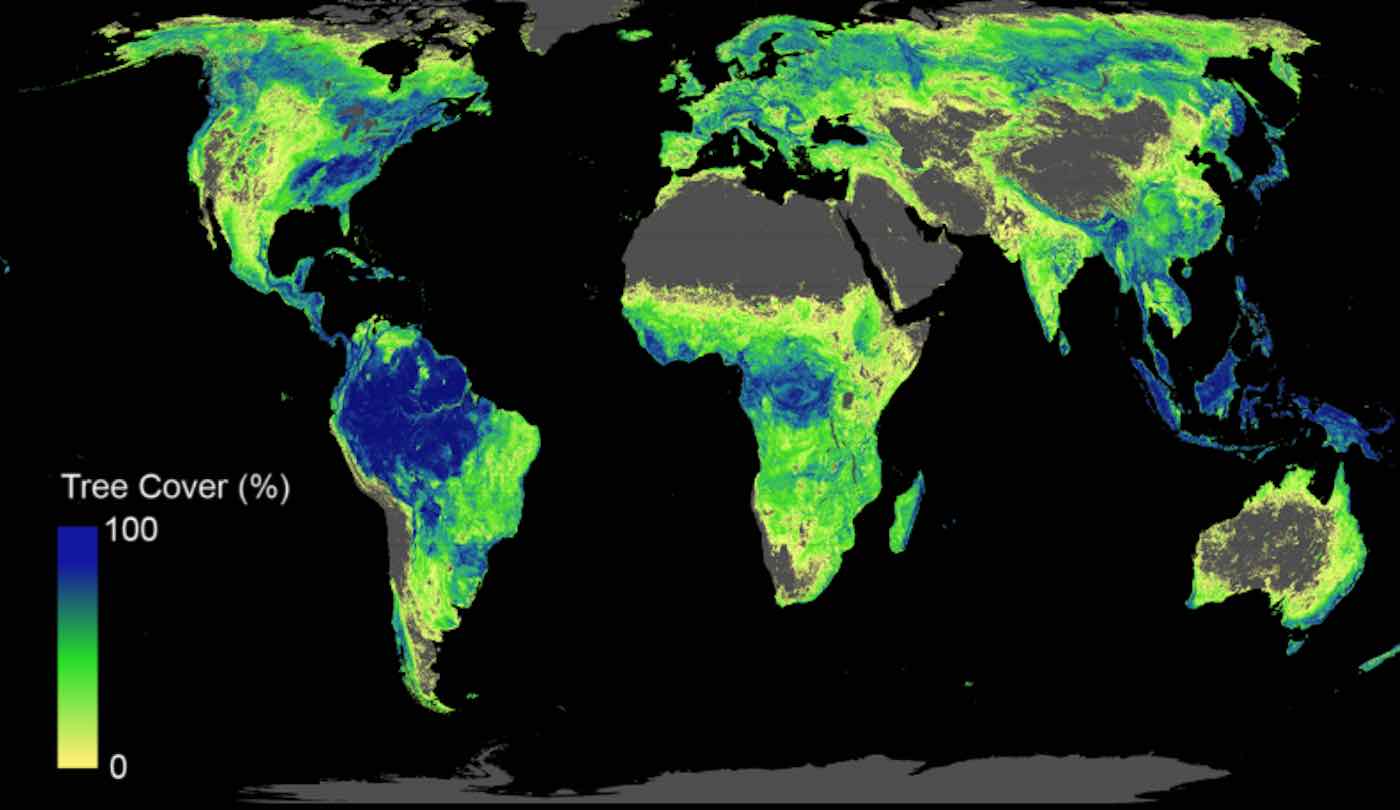
Quote from the article: "Around 0.9 billion hectares (2.2 billion acres) of land worldwide would be suitable for reforestation, which could ultimately capture two thirds of human-made carbon emissions."
This is wrong. The reason is a bit technical. The issue here is that about half of the emissions going into the atmosphere get soaked up by natural sinks, e.g. the oceans. However if you take carbon dioxide out of the air the reverse happens: The oceans and other sinks re-release the carbon.
This needs to be taken into account, but hasn't happened here. So the effect is only about half the size of what is claimed.
Sources by some climate scientists explaining this: https://twitter.com/pepcanadell/status/1147066574299377664 https://twitter.com/hausfath/status/1147190442145898496
To be clear: There's nothing wrong with planting trees as one solution to the climate crisis. However this study was presented in a way that overestimated the effect massively. (Also I have some doubts that planting trees is "easy" given the political situation in the countries that have the largest potential.)
Nevertheless, it also shouldn't be the case that what you remove from the atmosphere gets released from the ocean in equal quantities - it should be seen as trees sequestering CO2 from both the atmosphere and ocean (and potentially other sinks) as according to however the equilibrium of the system works out, right?
I agree with your point that it's not a cure-all though. It might be overstated in the abstract but is still worth pursuing. The enthusiasm, I understand, for planting trees is that it's broadly seen as returning the environment to something that is more equivalent to an earlier point in history and so is seen as less likely to have adverse affects as compared to forms of geo-engineering with less of a precedent in nature.
This objection doesn't make sense. The article is talking about the total estimated amount of carbon dioxide generated since the industrial revolution. That's an absolute number. It doesn't matter where that CO2 currently lives, and it's not saying 2/3 of what is in the atmosphere.
But then you'd lose a lot of farmland, and have to destroy a lot of cities and homes.
https://www.washingtonpost.com/news/worldviews/wp/2014/12/04...
Yet, somehow people in Europe think that a huge deforestation is taking place.
It's weird to me that people here seem to think of fields as nature, when it's actually huge zones where a single species of plant grows and where insects are killed with poison
EDIT: I will look for a source for this though, so do remain skeptical of what I just wrote for now.
EDIT2: this site claims a net loss in Dutch forest area of 3.8% since the year 2000. Clicking around on the map it seems like practically all European countries are losing forests faster than they are gaining them. At the moment I cannot find a source for the governmental policy claim though.
[0] https://www.globalforestwatch.org/map/country/NLD?mainMap=ey...
Change forest area into other use, e.g. residential, is hard AF. So forest-as-land-use is AFAIK not decreasing in Europe.
But re-forested areas are commercial forests, thus they're cut down. And the first re-forested forests reached their peak condition. So a lot of them are cut down. Usually they're given time to naturally re-seed from remaining trees (unless it was clear-cut, which are not advised in most cases nowadays), re-planting takes time and it takes time for that fresh cut to look like a forest again.
Trees take in much more CO2 while they're growing. So if we keep cutting down trees at their prime age, don't burn them and replant new trees in their place... That's pretty efficient. If that wood replaces some concrete in construction, which is terrible for CO2, double win!
We had a very heated debate about this in my country. Forest-land-use area is growing. But there're lots of clearings out in the forests. Cutting permits allow significantly less than theoretical yearly lumber growth. So sheer mass is growing too. But people see a clearing and think of that as deforestation.
Another issue when old and bio-diverse forests are cut down and then commercial mono-culture forest is re-planted in it's place. But from CO2 side - that's better than keeping the old forest in place. Not so good from eco diversity perspective though.
Person 1 - locally we (majorly developed nation) are improving resource X!
Person 2 - ... but you're not accounting for exporting/externalizing demands for resource X that mask true usage by us.
Person 1 - ah but XYZ group shows that even if you account for this (which is really quite tricky to account for accurately) then everything is fine and we are doing better.
But the ultimate test of whether or not we're really improving anything always has to be a global view. Local resource improvement is meaningless and accounting for exporting of consumption/production etc is very tricky to account for unless you simply look at global trends.
And globally percent of forest area has been in steady decline[1]. I have no doubt some think tank has written a report showing that "even if we account for europe's exportation of plant biomass needs, things are still doing better" but all that really matters is always the global trend.
https://rewildingeurope.com/rew-project/restoring-the-caledo...
(The video at the bottom is a bit gushing but it's a decent view of what the reforestation projects want to achieve).
But of course in the end you get to claim that you are using more renewable energy and increasing local forest coverage!
[1] http://www.biomassmagazine.com/articles/16053/uk-bioenergy-c...
Ancient forest can expand but it has to do so gradually to maintain the characteristic species mix. And in order to expand it has to be protected in the first place.
That actually highlights a global issue: We, in Europe, scold developing countries for doing what Europe has done (but it was centuries ago so people don't realise it). That is reasonable considering what we now know and modern technology but to avoid hypocrisy this should be accompanied by offers of help to achieve development and jobs without deforestation, and perhaps by no longer buying commodities that require deforestation.
This is the shifting baseline effect and it really negatively affects conservation efforts.
That's because they have empirical knowledge on the ground -- for example in my country there is tons of deforestation taking place, and has been going on for decades.
Note that statistics can be misleading, especially when governments want to paint a greener picture: e.g. areas can be de-characterized (from "forrest" to available for construction and commercial use, etc), after which cutting trees there is not "deforestation" anymore...
The plantations are dead wildlife-wise, and they alter soil chemistry such that native broad leaf trees will not be able to re-colonise.
The vast majority of us on here are some type of engineer. We can answer the question of "How do we efficiently plant 1bil hectare of trees within 5 years?"
Yes, we need to do other things too. But if we wait for some panacea plan to emerge it will be too late. Just do it.
Just imagine if we accomplished this within 5 years. How glad would we be in 30 years once they really started to mature? Let's be good to future us.
nature can plant trees instead. Trees, if left alone for a couple of years will naturally reproduce and plant themselves. The key bit is leaving the space alone. It is not something that really needs engineering on the whole.
There is a small amount of places where trees would not be able to colonise if left alone - and we need to use the science of Ecology to examine why. it's here where geotechnology can come into play, but for the vast vast majority of the billions needed, we just need to leave alone .
Now, saying that, there is a great benefit in getting children interested in nature and planting trees and so we shouldn't stop planting efforts for that sake. But there is a deeply troubling idea that we can engineer nature to save nature when it's nature that can save itself and us.
Some parts, such as New England, were farmed more intensively and have been allowed to go back to forest. In other areas, such as the midwest, poor or swampy land that was used for dairy farming pastures is no longer needed, since dairying is now concentrated in fewer huge herds. However, in these cases land had been allowed to go back to forests naturally, with scrubby transition shrubs and trees that are pretty poor forests. We could get both more carbon capture and more forest products by better forest management in the US. Invasive species such as kudzu, asian bittersweet, and porcelain berry make transitioning back to mature terminal stage forest difficult and expensive.
There's a pernicious influence from government here. It's unhelpfully easier to get funding for "plant 1000 saplings" than for "leave an area to transform into thorny scrub, pioneer tree woodland, and finally full woodland".
https://www.theguardian.com/commentisfree/2018/nov/26/wildwo...
The TL;DR: version is that because it was choked with trees and brush, the groundwater had been removed. The owners restored it to primarily native grassland, and in the process restored natural water holes, and streams.
National Geographic did a really good 8-minute video on it: https://www.youtube.com/watch?v=ZSPkcpGmflE
More info on the ranch: https://bambergerranch.org
Trees are great in some environments, but not appropriate for all environments.
Impossible until it isn't.
Feels a bit too good to be true.
If the only "real" solutions are things like reducing human energy use long term, you might as well stop caring and just hope for the best. It won't happen, and even if it does than the long-term^ consequences might be worse than climate change.
The actually sustainable solutions are those that are cheap, positive sum, and lead to humans thriving.
IDK if this is a solution (or meaningful part thereof) for climate change. It's not really an easy solution though. Land politics are tough, to put it mildly. They always have been.
^Operative term.
But that's absolutely the path we're on and have repeatedly chosen. I don't think comments pointing this out are claiming they are environmentalists, just pointing out something that very few people really want to discuss.
It's funny that we discuss "sustainability" as some sort of future goal, when, by definition, the alternative is a way of life that cannot be sustained. "Less unsustainable" is still unsustainable. Since serious sustainability is clearly seen as some sort of absurd joke, then we should at least stop pretending that things are going to be okay.
The really interesting part will be when we feel the other pain of unsustainable living: resource depletion. Fighting the impact of climate changes is going to be even trickier when we have less energy to do it with.
You're assuming that there are cheap, positive-sum solutions that will lead to humans thriving. I would be absolutely DELIGHTED if such solutions by themselves will meet the goal (I would also like to see other organisms in the ecosphere thrive, by the way - not just humans).
If such solutions exist, lets do it. However I'm both skeptical that they do exist and not yet ready to "stop caring and just hope for the best". I don;t find the counsel of despair to be particularly compelling.
[1] https://www.nasa.gov/feature/ames/human-activity-in-china-an...
It's hard and sometimes impossible to get other people to change. Especially when they are in other countries where legislative changes aren't even possible. This means it can take a long time, at best.
It's easier to change ourselves. Come up with things we can do that have a positive impact is a great idea.
> It's easier to change ourselves
is a bold statement. Maybe some of us can muster up the will to resist $5 meat packages in the supermarket every single day. I am sure not all and especially not enough people can do that off their own free will.
So what we need is to make meat a luxury item again and ban any and all mass production of meat. It basically amounts to torture anyway and the meat quality is somewhere near garbage.
It would be a lot easier if the meat options in supermarkets were restricted to expensive "organic" meat from animals who lived in acceptable conditions.
Cheap mass produced meat is an incredible ecological killer.
Ok, so there will be people who don't want to lose their meat. I don't want to. But even others will resist that notion. It's not like the production is sustainable so sooner or later it will happen anyways. The question is, how much damage will we produce along the way?
How do you change meat to be luxury item in Russia, China, Brazil, and countries all over the world? If the people in one country decided to do it they can't legislate all of the other countries to do so.
Changing others is harder than changing yourself.
Simply switching from beef to chicken results in a dramatic reduction of greenhouse gasses you are personally responsible for. I ditched about 90% of my beef for chicken last year and barely noticed.
For starters: https://en.wikipedia.org/wiki/Environmental_impact_of_meat_p...
Planting trees isn't the answer, drastically reducing emissions immediately, drastically reducing construction levels (creating concrete is a huge source of CO2), cessation of paving over square mile after square mile of soil to create roads and housing additions, ceasing the practice of removing all of the top soil from ecologically diverse fields to sell and then throwing Kentucky blue grass sod down and putting up cookie-cutter houses, ceasing coastal fishing that has been damaging kelp and seaweed 'forests' and actively repopulating them via sustainable farming of kelp and seaweed which will drastically increase local marine species populations over time.
Hell, abandoning foolish technologies like cryptocurrency will have IMMEDIATE impact. Bitcoin alone uses an insane amount of electricity. One estimate [1] puts a single bitcoin transaction at using as much electricity as it takes to stream 48,011 hours of YouTube which is nearly 21 days of average U.S. household electricity usage! The network has had an annualized carbon footprint equal to Denmark and an electricity consumption equal to Austria. For imaginary flippin' internet money that is largely used for speculation, ransomware and illicit drug trade!!!
Yes, replacing the forests we've cut down in the past several centuries is imperative but it isn't a solution. You can plant all the trees you want but as long as you're producing nearly 40 gigatons of CO2 a year, you're just making yourself feel good and getting some PR for your company/party/country.
I don't want to be too pessimistic, but even if the US and EU become carbon neutral tomorrow, China and India with their 3 billion people will cause an explosion of CO2 emissions as their population enter the middle class with disposable income. China is about to overtake US as the biggest air travel market in 2020, and India is just beginning its mass industrial revolution. No amount of external political pressure will make these countries to halt its GDP machine.
- It takes trees decades to reach optimum uptake levels
- It requires more than just a tree to make a healthy trees. Fungi in the soil, insects, adequate rainfall and all sorts of other biodiversity
- [1] Young trees absorb around 13lbs a year of CO2 (this is going to vary considerably by species) and at a decade old around 48lbs a year
>better solution than slowing down production
It appears in the past 2 decades CO2 emissions are up 25%. In the past decade about 6%. [2]
>I don't want to be too pessimistic, but even if the US and EU become carbon neutral tomorrow,
Where did I say the US and EU. Climate change isn't a single country's problem, or a dozen countries, it's a human problem. Planting trees is being 'too optimistic'
>China is about to overtake US as the biggest air travel market in 2020
Between 1986 and 2012 aviation fuel usage more than DOUBLED going from 2.6 million barrels a day to 5.3 million barrels a day [3], and IIRC from past research for another thread earlier this year. 42 gallons per barrel.
1 gallon of jet fuel will prorduce about 20lbs of CO2 [4]. If we average out the above tree figures we get 30.5 lbs a year per tree. The United States alone used 17.866 billion gallons for air travel in 2018 [5] meaning, if my math is right, 11.71 billion trees are needed just to handle that. Just between 2017 and 2018 the United States alone used half a billion more gallons.
Trees aren't a solution. They are a dollar store bandaid that you've removed 3 times and them tried to press back onto your skin after you got out of the pool.
[1] http://urbanforestrynetwork.org/benefits/air%20quality.htm
[2] https://data.worldbank.org/indicator/en.atm.co2e.pc
[3] https://www.indexmundi.com/energy/?product=jet-fuel
[4] https://paullaherty.com/2015/01/10/calculating-aircraft-co2-...
In the US and EU we are generally conscious about environment on a personal level (lifestyle etc), but the majority of the growing pollution will come from the upcoming superpowers, and they have very little intention of hindering their economic development with very radical environmental policies.
Take air travel for example, there is absolutely no way China and India will slow down their airline industry's growth. We need to start treating this fact as roadblocks, and must find solutions around it.
This is a business opportunity. I've calculated my footprint and would be willing to pay for the 1000 trees that offset my footprint. I'd pressure my wife to pay for her 1000 trees. I know that's just the start thou. In a couple of years I would pay for another 1000 trees to offset one of my parents and then hopefully before I die another 1000 trees for the other one. I know I am affluent and able to afford this and people on minimum wage couldn't, I would hope that some of the millionaires and billionaires of the world would pitch in. I know, how wonderfully naive of me.
Solutions like these are so insidiously evil, I'm not sure where to start.
We currently have a major housing shortage and homelessness problem in this country. The last thing we need to do is build less housing. We can have a debate about construction practices, but we need more construction (perhaps denser construction) to support our population.
Wouldn’t planting enough trees to gobble up 40+1 GT of carbon a year do the trick? I think this is the point of TFA.
Never mind the fact that trees don't immediately start sucking up their maximum amount of CO2 as saplings, it takes a decade or more for them to start doing that depending on the species.
Of course, the long term solution is to grow as many new trees per year as we emit CO2, so there is an upper limit for our CO2 budget, but this should give use time to convert to carbon neutral energy production and consumption without hampering the the GDP growth too much. In fact, it has been estimated that world GDP can actually grow even during the transition, due to, for example, positive effects of improved environment (health improvements lead to productivity improvements and so on).
What we can do is to start doing things on an individual- and community-level and hoping that awareness is spread fast and wide enough for others to wake up and join. Incidentally, planting trees and using the finished product for construction is one of the easier things to get started, even if it's not the most effective solution on the board.
It's the only way -- if we're going to wait for things like China stopping to use concrete for gigantic projects, then nothing will happen until it's too late anyway.
we all know this
and we all know it's not happening
you cannot divert a mass with that much inertia in the blink of an eye
reforestation and involving people in more natural lifestyle is probably a good way to start the curve IMO
From the article: "The Crowther Lab of ETH Zurich has published a study in the journal Science that shows this would be the most effective method to combat climate change."
Small correction:
To stop climate change you need to plant a sufficient number of trees to effectively unburn all coal, gas, and oil and then make sure any trees that decompose are replaced by new trees (naturally or as part of a managed system).
It doesn't, because it's not true as the ETH reseachers are well aware and will readily tell you. As I mentioned in my post, trees ALONE will not stop the climate crisis because the only thing they'll really help with is CO2 absorption, and climate change is driven by more than just C)2 levels.
By donating to cost-effective charities (ones that are experts at doing the offsetting), we can do more good than through other individual actions.
Read the Founders Pledge Climate Change Executive Summary:
https://founderspledge.com/stories/climate-change-executive-...
The treest would remove about 10-15 years worth of emissions over 40-100. Emissions are increasing (in fact, accelerating).
Moreover, that carbon would be removed over 40-100 years, and in that time, none of those trees could be cut, nor could they burn.
Now, it should be done! But it is by no means a way of stopping climate.
Fundamental systemic change is requied.
I have come to the realization that the most effective way to spend your time and money is to invest in Extinction Rebellion or a similar group in your country.
[0] https://en.wikipedia.org/wiki/Climate_oscillation [1] https://en.wikipedia.org/wiki/Atlantic_multidecadal_oscillat...
Yes, plant trees as a partial solution. Consider it a starting point, nowhere near an endpoint.
We can dance around it all we like, partial solutions like planting trees don't address that the environment reacts to our population and behavior.
Ultimately we must lower our birth rate and produce less or we will override partial solutions. Projections about or population leveling off would change when assumptions change, like the world being cleaner from planting all these trees. Unless we change our cultural values, goals, and behavior away from growth and externalizing costs.
But question, who must lower their birth rate? And how do you implement such a plan? How do you punish people that makes sense? That's a super tricky problem and can't just be waved around. China attempted this... and there's a term that comes to mind on how that turned out... cluster fuck. I mean, I'm not going to vote for any law that says if you have a child outside your allowed quota, then the child is "disposed" or taken away. Thus, how do you enforce it? Tax the piss out of someone? Just to make them poorer and then those kids have a piss poor life even worse than normal?
The population level off isn't tied to the climate being cleaned. It's based on the concept that if countries go from developing to first world status, they adopt 1st world birthing rates of 2 kids or less. Do I buy that argument? Eh? Maybe, to an extent. But knowing human nature. There's going to be a country or two that will propaganda to have more kids to out beat the rest of the world. Humans have a habit trying to gain an advantage over other people. If there's one to be had, they'll have it.
You have it backwards. People in clean, wealthy countries tend to have fewer kids than even the 2.1 required to maintain stable numbers. It's people in developing places, where the environment is often dirty and unhealthy, who have the most children.
Planting trees will not lead to overpopulation.
International trade organizations need to address the pollution happening in international waters, including combustion gases, dumping, and all the national subsidies for environmentally hostile activities relating to shipping.
The article does not actually present an actionable plan for tree-planting. It seems to be saying that deserts, mountains, and tundra are viable targets for afforestation--a.k.a. land area not already forested that is not used by cities or agriculture.
Plant trees.
I would be a big fan of a long weekend/vacation planting trees part of industrial scale joint operations where I am making an actual difference.
Maybe include payment and and donations for seeds/land/water/etc. I worry about climate change all the time but I don't know how to affect change at an impact level.
I would encourage you to donate to Trees For the Future, as I have done for the last several years. Here's a blog post I wrote about it: https://automicrofarm.com/blog/2019/03/solving-climate-chang...
the trouble with planting trees is that it's difficult to turn into a virtuous economic loop without government intervention because the cost of land is so high. nobody wants to buy a tree that is planted somewhere else, and very few individuals or companies are interested in purchasing trees for the creation of a carbon offset certificate or personal carbon offset. in other words, people don't value carbon sequestration, they value things that sequestration can produce downstream, like air that isn't jam packed with CO2.
in a vacuum, you can plant one tree for 20 cents of effort -- assuming you own the land you're standing on. but in the real world, land is expensive, and it has both up-front purchase costs as well as ongoing land tax costs. and trees aren't exactly productive assets unless the government assigns an economic value to carbon sequestration via a carbon tax or something similar.
all of these concerns occur well before you can even start to approach the idea of scaling tree-planting to the point where it makes a dent in the climate crisis. for the idea to work economically, it needs a lot of subsidization, at least under the present conditions.
of course, this is where philanthropy could step in and make a massive difference. if a billionaire or two would set aside a few billions to purchase deforested lands and replant them, we could make major progress. but they won't, so that leaves us hunting for a market capitalist solution to a problem caused by collective ignorance of externalities during economic activity.
I suppose a tree hating owner could sign up and then chop down your trees, but luckily, you can probably sue him for breaking a contract, or just not let him have another tree.
Do people actually read the reports and study’s around climate change or do they just follow what they see in the news?
What am I missing?
If this depletion of resources continues at the current rate, we are in fact committing suicide at a planetary scale. The sad thing is that we can only look and talk about it, there is no control by anyone. We wanted democracy, well this is one of the traits of democracy. No control, but above all discussion and corruption(for profit). I'm afraid that if our governing systems remain dictatorial, communist, democratic, etc.. we won't make it into the next century. Mankind will eventually destroy itself(and other species) because of a lack of an intelligent governing system.
Edit: They have a tool, sort of: https://www.crowtherlab.com/maps-2/
He told me it's always good to plant trees BUT know that by altering the environment, chances are you will be redirecting hurricanes to other countries and be ready to get sued!
in terms of efficacy, i'd say it depends on how productive your phyto/cyano farm is versus planting trees over a 10-year course per dollar. phyto/cyano farms will be super dense in terms of sequestration, capacity but you'll be investing hundreds of dollars per unit.
Having skimmed the paper it seems the only thing the authors do and what is peer-reviewed is estimate earth's theoretical maximum capacity for reforestation.
There are few problems:
1) Feasibility: "200 GtC is a technical potential assuming every hectare of forestland on earth is increased to 100% forest cover"
https://twitter.com/hausfath/status/1147190442145898496
"An assessment of the biophysical capacity for restoring global tree cover provides a necessary but insufficient foundation for evaluating where tree cover can be feasibly increased. The kinds of trees as well as how and where they are grown determine how and which people benefit. In some contexts, increasing tree cover can elevate fire risk, decrease water supplies, and cause crop damage by wildlife. Reforestation programs often favor single-species tree plantations over restoring native forest ecosystems. This approach can generate negative consequences for biodiversity and carbon storage (5), threaten food and land security, and exacerbate social inequities. How restored lands are governed determines how reforestation costs and benefits are distributed."
https://science.sciencemag.org/content/365/6448/24
There are no dollar signs or economic feasibility analysis in that paper. So the people who wrote it just cited some number that is not peer-reviewed and even if loosely based on previous numbers might not work at the scale.
--
2) There seems to be no scientific consensus how much (or even if!) new trees are a GHG sink on net. Some legitimate papers even suggests that new trees could be a net GHG source. (the paper does not make any new contributions to this question and I think just assumes that trees absorb GHG).
For instance, see this recent paper in Nature communications:
a) "Limited capacity of tree growth to mitigate the global greenhouse effect under predicted warming" https://www.nature.com/articles/s41467-019-10174-4
b) this recent paper in PNAS (top journal as well)
"On-going carbon uptake due to forest demography is large, but much smaller than previous influential estimates have suggested. Contrary to previous findings, these latest data sources indicate that the sink is predominantly in mid-high latitude, rather than tropical, forests.
https://www.pnas.org/content/116/10/4382.short"
from
https://forum.effectivealtruism.org/posts/xY3iSgDRHidue8J7C/...
[0] http://co2coalition.org/2019/09/27/chief-un-climate-scientis... [1] https://www.washingtonexaminer.com/opinion/op-eds/the-great-...
The second piece is classical climate change denial, e.g. the “pause/hiatus” in warming This animation shows well that it’s just an artifact of a hand picked timeframe https://de.m.wikipedia.org/wiki/Leugnung_der_menschengemacht...
More info here https://en.m.wikipedia.org/wiki/Climate_change_denial
> Atmospheric scientist John Christy developed a global temperature record of the lower atmosphere using highly accurate satellite soundings. NASA honored him for this achievement, and he was an author for a previous edition of the U.N. report. He told a House Science Committee hearing in March 2017 that the U.N. climate models have failed badly.
> Christy compared the average model projections since 1979 to the most reliable observations — those made by satellites and weather balloons over the vast tropics. The result? In the upper levels of the lower atmosphere, the models predicted seven times as much warming as has been observed. Overprediction also occurred at all other levels. Christy recently concluded that, on average, the projected heating by the models is three times what has been observed.
You characterize that as "classical climate change denial" and "just an artifact of a hand picked timeframe." Then you link to a Wikipedia article about "Climate change denial," as if he just needs to read it to understand what an ignorant denialist he is, and then he'll agree with you.
So, according to you, is John Christy in denial?