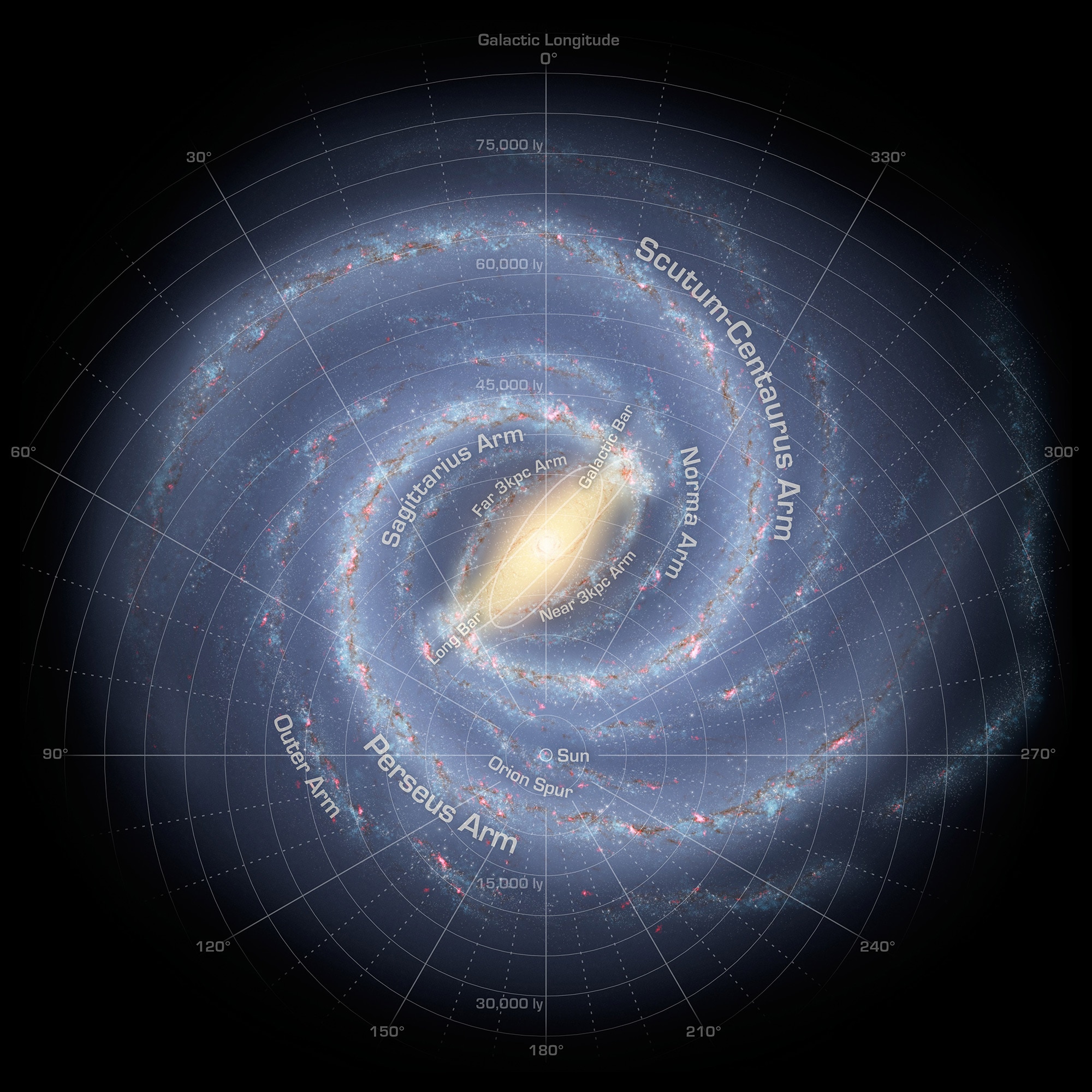
Where is the Sun located in the Milky Way?
The Sun is located about halfway out from the galactic center. But where is it vertically in the Milky Way's flat disk?
SYFY
222 points · by Santosh83 · 7y ago · 100 comments
And farther away there are not enough metals.
As best as we can tell we are at the distance where all other life would be.
You are thinking of... a ghetto.
> "The most current map of the Milky Way is shown in an artist’s representation. The Sun is directly below the galactic center, near the Orion Spur. The Scutum-Centaurus arms sweeps out to the right and above, going behind the center to the far side."
They aren't quite following best practices with attribute usage, a screenreader may read both the alt and the title text for example and they're the same here, but to have the level of detail is really commendable.
The caption you mention continues:
> The maser observed is almost directly opposite the Sun from the center in the S-C arm, 65,000 light years away.
...which makes no sense (there's no maser visible in the image or mentioned in the article) until you realise that this image was uploaded for another article and is being reused here.
Evidently the website's content management system asks for caption text when uploading the image, rather than when selecting it for use in the article. The latter is the right way to do it.
She's too young to appreciate it now when I point it out to her when we have the opportunity, and I worry that when she's old enough to appreciate it she'll be someplace she can't see it. For me it was a common thing up until I was a bit older, and now it's uncommon to be in the right place at the right time to see it. I wonder if the unlit night sky will become something like old-growth forests or other ecological sights that are long gone.
Story Time: I'm from Australia, but didn't got for almost 10 years. I lived in the Yukon, roamed all of Alaska, etc. etc.
When I got to Australia after 10 years I walked outside in the middle of a city of 50,000 people and almost fell over the stars were so bright and colourful and (seemingly) close. They were so good, in fact, I took photos right there in the middle of that city that are better star photos than anything I have ever taken in Yukon/Alaska.
If you're still in doubt, go to Australia!
You could see the band of the milky away across the sky. It was like something from Hubble.
There's nothing like looking up in the sky and getting some perspective.
That said, I've never seen the Milky Way.
I probably could if I went out somewhere far from the city, but I can't remember ever actually seeing it, even when doing star-gazing at school camp.
I'm really shocked to hear that. I feel like it's a certainty any night in Oz when it's not cloudy.
Where my family is from, in the northern US, the night sky is very clear and visible (barring clouds etc which aren't uncommon for various reasons). But where we live you can barely see much other than the moon and planets. I wish more attention were paid to light pollution.
By seeing it, realising that I am looking out from our planet across that galaxy plane. It was a very special evening.
As they say, you can be told things but you have to experience to know. I hope more people get to realise it.
I camp up there a lot, all seasons, even have full frame camera with tripod with me for night shots but you simply can't escape the glow (at least I didn't manage so far).
But to be honest, even in himalayas 2 years ago (3 passes hike in Everest region), or on Aconcagua (6000m camp) last winter the skies were mostly just OK. Of course with 30-second exposure things come to light, but I don't like those overly-photoshopped pictures of milky way so popular these days. Very little reality, too much painting with brushes with regard to color representation.
However, my mother's side of the family is from the deep south. I remember visiting relatives, and one time staring at the night sky. There were so many "things up there" I was both in awe and a little bit frightened.
With the stars gone from the skies in cities and their surroundings it is truly a dystopia, where humans will live their lives out thinking that our cities are all there is.
Out of curiosity, what is the galactic centripetal acceleration for the Milky Way that the Solar System is experiencing?
That said, the escape velocity of our galaxy is 537 km/s; almost 50 times that of the earth. Most of it is due to dark matter.
https://www.newscientist.com/article/dn24249-stars-escape-ve...
It comes to something like 2*10^-11 g
https://techcrunch.com/2019/08/01/the-galaxy-is-not-flat-res...
I don't think we have detailed data for the 100 million stars of the entire Milky Way.
Did the author answer these questions? How far above the center of the cake is 55 light years?