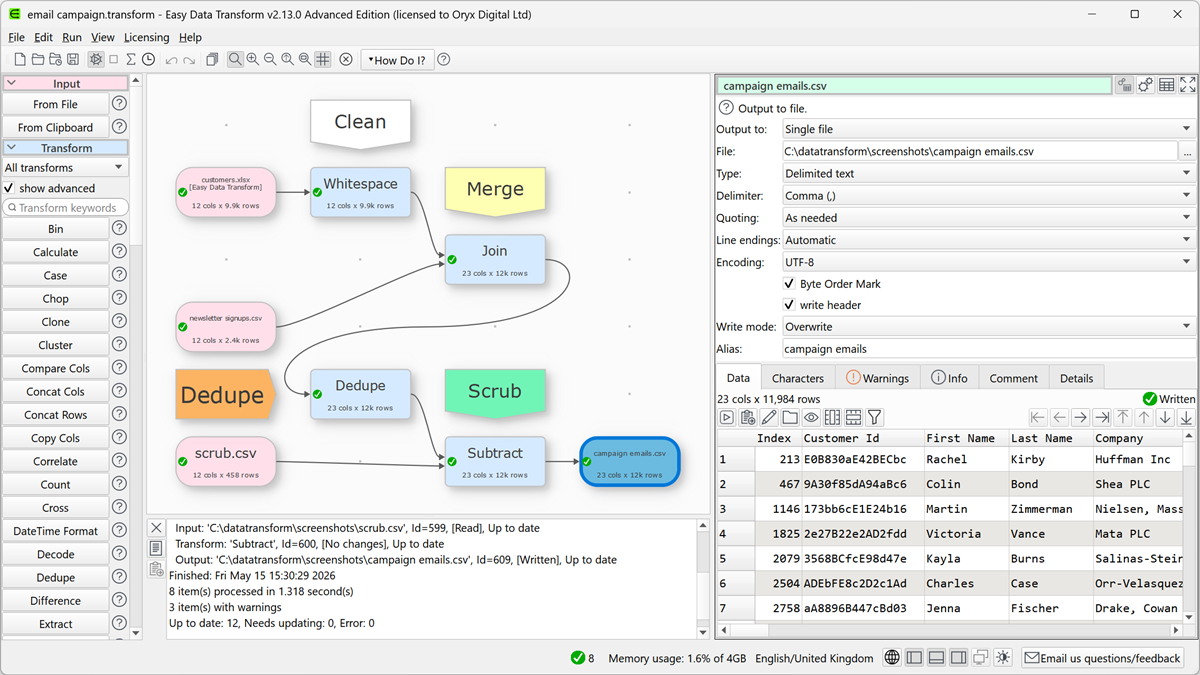
Data transformation/wrangling software for Windows & Mac
No code data transformation/wrangling software tool for Windows & Mac. Download a free trial.
easydatatransform.com
114 points · by hermitcrab · 7y ago · 61 comments
It is aimed at professionals who have data to transform, but aren't programmers or data science professionals.
Use cases include:
* making a list of all the people in mailing list A that are not in mailing list B
* filtering a log file
* joining two spreadsheets
* renaming, reordering and adding/deleting columns in a table
* reformatting dates
* de-duplicating a postal mailing list
It is desktop software for Windows and Mac, so there is no latency and you don't have to upload sensitive data to a third party server.
At some point we plan to start charging. But the current beta is free until the end of November. And there may be another free beta after that.
We would love to get some feedback. Particularly from people using it to solve real world problems.
Here’s a podcast interview I recently did with OP about his product:
https://bootstrapped.fm/2019/10/04/109-andy-brice-founder-of...
Worth listening to if you are interested in the decisions that go into creating, designing, naming, doing usability testing and promoting a desktop app like Easy Data Transform.
#1. The "Show First 10 Rows" dropdown... nice here would be "Show First 10 MOST FREQUENT Rows" ... helps get a view of the distribution of values
#2. A "Map" transformation - you can give it a list of input values and a list of one more more output values to which the inputs should be mapped. E.g. input values might be "New York", "Peekskill" and "Middletown" which map to "New York State" which can be placed in a new column (like the "If" transform)
#3. Finally because it's Hackernews... a "Function" transform allowing something like a Javascript function to be applied to a column, the output put in another column
You should be able to do this with a pivot, then a sort. But pivot doesn't work with non-numeric values at present. Next release!
>#2. A "Map" transformation - you can give it a list of input values and a list of one more more output values to which the inputs should be mapped. E.g. input values might be "New York", "Peekskill" and "Middletown" which map to "New York State" which can be placed in a new column (like the "If" transform)
You could do that with 'IF'. But I guess that could be a bit verbose and I should perhaps offer a 'Lookup' transform as well. The table lookup has the advantage that the lookup table can be created/modified by Easy Data Transform.
>#3. Finally because it's Hackernews... a "Function" transform allowing something like a Javascript function to be applied to a column, the output put in another column
Yes, an option to have some sort of scriptable transform would be very useful (even if it is slightly at odds with the "without programming" positioning). I personally loathe Javascipt, but I guess it would be easier to embed than, say, Python or Lua.
Thanks for the feedback.
Easy Data Transform is aimed at people who don't have either the skills, time or inclination to take on something like Nifi (which is most people!).
The aim with Easy Data Transform is that someone can use it to transform their data within a few minutes of first seeing it.
That's definitely true :)
When I write data-transformation code, I always have the feeling that it's often too inter-connected and an approach, like the one this tool follows, would be nicer.
Somehow the only the core idea of using these connected nodes is good, the rest of the UI is too clunky, so I drop down to "real" code again for some nodes and sooner or later the mixing up of nodes and code becomes too cumbersome and I drop down to "real" code for everything.
But, perhaps one day in the future, I might be able to add a script or plugin node, so you can add your own custom transforms.
Edit: not saying you’re shady, just that it has a vibe of being shady :)
I can see that might trigger some people to think it is of dubious provenance. Maybe I should put the above on a 'Buy' page?
BTW the software is digitally signed (and notarized on Mac) and we've been selling software online since 2005. http://oryxdigital.com/
If this is a standalone binary, what I'd want to see as a user would be a one-time purchase and an optional annual support plan.
I need to think a bit about how to flatten an XML/JSON doc into a table and then turn it back into an XML/JSON doc.
(*XLS(X) output currently only works on Windows, because it uses ActiveX. But I plan to have XLS(X) input/output on Windows and Mac at some point.)
It is true that a desktop system may not be suitable for transorming million row datasets or processing that is running 24x7 - but that is not the market we are aiming for.
https://www.kalzumeus.com/2009/09/05/desktop-aps-versus-web-...
TLDR : It depends.
1. Users always work with the latest version, so you only have 1 version to support 2. It would make monthly pricing an easier sell
But I think there are some downsides here, with an app that is solely about data:
1. If user's data has to flow through it, there are privacy, GDPR and intellectual property concerns (for both the SaaS vendor and customers) 2. Latency, since you're going to have to upload data 3. Possibly issues with bandwidth fees (I think most clouds only charge for egress bandwidth, but users are still going to want to download the processed data) 4. Monthly pricing is a big turn-off for a large segment
And there's openrefine http://openrefine.org/
Also building binaries for Linux is a pain. Which distributions to support?
Target flatpak and/or snap.
just build static binaries for x86-64
or better, distribute the source code ;)
My gut feeling is that Linux users: a) Don't want to pay for software. b) Probably have the technical chops to roll their own solution in Python/R/SQL.
It's free for non-commercial use though
Anyway - the space does need some competition so good luck with your project!
That's a bit of a stretch.