Free GPUs for Machine Learning and Deep Learning | Paperspace Gradient
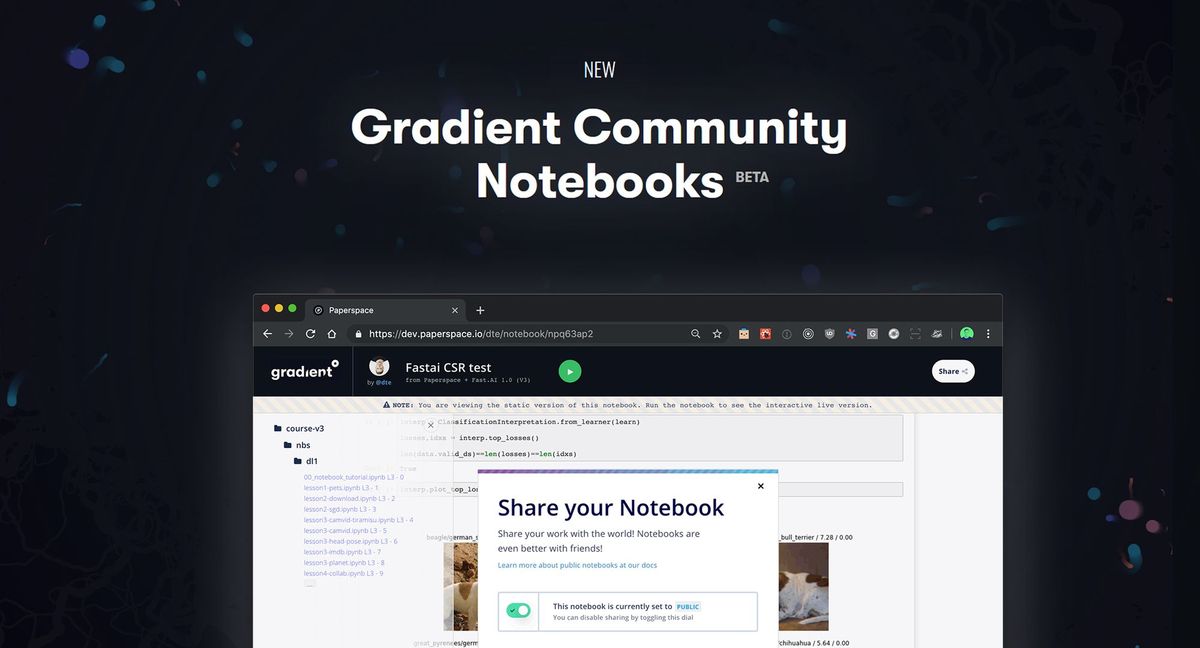
Gradient Community Notebooks provide free GPUs with pre-configured environments for machine learning and deep learning projects.
Paperspace by DigitalOcean Blog
199 points · by hsikka · 7y ago · 49 comments
Giving anyone access to free GPUs and powerful tooling seems like an incredible opportunity. I'd love to hear what you all think!
Other similar services include Kaggle (way more locked down) and Baidu's free GPU powered notebook platform (only open to Chinese citizens)
But as a cloud provider, I would be worried about abuse by cryptojackers. I hope that's not a problem and this is sustainable.
Google Colab is decent and free.
But you can do computing on cheaper hardware too. The CPU is good enough for learning and a GPU is not outside the budget of many people that presumably already own laptops and such.
I know a local group that shares an i9 / dual GTX "server" and are learning on this shared hardware. I think it's great!
I had a small budget for this learning curiosity and bought a Ryzen and a GTX with only 4GB of RAM. Got a job offer after a while which I had to turn down as it seemed to actually kill my interest in the field. Doing some small personal project now without much fuss to rekindle the fire. And using the CPU for it since it's so small.
Am wondering what to use for the data tier? Is there a dedicated backing cloud store supporting BigQuery style syntax? Import form S3 datasets?
Checkout the docs here -> https://docs.paperspace.com/gradient/data/storage
And happy to answer any other questions
Do you guys have a trademark for the name Gradient? I am developing a C#/.NET binding to TensorFlow with the same name: https://losttech.software/gradient.html
If you do, do you mind that clash of names?
Secondly, would you be interested to invest in providing .NET-powered notebooks? I just got it working on Azure Notebooks for F# ( http://ml.blogs.losttech.software/What-New-In-Preview-6.4/ ), but I feel like there would be more interest from C# developers. There is a good C# Jupyter kernel out there.
Do you think there's a format which is better suited to sharing data stories?
I agree with that problem, yet somehow like the idea of notebooks. Maybe the real tragedy here is that jupyter notebooks are saved as json and not as a valid program with comments, that can be run "as is" from the command line.
You are right that versioning is still an issue and we largely punt on it by using the docker container (with layer commits on each notebook teardown) as the versioning mechanism. Maybe not the best solution but it does have it's advantages.
Data is the second problem - you usually can't run a notebook without it. If the notebook transforms data over time, it can be a real issue.
Here's a pretty complete run down of the first problem, the .ipynb itself: https://nextjournal.com/schmudde/how-to-version-control-jupy...
An integrated solution that versions data, the notebook, and the computational environment (collaborators will make changes over time) is the ideal collaborative platform.
Disclaimer: I use Colab regularly as part of my job in Google.