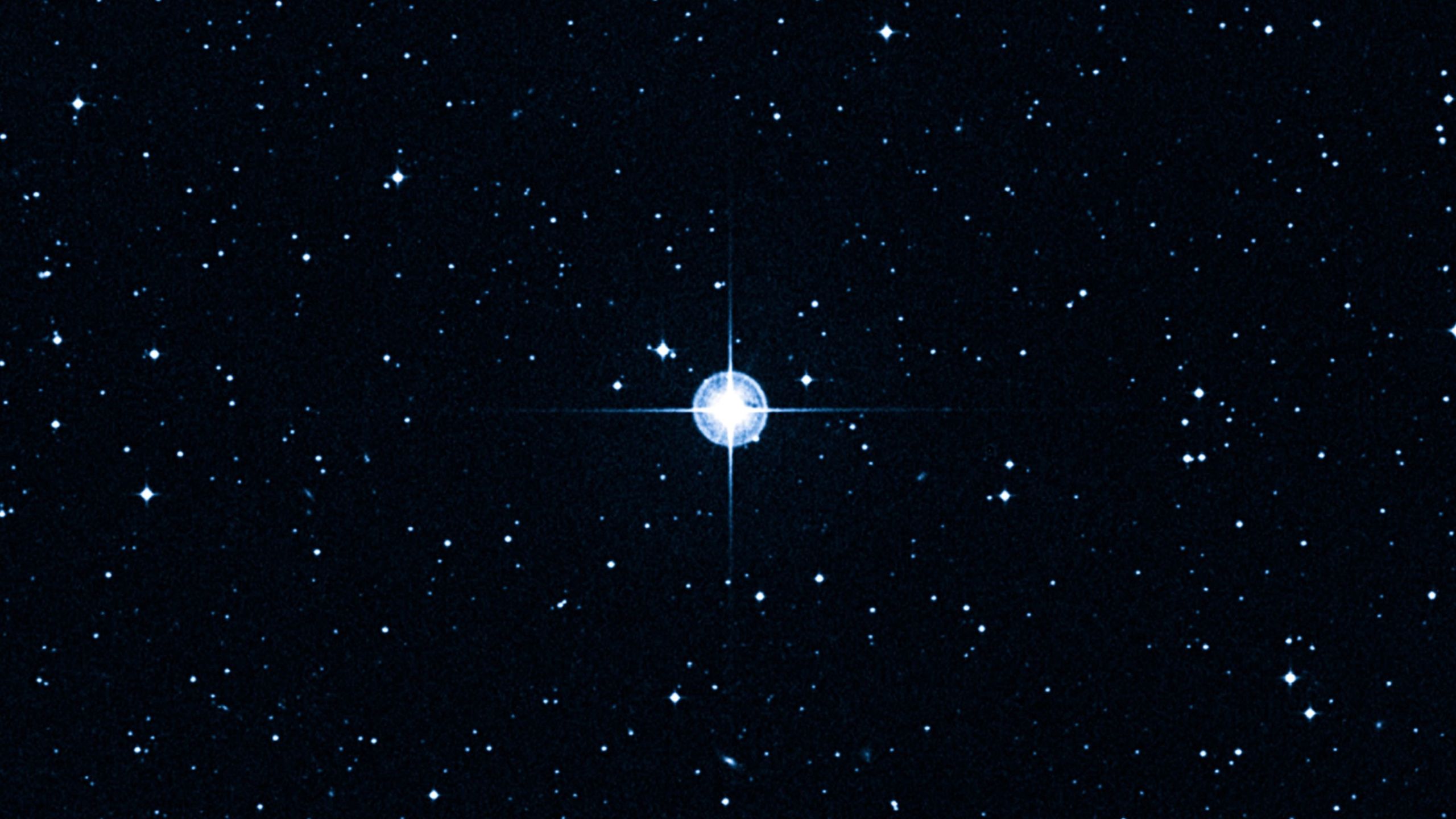
Methuselah: The oldest star in the universe
How can a star be older than the universe?
Space
261 points · by QuitterStrip · 7y ago · 222 comments
At first glance, the distance of 32 billion light-years (9.8 billion parsecs) might seem impossibly far away in a Universe that is only 13.8 billion (short scale) years old, where a light-year is the distance light travels in a year, and where nothing can travel faster than the speed of light. However, because of the expansion of the universe, the distance of 2.66 billion light-years between GN-z11 and the Milky Way at the time when the light was emitted increased by a factor of (z+1)=12.1 to a distance of 32.2 billion light-years during the 13.4 billion years it has taken the light to reach us.
I don't know enough General Relativity to give a solid explanation. But here is a rough over-simplification: Imagine you've spent the last 5 seconds blowing up a balloon, but there is an ant walking on that balloon, starting from a marked spot.
In the 1st second, the ant moved 10mm. But in the next four seconds you blew up the balloon, so that 10mm of rubber is now 70mm long. The total distance from the ant's starting mark to her end-point can now be well over than 70mm, even though she only walks at less than 10mm/second.
As the ant, so the photon.
The thing is we cannot see such a star in visible light spectrum anymore. The light of the star has shifted to infrared or microwave. Why? Because while the light was traveling in spacetime, the spacetime itself expanded and stretched the light wavelength. When you take a redshift into account, you can correct the distance and figure out that the star must be, say, 40B light years away.
By the way, note that this is all about the observable universe. There might be stars beyond our observation horizon that we might never see due to rapid expansion of the universe.
The space between objects can also expand faster than light, the object itself can still not move faster than light. If the space between two objects is expanding faster than light then for all intents and purposes, the other objects no longer exists to another. There is no way to contact or observe that object other than the light that was send your way before space went FTL.
The expansion of space itself doesn't violate that - you couldn't use it to communicate with someone in an FTL way.
My friend and I both live at different points on the surface of a balloon with distance A. I throw a ball at light speed while the balloon is being inflated, and the distance between us is B when the ball reaches him after T time.
To my friend it seems that the ball was thrown at B / T speed, which is faster than the speed of light.
There is no meaningful spatial boundary at a point that is currently at a distance of 13.8 billion light years from us. We can detect (severely red-shifted) photons from beyond that point perfectly fine! The actual boundary is 46.5 billion light years away in both directions, hence the "observable" diameter of 93 billion.
But of course the meaning of "observed" is kinda strange here, since we're not directly measuring the distance but estimating it based on from other observations.
Just to fit a bunch of observations that wouldn't otherwise make sense for the current model.
I remember the story of a chap from Pisa having a hard time trying to budge a bunch of clerics to consider his observations proof that their model was broken. ;)
That's very similar to a wormhole, but without the topological flaw.
Imagine two people (which are galaxies) walking in the same direction on a travelator (which is spacetime). Ordinarily one person would reach the end, and then in a predictable amount of time so would the other. But if the travelator is expanding evenly in both directions, then the distance between the two people will increase, even though they're walking at the same speed.
Travel happens inside the universe and expansion doesn't? If a rock is sliding along a stretchy sheet, stretching the sheet will make other things on the sheet move farther away from the rock, potentially faster than the fastest that the rock can slide, even though the rock doesn't move any faster.
They mention that the current universe age fits "within the bars", for example but also mention arguments for universe being younger as well, which would again put the measurements at odds.
Basically, both of these values involve a string of assumptions and while getting every single one of them to high accuracy is a remarkable achievement, the chance of some glitch in either measurement is significant.
I don't see why I'm being down-voted because as of yet no one has answered that question. I'm not saying the Big Bang didn't happen. I'm saying we have no observations that give us any confidence we'll never encounter something that wasn't part of the Big Bang. This star actually pre-dating the Big Bang is extremely unlikely, I agree. The simpler explanation is the uncertainty in it's age estimation. But equating "the observable universe" with "stuff that originated in the Big Bang" is an assumption we simply don't have much reasoning for, other than we haven't seen much other stuff. But then... we also don't see many stars this old.
It wants to be the answer, yet the facts don't really align with the premise of the question. We just shoe horn a litter of observations into some post-hoc rationale for how the universe "began" and then we retcon anything that doesn't make sense, when we think more deeply about it.
It's fine to have cosmic background radiation, and elemental distributions and ratios, and sure that all kind of lines up, pointing to some large, highly influential event in the past.
But just because we can chart certain facts doesn't mean the story stops where our charts end.
I'll concede that something really important happened 13-ish billion years ago, and that it represents a significant temporal horizon, beyond which we cannot draw conclusions, yet because we cannot see beyond the peaks of some mountain range does not mean the edge of the world resides on the other side.
All the mental backflips required to rationalize The Big Bang, and then from the other side of your mouth, murmur that it actually wasn't a "bang" but instead an "expansion" really just result in a colossal defrocking of the theory.
  Hey look guys, here comes
  emperor Big Bang in his
  super comfy new clothes!
And if it seems that we don't really know what was going on, as we try to recreate a march back inward to the hypothetical origin singularity, and every time we try to walk events backward, they stop making sense, we just need to say we don't really know.
The Big Bang is a smelly theory, and it smells wrong. There's a lot of evidence of a really powerful event some 13 billion years ago, and it may have been transformative, but there's no basis to the claim that it was truly event zero.
Just as possible is that we're the fallout of some localized very large bang, that cleared out a radius of space time that is more distant than we can observe. This idea is not interchangeable with the big bang origin story of the universe. It's not an Occam's razor victory in favor of the big bang.
If we are stuck within a spatial temporal crater as the result of a non-unique very large bang, it would mean that we can look differently at how we model the bang, and come up with saner conclusions than "oh, it just popped into existence, and then went kablooey, and that's okay because the very idea of time is bound to that ever even happening at all."
Like, sorry, that hand wavey whitewash doesn't adequately paper over the possibility of retconning some nonsense into the narrative, because it would be a threat to academic authority to say "we don't know" regarding the nature of a hypothetical origin singularity.
I get that there's no evidence beyond the reaches of our deepest observations, but it's lazy to put forward that because we can't grasp at evidence beyond certain terrestrial limits, then we get to say that we know conclusively that the observable limits are known to be the actual limits and thus the assured origin of all space time.
What we should say is that there is a depth beyond which we cannot summon further evidence, and while there seems to be some tumultuous event back there, we don't know what happens prior to that or where that limit comes from.
Because we really don't know.
Hence, no one would ever know if a star was there in the first place.
Understanding the difference between Type I and Type II Cepheid variables lead to a greater estimate for the age of the universe, resolving the difficulty. So I expect some interesting astronomy to come out of tracking down the cause of this discrepancy.
Hypothesis 1: the star formed in a way that did not involve or produce a lot of iron.
Hypothesis 2: the star is older than the universe itself.
Clearly, hypothesis 2 is the more likely.
Strap yourselves in folks, maybe The Big Bang is but one event woven amid a deeper tapestry of events, significant only in its capacity to occlude deeper periods of time.
It should surprise no one that we might be wrong about some centralized, focal aspect of the universe, given how wrong we've been before, about things we assumed to be the center or origin, previously.
I imagine something similar is going on here. The article mentions that once they got an age older than the universe, they started looking at how to make the star younger...finally by acknowledging the margin of error in estimates. That sounds like bad science to me.
Later (in section "Taking a closer look at the age of the universe"), they tell that your theory is also being looked into.
Imagine that you know physics and math very good. But then simulation suddenly fails due to segfault and you realize that all your knowledge was just a gibberish nonsense and your work sessions and discussions were dream-like experience. Otherwise it was just a pretty dumb 3d simulation slightly better than a modern AAA game.
Edit: I mean, a simulation argument opens a huge can of worms, if you consider the perspective of a lazy simulation developer them-self.
Even if some external observer can pause, rewind, intervene and violate rules, the reason a simulation exists is to model something else.
This "something else" will have some kind of rules, and the goal of the simulation will be similarity to the actual realm external to the simulation.
Meanwhile, a lazy replication of a model by an unmotivated author would likely impose finite quantities upon scales of interaction, since a simulation won't be able to recreate a real time version of something larger than the external reality itself.
We wouldn't notice a lagged simulation that tries to consume its footprint, but it's probable that an artificial creation would impose caps on aspects of a system to prevent runaway reactions that produce useless simulations. To us, those sorts of limitations would resemble extra physical laws, and while incontrovertible to the simulated entity, such limits might confront intuition in strange ways.
You really should read it, it's one of the best books in the culture series and Banks was a phenomenal writer.
It also contains the Affront, a species that are almost comically awful and coined the term "outside context problem":
"The usual example given to illustrate an Outside Context Problem was imagining you were a tribe on a largish, fertile island; you'd tamed the land, invented the wheel or writing or whatever, the neighbors were cooperative or enslaved but at any rate peaceful and you were busy raising temples to yourself with all the excess productive capacity you had, you were in a position of near-absolute power and control which your hallowed ancestors could hardly have dreamed of and the whole situation was just running along nicely like a canoe on wet grass... when suddenly this bristling lump of iron appears sailless and trailing steam in the bay and these guys carrying long funny-looking sticks come ashore and announce you've just been discovered, you're all subjects of the Emperor now, he's keen on presents called tax and these bright-eyed holy men would like a word with your priests."
EDIT: I could be wrong though, and additionally I believe the star being referenced by the article is actually in a similar reference frame so relativity likely isn't the answer anyways.
What we'd need is most stuff (that gave rise to most stars and most of our measures of the age of the universe) to be in a higher-gravity region compared to the star in question. It seems unlikely, but I suppose it's possible...
[Edit: I thought you were talking about GR time dilation due to gravity. A re-read shows that I may have been in error.
Also, for a star 190 ly away, any relativistic explanation, either special or general, is probably wrong.]
However, if most of the known universe is sitting next to a gigantic mega-blackhole (or enough of them to cover the whole sky), then surely we would have noticed by now...
Only if we take path of how the previous geniuses went through we will have a flawless exploration. Instead of doing that, if we work on someone else's work, its like eating someone else's recipie and trying to remake the tase of it without understanding the ingredients in it.
What we have are just different estimates for the age of our universe. And none of them involve simple measurement, obviously. So the challenge is finding the artifact(s) that generate the disagreement.
I’m new here, so instead of answering questions is the protocol just to downvote?
and it's a Libra.
Even if this was rare and there happened to be tonnes of very old stars only close to us, this could again be coincidental, especially if intelligent life is more common than we currently know.
0.120 stars/parsec^3 * 4/3 * pi (190 ly * parsec/3.26ly)^3
"Thus far, they have uncovered and studied in detail about ten ultra metal poor (UMP) stars"
Does a shortest path between you and your workplace exists that you can traverse? Is it a straight line? No, it's not, but there's one path that you as a being can walk along physically. The buildings, roads, obstacles force you to diverge from the ideal straight line. That's another analogy of what space & time is. Fabric is just shorter.
> On 11 February 2016, the LIGO and Virgo Scientific Collaboration announced they had made the first direct observation of gravitational waves.