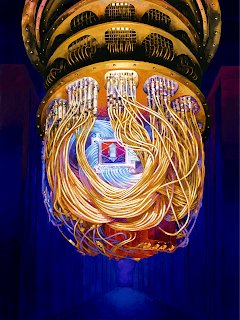
Quantum Supremacy Using a Programmable Superconducting Processor
Posted by John Martinis, Chief Scientist Quantum Hardware and Sergio Boixo, Chief Scientist Quantum Computing Theory, Google AI Quantum Physicist...
ai.googleblog.com
701 points · by ilamont · 7y ago · 179 comments
IBM's critique https://news.ycombinator.com/item?id=21333105
Scott Aaronson's blog https://news.ycombinator.com/item?id=21335907
Note, that the "extended Church-Turing thesis"[1] says something very different than the actual "Church-Turing thesis" (and is also not due to either Church or Turing).
The original Church-Turing thesis is not challenged at all by these experiments. Indeed, it has been shown that quantum Turing machines are not computationally more powerful than deterministic Turing machines - as in: any program that can be computed by a quantum Turing machine can in principle also be computed by a deterministic Turing machine (it just might take a little/a lot longer).
The extended Church-Turing thesis is concerned with the performance of a computation and says something about the "efficiency" of the computation.
The original thesis is concerned with what's possible, while the extended thesis is concerned with what's feasible.
[1] https://en.wikipedia.org/wiki/Church%E2%80%93Turing_thesis#V...
In the preprint, it is argued that their device reached “quantum supremacy” and that “a state-of-the-art supercomputer would require approximately 10,000 years to perform the equivalent task.” We argue that an ideal simulation of the same task can be performed on a classical system in 2.5 days and with far greater fidelity.
https://www.ibm.com/blogs/research/2019/10/on-quantum-suprem...
Basically what IBM is claiming is that Google's circuit doesn't do anything useful really, it is just meant to be very complicated to do in traditional computing systems. And even in this idealized position, Google's quantum computer doesn't transform an unsolvable problem into a solvable one.
According to IBM, "Quantum Supremacy" means accomplishing something useful to the society, that simply wouldn't be possible to do otherwise. Google's article doesn't show any sign of that, IBM claim.
Reading the IBM article, they are fully aware of what "quantum supremacy" means in a technical sense, and they are urging the media not to use that term, since it will be misunderstood by the public. Their claim that Google has failed to achieve supremacy rests solely on their claim that they can simulate the circuit far faster (and scale the simulation linearly) using better classical algorithms.
That's a strong claim, and I'm interested in seeing what Google responds with.
Disclosure: I work at Google, but hahaha, no, I'm not cool enough to work on this.
Another thing, this is actually Martinis' decades long work. I know Google recently started raining money down on his lab a couple years back, helping with the classical aspects, design etc, and media loves reporting as Google's Quantum Computer, but the actual quantum computer, the nitty gritty physics isn't Google's work. Martinis already had a working setup with ~10 qubits when Google started supporting him ~5 years ago.
This IBM "rebuttal" sounds a bit like cheating on multiple aspects, and the timing of the announcement is interesting. Note that they don't tell you how the memory requirements grow with the number of qubits either (which is exponential as well). I expect the response will be new toy computation proposals which will also be prohibitively expensive in classical memory (not just classical CPU with limited memory) in current supercomputers as well. If the experimentalists can roll out more qubits faster though (less likely), the "concern" will be addressed as well.
I often wonder why people feel compelled to write this. There nothing in your profile or in your post history to prove unequivocally you do or don’t work anywhere in particular so why even mention it?
Edit; responders are citing ethics and company policy; but does anyone really think vague hand wavey speculation on a public message board is relavant to anthing?
Sure if you work in the ads group and you posted "wow, our division is in trouble, competitor Z is really killing it, and our quarter earnings are going to miss big time!" Yeah that matters, but GP? Really?
I thought that the whole point was to show that what you'd done definitely wasn't just build a complex classical processor. The usefulness of the calculation is besides the point.
Quantum Supremacy is more about where quantum computers are clearly superior to non-quantum computers to solve a problem.
I posted an article explaining more: https://news.ycombinator.com/item?id=21337739
All in all, it seems more of a battle of semantics, and the two companies talking past each other. It's kind of how everyone seems to interpret Moore's Law to mean "any progress in computational performance whatsoever" these days, as opposed to the original definition of "transistors doubling in the same space every 18-24 months," and then using that to "prove" that "Moore's Law is still alive." (it's not, and hasn't been for a long time).
I think in the end what's important here is that it was proven that a quantum computer can do "something" (yes, even anything at all is a big milestone) significantly faster than a classical system.
Because this is what matters in the end that quantum computers can do some tasks significantly faster than classical systems. They don't have to do only tasks that are "impossible" for classical systems to be useful. It's also why we use GPUs, FPGAs, and ASICs for some tasks, instead of just using CPUs for everything.
I do agree that it was in Google's interest not to work so hard on optimizing the classical system for the simulation, to make its quantum computer look that much more impressive. But if the quantum computer is still faster, then it doesn't really matter.
Or is there some catch that undermines that headline claim?
Do you think it wouldn't be possible to simply upgrade the supercomputer to shave some time off those 2.5 days ?
To me it seems clear that everyone gullible already bought into the Cloud, ML/AI, CI/CD buzzwords and now they need a new buzzword to market.
> and with far greater fidelity
comes into play.
Some overhead is expected when using different hardware to simulate it.
What matters is asymptotic computational and memory complexity.
The QC isn't cheap or available enough to be relevant is your can compute it reasonably well in a few days.
A source of this confusion is that we need to discuss space and time complexity simultaneously. In the algorithms for quantum simulation (and many other algorithms), there is a trade off between space complexity and time complexity. ELI5: You don't have to store intermediate results if you can recompute them when you need them, but you may end up recomputing them a huge number of times.
For the quantum circuit, the standard method of computation gives exponential memory complexity in number of qubits (store 2^N amplitudes for a N qubit wavefunction) and time complexity D2^N, i.e. linear in circuit depth and exponential in number of qubits. For example, under the IBM calculation, 53 qubits at depth 30 use 64 PB of storage and a few days of calculation time, while 54 qubits use 128 PB and a week in calculation time. Adding a qubit doubles the storage requirements AND the time requirements.
Under google's estimation of the run time, they were using a space time memory tradeoff. There is a continuous range of space-time memory tradeoffs - USE MAX MEMORY as IBM does, MAX RECOMPUTATION (store almost no intermediate results, just add each contribution to the final answer and recompute everything) and a range of in-between strategies. While I don't know the precise complexities, the time-heavy strategies will have time complexity exponential in both N and D ( 2^(ND) ) and space complexity constant.That's why googles estimate for time complexity is so drastically different than IBMs.
Side note: IBM also uses a non-standard evaluation order for the quantum circulation, which utilizes a trade-off between depth and number of qubits. In the regime of a large number of qubits, but a relatively small depth, you can again classically simulate using an algorithm that scales N*2^D rather than D2^N, using a method that turns the quantum circuit on its side and contracts the tensors that way. In the regime of N comparable to D, the optimal tensor contraction corresponds to neither running the circuit the usual way or sideways but something in between. None of these tricks fundamentally change the ultimate exponential scaling, however.
As an extra step, you could also run compression techniques on the tensors (i.e. SVD, throwing away small singular values), to make the space-time complexity tradeoff into a three-way space-time-accuracy tradeoff. You wouldn't expect too much gain by compression, and your accuracy would quickly go to zero if you tried to do more and more qubits or longer depth circuits with constant space and time requirements. However, the _real_ quantum computer (as Google has it now, with no error correction) also has accuracy that goes to zero with larger depth and number of qubits. Thus, one can imagine that the next steps in this battle are as following: If we say that Google's computer has not at this moment beaten classical computers with 128PB of memory to work with, then google will respond with a bigger and more accurate machine that will again claim to beat all classical computers. Then IBM will add in compression for the accuracy tradeoff and perhaps again will still beat the quantum machine.
So this back and forth can continue for a while - but the classical computers are ultimately fighting a losing battle, and the quantum machine will triumph in the end, as exponentials are a bitch.
Each run of a random quantum circuit on a quantum computer produces a bitstring, for example 0000101. Owing to quantum interference, some bitstrings are much more likely to occur than others when we repeat the experiment many times. However, finding the most likely bitstrings for a random quantum circuit on a classical computer becomes exponentially more difficult as the number of qubits (width) and number of gate cycles (depth) grow.
It sounds like they're saying "simulating this physical process accurately is extremely computationally expensive, but just running the physical process in the real world is MUCH faster". But that's true of basically any physical process!
Simulating turning on a single lamp in a room and figuring out how much light falls on what walls is an enormously computationally expensive process, which can take immense amount of time to figure out (depending on your desired level of accuracy). Movie studios, CG artists and game companies build entire render farms to solve this problem. But the physical process itself (just turning on the light) happens instantly. Just replace "turning on the light" with "running a quantum circuit".
The trouble is we don't know many (any?) interesting algorithms to run on such processors. We can factor prime numbers using Shor's algorithm, but the numbers we can factor with 54 qubits are so small that our best non-quantum algorithms on our best non-quantum computers far outperform them. No supremacy is demonstrated. It's only when one takes problems that are ideally suited to run on this processor that it outperforms classical computers.
Even with the deck stacked this way, it's taken until 2019 for it to be done for the first time! It's a very, very early milestone.
Quantum "supremacy" only feels like a real thing when a quantum computer can solve a problem that isn't directly tied to the simulation of itself. That's my feeling, anyway.
BTW: this is not to disparage the work itself. This seems like great research, and great progress in this field. Good on Google and the researchers!
I just want to emphasise that there were people who believed that even this small step was impossible. Prominent quantum-computing skeptic Gil Kalai believes that scalable quantum computing is impossible in principle, and believes that this paper didn't achieve what it claims, but he says that his view would be refuted if they did! (This is in contrast to IBM, who isn't criticizing the quantum side of the experiment, but the comparison to classical computing; and to the Internet commentariat who are saying that even if they did everything they claim, it's not interesting).
While that's true, there are a great many physics researchers who are extremely interested in quantum effects. A computer that quickly simulates quantum circuitry, if only for study / practice, is still extremely useful.
In effect: a lamp isn't very important because most engineers and researchers already knows how a lamp works. But quantum circuits are itself an interesting, barely-studied, field with few experts truly understanding it yet.
https://www.osapublishing.org/prj/abstract.cfm?uri=prj-7-8-8...
EDIT: it looks like it only has a single, weird, type of gate. But I guess the connections between gates are configurable? Still different to a lamp!
GANs for generating random organisms anyone? Human 2.0 can probably come about after some of the feature vectors are figured out via PCA on the activations. Just boost feature vector for intelligence.
Anyways, yeah! Real matter is already programmable. As programmers its easy to forget that physics says this whole thing is all a monism of information and computation. Code and data. Yin and yang. Even the prime numbers come about as data because of self modifying code. P(0)=2 but all future primes are defined by not being divisible by P(x<n) - think snake eating its own tail and yet growing while doing so.
In fact, the most beautiful part about the prime numbers is that they are defined sequentially yet alternative constructions exist which are `atomic`. It is odd that something defined in such a sequential process would form a beautiful structure that can be reduced to direct construction. Relatedly, we see this all the time with recursive functions being turned into procedural ones or functional style data pipleline transformations.
The ordering is actually irrelevant to the chaos that the primes display between multiplication and addition. That is, if you defined the first prime as 3 you would yield an entirely different set of primes. For example, 4 would be prime. Beurling figured this out and a lot more through what he called Generalized Primes [1].
Reminds me of the last line from Watson and Cricks 1953 Structure of DNA paper: "It has not escaped our notice that the specific pairing we have postulated immediately suggests a possible copying mechanism for the genetic material" ;)
I bring up genomics specifically because the main profit driver appears to be biotech. Predicting near-instantaneously whether regulatory proteins bind to a target genome site could revolutionize drug discovery.
And while full "programmatic" control of transcription factors may be dozens of years away. In the near term, annealing based ML can speed up analysis of genome-wide datasets
Unconventional machine learning of genome-wide human cancer data
It’s hard to parse what the actual thing being computed is.
"Hey, we have a new fluid flow simulation processor that reaches CFD supremacy over classical computers... we pour water across the surface of things and the results are indistinguishable to reality compared to the days, weeks, months it would take to simulate and still wouldn't reach the same resolution of accuracy on a classical computer."
I’m wondering if there is some other way the problem could be computed without having to simulate qubits.
By taking an ensemble of real-live measurements, you can infer what the most probable eigenstate is, which is the "output" of the program.
Compare this to, for example, D-Wave. As far as I understand their quantum computer they could show it was faster but it was "X times faster" rather than scaling in a completely different way.
[0]: https://github.com/quantumlib/Cirq/tree/master/cirq/experime...
Can I ask an honest question? Shouldn't people be scared shitless of quantum computing?
If a single organization develops the ability to factor prime numbers at unheard-of speeds, doesn't this put in jeopardy the mathematical backbone of all encryption, and therefore don't they pose a threat to all financial institutions? Don't they then have the power to hold the world at ransom?
I don't mean this as a conspiracy theory -- I don't think an actual "event" is even necessary to pose such a threat. If it's proven that theoretically sound classical encryption can be theoretically cracked in record time by quantum computers, I am afraid of what will happen to the world financial markets due to panic. Nevermind the first time it is actually used to steal billions of dollars, or some other large-scale event.
I'm no expert on quantum computing, please enlightenment if indeed Shor's algorithm does not pose a threat to privacy or to the financial markets. It would help me sleep at night. For now, I do think the idea is not totally unfounded [1] and therefore quantum computing, for all the positives (eg fast solves for hard optimisation problems, which would have massive applicability), scares the living daylights out of me.
[1] https://web.archive.org/web/20121115112940/http://people.ccm...
Two things:
1. It's extremely unlikely that this will happen overnight, and practical factoring is still pretty far away compared to today's quantum computing state.
2. There's work done on developing post-quantum-cryptography (which is in essence all cryptography that we believe cannot be broken by a QC). NIST, the US standardization organization, is currently running a competition for future standards. It has some challenges, but it's doable.
That still leaves the issue that past-time communication may be decrypted in the future. But other than that - we will almost certainly have alternatives when QC factoring becomes real.
> That still leaves the issue that past-time communication may be decrypted in the future.
Honestly I didn't even think of this. Pretty freaky nonetheless.
I'm very perplexed that the main article states that "𝑃(𝑥_𝑖) is the probability of bitstring 𝑥_𝑖 computed for the ideal quantum circuit", but Supplementary Information section IV.C seems to argue that if the "qubits are in the maximally mixed state" (i.e. the quantum computer doesn't work) then "the estimator [𝐹_𝑋𝐸𝐵] yields zero fidelity" since 𝑃(𝑥_𝑖)=1/2^𝑛 for every 𝑖 in this case. To me this doesn't make sense, since P(x_i)=1/2^n is clearly the probability mass function of the empirical non-ideal quantum circuit output distribution (and not the ideal one).
I've posted a question on the QC stack exchange: https://quantumcomputing.stackexchange.com/questions/8427/qu...
"In summary, unlike the objections of the IBM group, so far I’ve found Gil’s objections to be utterly devoid of scientific interest or merit."
Yikes.
IBMs responce: "We argue that an ideal simulation of the same task can be performed on a classical system in 2.5 days and with far greater fidelity. This is in fact a conservative, worst-case estimate, and we expect that with additional refinements the classical cost of the simulation can be further reduced." From: https://www.ibm.com/blogs/research/2019/10/on-quantum-suprem...
Currently at a much greater cost in time and space, which is why they are saying "can be performed" not "has been performed".
> we expect that with additional refinements the classical cost of the simulation can be further reduced
Any such refinements would be certainly interesting to see, as they would probably be very hard won.
or efficiently are terms of trade for computer scientists and mean that there's a polynomial upper bound.
On the other hand IBM also claims (from the graphs? not sure if they have anything more to back up the claim) that their scheme "scales approximately linearly with the circuit depth" which would likely make the experiment meaningless.
The entire post is a bit odd though since it starts out with a serious discussion of computer science topics and then swerves into criticism of how the media misuses terms.
From Scott Aaron's blog post about this paper: https://www.scottaaronson.com/blog/?p=4372 -- he shares some thoughts on whether this benchmark is itself easy or hard to simulate on a classical computer.
> Ah, but at the end of the day, we only believe that Google’s Sycamore chip is solving a classically hard problem because of the statistical test that Google applies to its outputs: the so-called “Linear Cross-Entropy Benchmark,” which I described in Q3 of my FAQ. And even if we grant that calculating the output probabilities for a random quantum circuit is almost certainly classically hard, and sampling the output distribution of a random quantum circuit is almost certainly classically hard—still, couldn’t spoofing Google’s benchmark be classically easy?
He goes on to supply an argument that its a hard test to spoof classically.
I'm wondering though -- has anyone addresses how hard it would be to spoof this benchmark using a collection of smaller (potentially non-scalable) quantum computers ...? E.g -- if it were possible to spoof the benchmark with a smaller quantum computer -- would that undermine the argument in the paper that this benchmark is evidence of quantum computing scaleability ...?
I wrote about half of the wikipedia article that Google is using to explain how their quantum computer works (https://en.wikipedia.org/wiki/Quantum_logic_gate)
Should probably had done that using a pseudonym, and not just anonymously using my IP address.
But at least the IP address I used for the last weekends work is my homes static IP, that almost never change.. But still. I need an account at wikipedia!
If I treat my quantum computer as just a channel for sending a message to myself I think I can invoke the channel capacity theorem. Furthermore, I think that if I try to read an entangled state, it's as if I am reading the entire state all at once, so the maximum number of bits I should be able to read is bounded by the logarithm of the ratio of the signal to the noise, where noise scales with temperature. That number doesn't scale well. It suggests that if I want to read an additional bit from a quantum computation, I need to drop the temperature by half.
Furthermore, I introduce heat to my quantum computer when I input the state. I must construct the input to my quantum computer from a uniform mixture by the no cloning principle. This is going to generate heat, and the rate at which I can dissipate that heat is bounded by the speed of light, This gives me an upper bound on my temperature of O(1/t^3) assuming extremely optimal heat dissipation. This means that the time required to cool my state to the point where I can read n entangled bits is exponential in n, right?
You can't read the entire state. A quantum channel where you send n-bits lets you read n-bits, not exponential in n-bits.
There is indeed reduction of signal as you increase temperature. Under the error correction theorem, you can amplify that signal back to full strength as long as you are under a threshold temperature (but with ever-increasing resources as you approach the threshold temperature.)
Also this: "This is going to generate heat, and the rate at which I can dissipate that heat is bounded by the speed of light". Sure, the heat has to be transferred out of the system, which takes time that is bounded by some distance divided by the speed of light. But the qubit is on a 2D chip surrounded by a 3D refrigerator. The distance doesn't necessarily increase with increasing qubits.
An entangled state is different, Since I can read all of the bits outside of each other's light cones, they cannot causally influence each other, which is why I said as if instead. There is no such thing as "all at once", but I can properly read each qubit before all of the others, as far as that qubit is concerned and it would still obey the correlation. The reading of an entangled quantum state is indeed a single measurement.
>Under the error correction theorem, you can amplify that signal back to full strength as long as you are under a threshold temperature (but with ever-increasing resources as you approach the threshold temperature.)
2) I don't think that quantum error correction ultimately solves the problem of heat. It tries to solve the problem of single bit/sign flips from not doing your computation in a closed system. My argument assumes that the only things that exist in the entire universe are the computer and the heat.
"This is going to generate heat, and the rate at which I can dissipate that heat is bounded by the speed of light". Sure, the heat has to be transferred out of the system, which takes time that is bounded by some distance divided by the speed of light. But the qubit is on a 2D chip surrounded by a 3D refrigerator. The distance doesn't necessarily increase with increasing qubits.
3) you're misinterpreting my statement of the problem. I don't have to get each additional qubit just as cold as the original. Every qubit I add requires me to get the entire quantum state to half the temperature that I had previously. The geometry of your refrigerator here only matters in that it's finite dimensional.
To be honest, after the hype I was expecting there would be more applications.
In terms of where I am personally excited about quantum computing, it has the potential to greatly speed up simulations of chemical and material science properties that are currently hard to simulate accurately at all. This will be great for, for example, semiconductor development and medicine. These applications are a ways off though, but if we weren’t hitting milestones like today, it would suggest they were not worth vigorously pursuing.
Disclaimer: I work at Google, not on quantum computers. Not an expert in quantum computation.
In coming days, I am sure many will perform the independent analysis of these datasets.
HFS!
As for where we are with Shor’s algorithm, it works by figuring out the prime factors of an integer (which is how RSA keys are constructed). In 2001, IBM factored the number 15 (into 3 x 5) using a quantum computer with 7 qubits. In 2012, they were able to factor 21 into 3 x 7, which is currently the largest number factored using Shor’s algorithm.
Given that cryptographic keys run into the hundreds and thousands of bits, Shor’s algorithm isn’t going to be a threat anytime soon. But note, too, that it’s focused on RSA, which is the original PKI algorithm. Newer algorithms exist which aren’t threatened by Shor’s algorithm, and work is already underway to develop new quantum-resistant PKI algorithms.
We’ll hear about it when low-bit RSA is easily cracked. And for several years it will be good enough to just increase bit lengths to stay ahead of it. Given all of that, I’d expect it’ll be 20-30 years before quantum computers are a threat to today’s PKI. And by then, PKI will be 20-30 years on from what it is now.
"Our machine performed the target computation in 200 seconds, and from measurements in our experiment we determined that it would take the world’s fastest supercomputer 10,000 years to produce a similar output."
10e10000000000 + 10e10000000000 = 2*10e10000000000
But could we use this quantum processor to aid the rapid design of far more powerful classical computers?