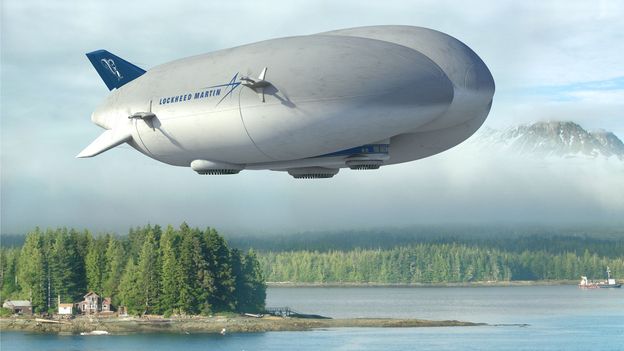
How airships could return to our crowded skies
Airships lost out to conventional aircraft after a series of disastrous crashes. But now safer technology could be the key to their return.
bbc.com
88 points · by clouddrover · 7y ago · 74 comments
Laden drones which can drop down to their delivery point from above, and then return empty back to the air dock seem like they could operate much more quietly and efficiently than drones which need enough power to maintain altitude as they travel horizontally to their target.
Of course the drone would need the capability to throttle up and climb fully laden, possibly even minus one rotor, and the energy reserves to spare.
But the theory would be launching off the airship, and traveling horizontally (at altitude) above the target, then a controlled descent straight down to the drop point.
Presumably you would have two or three ships so one would be in position, while another was moving to/from the ground warehouse, while the 3rd was being loaded for the next batch.
The whole thing only makes sense if the energy density of the drone batteries doesn’t allow them to simply launch from a remote warehouse and proceed directly to their destination at altitude and return all on their own power.
Carrier has arrived: https://www.youtube.com/watch?v=7B5DPovWY7o
I've put some thought into this from time to time and I see a few alternatives. One is to use a tow line with some sort of auto-belay, and shield the rotors so that the line can't get snagged under usual circumstances. Then a drone can be reeled in if the need arises. Another option is to have drones able to adhere to each other (magnets? velcro? carabiners?) so that functional lightly-laden drones can perform an in-air rescue of a malfunctioning drone before it reaches the ground. This assumes that a malfunctioning drone would still have some mechanism to slow its descent, which isn't unreasonable.
The autonomous problem is far simpler than autonomous trucking. It's probably somewhat comparable for autonomous shipping.
That all said 4 TEUs is far from the ~20,000 TEUs that the largest cargo ships can carry. Even if you can build something that can move 20 TEUs, that's still three orders of magnitude difference in terms of volume.
For certain goods however, like moving wind farm blades and pillars, airships would be ideal.
I'd be interested to know more about the technical details. The article mentions something about "cells" to reduce risk of buoyancy loss from a tear, and something about ultracapacitors. While some of the details may be proprietary, I'm sure there are some interesting things to say about the technology that this article somehow manages to almost completely avoid.
Also aren't we running out of helium (because it's a mostly non-renewable resource on Earth)? I know it's not actually consumed by the airship, but that's a lot of helium, right? Edit: According to my calculations, filling up a Hindenburg with helium (0.2 million cubic meters) uses about 1/900 of the annual global helium production (about 180 million cubic meters).
Also, take advantage of Magnus effect.
A quick search suggests that one Airlander costs about as much as 10 miles of two lane highway.
That's misleading. The record was for "Fastest text message (SMS) on a touch screen mobile phone while water skiing." It happened to be set behind a blimp, but that's not a requirement for the record.
if you could make it battery-electric and autonomous, then you've solved for global shipping emissions (cuz we don't need the ships anymore).
Then looking at energy consumption, a container ship might need 8 HP of power per 40 foot container sailing at 18 mph. This airship has 700 HP per container at 70 mph.
Ideally you'd use windpower (sails) and solar (electricity) for the ships.
With airships, smaller businesses can directly trade over long distances. I'm personally excited by agriculture potential... shipping spoilable heirloom produce straight from farm to markets across the country would be disruptive.
However, a single container ship carrying upward 10,000 containers still offers value at larger scales.
Here is the experiment: Stare very hard at this graph. memorize the trajectory and timeframe.
https://www.ipcc.ch/site/assets/uploads/sites/2/2019/02/SPM3...
Keep it open in a tab and come back to later, maybe even several times over the course of a week or month.
For those reading along I mean specifically a few points:
  * emissions peak in 2020 (<2 months!)
  * emissions are approximately 50% reduced by 2030 (a mere decade!)
  * emissions achieve net-zero around 2050 (-5 to -10Gt/yr)
  * the entire back half of the century we run -5 to -15Gt/year
What I mean is, assume we succeed in avoiding the worst of the catastrophes. Assume success. Try optimism. Not in a blind way, but in a quantitative mental framing way.
From that place of quantitative optimism, "solve for zero". That is, in all of your thoughts, opinions, comments, actions, causes, votes, etc, ask yourself "is this consistent with solving for zero?"
The point of this experiment is that, in my opinion, the number one hold-up to making meaningful progress on this challenge is people who are trapped in "analysis and debate" mode where they assume the time-horizon is much longer than it is, or they assume the goal is marginal reduction of emissions, rather than zero (and then negative!).
I believe that we, as both a community here on HN and as a global civilization, are in desperate need of quantitative-optimism, rather than dismissive pessimism.
Now after all that typing to tie it back to your post here. We both know airships flying containers are not going to be as cost-efficient as a diesel powered truck or a kerosene fueled jet. That's basically just stating the obvious. But that's also accepting failure.
Please stop accepting failure as the default mental framework with which you engage the topic. For any one person it can seem like reasonable skepticism. But when the majority of a community does it, especially its most vocal members, then the cultural result is one of inaction and delay. Analysis paralysis. Stalling. Stalling on climate change is effectively denial, even if that's not your intent.
Edit: Also, if there is one type of ship that is going to be replaced by airships, its going to be the cruise ship.
But modern cruise ships are huge and are largely oriented around providing tons of activities. In fact, as far as I know, there's only one ship that is more oriented around providing trans-Atlantic transportation (among other things and only for part of the year).
That said, the reason we don't have a return to airships, is that they cannot carry the sheer numbers that planes can, need a much larger 'docking' area compared to planes, and take 100 times as long to get anywhere compare to modern air travel.
Give me a real bed in a room that can be locked (even if shared with a few other people), and a restaurant to socialize like in a train. For comfortable travel I would pay extra, business or not. I must not be the only consumer wanting that.
And no, regardless of "class", airplane travel is miserable. I do not want to seat in a open space with people walking around, eating on my lap or from a folding table food served on a tray.
Not enough people will pay the extra for regular point to point travel. I could see something like that taking off in terms of an experience, like an air version of the orient express.
We could easily fit 50+ small private rooms in an airplane.
Not in Germany.
Can't we just go everywhere by train and boat, by land and sea? Humans were not meant to soar up in the sky, thousands of meters high. We're not birds.
I hate flying.