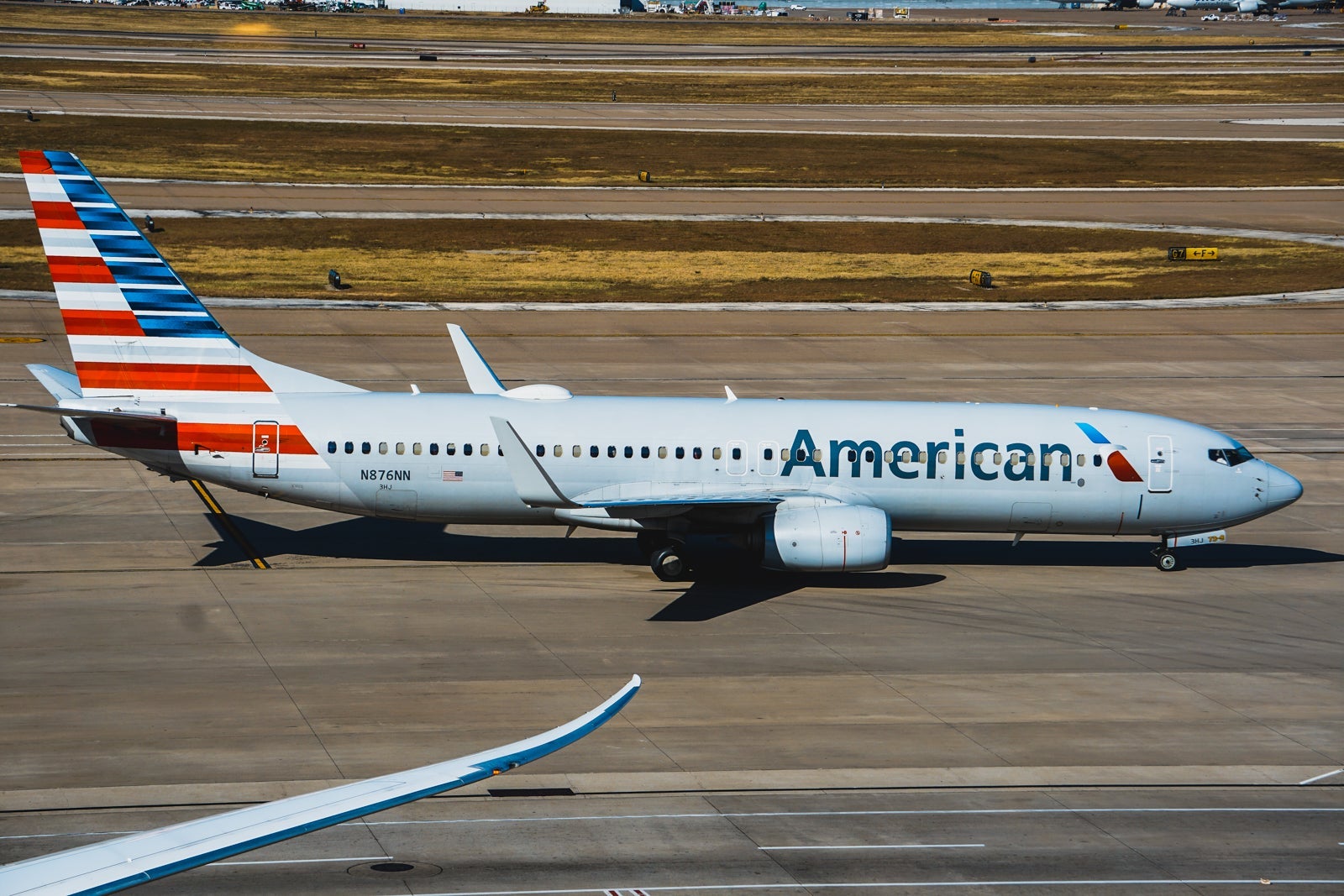
Why the Boeing 737 will never take the place of the 757
I’m depressed. I’m depressed because the word on the street is that Boeing will not be moving forward with its so-called “new midsize airplane,” or NMA, also...
The Points Guy
253 points · by smacktoward · 7y ago · 184 comments
Years ago I worked at Ames on the ACES system (minor but fixes and a Greenfield projects involving data/flight path visualization), but I felt the airplanes themeselves were these magical black boxes. I'd would appreciate having a deeper understanding about how they differentiate from one another in a non-superfical sense.
I worked specifically on the stabilizer trim system (like the one in the news on the 737MAX), and did some work on the elevator system. In particular on the latter, I did many calculations to prove it would not flutter (dynamic instability).
My very first assignment was to size the stabilizer trim jackscrew. I panicked and told my lead I had no idea how to do that. He laughed and said of course you do, it's a simple column buckling problem. Which of course it was, and I sized it.
A couple years later, and the first jackscrew gearbox assembly came off the line, and was doomed to be subjected to the ultimate load test. Any buckling, cracks, deformation, etc., would be a failure. The test guys told me they were gonna bust my jackscrew.
They hooked it up to this big ugly iron I-beam with a hydraulic ram to compress my green BMS10-11 painted gearbox and shiny chrome steel jackscrew (made by Saginaw Gear, who made the best kick-ass forgings).
They started cranking up the pressure, while I stood around anxiously watching it. Slowly, the I-beam bent into a nice curve. We didn't have to make any changes to any of the stab trim system due to test failures. Whaddya know, the math works! So I am not a bit afraid to fly on a 757. The seating can be cramped, but that's the way it goes these days.
As far as know, there have been no in-service failures of that system. The 757 itself has a fantastic safety record, of which I am proud to have contributed to. The last D conference I flew to on a 757 operated by Iceland Air, yay!
At the time I bought a bunch of Boeing stock as a result of my confidence in Boeing, and it has paid off handsomely.
That's refreshing. I have a friend who worked on the A380 and she says she'll never set foot on one.
My answer was usually to mock them and say "so just because you are looking from too close and have lost perspective you prefer to fly an ageing aircraft or trust some random Boeing contractor more than yourself".
And fast forward ten years, the "deathtraps" they were working on - A340, A380 and A350 - turned out to be extremely safe (with fatality-free records).
The 757 was the last airplane designed using paper drawings and wooden mockups. The end of an era :-) Some of the engineers still used slide rules. My lead engineer once said "let me show you how it's done" and pulled out a very nice slide rule in a leather pouch. I made a little show of blowing the dust off of it, and he laughed heartily. He started at Boeing on the B-47 design, and even he had already moved on to calculators.
But nobody used computers yet. I found a PDP-11 in a neighboring building and sweet talked the sysop into giving me an account on it. I'd write my own numerical analysis programs using Fortran IV.
My other lead was an old salt who told me he didn't trust computers, they always produced unreliable answers. But he was a good egg, and said he'd give me a chance. There was some long complex geometrical calculations to be done to prove the elevator linkage wouldn't bind up under load. The usual method was to use drafting tools to figure it out, and he put his best draftsman on the job. I wrote a program to figure it out, and came back with my column of numbers to 6 places. His draftsman compared it with his column, accurate to 4 places.
One of them was off. My lead said see, I told you computers were garbage. I asked the draftsman to recheck that one, and he did, and came back and said I was right.
Ever since then I got the calculation jobs, and my lead would defend me. One day, the CS dept head discovered I'd been stealing unauthorized time on the PDP-11, and I got in trouble. My lead went to bat for me, it went up 3 levels of management, and the top guy told the CS mucky-muck to piss off and give me whatever computer time I needed.
I was only the vanguard of what was to come in using computers to design airplanes.
My experience with that motivated me to ensure D had a first class foundation for numerical programming.
I’m quite sure that if you started a blog today with the stories that you can remember, that you’d have a ton of HN’ers who would read it.
Thanks again - your posts are great to read!
  > One day, the CS dept head discovered I'd
  > been stealing unauthorized time on the
  > PDP-11, and I got in trouble.
I’d say you’re in decent company.
:-)
> JetBlue is among airlines planning to use the [AirBus A321LR] on routes across the pond, serving Western Europe from New York and Boston.
This has to be a gut punch for Southwest, who has famously relied only on the 737. They're close to hitting their ceiling on domestic expansion with the 737 and can't compete on US-EU routes because of their fleet.
I like that the author points out the realities of modern 737 performance - just because it _can_ reach coast to coast destinations doesn't mean it _should_.
Thats not to say that the 757 is perfect. From what I've heard, maintenance is significantly more complex than the 737. And as the article pointed out, it takes way too long to board/deplane for the short hops that the 737 dominates now.
It seems that switching to a new plane would mean a drastic economic change.
So the transatlantic ambitions should be a cause to go past that, rather than a side effect.
Delta flies pretty much everything including the 737.
If I have an important device that I'm not attaching to a network, that sounds like a good thing. It may not have every feature but it's very stable and efficient.
It's amusing that I got downvotes for someone else's analogy being bad.
> is a concept that reflects the implied cost of additional rework caused by choosing an easy (limited) solution now instead of using a better approach that would take longer
737 rated pilots are abundant, production lines are ready and paid for and orders come in as long as the product works. There is huge incentive to do just small fixes if you can't see technical debt in the books. When it shows up in the bottom line company is already paying interest.
For instance: “ If built, the 797 would bridge the range and capacity gap between the narrowbody 737 family and the much larger 787 and 777 families — a slot occupied by the now-geriatric 757 and 767.”
The 787 and the 767 are the same size to a rounding error. The 787 is basically a drop in replacement for the 767 but much more efficient.
And further, the 737MAX and the A321LR (and A320neo) and even the A220 are designed to replace the role of the 757 in air travel. The US market wants smaller aircraft that are more efficient and fly longer range to open up more frequencies. They’re getting them.
> “ I may be biased, since I fly it, but you might undoubtedly call it the most versatile jetliner Boeing has ever built. It’s a medium-capacity, high-performing plane able to turn a profit on both short and longer-haul routes”
Even a quick perusal down Wikipedia would tell you the 757s are incredibly inefficient aircraft, getting a second wind a cargo haulers due to their way outsized power to weight ratio. And even with all that they can’t make regularly scheduled east coast transatlantic flights without often stopping along the way if there are temperatures or headwinds.
As for domestic travel the sheer inefficiency of the planes makes them a poor contender. Really only the full-transcon corridor made any sense at all and even those are being replaced. JetBlue went all A320. They’re by no means “able to turn a profit on short and medium haul flying” solely by virtue of them being scheduled. They’re often flying them for utilization reasons. Can you even call any of this flying “profitable” when American had a 3% margin last quarter across their entire route network, lost money on domestic and made it up on international?
The 737 will absolutely take the place of the 757, and already was scheduled to prior to the MCAS issues coming to light.
Ironic considering the genesis of the 757 was a new wing and new engines that produced a 35% improvement on fuel efficiency over the 727 it replaced.
It's too much plane for most use cases — too heavy and too thirsty.
There is now a big demand for aircraft that size for certain routes (US transcontinental, and second-city Transatlantic, especially the transatlantic)
What happened is that laws changed to allow twin-engine aircraft to fly routes much farther from the nearest alternate landing site, making 757s suddenly great vehicles for Transatlantic flights between second cities. Of course, this happened shortly after production of the 757 ended.
ETOPS helped the 757 into the international role sure, but the 737 and A320 are more fuel efficient and benefit from being able to share crew.
737-900er, the longest-range 737NG only has 3000 nautical miles of range, which is just enough for TATL flights. The 757-200's slightly longer range opens up many additional city pairs without having to upgauge to a 767.
Of course, now that Boeing has lost a couple of years due to massive failures (like the 737-MAX), Airbus has had time to catch up -- and the A320neo-based A321-XLR finally surpasses the 757-200 in this space.
However, the XLR seats about 70 fewer passengers than the 757, so the 757 will probably still live on for a little while longer.
If Boeing hadn't killed the 757, and then immediately start sucking, there might've been a refresh to a 757 MAX-like aircraft that sat 225-290, had a 4500nmi range and was efficient. But, you know, we got the real timeline instead.
It will definitely be the A320 family, which has none of these problems, comes in sensible size variants already, is used extensively every day around the world, is price comparable, and isn't going to spook Western consumers in the same way that a Chinese plane will.
Price, flight times, and minimal number of connections are the main focus; but is there a website that can add in aircraft type?
I realise types can be swapped, but with historical data there should be very high probability of prediction of aircraft type at booking.
I flew a 757 back in the 1980s and have fond memories of it. This article made me realise that a spate of flying in 737s might have been what put me off flying for so long.
I can imagine adding another dimension for searching flights could have an impact on usability though.
Even if you knew what plane they're planning on flying when you bought the ticket, the plane that rolls onto the gate might still end up being a different one.
I asked the attendant and they explained that they were having some issues with the B787.
Yeah, just don't pay too much attention to the structural problems that Boeing is having with the 737 NG (cracked pickle forks). The inspection threshold keeps getting lower and the scope of the inspections keeps growing.
I'm sure many customers will avoid 737s in general due to confusion.
I am not an aviation expert, so the article was a bit short on details which make the 757 better than the 737 MAX, but I assume it is the wider body and probably better sized wings etc.?
Wouldn't colder (denser) air and a headwind make the plane require less runway?
Prevailing surface wind direction doesn’t vary much with season.
I far prefer the MD-80/MD-90/717 to the 737. The rear mounted engines make most seats (except the very back) far quieter and landings always seem smoother. Obviously they’re a smaller plane than contemporary 737s, but it’s still far more comfortable than the cramped conditions of the 737.
the default should be that if the flight handling characteristics of the airframe itself inherently are not the same then it doesn't get type certification, and you should have to prove why your tweaks make it OK.
> A type certificate signifies the airworthiness of a particular category of aircraft, according to its manufacturing design (‘type’). It confirms that the aircraft is manufactured according to an approved design, and that the design ensures compliance with airworthiness requirements.
And to be clear, since it seems my comment was also not totally clear: I'm not saying aircraft regulation / Type Certification is bad in general. Just that this particular implementation currently has unintended perverse incentives which lead to the 737 MAX.
Designing a small collection of different aircraft, each specialised to a particular role, can produce a complementary fleet with capabilities a modern air force needs. But doing so comes with the overhead of producing lots of different aircraft.
Instead, "the spreadsheet" shows that designing one aircraft capable of lots of things comes with the lowest overheads -- but with all the disadvantages of an overcomplicated aircraft and only average performance in each trait.
I agree Boeing isn't the engineering company it used to be, in many ways, but I don't think it's as simple as "controlled by bean-counters".
Boeing has irrevocably gone down the tubes. It is time to separate the space/defense groups from commercial and reboot them all.
As a Seattle native, it feels strange to seek out A320s when flying, but Boeing has clearly shown that engineering is just a cost center to them.
Here on HN I have ranted about the wobbly bobbly handling, obsolete hydraulics, and noisy crappy cockpit of the 73, versus the modern and comfortable 75.
Pay attention to what the article says about takeoff and landing performance. We used to load the 75 heavily for trips between NY La Guardia and Chicago Midway, or Midway to Washington National. We could NOT load a 737-NG heavily due to field length or climb limits. Boeing made a bad, bad decision to push the 737 instead of advancing a fresh design.
Just wait and watch. They won't abandon the 737 until one or two more are lost due to runway overruns or something else related to its shortcomings. That is WITH better than average pilots, all the sooner to happen with typical ab initio crews.
Is it that new planes being developed have much stricter regulations? If so, that's a problem, the incentives result in the public being less safe.
The A220 ran so much over budget that the whole program was sold to Airbus. Yet it seems like a really good airplane from what I've read. 787 and A350 were also terribly expensive.
Something similar has happened with nuclear plants. They seem to take much longer to do than way back and are so expensive to be barely profitable. A friend commented that one reason is because top talent doesn't see the nuclear industry as a "cool" thing or a viable career anymore.
There is one additional problem in airplanes and nukes. They are seen as prestige projects by governments. This makes it hard to make regular money in the industry as you always have subsidized competition.