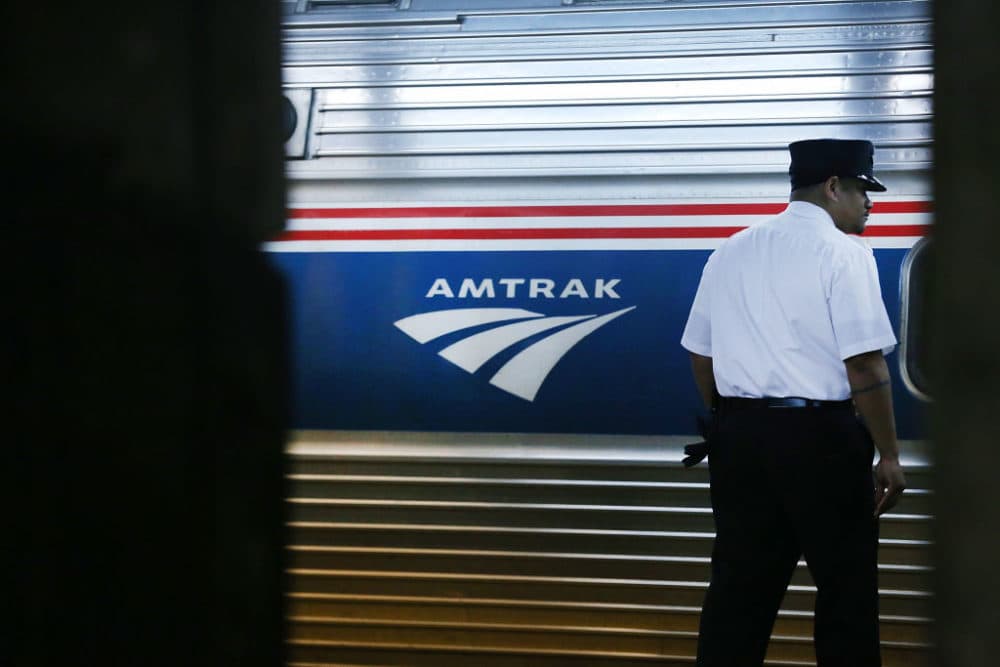
Amtrak Could Turn A Profit In 2020 For The 1st Time Ever
Amtrak says it logged an operating revenue of $3.3 billion — a 3.6% increase over the last fiscal year.
wbur.org
484 points · by jonbaer · 7y ago · 434 comments
There's barely a road in the entire country that's turned a profit (gas and vehicle registration taxes don't come close to covering road construction costs, and of course most roads aren't tolled), yet we still rightly consider roads as being worth it. We should treat our rail, transit, and other transportation infrastructure similarly. Expecting a profit is completely missing the point, but doing so is a nice bonus.
The real issue is how much we’re paying in subsidies compared to how much we’re paying in subsidies for other forms of transportation, and perhaps what other people are paying in subsidies for the same kinds of transport.
Highways get about $75 billion in subsidies (what’s not covered by gas tax). A lot more than Amtrak for sure. But highways carried over 3 trillion passenger miles last year. Amtrak was just 6.3 billion. We spent 50x as much on highways as Amtrak, but got 500x as much mileage out of those highways.
(You can throw in pollution externalities, etc., but even if you use current carbon recapture methods to suck out CO2 from driving, and ignore the fact that Amtrak’s mainly east coast operations are not powered by renewables, driving still comes out ahead.)
Imagine how many people would be biking, riding electric scooters and walking if US cities were actually designed with these modes of transportation in mind.
From what? Riding horses cross country?
Outside of the Eastern Seaboard, has anyone ever attempted to book a rail trip? It's insane. You have to really work at it and you are losing a ton of time, have overnight "connections" and other odd problems. Furthermore, nearly all the train stations of any size are in the ghetto. The whole system has not kept up with the times. And while there is still some romantic notion of "riding the rails" it quickly gets subsumed by the price, which is also ridiculous.
That said, I suspect we overinvest in both subsidies because of romantic ideas and status quo bias.
What we really need is far more subsidies in urban and dense suburban areas. The problem is that with our bifurcated political system in the US the people who make up less than 50% of the population outside the cities will block investment in the cities because they will feel like they’re not getting equal investment.
That's only because highways cover the country like a fishermans net. Capacity and connectivity are massive for roads. Locally it might back up, but average the capacity of every road in the U.S., and it can probably handle the population of earth. Imagine if that were the case for high speed trains, it would be borderline idiotic to drive.
It seems like recently transit agencies are finally working to improve options for commuters beyond the road network. Simple fixes, needing only a can of paint and a traffic cop enforcing law and order, like bike lanes and buss lanes can be done practically overnight in many urban areas.
LA metro has studies done for hundreds of transit corridors involving bus lanes, BRT, LRT, and HRT. The only barrier seems to be political will, not the engineering. I'm sure this is the case for most large cities, so if we ever get an administration that would prioritize funding transit projects on a federal level, as was done a century ago, we could see a transit explosion.
When you do that, suddenly the tables flip and driving is way behind.
Amtrak is a speck on the federal budget. It’s a worthwhile investment if only to keep the rights of way open for the future
Amtrak doesn't compete with local roads, it competes with interstates.
Glad you mentioned the externalities of pollution that people are allowed to create without penalty, but are you also considering that CO2 is hardly the only thing to worry about. Air pollution is a major cause of neurological illnesses, since auto exhaust is neurotoxic, as is non-exhaust pollution from brake pads and tires.
The only time your question matters is if/when the transit system is useful enough that someone can actually consider selling a car. I sold my car to ride the bus to work. However the one week my wife's car was in the shop convinced us that we won't be doing without a car anytime soon. (We often take trips that are 5 minutes by car that were 55 minutes by bus! Then there is the annoyance of the one time we missed the bus)
Trains are paid for by riders in the form of fares and taxpayers in the form of subsidies.
This has total vehicle miles at 1.4 trillion in 2017, having around 2 occupants per vehicle on average sounds about right: https://www.statista.com/statistics/193007/vehicle-miles-tra...
On a side note, that would be an interesting PhD dissertation - figuring out the actual cost of America's car-centric lifestyle broken down locally, state and nationally.
The combination of the US and Canada has been producing all the oil the combination needs for a year or 2 now. Everyone in the industry says it is only a matter of time before the US will be able to produce all the oil the US needs. Whether that happens next year or 5 years from now depends on pricing and production decisions made by the OPEC producers.
I wouldn't be surprised if in 8 or 10 years the US will be in a position to guarantee a steady supply of oil to one of its strategic partners: the UK or Japan, say.
But this has thread has gotten off track because like grandparent already pointed out, Amtrak run on oil, too. I suppose your reply to that is that it is easier to convert Amtrak to renewables than to convert the highway system to renewables
But many of those miles were necessitated by the astoundingly large footprint cities and towns have when they're built to accommodate highways.
When the answer necessitates completely redesigning every major city in the country, I'm not sure the question is valid in the first place.
What is the total spent per person-mile of travel?
If infrastructure is really such a multiplier, people should be able pay for it from the multiples they earn, and the infrastructure owners will turn a profit. This means that more infrastructure gets built, and higher multipliers achieved, until the multiplier is not so big, and they stop. (This is a state where owners earn an accounting profit, but not what the economists call an "economic" profit, that is, it's not any more money than you could make investing anywhere else.)
This is how the price mechanism works, and how the pursuit of profit in a market works, and why capitalism is actually good at making things happen. The alternatives to using the pricing mechanism generally leave you underprovisioning infrastructure (leaving these potential profits on the table), or overprovisioning infrastructure (wasting money), or in a state where people overuse infrastructure in wasteful ways (see the nation's road system, which is very good at connecting things -- but socializing its construction and access has led to ridiculous traffic jams in many cities, and many segments that are heavily accessed by trucks charge extra for the wear and tear through the use of tolls.)
Are there obstacles to realizing this capitalist utopia of efficiency in practice? Yes. Definitely, lots of them, and especially for network-y infrastructure like railroads. Is state intervention warranted sometimes? Yes. Is abandoning the pricing mechanism entirely, because multipliers exist, the only thing to do? No. And even when it is, it is a fraught endeavor. Among other things, the people who benefit are not the same as the people who pay, and the transfers involved can be unfair.
Let's say a good quality rail link from Town X to some big center of employment has the following effects:
* Raises attorney Alice's salary from $150,000 to $175,000
* Raises barista Bob's salary from $23,000 to $28,000
* Raises retiree Clive's home price from $300,000 to $400,000 although he'll never set foot on a train himself.
* Allows business-owner Doris to fill a specialist job that previously she hadn't been able to fill, indirectly leading to a better product and improved sales in ways that are hard to quantify, but are probably several times that employee's salary.
Which of those should the rail link owners capture, and how would you propose they do so?
The challenge of for-profit infrastructure is, even if you choose ticket prices to capture 50% of Bob's benefit, you only capture 10% of Alice's benefit, and ~0% of Clive and Doris's benefits.
More recently, China have managed to build more high speed rail network than the rest of the world, and served it at loss. As I understand and having personally rode it, the effect of such transportation option to both the economy and personal convenience can be said to rival that of the interstate.
One problem with a private road system is that roads take up space and prevent people from using that space for something else. I think that property tax on road surface area would be prohibitively expensive if a private entity were to own it.
Another problem is that building or expanding a road through an already populated area basically requires eminent domain.
The iPhone revolutionized mobile phones and greatly expanded the interconnectivity of the world. And yet nobody is demanding that the general public should subsidize Apple.
You correctly point out a double standard, but perhaps it’s worth a bit of thought before choosing which way we want to resolve the double standard.
Healthcare fundamentally, aside from its intrinsic value, additionally, is perhaps the most ‘potent multiplier for economic gains’ in the wider economy.
Shame it’s often treated as a burden.
Good jobs lead to surplus income, which leads to higher quality food, which leads to better health, which is a.. multiplier!
More product distribution centres leads to shorter commute times, which leads to less traffic and lower consumer prices, which are both multipliers!
It's also worth pointing out that transportation systems that do turn a profit are generally healthy and run well. It is difficult to turn a profit on a poorly run system.
> Expecting a profit is completely missing the point
On the contrary, expecting a profit is expecting excellence, which we should absolutely do. There is no reason not to have high standards and high expectations.
I suppose if Intel had been nationalized then they would be loss-making and we would be hearing about how taxpayers should feel good about subsidizing their losses.
It also leads to natural monopolies.
Film, television, publishing, and music are classic examples of this. A huge and often unrecognised role that the gatekeepers play (studios, distribution companies, broadcast and cable networks, presses, recording labels) is to assume risk on the part of individual ventures. VC operates on a similar logic, where of ten efforts, 1 hit and 2-3 merely profitable ones account for another 6-7 failures. (I suspect the actual success rate is much lower, with increasingly decadal megahits seeming prevalent.)
Those are time-based bets.
In geographic networks -- canals, railroads, highways, air travel, telegraph (often co-tenant with railroad rights of way -- 19th century maps of each are fascinating), telephone, electricity, even water, oil, gas, and other pipeline networks -- a few major success/concentration points support numerous others. Transit systems in particular seem to go through an evolution of private venture to public-subsidy, to wholly-publicly-owned.
Though it's more complex than even that.
Postal subsidies played a massive role in supporting rail and early air transport. Through the mid-1960s, the US Post Office ran mail-sorting cars on trains where mail was sorted en route. The introduction of Zone Instant Postal Codes, better known as ZIP Codes, as well as pre-sorted mail, allowed for routing at origin (or regional) postal hubs, rather than in transit. The loss of this subsidy proved fatal to trains.
Many city transit systems -- bus and streetcar -- were cooperative ventures serving factory and office employers, retailers, and real estate developers, more than the actual daily riders of the systems. It was the creation of a viable transport link between locations that induced the resultant value of those locations.
In the Chicago region, a network of electric-powered commuter rail systems emerged in the late 19th and early 20th centuries. Not only the above dynamic came into play, but these transit links created new linear bands of viable "bedroom community" suburbs surrounding the urban core. Transit times from 30 miles out were less than an hour, shorter than today's commutes.
Construction of highways (notably the Eisenhower Expressway) lead to a sudden collapse in 1956.
https://www.american-rails.com/aurora.html
https://en.wikipedia.org/wiki/Chicago_Aurora_and_Elgin_Railr...
Rural electric and telephone service have long been at best marginally profitable, and development of infrastructure (as well as considerable generating and mainline distribution) were enabled through rural electric and telephone cooperatives, supported by surcharges on urban/suburban service.
Private enterprise enjoys cherry-picking profitable areas/regions for operation. Reality is that a functional country and economy require some level of subsidy.
The gyrations of PG&E over the past two decades may be preamble to a transfer to public (state) control of electricity services in California, possibly elsewhere. This may be a more general trend in such services: originating as private operators, shifting to government services over time.
If you listen to some activists and look at the budget, you'd think that the intent of AmTrak is to lose as much money as possible without arousing suspicion.
There's a big difference between not turning a consistent profit and losing more money than it could possibly save us. If the point was really to serve as transportation that can compete with the automobile at the point of sale (so that it would actually take cars off the road), or in terms of speed (increasing the economic output of passengers), most AmTrak lines and railcar-miles fail that test.
Why can't the same logic be applied to power and telecommunication?
The only reason we provide transportation through public funding is that it enables us to overcome the problems that arise from private capture of natural monopolies.
If you're not going between D.C. and Boston then maybe it'll be different, but if you're riding on the one line Amtrak has to keep operational or it'll die completely, I think it should be fine.
Even when I was going DC > NYC years back it was barely worth the trouble, and still more than flying, only benefit being you land right in the middle of NYC and don't have the nightmare transit from NYC area airports.
DC->Boston full trip would obviously be insane - it's 6 1/2 hours even on Acela. But, probably preferable to driving.
You show up in the middle of one city and wind up in the middle of another city
Big contrast from airports.
But Amtrak is too expensive and slow compared to other developed nations high speed trains, especially in Northeast corridor. Everything I said earlier applies to Japan, and western Europe.
(Ok on the last point, I believe some high speed trains have light security checks.)
But I think the OP was comparing a train to flying, you don't pay for baggage on a train but you would if taking a flight.
It is a nicer trip though, I'll give you that. But not nice enough to mean an extra day away from home.
If you’re flying, Dulles and BWI are 45 minutes from downtown DC (or more); ditto for the NYC end, and you need to factor in another hour+ for security. I think air travel might end up slower—-and it’s certainly less pleasant.
Just an anecdote, but with TSA Pre, I haven’t needed more than 15 minutes for security, flying domestically and internationally several times per year for the past few years.
Agree with you on the other points, though.
wait, what? Why? Here as long as I'm there before it departs it's fine.
You're absolutely correct about the comfort points, but price should be just as strongly in the train's favor and it isn't.
> “Our biggest challenge is I go testify in Congress and all we talk about is French toast on dining cars or food,” he says. “We aren't talking about the really big infrastructure issues and transportation congestion issues that all the people in this country want a solution for.”
Of course! It's a waste of time talking to these people. Please keep the subject on french toast, because if they're going to screw something up, let it be a breakfast dish. And lets extrapolate this out to all other subjects and consider how they would do with all the policies the progressive left are dreaming up.
It is a very high quality service.
Biggest issue I had was occasionally, they would look at it funny going through security and give it extra screening.
Fits pretty well in the overhead too, especially laying upside down, so bags can be stowed above it.
The reality is, intercity trains are not an efficient way to travel in the United States. Most of the important cities are far apart, because it's a very large country with a lot of empty space. If you need to be somewhere, book a flight. It's less expensive and if you give yourself a day of leeway you will probably never be late to your thing, barring some sort of natural disaster.
I am a huge railfan but I have accepted that the geography of the US doesn't make train travel as viable as say, Japan. Tokyo, Nagoya, and Osaka are the three largest cities and are comparable in distance between each other like Chicago, Springfield, and St. Louis. If New York was where Chicago is, Chicago was where Springfield is, and LA was where St. Louis is, high speed rail would be enormously popular in the US. But New York and LA are 2500 miles apart, 10% around the world from each other.
I even question California High Speed Rail. San Francisco / Silicon Valley and LA are both big metro areas with a lot of money, but SF/LA are 41% farther apart than Tokyo and Osaka. Japan got very lucky that its two largest cities are actually very close to each other. Building the Shinkansen was an enormous engineering challenge, but one that was very clearly profitable. It's so profitable they're building another Shinkansen between the two cities, taking a shorter route and using faster trains. In the US... such a city pair does not exist.
OK this is going very off-topic from your exact comment... but it's something I wanted to talk about. Sorry.
E.g. Shanghai - Kunming is more than 2200 km and takes between 10-12 hours[1]. At that speed LA-SF would take around 3 hours. For context the flight time is an hour and a half, so when you account for airport overhead, taxiing etc. the train would take around around the same time, and be a more pleasant mode of transport.
The density argument also goes both ways. A country like Japan is going to find it much harder to find empty space to place rail than somewhere like the US.
There's a lot of reasons for why the US isn't doing what China's doing with high-speed rail, but those reasons are mainly political, not geographical.
1. https://www.travelchinaguide.com/china-trains/shanghai-kunmi...
You’re really making the case for defunding at least everything outside the NEC. We shouldn’t be spending public money on something that’s only good for leisure travel.
First leg was 15 minutes early to Philadelphia
Second leg was maybe 5 min late. Not bad for a 3 day, 2 night trip.
https://e-skateboarder.com/can-you-take-electric-skateboards...
That's some unconventional accounting. Most GAAP accountants would tell you that capital investments should be amortized over their expected lifetime, with the first depreciation hit in the year they're made. That would of course mean an additional expense to cover before calling yourself profitable.
So, one could argue that Amtrak's rail infrastructure _should_ be entirely off-budget, because really it shouldn't be part of Amtrak at all, to make a comparison to bus companies more valid.
And I have looked into using them even more - but their is a litany of reasons why its impractical:
THeir ticket prices, staffing, schedules, lack of full-through-connection services, and delays all but make it hard to use as a service for all but one specific type of commuter.
Lets look at staffing.
They will know that its the commute hour; yet they will schedule ONE ticket agent at the counter in a major station - who has no incentive to be efficient with their tasks, and have made myself and MANY others miss the trains they were trying to get to. When you complain to the staff, they immediately take an attitude. Once when I asked why they only had one ticket teller during the major rush hour, the ticket teller didnt answer me, but called the Amtrak police to come question me. (I was being polite - and asked matter-of-fact why they would make such an oversight.)
Pricing: The tickets are way over priced for the service. Also, lets look at the "rewards" benefit - and the "10-pass" packets.
1) The rewards - it costs $19 to go from Sac to Martinez. You get (2) reward points per dollar you spend. For that same $19 leg to redeem points for a "free" ticket costs 900 points. -- That means you have to spend $450 to get ONE $19 reward.
2) A 10 pack ticket expires after 45 days. No matter what. Last holiday season - with validations, office shutdowns, holidays etc - there was no way to use the tickets I had until after the new year - yet they would "expire" on 12/31 - no matter what.
Their rewards points often fail to show up on your account - and its a tedious process to rectify - and even when you do rectify, it take more than 3-weeks for them to hit your account.
The pricing to go any distance, is just absolutely too high.
Now, the good things about Amtrak:
They have power, wifi and a snack car. The cars are clean (generally), and the ride is smooth - and actually faster than driving (more relaxing at least) along 80.
---
I really want Amtrak to succeed - but I wish they would address the problems they do have.
That’s why you do in Norway, and I guess large parts of the developed world
I can see why you’re to obtuse to understand.
Those early morning / early evening trips are packed with other business people doing the same thing you're doing. Full train of people quietly working/reading, maybe talking to a colleague. Very civilized.
The few times I had to travel mid-day on the same routes? Shit shows of confused tourists, kids who don't want to sit still for 3 hours (don't blame 'em), and all manner of "what can go wrong will" (delays, issues with the heat/ac, issues with passengers, etc).
Its like there's two parallel dimensions of Amtrak out there.
I'd choose Amtrak 100% of the time for business travel if its an option, 0% of the time for pleasure.
Why should anyone in the society give a fuck about anyone else in society? Maybe the answer is because people think it's better for the society, as a whole, when various things are supported by all.
Same reason people in rural or suburban communities subsidize city buses?
Amtrak has always been a company with two halves, and Congress really should just split it to stop this Jekyll and Hyde tug of war about what exactly the company is supposed to do.
edit: My mistake, Milwaukee.
If that's true, it seems like those communities would be better served by subsidized long distance bus travel instead.
I understand that doesn't make a whit of difference to congress, though.
https://www.govinfo.gov/content/pkg/GAOREPORTS-RCED-95-138/h...
People in America are diverse, with diverse preferences and needs.
I love taking Amtrak, and happen to live on one of the cross-country routes. I prefer it to airline travel in all ways. Clearly, the routes are sparse, so it does not always work out for me. But as a remote software engineer, I can work from the train, I can relax and read a book, and watch the scenery go by. The extra time it takes is not a problem. It is a great change of pace to sitting in my home office.
There certainly are people who disagree, but generalizing that the whole country refuses to use the service is simply incorrect.
Personally for Boston to NYC, I prefer the bus. It’s $15, faster than the train, more reliable and plenty comfortable for a few hours. Boston to DC I’d probably fly.
Trains by contrast are actually a pleasure to be on; I'd rather be on a train than my own couch at home. Compared to buses, Amtrak trains have less shaking, less unexpected accelerations, more space to walk around, better scenery, and fresher air. In my opinion the only form of transit better than train is a ferry.
For my commute, there is a bus, an regional rail and Amtrak. (And driving.)
The bus is potentially the fastest, about 2 hours door to door, but for about half the trip I'm unable to do anything but stare straight ahead and focus on keeping my stomach settled, and about 1 in 10 trips there is a traffic delay that makes it take 3+ hours.
The regional train varies between 2.5 and 3 hours, depending on how many stops that particular train makes, but it leaves me on the wrong side of town and the last fast train is at 7am.
Amtrak is best for me, more coincidentally, because it happens to stop near my workplace, and because it makes few stops it's as fast as the fastest regional trains, for an average door to door of 2.2 hours.
Both the regional and Amtrak trains tend to have delays about 1 in 50 rides or so, usually about 30-60 minutes.
(Driving is about 2.5 hours door to door, parking under my workplace, and costs as much as a bus or train just in tolls and parking.)
Can you not get a ticket for $5 anymore? In the post-FungWa vacuum it seemed like everybody and their brother was running a bus line that charged $5 for a 1-way to NYC.
I went to visit my friend in Virginia. I took the AmTrak from Minneapolis out to the East Coast. It was basically hell until we got into Philly. Then it was just commuter rides and few switch overs until I was in DC. Then my friend picked me up and promptly got lost and dropped us into one of the worst neighborhoods in DC, but that's a story for another day.
Basically the long haul was horrendous. Bumpy and loud and people constantly bothering me for one thing or another. I didn't get a wink of sleep until we hit Philly. The commuter trains I took were like a library. Quiet, smooth and nobody bothered me at all. I figured if I lived on the East Coast, I would probably use the train to commute, but those long rides across the country were painful - I'll never do that again.
This is infuriating.
Counting subsidies from eighteen states as revenue does not make you profitable and Amtrak does exactly that. Plus they have such a huge backlog of repairs and maintenance so any "profit" claims are meaningless when you keep putting off maintaining your system and cars. However they make sure where the most noise is where the most investment goes.
Plus fleet age is a real problem[0] and requires billions of investment to bring that up to date
I love trains as much as the next person but Amtrak isn't profitable and they don't strive for actual profits because they know they are protected.
[0]https://www.bts.gov/content/age-and-availability-amtrak-loco...
AmTrak was created when the private passenger rail operators were failing, and they were failing for a good reason: demand for long-haul passenger rail service declined sharply when better alternatives entered the market.
The one thing that rail can do better than these other forms is comfort and service, but for the vast majority of people, they would rather be able to afford to make it to their destination.
China has a similar geography to the US, and similar sizes and run lengths of their high speed space. The US has decided to build roads and highways instead of investing in other transit options. It's not that it makes "more sense", it's that the US has intentionally built things this way, for a variety of corporate and historical reasons.
> many rail lines went from necessary to obsolete with the natural progression of technology.
What? You mean, except for literally every other developed country has well developed rail lines that transport billions of people with levels of unmatched efficiency?
> when better alternatives entered the market.
Only because the market was intentionally weighted against that form of transit.
China has extreme restrictions on domestic flights, and a great deal more population; and on top of that, so much is different about the way things are done in China, the state will just bulldoze things for looking too "towny".
> What? You mean, except for literally every other developed country has well developed rail lines that transport billions of people
Britain is a developed country with well developed rail lines, but probably few there would tell you that it's great right now. Some of the failure there can be attributed to their poorly-designed pseudo-privatization of the trains and crews themselves (but not the rails or facilities, which remain national), but a big part of the reason that was politically viable was that the rail services weren't all that great when they were national either. France's TGV is really cool, when the operators aren't on strike.
Up here in Ontario, we have one relatively useful rail corridor, but the further you get from Toronto, the less the passenger load. On my morning train from Hamilton, there are (charitably) a couple dozen passengers on the whole train for several stations. As for national rail in Canada, it is rare to hear that anyone has used Via. I've used it once in my life, but I found out later that a bus on the same route would have been faster and dramatically cheaper.
Long-haul rail networks are attractive to politicians because of what they represent, but to transport consumers, the reality of long haul passenger rail is that it is rarely the best option. When passengers bear the cost, long-haul passenger rail is, by natural means, rarely the best option in the U.S.
> with levels of unmatched efficiency?
"unmatched" by what? High speed rail is extremely capital intensive, and expensive at the point of sale, and that's when you don't have any trouble clearing land for it. In the U.S, most of the viable places for passenger rail already have rail lines, but they are not appropriate for high speed rail. Conventional passenger rail is too slow to attract fares, and is still very expensive.
Dude it's alright to like trains, trains are cool; but none of what you said justifies the subsidies that would be required in order to make a comprehensive U.S. long-haul passenger rail network that's worth using, and no policy would make it worth the cost.
If you have some brilliant business practice, policy, or idea that will change this, I implore you to develop it! :- )
I’ve taken hundreds of trips, anywhere between 2 and 8 hours, on TGV, ICE, and Eurostar trains in Europe. I loved it every time and came out refreshed even after longer trips. At times when I wanted to get work done (probably 60-75% of total time spent on trains) I was as productive - likely more productive, due to lack of distractions - as at the office. In contrast, I don’t think I can remember any road trip lasting more than 2 hours when I could say I enjoyed it; many times I was so exhausted that I needed rest upon arriving to destination.
So, if we are going to try to fit this into some sort of economic model let’s not forget about countless billions of hours of productivity loss due to people stuck behind the wheel staring at traffic.
Not to mention both emotional and physical strain associated with driving (nope, can not stand up when you like, or walk over to the buffet car for a coffee), respective health care costs, and more productivity losses. Once we do that, the picture will be very different. It’s sad we in the US haven’t realized this yet.
The estimated cost of an additional two tracks in the Northeast is over $100B.
> The host railroads have been obligated to give the company preference over freight trains so Amtrak can run on time, but that statute has not been enforced, he says.
Anyone know the details on this? It’s something I’ve experienced to a degree and a complaint I’ve heard from other riders.
Toll highways cover a fraction of operating costs. In most cities, your bus fair pays for 50% or less of the cost to run the bus. States use transport to build commerce, and it's difficult to measure what revenue that generates.
Funding needs to be pumped into AmTrak to help expand some of the very limited high speed rail we're just starting to see in the USA, including Florida's Brightline (now Virgin Trains) and the half-canceled California project.
Yes I have and your statement is correct. Amtrak is almost entirely dysfunctional but rail as a concept is not dysfunctional and actually works in many other countries.
It's like healthcare, which is an absolute shitshow in the US, however in the rest of the developed world it's not a shitshow.
Likewise with the military.
What is it about the US that makes so many fundamental services needed for the functioning of society into shitshows?
Healthcare might be the same thing. US residents pay a lot for healthcare, and that's used to fund healthcare research. Then the products of that research are given to other countries without them having to pay much.
Ukraine has proved that's not true for US-friendly countries facing US-hostile foes, which is essentially the optimal scenario short of actual formal alliance, so I don't think that actually is a plausoble explanation except possibly for formal US allies.
I'd really like to see a source for that, because that's far from obvious to me. I could see that being true for pharmaceuticals, but then there's a lot more to health care than just drugs.
In the US, health care seems more like the Parkinson's law of the economy: health care costs expand to suck up much (most?) of the economic surplus that results from any improvements in overall productivity.
The sweet spot for rail seems to be journeys of 100-300 miles... lots of even major US cities don't have another major city in that radius.
I've got Denver, SLC... where else?
The US's major cities are not close to each other, with the exception of the North-East Corridor, and the distances involved are far larger than most corresponding distances in Europe--you have to be talking about trips between Spain and very deep into Russia to start to compare against the NYC/LA pairing.