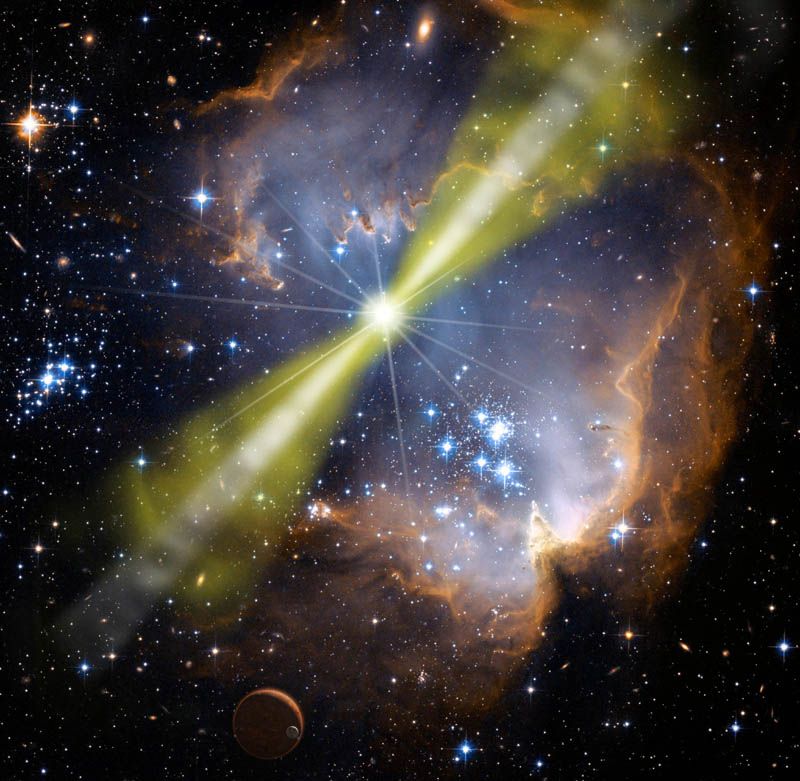
Astronomers Detect Record-Breaking Gamma Ray Bursts From Colossal Explosion in Space
A powerful outburst in a distant galaxy produced photons with high enough energies to be detected by ground-based telescopes for the first time
Smithsonian Magazine
69 points · by whocansay · 7y ago · 35 comments
This is so insane to me. I knew the wavelengths were small but not this small. Nature is so cool!
The energies we detect go into the hundreds of TeVs and charged cosmic rays have been detected to much, much higher energies.
AMA ;)
Unfortunately all ground based telescopes until now keep their data private but nothing is thrown away ;) We have several Million air showers recorded.
This is going to change with the next gen observatory, which will operate as an open observatory.
A magnetar quake 500 light years away would sterilize the planet (but not harm the magnetar at all). Fortunately, the nearest magnetar we know about is 9000 light years away, so its blast would be ~300 times weaker, just enough for a garden-variety mass extinction, and end of civilization. But there might be one closer.
All the ones we detect happen millions of times farther away. So they are only terrifying if you think about how we can even tell something happened that far away.
Is it unlikely that we are far enough to be mostly safe from these threats?
Or maybe it's one filter for Fermi paradox (on a planet that isn't far from these kinds of threats life wouldn't survive long enough to develop civilization).
First sentence makes no sense.
several galaxies produce photons with high enough energies to be detected by ground-based mark-1 eyeballs every night.
Staggering numbers of galaxies produce photons with high enough energies to be detected by ground-based telescopes every night.
They need to include the unusually short wavelength of the photons to convey their message.
So this must have been a really scary event, sending photons over 4 billion light years, energetic enough to pass through the absorbing atmosphere.
We can only hope to never be hit by a GRB from our cosmic neighbourhood, that would be a life-ending event.
We only detect the particles indirectly.
When a high energy particle enters the atmosphere, it creates a cascade of particles called an air shower. In that cascade, charged particles, mainly electrons and positrons, travel faster than the speed of light in air and thus produce Cherenkov radiation.
This is light in the UV to blue visible range, you may know it from pictures of nuclear power plants.
The telescope measure the Cherenkov light and from that reconstruct the properties of the particle that created the air shower.
This event was not the first time we measured high energy photons on the ground, we do each night. But it was the first time we measured them from a GRB.
The universe is also opaque to these energies, because they interact with 'background photons' (and possibly electrons) in their travel. We're lucky that only a few 'make it through' (and require sensitive scopes to detect).
https://science.sciencemag.org/content/320/5884/1752
(The energies in the new report are 10 times higher than those in the cited paper from 2008.)
The powerful outburst produced photons with high enough energies to be detected by ground-based telescopes for the first time.
We are talking here of the first time a short burst of only a few minutes was detected from a source not previously known.
Distant galaxies with super massive black holes in their center are a well known source of this kind of gamma radiation. Known as active galactic nuclei and especially blazars