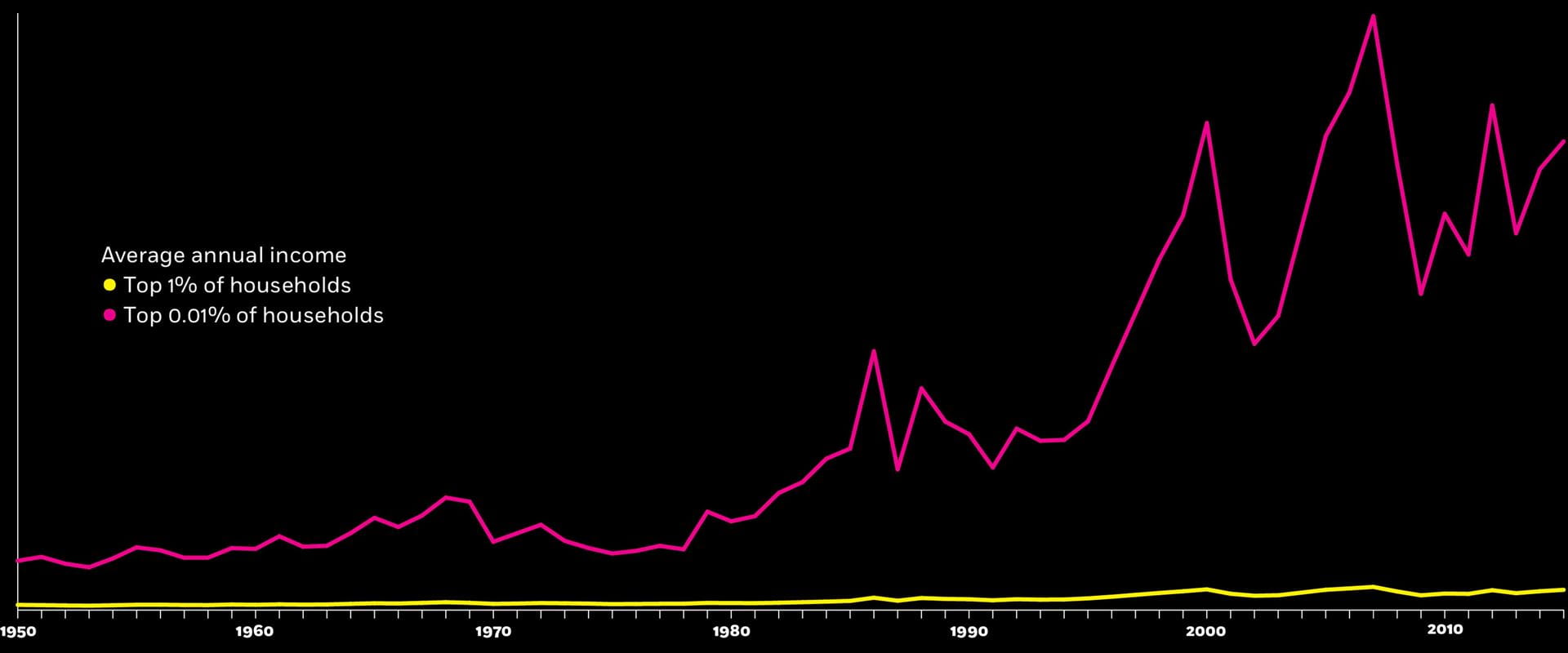
Never Mind the 1 Percent. Let’s Talk About the 0.01 Percent
Examining the macroeconomic impact of America’s top earners.
The University of Chicago Booth School of Business
148 points · by nabla9 · 7y ago · 188 comments
>“The demand for top skill has outpaced its supply, with the returns to top skill increasingly taking the form of business income.”
This really doesn't come off as a problem that needs solving and instead sounds like a purely political war cry. These aren't lords abusing powerless peasants, they're contributing members of society being disproportionately rewarded for their disproportionate contributions. Wealth inequality needs to be considered in the context of overall prosperity and despite the fearmongering you see online, most Americans are doing well. Even our poor have modern conveniences, access to emergency healthcare, generally safe food and infrastructure - eating the evil rich and redistributing their wealth is unlikely to solve any of the major issues in the country, as we're already throwing tons of money at schooling and healthcare and the like.
In a nation with as much wealth as we enjoy, it is shameful how we relegate our neighbors to defecating on sidewalks, living in tents with no heat or plumbing, and raving in the streets due to lack of mental health care.
Over 100 years ago sure. Over 40 or 60 has it really? People usually consider more stuff (access to cheaper and more gadgets, the internet, etc) as an improved standard of living or quality of life. In other words they conflate technology making some products cheaper for a better standard of living.
But even more important factors, for a large part of society is access to healthcare, education, house, etc -- all of which have gotten more expensive. There was a time when a single earner could buy a house at 25 or 35 and get their kids to college. Now two earner families often struggle.
Middle class jobs have also become more stressful and pressing, while many middle and working class wages, inflation adjusted, have stagnated for decades, despite the increased stress, working hours, and productivity gains.
Do you really argue that the people in the top 0.01% are contributing to society at a rate hundreds or thousands of times higher than the rest of the people?
And in the case of heirs, such as the Walton family, are they contributing so vastly more than the guy who mows people's lawns during the day and cooks their dinners in a restaurant at night?
Or how about the Renaissance folks. They (whether fully legally or secretly illegally) reap huge rewards yearly, certainly using some advantages and situations most people do not have access to. Are they likewise contributing to society so much more than the average person?
Oh wait, let's talk nurses and schoolteachers. They pretty clearly contribute very heavily to society, and they get paid pretty poorly. Are they really contributing less, by factors of tens or hundreds, than Larry Ellison?
I've been thinking about this lately. A schoolteacher generates huge value for dozens of people per year. A CEO of a big firm may generate tiny value for millions or billions of people per year. If the schoolteacher is generating a thousand times more value for each of their students than the CEO does for each of their customers, then the CEO still generated a ton more value to humanity.
My napkin math is that teachers make about $200B/year in the U.S. (3.2M teachers * $60k/year). The top 0.01% seems to make about $100B/year (16k families * $7M/year). So we're in a situation where yes teachers make more value than the 0.01%, but they also earn almost twice as much. (To be fair, it seem reasonable that teachers should earn more than 2x more, but that's a separate conversation).
The scale factor is a weird one for fairness. If someone's value to others is the value per person (X) times the number of people (Y), it seems like our society or technology or something is set up so that it's much easier to maximize X*Y by making Y huge and lowering X than it is to make X huge and lower Y. You can make your firm serve a million times more people, but you can't teach a million times better. Framed this way, no wonder a "value" maximizing world is getting less personal and more corporate as people lower X wherever they can to explode Y.
Not to mention, many companies are a net negative to society.
So does it count as generating tiny value for millions or billions if you're actually forcing a customer to stay with your overpriced product when there are actually plenty of equal or better cheaper solutions?
I get what you're saying, but I think it would be a struggle to find many corporations whose actions are enough net-positive to society to justify their CEOs' compensations.
But is that a problem, really? Is it a problem if 0.1% of society have absolutely no lack of money whatsoever?
It sounds rather small to me, particularly since most of the money is a valuation of someone's job (or some other productive resource). Taking away the money is also taking away that someone's job.
The current form of global capitalism doesn't really have a direct corollary to the LTV pricing mechanism.
On an individual basis, leveraged through his organization - I think that it is objectively clear that the answer is: yes.
Yes. That is because of of the impact of their actions.
Let's take the example of a CEO of a major company. The difference between a good CEO, and a great CEO might only change the value of a company by 1%. But 1% of a 100 billion dollar company, is 1 billion dollars.
So if you are effecting a large enough company or area, then only being a little bit better than everyone else, turns out to be massively valuable, and therefore this value needs to be incentivized.
There are lots of examples of consistently bad or self-serving behavior of banks - banks which get special benefits from the people, including quantitative easing (essentially the ability to print money). I find it incredibly difficult to believe that they are contributing to society in line with their compensation. In fact, I believe in some cases it's the opposite.
If you consider a measurement of their financial compensation to be proportional to their contribution to society. In reality, the actual impact of their actions is unknown - such things are beyond our ability to measure, we can only speculate.
> therefore this value needs to be incentivized
Technically, it doesn't need to be incentivized. Life would carry on if it wasn't, perhaps even with a better outcome. It is not possible to know what the outcome would be.
The value that you add depends on what you do.
First example: someone who manufactures useful widgets is useful to society roughly in proportion to the number of widgets they make — this is probably non-linear diminishing return of usefulness with more production, but I think in practice we can ignore that most of the time for simple manufacturing jobs.
The range here is small, perhaps only a factor of 2-10.
Second example: an inventor who makes a machine that makes it easier to make those widgets. Their value to society could be as much as “difference in number of widgets produced by everyone combined, totalled over a period which is hard to even estimate”, unless that number is so large that diminishing returns is relevant. Unlike the people who actually make the widget, it’s reasonably likely for the person who invents a widget-making-machine to reqch this point. You might even get some extra problems from technological unemployment - short term or long term, it’s still a problem - or the waste of overproduction.
It isn’t as simple as saying “Tim Berners-Lee is as valuable as the entire internet”, because of all the work of other people that built on his, but even a single invention can benefit society to the tune of billions.
Third example: an entrepreneur who recognises a problem in the world and creates a solution. A new type of widget, or whatever. In an optimistic case, they might hire people that would otherwise be unemployed.
I’m not saying this always happens - and “wealth creator” as a term seems to be used to describe people that get rich by moving money around rather than just those who get rich by doing what I describe here - but that it could happen means it’s worth keeping track of.
I would argue that creating a thousand new jobs is at least as valuable to society as the cost of a thousand unemployed people, though almost certainly not as valuable as the wages those thousand earn in the new jobs, because that would be double-counting.
This could still easily be worth millions per year.
Fourth example: Management. Most work is done by teams, and a manager who can make their team 10% more productive is worth as much to society as that productivity boost, summed over the entire team.
I will acknowledge that management can be bad as well as good, so the sort of manager which makes everyone in the team resign (a friend mine recently left such a team because of such a manager) is worth negative their combined productivity.
I can easily believe that Bezos has been an enormous force multiplier because of all the other retailers that have not grown like Amazon. I can believe that Musk is great for SpaceX and entirely average for Tesla, because of how well SpaceX is doing and how averagely Tesla is doing.
How much is SpaceX worth? How much is reducing launch costs by a factor of three worth? I’m not sure, but it’s a lot, and SpaceX succeeded where all the other launch providers — and their, I assume, equally smart engineers — failed.
—
As a separate point, I totally agree with your implicit claim that productivity != income.
This line is extremely condescending. Why don’t we tell the top 0.1% who seem to always need more to do their valuable service to society that they have it much better than any king had it a hundred years ago? So why they need more every year? why is this line only used against the little guy? Fact is that more and more wealth goes to a small group of people. In my view this is extremely damaging to a society in the long run. some level of inequality is probably helpful to motivate people but it shouldn’t be growing constantly.
Our poor do have modern conveniences, because that’s what the world does; it evolves with current technology. They have access to emergency healthcare, which will almost inevitably bankrupt them when they need treatment. “Generally safe food” is not good enough in what is supposed to be one of the top first world countries. Infrastructure? Sure. Depending on how poor you are you’ll have varying access to infrastructure.
This hasn’t happened out of concern for our poor. The poor are getting society’s leftovers.
I don’t particularly care if we’ve “thrown tons of money at schooling and healthcare and the like” when we spend exponentially more money on the US military. Teachers across our country are still underpaid, and our education system is still not taken seriously enough. The US is not in the top 10 most educated countries (K-12), despite being a top first world country. Admittedly, money wouldn’t fix all the problems with our education system, but it would make a big difference.
It sounds like this was written by someone with a limited frame of reference.
What makes inequality increase is actually the mindset of poor people that their poverty is "someone else's fault" like this kind of comment ( and also that "the state should do something" like it is their mother ).
The hard truth is that inequality increases because poor people dont fight against and do nothing about it except complaining. Its always the fighting that has brought any of the social improvements, not the goodwill of politicians or anykind of "fair invisible hand".
It'd be far nicer if even the poor had access to non-emergency medicine, too, though.
Ironically, the poor tend to contribute a disproportionate amount of their income to things like taxes and infrastructure, being without the ability to shield their "wealth".
> they're contributing members of society being disproportionately rewarded for their disproportionate contributions
Are they contributing for their level of wealth being rewarded? Are they contributing 5,400+ times the average American is?
Our schools need funding (teachers are buying their own supplies), infrastructure needs funding (bridges are collapsing), and our healthcare is extremely expensive for the average person.
2. Outsized contributions shouldn't result in outsized rewards. The marginal utility of additional wealth is much higher if you're poor. Inequality is inefficient. Also, if you are rewarded as much as you contribute, your net contributions are zero.
> Even our poor have modern conveniences, access to emergency healthcare, generally safe food and infrastructure.
Dude. Emergency healthcare and generally safe food isn't something to be proud of unless you're a developing country.
It doesn't "come off as" a problem, because that is how you have personally interpreted the situation.
> that needs solving
It doesn't in fact "need" solving - life will go on, one way or another, regardless of whether policies are changed or not.
> and instead sounds like a purely political war cry.
In may in fact be "a political war cry", but is it purely that, or might there actually be something here that deserves attention?
> These aren't lords abusing powerless peasants
This is true, but colorful, rhetorical characterizations like this are an excellent way to persuade people without sticking to cold hard facts.
> they're contributing members of society being disproportionately rewarded for their disproportionate contributions
This rhetorical device is effective in that it persuades readers to logically think of the issue as a binary rather than a continuum.
The proper question is: is their disproportionate reward proportional to their disproportionate contribution? And even this improved statement of the situation is flawed in that is kind of implicitly assumes that the relationship between contribution and reward should be linear, which is inconsistent with the general societal decision that taxes should be progressive (the tax rate(!) increases as the taxable amount increases).
And to be clear, I'm making no absolute claim that progressive taxes are "right", I am only stating that this is what society generally deems "proper". This aspect of the situation seems absent from your analysis, so it seems appropriate to point it out.
> despite the fearmongering you see online
This style of rhetoric is persuasive, and it may even have some truth to it, but it is orthogonal to a proper logical analysis of the actual issue and should therefore be avoided.
> ...most Americans are doing well. Even our poor have modern conveniences, access to emergency healthcare, generally safe food and infrastructure
This style of rhetoric is persuasive in that it frames the issue according to one specific perspective (a subset of dimensions) on the overall (the entire subset of dimensions) issue.
A loose (and uncharitable) restatement of this might go something like: "Because most people are "doing well", then therefore there is nothing to see here." I will note that this isn't actually what you are saying, I'm just pointing out the beauty of rhetoric - when done well, it invokes a style of thinking, which results in real-time generation of certain "facts", without actually having to explicitly say certain things (ex: dog whistling). It can cause the reader to change the way they conceptualize the situation, and therefore change their conclusion from that which it would be if they were to engage in a purely factual analysis of the situation in its entirety.
This isn't to say that you are doing any of the above consciously and with intent to deceive, I'm simply pointing out some of the flaws that are ever-present in the way modern society, politicians, advocates, etc engage in communication. It's no wonder we've made such a mess of things.
People believe they think logically, based on facts, because this is how it seems to each of us. Bu in such matters what people actually do is think in narratives, that are very loosely (and often incorrectly) based on "facts" (most of which are also narratives), and then only a subset of the entirety. This is by necessity, because outside of the hard sciences, systems are far too complex and interconnected to think about using pure logic and facts. However, it's not a necessity to think we think in facts - this we are capable of realizing, and many philosophers and psychologists have amply demonstrated this, but the realization of the importance of this has not made it's way into widespread knowledge, and certainly not into behavior in discourse, even that between highly intelligent people.
I wonder if awareness of such complexities in communication was widespread throughout society, if we could improve the outcomes of our political process. I suspect we'll never know.
In some cases, these people are lords abusing powerless peasants. Most of America isn’t Seattle, Austin, NYC, or the Silicon Valley. People can work for WalMart in the town I grew up in or go unemployed because WalMart swallowed competition. They’re literally at the mercy of whatever WalMart wants to pay them.
Our poor have emergency healthcare but will get bankrupted in the process.
They have safe food insofar as they won’t die of typhoid or hepatitis like in the developing world, but they don’t have healthy food. They have access to various forms of packaged, refined sugars. A diet based on cheap access to these goods will only lead to longer term health problems - there’s scientific data backing that claim.
Interesting how you frame your argument - that the poor aren’t as horribly off as perhaps in another century or in the developing world, and so it’s good enough. The same argument can and should be used to call out the endless greed, especially of the 0.1%. Don’t have they have enough? Are they they some of the richest folks in human history?
My family has been in the 1% for a few years and we’re just bottom-rung individual contributors at FAANGs. 50% of our net worth is in our house. We don’t run or have stakes in any private businesses. No investment properties. The only thing that sets us apart is while an upper middle class family might do a European vacation one year, buy a car the next, and redo their bathroom the next, we do in the same year. Otherwise, I imagine our lives and aspirations are similar.
>Mankiw noted that the 1 percent’s share of total income, excluding capital gains,...
I'm not completely sure how the discussion turned into top 1% of income earners and specially exuding capital gains. I think it's possible that there is intentional attempt to change the discussion.
If you are in the top 1% of wealth, your net wealth is roughly $7 million. If you get just 3 percent real return for you can get $210,000 a year income without working.
1 - https://www.cnbc.com/2018/07/27/how-much-you-have-to-earn-to...
There's a huge difference between that type of 1% for a year and age 30-40 dual (or very high single) annual income earners.
The former may retire with a $1-5M net worth, the latter is either spending heavily or retiring with a $10M+ (and likely $20M+ with reasonableiinvestment returns) nest egg.
Gets worse as you go down in income. Try two wage earners at $60k/year.
Roughly the point is that while "the working elite" is much harder to be repelled by; it is still a problem that many tasks in society that could before be done by a medium educated middle class, is now done by a few highly educated people plus a swath of people with no education.
This causes the second group to have less part and prestige in their work, while the first group gets alienated from their own work, by being forced into the few fields that allow one to reach the 1%.
And so forth and so on. This is far more about resentments and insecurities than policy.
The fact of the matter is if you want to re-adjust the economic landscape towards the poor in a meaningful way it is going to realistically require harming the economic interest of all the current winners -- from the $90k/year tradesman all the way up to Jeff Bezos. In all likelihood it will probably also mean higher prices for goods and services as well as higher unemployment. Maybe those trade-offs are totally worth it, but we should be adults about these things and not pretend there's some magic policy that's going to make everything great for everyone except some tiny cabal of not-us that's probably evil anyway.
It’s the handful of people who control 90% of all wealth. “1%” was a catchy soundbite but it was always the 0.0001%
There's a sizeable group of people that just cannot stand someone working hard and reaping the fruits. Again I'm not talking about Lambo-driving, yacht owners but an average doctor, small business owner or an engineer for that matter.
Per the old meme, success breeds jealousy, but unfortunately recently it breeds hate and violence.
Critiques of the merely well-off can sometimes be more indicative of the major problems facing America, since there are so many more in this category. For example, by critiquing this 1% class you also get into very interesting questions about land use in California.
At some point very early on, your money starts making money and you cease to do "work" to make that number grow. It seems inappropriate to equivocate capital gains with gainful employment.
From a material perspective, it makes sense that they behave this way (the ultrawealthy are more likely to sign their paychecks and they’re less exposed to many of the harms present further down the income chain), but does allow for a politics of resentment to develop around the position they occupy in society. Most working class people are unlikely to encounter a billionaire in their lifetimes, but will come across many upper income individuals who will tell them (either directly or indirectly) that they deserve their low station or that nothing can really be done to improve their material standing.
[0] https://www.dissentmagazine.org/online_articles/on-the-origi...
Of course once you are so wealthy that the majority of your income is passive income from e.g. stock market gains, the capital gains tax is at 25%.
The situation is so bad that in relation to what your employer pays for you (Arbeitgeberbrutto), you get much less than 50%.
The wealthiest make a lot of money, but it's nothing compared to the aggregate of millions of Americans making upper middle class wages.
Taxing the super rich is a great idea, but at the end of the day the govt just needs to spend less money on programs that don’t work or aren’t needed.
Translation:
>You could recover some of the wealth that is systemically siphoned (by inflation)/withheld (via wage suppression) from everyone, but you really should look at that whole wealth redistribution mechanism working against centralization of capital in private hands. That's the problem.
Not really buying it. The fact you're pushing these systems off as not working leads me to conclude you've not met the level of understanding to safely do away with Chesterton's fence. There is tons of room for improvement in the execution of these safety nets; but the Market doesn't want people feeling safe. Risk aversion from guaranteed stability makes exploitative employment/compensation schemes more difficult to sustain.
That's pretty much already solved with 401ks and IRAs which are retirement investment accounts with tax advantages.
It’s the handful of people who control 90% of all wealth.
The reason why CEOs get paid so much is not because of how hard they work, it is because the effect of their actions is massive, and eaking out that extra 1% is worth it.
“Never mind the 0.01 percent. Let’s talk about the 0.0001%!” would be even more crazy, considering the exponential distribution of wealth.
_That_ is the point
Also, “you can never change how it is!” is a nirvana fallacy; you certainly can make things better. It’s been done before.
The wealth inequality in America is higher than it has ever been. This did not come about naturally.
The respondents weren't opposed to an exponential distribution as such; but the images of the disparities between what they thought was ideal, what they thought the reality is, and what the surveyors say the distribution is is still striking.
People who write don't earn a great deal of money. Nor (typically) do they have the potential to do so. Other professions can at least dream that they will hit it big or earn a good steady income if that is not the case. People at the bottom can't even dream but 'they know their place'. News articles with head lines like that draw readers sure but I think it's more than that ('people who write...'). This is human nature. Very generally the middle class that are employed and not taking on credit card debt and spending over their means (which they do) don't care that there are super wealthy people.
What is to stop people in some dirt poor foreign country from talking about how it's not fair that people in the US, even our poorest, very likely have it better than they do? (Well nobody other than the writers in our country will say anything and quite frankly nobody in our country would care enough to give them anything that we have so it doesn't matter). When was the last time you heard of a tax specifically to help people in dirt poor countries? (Not talking about aid but actual 'we will take your income', well never).
You know what has changed more than anything? What we know about what others are earning and what they have that is what material goods.
As many older HN readers will probably agree when I was growing up their were the Rockefellers, Howard Hughes and maybe a few other people. There were movie stars and the Beverly Hillbillies. You didn't really care that they were wealthy it was just the way it was. There was no revolt of the masses. Sure there are more people will money today but what there is grossly more of is attention and that it's in everyone's face (and of course the people who write and broadcast about it).
For example, charging lower tax rates on capital gains than ordinary income promotes a concentration of wealth to people with wealth. Suggesting this is purposeful policy for society to encourage investment is comical -- what else would wealthy people do with the wealth? Store it under the mattress? Or spend it (in which case that would accelerate the velocity of money, also good for society). Capital gains taxes are only on the gains -- income that had not yet been taxed. Actual double taxation is a wealth tax.
Similar tax policy that results in concentration of wealth are: 1) 1031 transfers (where income on sale of real property isn't taxed so long as the proceeds are used to purchase real property), 2) Qualified Small Business Stock (where federal tax isn't paid on gains of sale of small business stock) 3) Economic Opportunity Zones (where tax is deferred on gains so long as the gains are invested in an Opportunity Zone, and all additional gains aren't taxed).
I don't have a problem with the idea. It recognizes that income derived from investments is riskier than income from a paycheck, and applies a discount.
The problem is with the execution. Why is the top rate for cap gains only 20% - even if you earn $10b, but 37% for a mere $510k in ordinary income? Surely there should be some amount of cap gains that can be taxed at 37%. Maybe it's $5m instead of $510k (to recognize the riskiness of the income stream) but it shouldn't cap out at 20%. Simply put, why aren't there more tax brackets for cap gains and other investment income?
It's unclear why as a matter of tax policy we want to discount taxes because risk is taken. If an investment results in a loss, that loss is permitted to offset gains elsewhere.
Because the people who make large capital gains are the ones funding political campaigns and helping to write the laws.
The argument that one is riskier than the other and therefore entitled to lower tax rates doesn’t make sense to me.
Sure, investing in an asset might be riskier if you’re randomly throwing darts, but I thought these folks were all about personal responsibility.
To be clear, I work at a FAANG. My total comp was is near half a million, a significant chunk of which is equity. The only risk I take is not cashing out immediately and waiting a year for the long term capital gains tax. I don’t necessarily provide more output or value than someone like a teacher. The equity I sold this year was in the hundreds of thousands and I paid less taxes on it than what most teachers probably pay. It doesn’t make any sense, and this system in my opinion isn’t sustainable. The inequality is going to lead to conflict.
You already pay income tax on the RSUs when they vest. If you sell them immediately, you’ll have a de minimis capital gain or loss.
Unless you actually would have turned around and bought your company’s stock with a bonus, you should really just sell immediately and ignore the trivial capital gain (or loss).
For ESPP it can make sense to hold, but even then, only if there was a huge increase in value since the beginning of the holding period, so perhaps that’s what you meant (but ESPP is capped at a very low amount, so that would be a tiny portion of your hundreds of thousands in RSUs).
Create a system that can be applied evenly, and fairly, from the top to the bottom and then I think you’ve got a great and novel idea.
And a fair tax is just too simple. Politicians wouldn't have anything to sell anymore...
You’re right! Without the ability to carve out exceptions, why would a powerful lobby need to come with a proverbial suitcase a cash?
If you take 10% from someone making $1000/month, they can't pay their electric bills.
If you take 10% from someone making 1,000,000/month, they have to wait a little longer to buy their third superyacht.
That's why the idea that taxes could be made easier by getting rid of brackets never made any sense. That argument is just a cover for undoing the progressive nature of the tax system (as in, the more you make, the larger the percentage you pay in taxes).
2. the wealth of the 0.01% are numbers stored in computers. They are claims on future production, yes, but the whole system only works because 99.99% of these claims never gets cashed out, because there are physical limits to what a handful of billionaires can consume, no matter how opulent their lifestyles. If you try to distribute this virtual wealth, people will try to turn it into physical consumables, only to find there really isn't enough for everybody, and the whole system will go to shit.
3. at some point, a guy I know made the observation that revolutions don't really redistribute much, mostly they just take the wealth from the wealthy and burn it. Well maybe how it works is the most important and expensive physical good - land - gets redistributed, most other physical goods are destroyed, and the virtual wealth is zeroed in a very expensive accounting exercise.
No. The upper .01 percent have tax lawyers and accountants and many other staff members (not to mention lobbyists) working full-time to reduce their taxes. In theory, anyone could do the same. In practice, the tax code is so enormously complex that only people who can afford to hire multiple college grads full time can pull it off.
I think we evolved the emotion of envy in a time when being rich meant hoarding. Markets break that evolutionary intuition.
What are your thoughts on the counter-arguments that basic income will lead to a dystopian future where an underclass just sullenly gets by as dependents of the state. Plenty of scifi speculative descriptions of this future are a bit scary, but are they just scare-mongering?
An old man is relaxing on the couch in his apartment in 1917 Saint Petersburg. His grandson runs excitedly into the room and proclaims: "Grandfather, the revolution has begun, we're killing the rich, and nobody will be rich anymore." To which the old man wearily replies: "My generation fought so that nobody would be poor."
Simple arithmetic shows that if you were to completely strip the 0.01% of their wealth (which just isn't going to happen, since they own the Congress) and "give it all to the poor", the poor would still be pretty poor: 6T between 350M people is $17K per person, or about 3 years worth of Obamacare. And that's pre-tax.
The way you prop up the poor is by creating opportunity and competition for lower skilled labor and trades, by rejecting some parts of globalism, which forces "the rich" to pay more for their labor supply. That propping up seems to be happening as we speak: unemployment is at a 50 year low (https://www.wsj.com/articles/u-s-september-nonfarm-payrolls-...)
Historical reference: https://en.wikipedia.org/wiki/Decembrist_revolt
My guess is the people who make the list this year, drop off the next and never end up on it again.
The top people (again income) are the folks that sell their company or equity stake. It’s a huge windfall, but they never make that much again.
The article addresses inherited wealth:
> On the 2016 rich list, two-thirds were self-made and one-third had inherited at least part of their fortune. More than 10 percent were immigrants to the US.
I wonder what portion of that 10% fits into the inherited wealth bracket also. Anecdotally I've met a lot of rich Indian and Chinese immigrants in tech, however they came over with family money, with strong family power networks, attended top schools and then parlayed their wealth + connections into something even greater.
It feels as though we throw "immigrants" out there to be synonymous with "broke" and "powerless".
And if you own a large company, you have no income (beyond a salary) unless you sell equity.
There are probably people worth $1B+ who aren’t in the top 0.01% because they’re money stays invested and they don’t pull income from selling.
The richest 10% own 70-80% of the wealth in the U.S.
My point is that the entire wealth distribution curve should be looked at, and any serious discussion needs to go back to first principles and determine what the curve would look like in a fair society.
Of course there are wide philosophical-moral chasms between different notions of fairness, with HN readers, by nature of the hand that feeds them, skewed heavily toward the belief that market forces are the best arbiters of worth and fairness.
the ultra-wealthy are literally an unelected shadow ruling class.
By constantly painting things as hopeless and unfair, all you do is stimulate rage.
Also, if it's not just painting, but actually unfair, then it's up to the reader to have an emotional reaction or not.
You think that the ultra-rich don't have an "us-vs-them" mentality? You think that they aren't lobbying and fighting and advertising and campaigning to keep their unearned wealth and power for themselves?
The distributions we currently see have no excuse or purpose. It's fine talking about the value of exceptional individuals, but if a Jeff Bezos is even ten thousand times better than your average schmoe, never mind 'millions of times better', then he would be able to have his influence without the aggregated power given him through accumulation of capital.
Never mind whether his dumb kid deserves to have the accumulated power of entire countries abstracted into the form of capital: HE himself has no business possessing that kind of power on top of his functional exceptionalness. He can damned well fend for himself, and will likely still be a big winner and have all he could wish. He has no right to the accumulated power our system awards him, on top of what he can do with his own intelligence and efforts. It's a magnifying effect, fully exploited by just the sort of person Bezos is.
Concerns of inheritance only highlight the problem. The parent is not that much superior to the dumb kid, and humans do not merit so much importance (as 'exceptional individuals') as our system claims they do. The BEST you can hope for is a crazy person like Elon Musk, aiming for some quixotic goal while they blunder around causing damage… and that's a best case scenario.
What is not mentioned but certainly plays a key role in one's ability to perform so well financially is the special opportunities the top 0.01% have and circumstances they operate within compared to the lessers. If we were to review each person in the top 0.01%, I expect most of them would be making their huge gains not by exercise of special skills but rather by exercise of special circumstances.
RISK - As we have seen with the 2007/8 financial crisis, there is a small group of very wealthy, very powerful finance people who can take enormous risks with other people's money, profiting whether they win or lose. The 07/08 crisis cost the general public (in bailout using public funds (debt)) hundreds of billions of dollars. But the stratospheric executive bonuses paid to fund managers and bank executives during the lead up years was not retracted. So the people that took unreasonable risks profited greatly, and the public paid for their profit and then some. Even during the following years, the executives and fund managers received significant bonuses. And thanks to golden parachutes, the exit/firing of some of them resulted in even bigger profits for that group.
OPPORTUNITY - The wealthier one is, the easier it is for them to get credit. Even in cases such as Trump where he has a long history of running businesses into the ground and leaving debtors unpaid, he was famously able to secure very large loans to take even bigger actions (which similarly often resulted in underperforming businesses which would later seek forgiveness or reductions of debts). The point is, once you're rich enough, you need never risk your own money. You can borrow huge sums to seize opportunities. When you win, you win big. When you lose, you can probably get away with no personal loss.
LAWS - With wealth and power comes influence. You can afford to lobby (sometimes a polite term for bribe) to get special laws or loopholes that have direct financial benefits for you. Perhaps it relates to a defense contract, and you hold a lot of Boeing stock. Or perhaps it relates to an FAA regulation and you hold a lot of Boeing stock. Or it's a special rule that lets you write off the purchase of a piece of luxury property as a business expense.
TAXES - This is a huge space for gaining an advantage over the normal people. Not only do you have the means to play the offshore/shell-company game (reducing your tax burden, perhaps to zero), but you also can do strange things like deferring your taxes indefinitely if you're a hedge manager.
I could go on with plenty more examples of special advantages that the top 0.01% have compared to everyone else. These advantages, even if modest, represent an exponential benefit in terms of financial growth over time.
I belong to the Top 10% and I'm fine with that.
Why do Americans focus so much on the "ultra-rich" and the billionaires when you can build a successful welfare state by just taxing the Top 10% a little more?
Because in America, the top 0.01% makes their wealth through investment income, which is taxed at a lower rate. So, the top 0.1% pay a considerably lower rate than the balance of the top 1%.
I know a few folks in the top percentiles that feel like they pay the same number of dollars or more than everyone else - they see this as fair. They seem to miss the fact that they get to keep a larger percentage of their money every year. If you get to keep more of your money every year than everyone else then its easier to build your wealth at the expense of everyone else.
So, some bitterness there. :D
Or, more simply, your country doesn't have anywhere near the same systemic and cultural issues the US does currently.