55 points · by chat · 6y ago · 48 comments
I'd argue that if you look at history, his argument decisively does not hold, which you can see from the rushed construction of the USS Monitor and CSS Virginia in 1862, all the battleships canceled after Pearl Harbor in 1942, the rapid development of the atomic bomb only 7 years after nuclear fission was discovered, or the cancellation of SDI and ABM defense when the Cold War ended. Basically, everything goes according to plan until war happens, at which point all plans are useless.
I'd further argue that the exponential curve he shows cherrypicks examples. The kinetic energy of a subsonic bullet fired from a silencer is orders of magnitude lower than that of an ICBM, yet the former is significantly more useful in today's conflicts.
Further, are you so familiar with the authors work that you feel it can be dismissed with little more than a wave of the hand? A wave that by the way states that the period of time containing both all the geopolitical effects of the end of the cold war (those certainly appeared after 1990) and the two longest running wars in US history is "peaceful" with only "minor geopolitical changes".
I at least feel the author deserves more credit for actually trying to do some quantitative work, instead of just making a snarky comment of little substance.
Option 1:
- ICBM: 3e2 kg warhead [1] to 1.1e6m at cost of 3.3e4 kg launch vehicle mass [2]
- KE > 3e2 * 1.1e6 * g
- T ~ 1800 s per shot
- R1 > (3e2 * 1.1e6 * g) / (3.3e4 * 1800 )
- R1 > 5.556 g ~ 54.48
Option 2:
- 9mm: 300 J, ~1kg launch vehicle mass [3]
- KE = 300J
- T ~ .5s per shot
- R2 ~ (300) / (.5 * 1 )
- R2 ~ 600
Comparing, the 9mm outperforms the ICBM by this measure according to my under-caffeinated math and googling (please check). But they are suprisingly close. ICBMs are optimized for the longest tail of reach, rather than a nice tradeoff of fire rate, carry weight, throw weight, etc, so this roughly makes sense. Also we should consider the roughly 40 years difference in design and deployment of the two systems, which may remove the order of magnitude advantage of the 9mm. Not also, we've ignored the lateral velocity of the ICBM.
1. https://en.wikipedia.org/wiki/W87
2. https://en.wikipedia.org/wiki/LGM-25C_Titan_II
3. https://en.wikipedia.org/wiki/9%C3%9719mm_Parabellum
EDIT formatting.
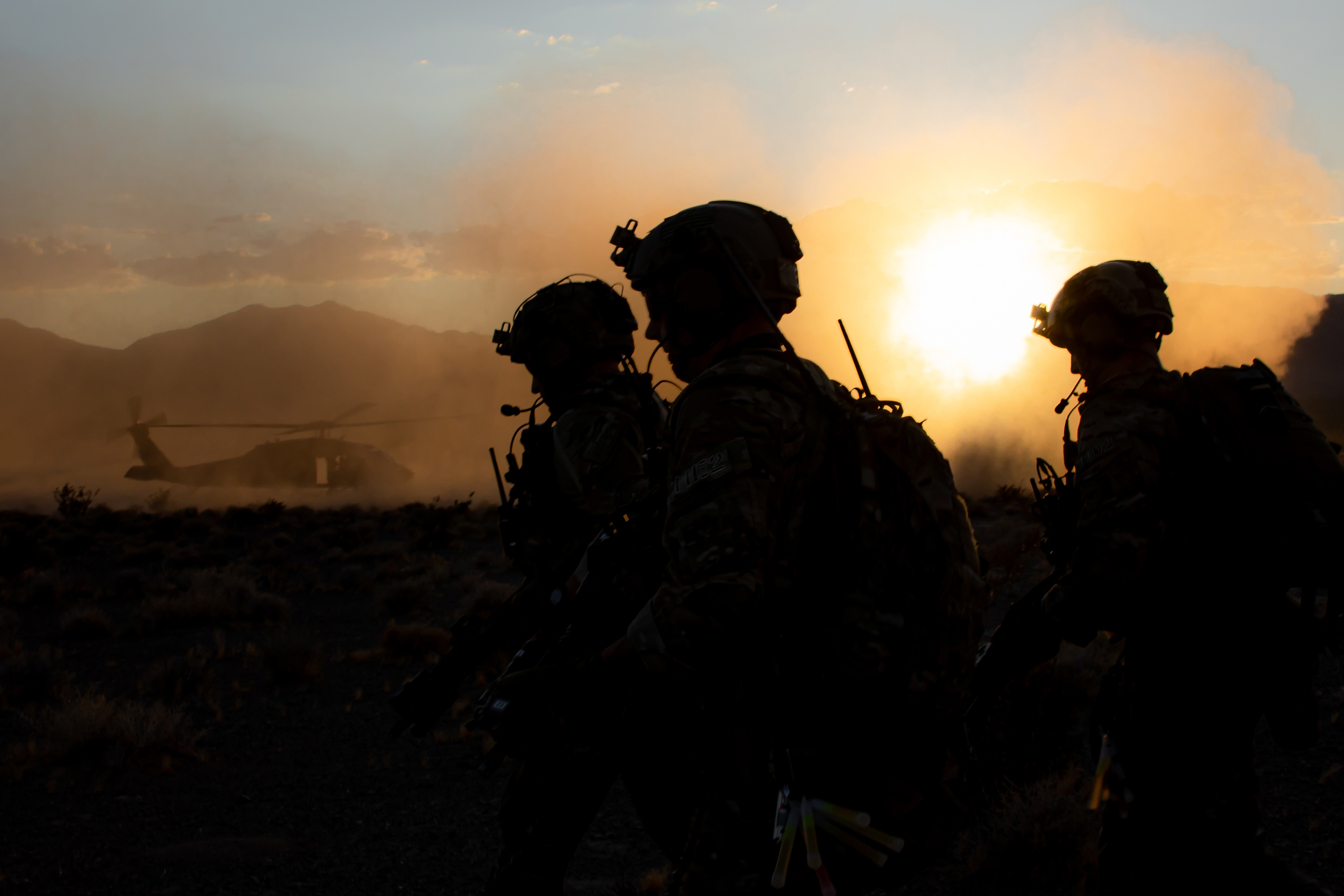
As far as I remember, there hasn't been a single year without a significant war going on since the Cold War ended? (not saying that it's worse then during the Cold War, but it also didn't get any better, depending in which part of the world you're living of course). Bosnia, Chechnya, Iraq, Afghanistan, Syria, Ukraine... and I probably forgot quite a few.
No atom-bomb-raining World Wars of course, but then I think what we're currently seeing is the future of war.
We can only hope. AFAIK, none of the wars since WWII were total wars between powers with strong industrial/technological capability.
If that should happen, heaven forbid, it will be mayhem with crazy weaponized computer security exploits and rushed autonomous weapon platforms deployed within weeks or months. I think that's what GP is alluding to. We have seen plenty of conflict, but not the kind that drives the most significant innovation in weapons technology.
Here's to hoping that things stay on this level, and the superpowers continue to realize that trade is more profitable than war. (And that disagreements are settled, at the most, with economic warfare rather than shooting wars).
The celebrated revolution of the atomic weapon is a good example: during the war it did not add any new capability; the US had already completely obliterated many Japanese cities with similar numbers of (civilian and military) causalities, indeed special provisions for sparing some from destruction to use the new weapon on had to be made. (And the war almost ended before they managed to drop it: the Soviets entering the conflict in August 1945 is just as plausible as the primary reason the Japanese capitulated)
It is only with the introduction of intercontinental nuclear ballistic missiles, that allows belligerents to hold entire cities at risk with little recourse for the defender to prevent it that an entirely new capability is created. This development happened after the war, when supposedly no "revolution" happens.
Also, we've had autonomous weapons for ages, they're called mines, and have been widely deployed in past conflicts. They do tend to kill a lot of people long past the conflict actually ended, so that's something the new autonomous weapons might actually avoid.
and
>crazy weaponized computer security exploits and rushed autonomous weapon platforms deployed within weeks or months. I think that's what GP is alluding to. We have seen plenty of conflict, but not the kind that drives the most significant innovation in weapons technology.
In the unfortunate event of total war between great powers today, I'm sorry, but I wouldn't count on your country's weapons research programs having "weeks" or "months" to come up with new devices. Days is more likely. Unless you're dealing with hot headed leaders who don't use the natural pauses to deescalate. In which case you would have maybe hours if you're lucky.
I'll go ahead and make the disclaimer that I am ex-military, but this is not American military bravado talking. This is just the reality of total war by any other great nation on the United States Military. The same truth holds for total war on the militaries of the EU, or of Russia, or of China. Nowadays, total war between great powers will drive a great deal of change, but it's not likely to drive a whole lot of high tech weapons innovation. This is just the environment we live in today.
Total war is generally, (assuming you're not insane), out of the question. Proxy, Cold, and Information wars are about all you can really do while protecting our current way of life.
Further, warheads were not factored. e.g. the nuke part.
Is the Digital Century Series an attempt to change this?
They want a brave new world, where they entertain and distract you and manipulate your information bubbles primarily, secondarily, if you fight, is when the 1984 tactics will be used.
Through these mechanisms other future strategic pushes are enabled, such as for example, the increasing use of manipulated and inorganic color revolution movements to weaken or overthrow governments. Those participating in the revolutions may not even know or understand the shady forces that started said revolution.
Railguns and new kinetic energy weapons seem to the natural trend following on the graph (in the article)
Rifle --> Railgun --> Energy Weapons?
I think the hard part about modern war technology is making sure you quickly neutralize adversaries whilst minimizing collateral damage. That's why drones are exciting. In theory, anyway.
Also defence against cyberattack is hard. So far it's only nationstates that seem to be able to hit infrastructure and autonomous systems, but I worry about proliferation to terrorist groups.
I would argue that the peak of destructive technology was the ICBM. We're now at the point where we have "enough" destructive capability. At the height of the cold war the plan was to wipe out half the Russian population in an hour.
The problem of today's low-tech widespread conflicts is how to bring them to a peaceful resolution that stays resolved, so that the refugees can go home. Something like three million Syrians are refugees in Europe including Turkey, and this is destabilising local politics. Refugees from Guatemala and Honduras are causing a similar problem to the United States. The war started on 9/11; people born after then are now old enough to fight in it.
The guy with the chart of destructive energy has no solutions to that. Well, one solution, but you're not going to like it.
It leads to a whole family of fairly useless remarks, such as pointing out that neither magazine size nor calibre, commonly held to be important numbers for guns, are not very useful measures when applied to ICBMs.
More seriously, prevention is a strategy that is complicated to apply to existing conflicts, and those are the ones we have a most pressing need to resolve. I do agree that "bomb more" doesn't work very well.