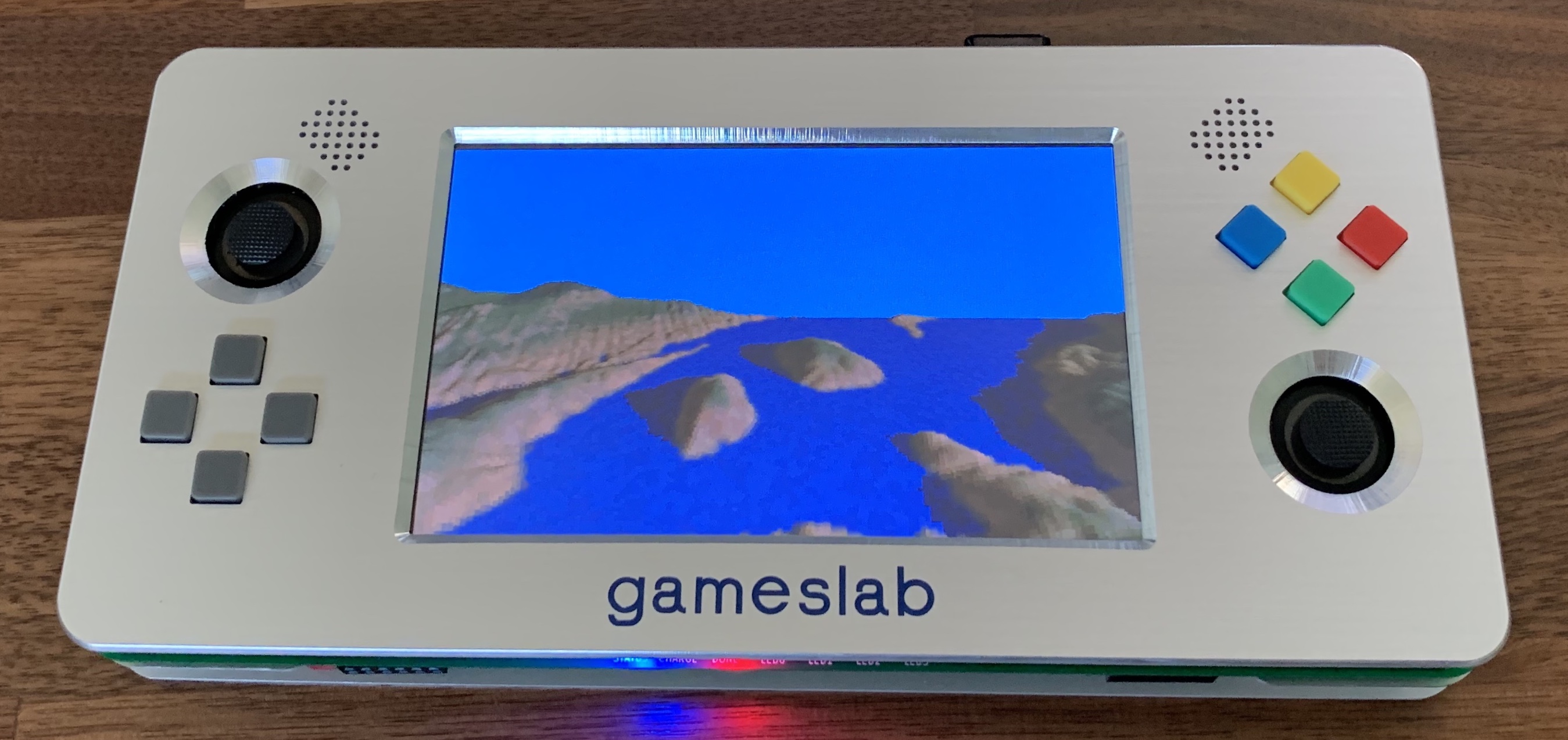
Gameslab project overview
Adventures in hardware hacking, low-level software, FPGAs, and more!
craigjb.com
406 points · by craigjb · 6y ago · 50 comments
I love that retro game emulation has spawned this massive culture of super complicated and roundabout ways to replicate $50 consoles. It’s everything I love about DIY projects in general.
I actually didn't originally intend it to be for retro game emulation, more for experimenting with custom hardware for each game and with 3D acceleration hardware. But, the idea of putting retro emulators in the FPGA fabric is so easy.
In fact, over the holidays, I'm working on porting some of the MiSTer FPGA retro emulators to the Gameslab: https://github.com/MiSTer-devel/Main_MiSTer/wiki
It's 64k ram 8-bit avr instruction set and a blitter doing a variety of data formats. It's not quite ready for prime-time yet, but you can see some of it online. The virtual hardware registers can be seen at https://k8.fingswotidun.com/static/docs/io_registers.html It might be quite amenable to something like this.
Analogue does great products usually so I can't wait for it.
(I'm not affiliated at all with them, I just love their products).
You're slowly becoming a software guy after all...
Just mastering Ki-CAD is an accomplishment. I learned circuit design with P-CAD. And it was anything else but intuitive. Playing around with Ki-CAD reminded my of thise days.
Can you recommend a good Ki-CAD tutorial?
Can you elaborate a little bit on the mistakes you made and what led to the choices you made? E.g. first time read about Das U-Boot.
To be honest, I really don't know a good KiCad tutorial. I kind of just banged myself against it until I learned. But, I had previous experience with Eagle, Altium, and Cadence Allegro.
Das U-Boot is the embedded bootloader and is pretty standard for embedded ARM systems (and others! https://github.com/u-boot/u-boot/tree/master/arch).
On a dev-board prototype before, I had also used Buildroot (https://buildroot.org) to create the minimal root filesystem image. This time around, I decided to use Debian since it makes installing packages I want much easier. For example, I can just apt-get install the USB wifi firmware packages instead of hunting them down and including in a manually generated image. It's still using a custom compiled kernel though, since I have custom drivers for things like the graphics hardware.
I'm trying to use Rust for as much as possible (I like Rust a lot). The STM32L0 runs rust, I bodged together a framebuffer driver in Rust, and the games in userspace are also in Rust. I'll post about the Rust framebuffer driver at some point.
Shout out to the Real Time For the Masses project (it's an RTOS) I used: https://github.com/rtfm-rs/cortex-m-rtfm
https://www.youtube.com/watch?v=vaCVh2SAZY4
(first video of a series of 10)
P.S: I'm the ultimate noob on these topics.
Curious, can you both execute code on the FPGA and simultaneously write other parts of it? Or do you have to write it in one go, than "start it"? And in the latter case, can you write it incrementally or do you have to erase it first?
Every time I've been involved with one, it's been basically a CPU with various accelerators for specific functions done in the fabric, with the design being CPU-forward. I've never seen anyone approach them from a FPGA-forward angle. Interesting!
With regard to Verilog/VHDL, you'll have to learn at least verilog at some point, but I stay away as much as I can. SpinalHDL (based on Scala) is my goto. Some people like the Python based ones like migen, but I like me some strong typing.
I have a couple of blog posts about starting to put together a Gameboy CPU on craigjb.com (not finished yet).
It's verilog, but you're going to have to learn some anyway. All of the new-generation HDLs compile down to verilog, which then goes into the various synthesis tools.
I had it fabricated for me by a company by Front Panel Express. In a DIY audiophile forum I saw people using them, and if they're good enough for audiophile gear, probably good enough for me :P
Basically the holy grail of emulation... Not-emulation.
First time I’ve seen a real project using this.
How far is embedded rust away from “prime time” you think?
Also, the STM32 is a system supervisor, did it really need an RTOS?
I'm actually working on a post about restarting my firmware using the latest and greatest (I started working on this firmware over a year ago).
I used the RFTM real-time OS (RTOS) because it's super light-weight and handy for checking at compile time that my interrupt handlers don't cause conflicts. It's really a nice framework for any event-based firmware (a big chunk).
Most game engines are about throughput and I don't think you'd see a lot of use for them, heck we had a hard enough time using the PS3 back when I was in the industry and that wasn't nearly as wide as a FPGA can be.
Good work!