antonio (@lelff) on X
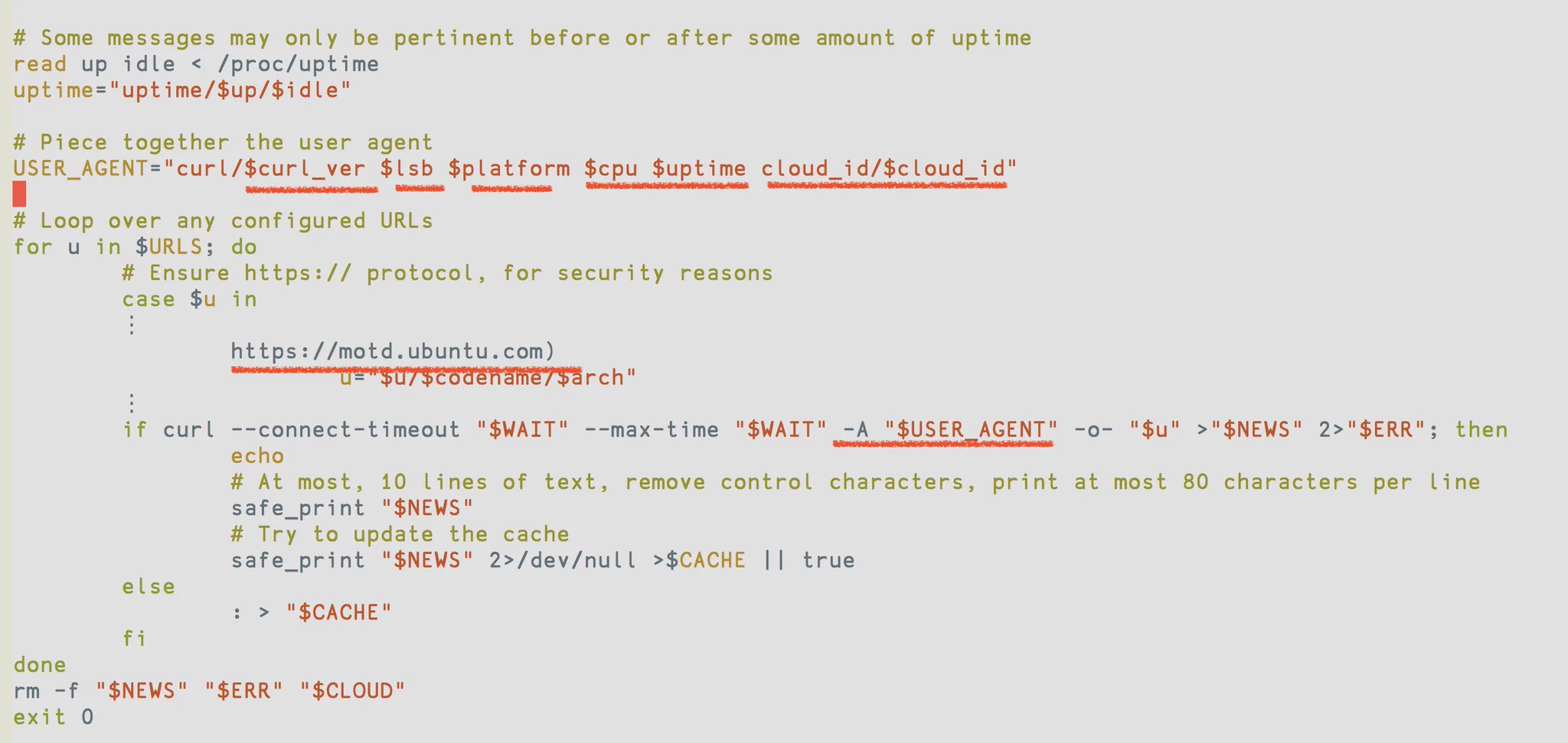
*BSD’s idea of motd(5) [“message of the day” you see upon login]: print the damn /etc/motd file Ubuntu:
X (formerly Twitter)
251 points · by lelf · 6y ago · 187 comments
The functionality is included in the "base-files" package, which has a priority of "required" and is marked as an "essential" package. Thus, if you have an Ubuntu instance, it's nearly 100% guaranteed this is installed and enabled by default.
(If memory serves, this was added in 17.04 or thereabouts.)
With this crap and others (e.g. aggressive snapping), Canonical is eroding trust in its most important market. Inertia will only take them so far.
This implies there is one script. However, ubuntu is full of crap.
the privacy panel, snapd, amazon, lots more.
The fixubuntu.com site has disappeared.
I switched to arch linux.
one amazing difference - launch gnome on arch and it comes up in a second. On ubuntu there is so much bloat.
Fedora or CentOS does not
I'm pretty sure the "phone home" crap started shipping with Ubuntu 17.04.
I think this motd is there to (1) advertise more complex canonical products and (2) be used for security announcements.
Also, I don't think you ever see motd on a desktop install.
Whether you see it or not, it's still there and it's still running every ~12 hours.
I used to have a privacy.sh script for fresh Ubuntu installs back on the Amazon shenanigans days. That file has been empty for a while but I guess I need to update it again.
ENABLED=0
To get rid of the entire "dynamic" MOTD, disable the timer unit:
$ sudo systemctl disable motd-news.timer
(I'm on an iPad and going from memory, but I think this is correct -- someone will correct me if it isn't!)
There are differences between them but I am 100% confident that I can do everything that an Ubuntu system can, especially if we're talking about infrastructure.
It was always a big one for me, I ran with ZFS root for 2+ years and every kernel/zfs update was a bit of a Russian roulette (I did have to perform elaborate recovery once or twice). Even if it was 100% guaranteed to compile and work, there was 1. a very scary window during which if the system hung, you're semi-bricked; 2. the long build.
Running a desktop/laptop without a time-traveling file system is quite simply not an option (especially once you get used to it).
On servers, not so much difference. Well unless you are using k8s, etcd, juju and all that jazz
- Bug #1701068, "motd.ubuntu.com currently shows media item (HBO's Silicon Valley using Ubuntu)" [0]
- Dustin Kirkland's explanation here (on HN) back when this first happened [1].
---
[0]: https://bugs.launchpad.net/ubuntu/+source/base-files/+bug/17...
I'm not even saying this is bad. Ubuntu has to fund itself somehow. But people should really know what they're getting. Ubuntu is not a privacy-focused or user-centric OS. It's the Windows of the Linux/Unix world.
> I'm not even saying this is bad. Ubuntu has to fund itself somehow.
Oh dear. You make as if its fine for the users to give themselves up to Ubuntu (and Amazon) to be mined by the distro that does call itself "privacy-respecting" and "open-source"; some may call such claims misleading in the light of this now. Due to your defeatist rhetoric in supporting these overlords, I would have to change the guide to support the devil I know that can't read my encrypted data, rather than two or eight unknown devils that can.
At least with macOS its all "encrypted" and has sane defaults with a consistent user interface and when some settings are turned off, they stay completely off.
Wait, what. You can completely disable any "phone-home" features of Ubuntu. Actually, you can make sure that this feature is disabled by removing the corresponding package of your system, something that isn't possible in macOS. And you can also audit the code, because all this code is actually open-source [1].
Also, this controversial feature of Amazon search could be disabled quite easily [2], and this motd can also be disabled [3].
So sorry, Ubuntu may have some controversial features, however saying that using macOS is more privacy-respecting than Ubuntu is a lie. They are at least at the same level, however considering that I can't get the source code of macOS and make sure that turning off a knob will stop spying on me, I still think Ubuntu is better than macOS in this point.
[1]: https://launchpad.net/unity-lens-shopping
[2]: https://www.howtogeek.com/126995/how-to-disable-the-amazon-s...
[3]: https://raymii.org/s/tutorials/Disable_dynamic_motd_and_motd...
Privacy is not a super-set of Open Source. They're two different things; somewhat correlated, but only insomuch as the auditability and self-correction of any claims to privacy may be.
Auditability is important, but most people won't do it, and even those who do miss things; OpenSSL is fully auditable, yet security bugs are discovered every year. Its not the same thing, but its in the same vein; just becuase we're capable of catching a needle among the haystack of a million lines of code doesn't mean we will (in the case of the MOTD, its less of a needle and more of a giagantic pile of crap just laying on top).
Self-Correction is important, but even fewer people will do it. Defaults Matter. People just don't dive into VSCode and rip out Microsoft's analytics tracking code en mass. It doesn't happen. People use the defaults.
In the face of these two assertions; Open Source is important in the fight for Privacy, there's no doubt about that. But even more important than that is Trust. Its not enough to see the code; its important that the organization and people writing it have a demonstrated history of caring about the privacy of their users, and that they've taken both "table-stakes" and "above and beyond" steps to assert their position on the matter on behalf of those users.
Canonical does not have this demonstrated history. They barely lurch in the right direction, against their collective wills, when we care enough to crusade across the internet to convince them that they're wrong. By comparison; Apple does care. You can complain that its in the interest of their profit margins (OF COURSE IT IS) or that its genuine (I'd bet my net worth that this is also true); it doesn't matter. They productized full disk encryption with hardware security modules. They don't just support hardware MFA; they make it the default. When they realized phones wouldn't have the power to do natural-language processing on voice in the same way servers do, they didn't just throw their hands up and move everything to the server like Google did; they made better silicon. That's their history; Canonical's history is sending keystrokes to Amazon so they can sell you more expensive toilet paper. The most knowledgeable Ubuntu users turn this off; the most vulnerable won't even know its happening.
Everyone is welcome to their own opinion on this, and you're also welcome to place the value of open source above the value of privacy; but I take the stance that Privacy isn't negotiable, and its more important than a product being open source or having privacy if you tweak the knobs in just the right way.
Literally everything you can't read and understand the code to seems to be actively hostile, I'm surprised clang doesn't call home.
You should, though.
Yep, just like all the other distros...
The "adverts" are benign. Right now it says to check out microk8s and also to look at livepatch.
But logging in and seeing a summary of: loaf, disk usage, processes, number of users logged in, IP addresses, memory usage and swap usage, kernel version and also last login time and from what IP.
That's pretty useful stuff to me.
Also if you're in the position to care about motd, you're going to have the skill to change it yourself.
My distro shouldn't be advertising to me. Call me "old school" but this has no place in Linux. Also, if you're in a position of trusted compute then you don't want this sort of information leaving your network.
> Also if you're in the position to care about motd, you're going to have the skill to change it yourself.
Yeah - and I feel I shouldn't have to add it to my images/recipes/whatever to fix this. I use Linux for a lot of reasons, and some of the most important ones are that it doesn't advertise to me and/or leak data. This is telemetry and it's unacceptable.
I don't use Ubuntu, and you don't have to either! It's almost like there are millions of Linux distributions!
I'll argue that utilization of Linux comes with certain "expectations" which is why so many of us decide to use it in the first place. Some of those expectations include (but are not limited to) rock-solid stability, "be good at one thing", lack of bloatware, sane update/upgrade cycles/policy, privacy, and security.
I've been using Linux professionally for just over 15 years now, sometimes in highly compliant/systems-critical infrastructure. The privacy and security bullet points above are the most important factors to me when designing and/or hardening systems.
> I don't use Ubuntu, and you don't have to either! It's almost like there are millions of Linux distributions!
Actually - I had to at my last position. When people make technology decisions they often go with the most popular/"safe" options and then dictate the decision to those implementing it. Welcome to corporate America (which is where the jobs are). Everything new was spun-up with Ubuntu as a base distro and you better believe I manually opted-out of this "feature".
---
There's a big problem when the most popular distro starts making moves like this as it sets precedent that it's OK. Canonical has made the decision against privacy/security in regards to their motd and that's a huge issue, and I argue it goes against the ethos of Linux and OSS.
I dislike the idea of tying particular political or economic philosophies together with a tech stack like Linux.
Everyone can distribute linux distributions however they see fit, it's an open platform and if that includes telemetry by default that's fine too as users have choice. I don't think anyone uses a Canonical distro and is genuinely upset or surprised about this particular benign case.
The linux distribution space is truly one of the few places where we can't make any excuses about market power or lack of choice. There are a billion distributions, almost all of them free. Users will pick accordingly, and my sense is that virtually nobody cares about this particular case of telemetry.
It isn't about politics nor economics. It's about privacy and control. That is linked with Linux for a lot of users. And Linux users have a pretty good situation in regard to this.
But it is starting to erode and if allowed can only get worse.
It is unacceptable and the fact that canonical don't realize this is why I'm thinking of alternatives.
Especially considering the use case. Either they haven't got a clue, or they are testing the waters. Does not look good any way you look at it.
I've had to use Ubuntu in an environment with high security needs/regulations. I've had to disable this exact feature because leaking OS versions, network information, etc. externally via that user agent string was unacceptable from a security standpoint.
I was upset that something as simple as a motd had been retooled to leak data.
> and my sense is that virtually nobody cares about this particular case of telemetry.
And in my real-world experience I've been paid to care. When forced to work with Ubuntu (which is everywhere these days) I have to "reign it in" with custom images/scripts/etc.
> I dislike the idea of tying particular political or economic philosophies together with a tech stack like Linux.
This isn't "political or economic philosophies" this is security 101. Leaking data like my OS version, IP addresses, when admins are doing their work, etc to the public internet is a hard "no" for anyone who's operating in any semblance of "best practices".
As such, linux is just as much a product and a service as it is a technology tied to very real markets and niches. And it with that come the exact same concerns you'd find in any other market.
Your observation is totally correct: there are tons of distributions and there is plenty of choice and people don't care.
But that choice is far from granted, and it's not an argument that deprecates questions about moral responsibility: Are companies providing a service/product entirely responsible for the consequences? Or are customers entirely responsible for their own choices and behavior? Or is it both?
Let's use an analogy to demonstrate. Bread is a great example.
The vast majority of people eat bread daily. And so there's a huge demand. But the market has consolidated in some places and so many people end up buying bread from retail chains. Sadly, such bread is a processed food and contains many ingredients that aren't that healthy such as emulgators (E-numbers), or loads of sugar.
You could argue that people still have a choice: You could go to an artisanal baker. Or you could bake your own bread: the recipe isn't that difficult and requires few raw ingredients. So, why aren't people doing that when they know retail chain bread isn't good for them? Three reasons: because artisanal bread is expensive; it's a different shop from a centralized retail shop and making decent bread takes time and skill. Consumers simply calculate cost/benefits: buying cheap bread is far more convenient in the short run, even though the long term consequences may cost more.
Okay, so how does that hold up with Linux? Same thing.
Ubuntu is huge because it was successful in it's marketing early on; and it did a bang up job in creating an effective onboarding experience for new linux users. You can argue about their design choices over the past 15 years, but in the end, they have been ahead of the competition when it comes to tapping into a new generation of users.
As time went on, what you see is that the Ubuntu community has spawned a huge volume of documentation: tutorials, videos, stackoverflow posts,... Google "how to install sound drivers in linux" and your first hit will be tutorial for Ubuntu. Whereas trying to find the same information for lesser known distributions might be just a tad harder.
And that's what makes all the difference. Convenience. If you spend an evening trying to fix your damn audio after first installing Slackware, and all you find is Ubuntu tutorials, you will likely just switch over to... Ubuntu. Especially if you aren't particularly interested in the design philosophy of Slackware, or who these Canonical people are anyway. You simply want to listen to your favorite Spotify playlist, right?
So, the issue here is that both retail chains and Canonical understand that the vast majority of people simply want convenience and they will easily choose it over principle or their own self-interest. And so, it's extremely tempting to exploit that.
The question then becomes whether it's morally right to tap into that and take more from your customers or users then what they are bargaining from. Especially when they aren't really aware you're doing it. Either by using ingredients that aren't prohibited, but clearly unhealthy, or by using techniques to gain more insights about their behavior. Especially when everyone sells them "Linux doesn't do that unlike Apple, Google or Microsoft".
And so, ever more people will keep choosing Ubuntu over other distributions, even when they do have a free choice.
The mere existence of a choice isn't a defining factor at all, it's everything else: available tutorials, number of users, onboarding experience, how quick they can get things working and so on.
Tis where the discussion does turn political. The public space is regulated through laws for many reasons. But such rules and laws aren't static. They can change through political discussion and ever changing power balances. And so, consumer protection laws exist not just to protect individual consumers, but also to ensure that large, unintended second order effects of new products and services don't cause shocks that might derail an arguably stable society.
If retail chains are free to add more and more unhealthy ingredients to their food products because that clearly drives costs down and attract more customers, the societal cost will be an increasing number of people who suffer from health concerns linked to consuming those products. Not because people don't mind their health, but because convenience forces them, and the alternatives are simply too costly.
By the same token, if companies are free to build in all kinds of telemetry sending scripts, that won't stop people from using those products as they prove to be really convenient. But the societal cost will be that private enterprises are able to derive very accurate profiles about who we are, and what we want, and use those in ways that don't align with the interests of users of their software.
This is an elitist view which implies that if someone doesn't understand something, they aren't affected by it.
And look you dont need to answer those questions either, but take it from me, that kind of thinking and attitude will tank a business and eventually compromise or overburden IT, who will just jail-firewall Machines running that kind of code because its impossible to reign-in in a militerized zone such as a company with over, say, 150+ employees, let alone anything major.
Please reconsider/rethink.
Not like it is the first time. - in the past, Ubuntu has demonstrated a willingness to sell surveillance of their user base to a third party[1].
It makes me trust the company less and worry that if their fortunes or management changes, they'll do slimier, less obvious things.
I suppose this all is ultimately a positive thing. Greed heads serve the function of keeping distro-churn up when they do something gross enough to chase people off, which helps keep the ecosystem healthy.
[1] https://www.zdnet.com/article/canonical-performs-u-turn-over...
edit: google found this article https://lwn.net/Articles/726902/
Also, wouldn't apt be a much better source of analytics data? Yes, there are apt mirrors which aren't controlled by Canonical, but most people would be hitting ftp.{countrycode}.ubuntu.com, or at the very least be downloading http://mirrors.ubuntu.com/mirrors.txt.
* https://git.launchpad.net/ubuntu/+source/base-files/tree/deb...
* https://git.launchpad.net/ubuntu/+source/base-files/tree/deb...
https://lwn.net/Articles/726902/
It runs twice a day, regardless of whether you ever see it.
When packaging we are required to disable privacy harming "features".
It’s nice to see only a handful of processes running on a new setup.
That's a heck of a gotcha.
edit: If, after installing, you install sudo and manually disable the root password, you won't be able to boot to the rescue or emergency targets; a valid root password is now required by default.
If you want them to work without a password, like classic "single-user mode", you can edit both the rescue and emergency unit files, and add the --force flag to sulogin.
The popularity-contest package is installed, you're asked whether you want to participate, and then the package is uninstalled when you say no -- as opposed to asking and then installing the package if you say yes.
I had a better / more elaborate explanation bookmarked somewhere but can't find it now, the tldr is a "modern" OS (past ~2-3 decades) wants the freedom to manage anonymous (malloc) and named (mmio) memory between physical RAM and disk devices. Disabling swap means the OS must always keep the anonymous pages in physical RAM, which negatively impacts any IO-bound workload (can't cache) and, ironically, puts more pressure on the disk.
So unless you have an extremely specific and finely tuned use-case with lots of benchmark data, the OS will almost always make a better call.
I have been running swapless for two decades without any issue.
I would say you have that a bit backwards, Ubuntu exists because of Debian - not the other way around. This would be like saying children are the reason parents exist.
Ubuntu has given me PTSD for anything that ever slightly resembles it so I will take a pass on Debian - many other distros out there.
From an evolutionary standpoint, kind of.
In nature there are a bunch of species that have one/all of the parents die after the offspring are conceived/born. The same applies for Linux distributions a surprising amount of the time.
I think I understand what you're saying, but the phrasing is a little strange. Without children, there wouldn't be any parents by definition.
Good point - the phrasing is rather unfortunate.
What this means in this context is that Debian is still relevant and useful rather than a relic. It's the biggest community-based rather than company-supported distro and rejects such features.
The remaining bits likely come from Debian. If you believe it's a bug, have you tried reporting one?
  $ sudo apt remove base-files
  ...
  WARNING: The following essential packages will be removed.
  This should NOT be done unless you know exactly what you are doing!
    base-files bash
  ...
  You are about to do something potentially harmful.
  To continue type in the phrase 'Yes, do as I say!'
   ?]
The best you can do is disable it (and hope it isn't silently re-enabled later):
$ sudo systemctl disable motd-news.timer* https://bugs.launchpad.net/ubuntu/+source/base-files/+bug/18...
This is why.
There seems to be one assumption that all online advertisers and telemetry implementers make. They assume the user is not in full control of name resolution. ("Full control" as used here means relying on whitelists not third party blocklists.) In this case, they assume motd.ubuntu.com will be resolved without any user input. "Without any user input" here means the user never looked at the domain "motd.ubuntu.com" and made a decision whether it was needed or not.
Perhaps we make a package that patches this out? I'm thinking of something that detects this file and replaces it rather than a manual process. That way it gets fixed whenever "base-files" or whatever gets its updates. Make it a depend on base or similar.
Somebody with a sharper set of teeth and specialised dorsal fin might want to do an audit for similar shenanigans. Canonical have "prior art" for this kind of thing. I doubt this is the only addition.
"In Ubuntu 17.04, we added /etc/update-motd.d/50-motd-news"[0]
[0](https://www.reddit.com/r/linux/comments/6k7a86/comment/djkd8...)
- There is a vast income discrepancy across the world. For some people $1000 for an Ubuntu copy would be cheap and for others $10 would mean going hungry. Not to mention all the people who have no good way to pay online, such as people without a bank account. (And without a bank account, how do you even get started with cryptocurrency on a minimally powered machine?)
- Ideally the price would be as much as it's worth to each user, but there's no way to determine what each user thinks it's worth (except in a utopia of perfectly honest customers, which presupposes perfectly honest businesses).
- As much as I hate ads they are probably one of the easiest ways to get a relatively steady income stream no matter who the users are.
Like the other commercial Linux distros, Canonical profits from support.
Also, now it seems that even when you pay for the product you're not guaranteed to have something that doesn't include spyware. Windows 10 is a great example of this.
What’s your Linux of choice?
Do you think we will see banner ads eventually in Ubuntu?
I agree I’d rather pay 30usd or whatever.
To us purists, it shouldnt phone home for a motd.
looks like it never hits the cache unless the curl fails.
Right above that code is this block
  # If we're not forcing an update, and we have a cached motd-news file,
  # then just print it and exit as quickly as possible, for login performance.
  # Note that systemd should keep this cache file up to date,
  asynchronously
  if [ "$FORCED" != "1" ]; then
          if [ -r $CACHE ]; then
                  echo
                  safe_print $CACHE
          else
                  : > $CACHE
          fi
          exit 0
  fi
Except when there was a bug that caused it to do just that (and also caused a five second delay when logging in).
Can you provide links to all software you have ever written so I can complain about bugs that existed in 2017?
*sane defaults used to be thing.
I dont want to worry about stuff i dont know about making connections i didny say it should.
Confugure one thing, sure is easy. You think they’ll stop at one?
If it was just about the ads, I'd agree. But comparing it to BSD is silly. BSD doesn't have scriptable motd and I'm supposed to act like that's obviously better? Eh.
Look, Nothing against you, you dont seem to have a systems exposure i do. Im not a fullstack dev, maybe you are and its fair to just see your own machine and expect everything else to work.
Car builders and bridge builders see different problems to solve, and see risks differently too.
Further, as an avid user of Ubuntu, who reaps the benefits of millions of work hours of Debian &/or Ubuntu employees, I'm ok with advertising whose source code I can audit, and modify even.
And to think that the majority of dissenters are commenting from their closed source Macs & iPhones, or their equivalent commerical competitors, on Google funded browsers tracking their every click, is all a little ironic
People having emotional reactions as if some tribe they imagine they belong to has been insulted by someone else who they imagine belongs to some other imaginary tribe, instead of just, "yeah that's wrong nobody should do that, let's do better" has always been one of the most off-putting things to me about the whole free software community, such as it is. It was annoying on Usenet in the mid-'90s, it was obnoxious whenever RMS prioritized that sort of thinking over actually just turning the other cheek and making the world a better place, and wow does it not do anyone any good decades later.
My theory is that people get sucked into these black holes of rational thought because, like me, a lot of people drawn to the open source world tend to be obsessive introverts who often feel more comfortable with computers than people, and like me, are susceptible to getting sucked into feelings of belonging and camaraderie with often imaginary subcultures/tribes/families online or elsewhere, when in reality the only common thread is they're random people from mailing lists trying to work together towards a very narrow range of common goals.
The instant people get sucked into the dark side, next thing you know they're going around IRL saying stuff like "ACTUALLY it's guh-noo SLASH lee-nooks and anything else is disrespectful and I will personally feel disrespected by anyone who defies me". And then all is lost and this whole thing becomes a net negative for everyone involved. No fun, no fun at all. Nobody should feel personally insulted by anyone pointing out obvious technical flaws in anything really, including their own work, but certainly not in open source operating systems that they may or may not even contribute to.
Perhaps. There is at least one person who is now less likely to use Ubuntu after learning this: me. I have typically used a mix of Debian and Ubuntu for both desktop VMs and servers; now I am more likely to use Debian, which takes a significantly stronger privacy stance.
I am commenting from an iPhone though. Safari is not Google funded and does not track every click, but I do believe that Apple is getting the kind of OS version stats that Ubuntu’s motd script sends. Relatively tame for commercial software, honestly, but Linux is a different story.
This is just yet another quite literal example of how many GNU/Linux distros are becoming more like Windows - they do all sorts of things now that they were never asked to do, and it's up to us to fix things after a clean install.
And others aren't. Though I disagreed with the SystemD move, I've quite enjoyed arch for years. There are also some excellent other options, for instance, Alpine is a Musl/Busybox/Linux distro that works great on old machines. I think most Linux users will move to a different Linux before moving to BSD for comfort reasons.
Despite all of this, the number of people switching from Win/Mac to Linux is in negative territory. Why? Because they first advertise their switch on a blog-post or Twitter, then they later realize that they can't do basic tasks or keep up with new features added on Windows and Mac. They then have to live with half-working unstable hacks which they then ultimately switch back or dual boot.
It's a bit misleading for Ubuntu to call itself "open-source" and "privacy respecting" when they're teaming up with Amazon planting adware and telemetry in the OS, which gives the impression that they already abandoned the idea of "privacy".