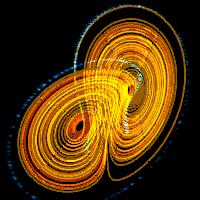
Interactive Lorenz Attractor
Interactive Lorenz attractor with 10,000 butterflies under the Lorenz attractor flow.
Malin Christersson
102 points · by webdva · 6y ago · 17 comments
The correct glChAoS.P / glChAoSP and wglglChAoS.P / wglChAoSP website is:
https://www.michelemorrone.eu/glchaosp/
glChAoSP /wglChAoSP is RealTime 3D strange attractors GPU explorer and hypercomplex fractals - over 200 Million particles.
It's freeware, Open Source, and both: native Multi Platform and WebGL... and display not only Lorenz Attractor, but over 100 object types between Attractors, Hypercomplex Fractals, and DLA/DLA3D (Diffusion Limited Aggregation)
Thanks again.
BrutPitt / Michele Morrone
Just one thing: on a touchscreen interface with Firefox, zooming out works well but zooming in is sometimes jittery or not registering at all. (Panning and rotating work fine.)
https://docs.juliadiffeq.org/latest/analysis/uncertainty_qua...
where divergence on the Lorenz attactor tends to occur by t=80 or so even with accuracy of 1e-16.
But the funny thing about chaotic problems is that the shadowing theorem holds, which is:
>Although a numerically computed chaotic trajectory diverges exponentially from the true trajectory with the same initial coordinates, there exists an errorless trajectory with a slightly different initial condition that stays near ("shadows") the numerically computed one.
So you might as well just use Euler's method with high error, because it's backwards stable for this calculation, i.e. it gives a trajectory on the attractor, just the wrong trajectory. But since every method gives an O(1) error wrong trajectory after a short finite time, you might as well use the cheapest most error prone but convergent method.
They simulated Lorenz reliably up to 10000 time units; I managed 1400 units using MPFR on my NUC using my own code (500th order, took about 13 hours!).