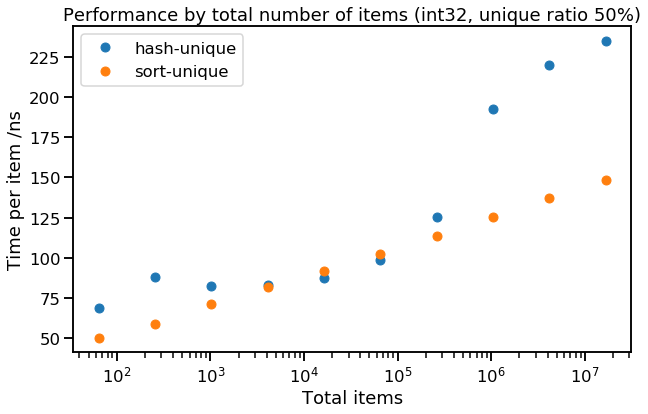
Hash vs Sort
Doug
137 points · by douglasorr · 6y ago · 81 comments
One option is this one [1] which I actually wrote as part of this exact task: de-duplicating a list of integers, as part of working on [2].
I wrote about the types of speedups you can expect with radix sort here [3] - it depends on the size of the input elements and their distribution (e.g., if many top bits are zero, radix sort will be much faster), but in my test case I see a ~5x speedup for moderate or large input sizes (thousands of elements or more).
Of course, the same could be said about hash tables...
[1] https://github.com/travisdowns/sort-bench/blob/master/radix7...
[2] https://lemire.me/blog/2019/05/07/almost-picking-n-distinct-...
[3] https://travisdowns.github.io/blog/2019/05/22/sorting.html
O(1), hah, I wish!
Yes, there is the caveat of constant k, but in practice this is usually implied for integer keys e.g., the int32 integers used in the OP.
If the keys become arbitrarily long, hash tables also become O(n log k) since you have to hash and compare log k bits of key state.
In typical usage of thousands of items, locality wins, low constant factors win. Simple lazily defragmented list can be faster than constant size hash table thanks to constant factors, faster than sorting.
Unique objects have a perfect hashing function, but it still has to be fast. Sometimes making it an intrusive structure is a major speedup due to cache locality - let the unique object track where it is.
If you cannot know the maximum size (which you will with unique objects), then get more adaptive.
Would you mind linking a few papers?
If you hash with SHA-256 then any sorting operation seems like it’d just take O(256N)=O(N).
What am I missing? Clearly this cannot work because otherwise everyone would do this as we accept O(NlogN) as the norm!
Let's assume a perfect hash that never collides or leaves gaps, the best case for this.
For a radix sort in some base with K digits, N can only go so high before you have duplicates. Specifically, base^K >= N
Take the log of both sides. K >= logN
So with arbitrarily large numbers the time taken to sort is actually NlogN.
With fixed-size numbers it's "O(K*N)" but K is larger than logN would be.
If I understand your post correctly, Radix sorts in O(log(maxsize) * N) instead of O(NlogN). So why do people say Radix Sort is O(N)?
Your idea is interesting and might be useful in some applications! But calculating a SHA256 takes time linear in the length of the thing you're hashing. Even if you assume fixed-size keys, SHA256 isn't fast. It's not designed to be fast.
You'd likely need an extremely high N before O(N) SHA256's is faster than O(N log N) comparisons.
Ahem, so does hashing.
And so does sort comparison.
The GP's idea is actually quite effective for medium-to-large objects.
As a bonus, you can cache and store the SHA256 of each object for future in-set testing and uniqueness-finding without looking at the objects themselves. (You cannot do this with non-cryptographic hashes or sorting by comparisons.)
This is basically what Git does.
Yes, it takes time linear in the length of the thing you are sorting, but comparison sort is generally worse in that respect: comparison also takes up to linear time in the comprands, and you have to compare each element not just once but log n times [1].
So the time to hash all the elements once (if the hash is not already cached in the element) is going to be a small part of the sort time.
[1] There are ways around repeatedly re-comparing the entire key, but they work mostly in specialized cases.
I think radix sorts are probably less popular since, the standard for sorting has always been to provide a "comparator" that compares two objects, and radix sort wants something different entirely: an key you can extract bits from instead. So radix sort was never a drop-in replacement e.g., for qsort in C.
Often you can provide such a key object (and indeed in trivial cases like sorting integers, the entire object is simply the key), but sometimes it would need to be longer than 32 or 64 bits, so the best interface isn't clear: especially in oldschool languages like C which want to pass function pointers as the comprand.
This was kind of cemented when e.g., C++ standard library made == and < the standard things you need to implement not just for std::sort, but also std::map and std::set and many algorithms that rely on order. It's similar in a way to how std::unordered_set/map wasn't a thing until much later when the hashing concept was introduced.
When you can use it, though, radix sort is great: sometimes an order of magnitude faster than comparison sort.
Note that locality of reference is so important that even though "single pass" radix sort does the least work, the ideal radix turns out to be 6-10 bits usually, even if that means e.g., 5-10x more instructions executed for 64-bit keys: because sparsely writing into buckets spread across memory is just really slow.
Why wouldn't a radix sort approach suffer from the same disadvantages as the hash unique approach (e.g. locality of reference)?
Every std::unordered_map I've used is surprisingly slow. Normally hash-tables are slow because it's so easy to write a slow hash-table, but std::unordered_map is slow for other reasons that I have had explained to me and then quickly forgot :(.
I also find it strange that unordered_map is used rather than unordered_set. Not sure if it would make a performance difference, but if we are going for naive implementations, that should be at the top of the list.
For the OP’s use case, replacing std::unordered_set<T> with CAtlMap<T,bool> improves the hashtable method performance by a factor of ~4, consistent over different input sizes.
Java's HashMap doesn't have the oddities unique to C++'s unordered_map, but it has broadly similar performance.
For a hash map to be faster, you'd need to trade memory for speed, i.e have significantly more buckets than the expected size. This may however collide with good caching performance which I suspect is what the author observes.
I have to remind them that O(1) is just a rule of thumb for scaling and that technically a dictionary lookup + sleep(5) is still O(1)
Now what this article is showing is something else, which is that contrary to the claims in the spec, the benchmarked std::unordered_map implementation does not actually have amortized O(1) insertion time and that you can beat it with an O(N log N) sort if you want to deduplicate integers, for any input size. Which is interesting, but very specific, and not an observation that would carry over to other algorithms (or data types, for that matter. For example, it would be interesting to see what the graph would look like for types that have a more complicated/expensive way to calculate which one of two values is smaller).
The example in this post is a log N factor. log N is a relatively small growth, you'd need 1000 elements to get 1 order of magnitude and you'll never run into 2 orders of magnitude.
If you can come up with reasonable code where an order N complexity slower algorithm is faster in practice - I'd love to see it.
Almost all instances I've seen of big O scaling not being realistic count every memory access as 1 operation. In reality, memory accesses have a huge variation in how much time they take. Moreover, this does have a dependence on the program.
This is of course due to caches. As such, an O(n^2) algorithm that has very local memory accesses can actually beat an O(n) algorithm that spreads out its memory accesses randomly over the entire memory space.
It has come to the point where I care more about the expected cache hits of an algorithm than the big O scaling.
Upon thinking about it, the example is comparing the relative speed of hashing every item (O(n) * O(1)) == O(n) and sorting (O(n * log(n)).
That means the ratio of these two is a log n factor n * log(n) / n == log(n).
good point.
As a side point, I think the main point of the post is that the time taken for the hash solution, increases at a greater rate than the sort + unique solution. Now, that doesn't make sense with our big 0 notation.
This is because we don't have a simple hashmap, what we have is a dynamically resizing hashmap, which we don't set a capacity on, and the resize operations are order n. Now, how often can we expect to resize? I think most hashmaps double their capacity, so there will be log(n) resize operations that each take O(m) (where m is the size of the hashmap when it needs to be resized).
Now at this point, I can't be bothered to think further about it. That feels like it should be less than O(n * log(n)), but it's kinda close. Either way, it's definitely larger than the simpler O(n) case we're thinking about.
If there are deletions, both operations are amortised O(1) provided they have been sensible and made the deletion threshold a lower factor.
It's the same sort of pattern as dynamically resizing a growing string. As long as you resize by a constant > 1 factor, rather than an addition, the number of resizes is low enough that the O(n) cost of copying is amortised over prior appends.
> Either way, it's definitely larger than the simpler O(n) case we're thinking about.
It actually isn't larger than O(n), setting aside constant factors.
For a hash map's time to grow more than O(n) for n insertions starting from empty, suggests an implementation problem.
Would be interesting to build a hashtable with an equivalent “small string optimization” approach where you have a fixed sized array that is replaced by a canonical hashtable once it grows past some threshold.
At school I had a friend implement a Fibonacci heap (which is O(1) or amortized O(1) in every step) for a simple thing and didn't bother to benchmark it against a simple vector based binary heap.
It was slower by one order or magnitude. Only twice have I had to use something else than a simple binary heap due to cache issues.
But yeah, they're one of the classical examples of "faster on paper, slower in practice" algorithms. Just use a binary (or d-ary) heap.
Like, Fibonacci heaps guarantee an amortized O(1) "decrease key" operation, which is a stupendously obscure priority queue operation. Except, of course, in Dijkstra's algorithm, where the lowest runtime complexity bounds depends on it.
I'm not saying all cases can be deferred until later. Sometimes you really need to address it up front. But I think most can be refactored later.
I can be totally wrong, but I suggest trying a simpler hash such as FNV. It might outperform the sort-based approach.
I also suggest replacing the hash table implementation with something better, such as absl::flat_hash_map. The C++ std::unordered_map is hampered by compatibility requirements: the designers wanted these unordered containers to be a good substitute for the preexisting std::map, and necessitated certains design decisions such as pointer stability which is not necessary for most applications.
I do agree that unordered_map is extremely slow.
        ∪ 'AABBADCAB'
  ABDC
        ≢∪ a←{⍵[?⍨≢⍵]} {⍵,⍵[(?⍴)⍨≢⍵]} 5e5?2e9  ⍝ 1e6 ints with 50% unique
  500000
        cmpx '∪a'  ⍝ Time taken by ∪a in seconds
  1.8E¯2
- Hashing with the Murmur3 mixing function (at the top of [1]), not the full hash function
- Open addressing with ints stored directly in the hash table
- Sentinel value for empty slots chosen to be outside the argument's range
- [edit] Preallocated fixed-sized table. It should be resizable when the argument is large enough; I will fix that some day.
We know the range of the argument since we check it in order to possibly apply small-range code, which can use an ordinary lookup table rather than a hash table. In 18.0, which features a largely rewritten Unique implementation (not much faster here), I applied some careful logic in order to use the first entry of the argument as the sentinel rather than trying to find a value not in the hash table.
[1] http://zimbry.blogspot.com/2011/09/better-bit-mixing-improvi...
        cmpx '{(1,2≠/⍵)/⍵} {⍵[⍋⍵]} a'
  1.3E¯2
        ({(1,2≠/⍵)/⍵} {⍵[⍋⍵]} a) ≡ ({⍵[⍋⍵]} ∪a)
  1
The second line tests that this unique-sort code gives the same result as sorting the result of Unique.
We use a radix sort for vectors of 4-byte or larger numbers. Unfortunately we can't use sorting to implement Unique in this way because Unique has to preserve the ordering in the original argument. However, it could be used to implement the sort-Unique or Unique-sort combination.
This results in poor cache utilization and higher memory management overhead.
The SwissTable family of containers are much faster if you do not have this requirement. See https://abseil.io/about/design/swisstables
for more on the optimizations that make them fast.
I wrote a quick benchmark to compare sorting, std::set, std::unordered_set, and ska::flat_hash_set (an older version of SwissTable I believe) and flat_hash_set was generally ~2.4x faster, even up to 100M integers.
Hand-wavy proof:
If your last insert caused a rehash, then you have done O(N) work plus O(N/2) plus O(N/4)... the limit of which is equal to O(2N), and thus only a constant factor more.
https://15721.courses.cs.cmu.edu/spring2016/papers/kim-vldb2...
It's interesting they predicted sort would surpass hashing when the registers got to 512b, and we got AVX512 nowadays. TBH, their SSE4 sort implementation was quite complex (but beautiful).
For example, long ago I wrote a small program to find file duplicates. My first step was to use the fact that files with different lengths can't be duplicates. Thus only files which had the same length had to be checked further.
For files on your average hard drive, that simple test screens the vast majority of them.
- Putting a bloom filter in front of the hash table
- Hashing the keys and performing radix sort on them
I think I've told this story before here but the best bug I've ever fixed is adding an order by clause to a query. The client was trying to find items in a combo box that were essentially randomly ordered, it was literally taking hours out of their day to find stuff in this list and forcing them to do overtime to keep up with the workload, they literally cried when I fixed it. I had to sneak the change past management but I'm not sure if I was successful, it may have played a role in my short tenure there.
That's a particularly bad example but like perl4ever I've found this to be more common and in practice a much bigger deal than gratuitous order by clauses.
I've seen many variations where the natural ordering is fine but once it's combined with top, or joined, or filtered the results become very random to users.