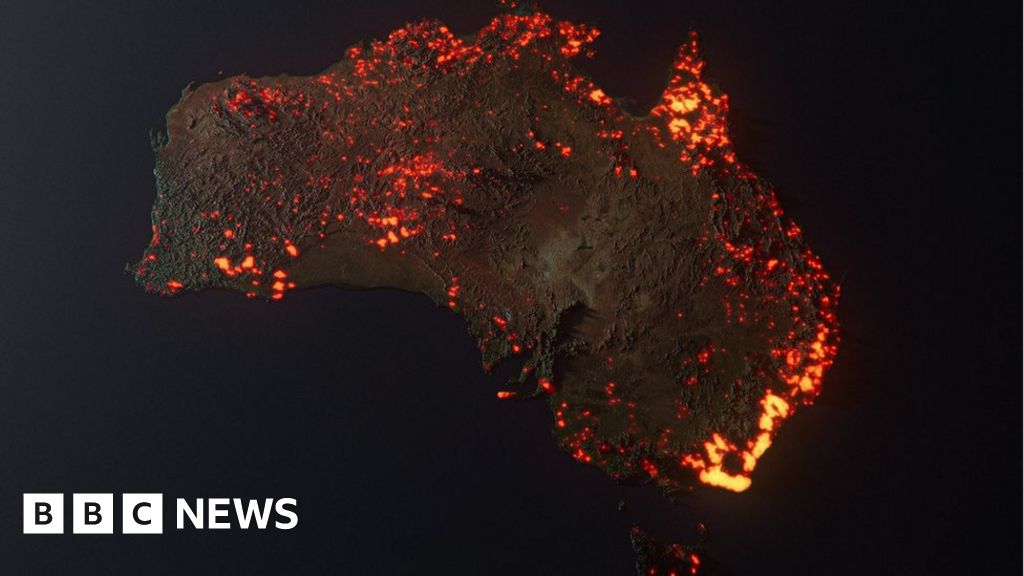
Australia fires: Misleading maps and pictures go viral
Maps of Australia's fire crisis are spreading on social media but many are misleading.
bbc.com
165 points · by pionerkotik · 6y ago · 184 comments
I've seen countless articles mention that 500,000,000 animals have died. I was skeptical as to how you could even devise such a number reliably so I looked into the source of this statistic. First off, this number was devised by a single Uni professor. How? He multiplied the square-mile density of each species by the amount of territory that's burned. Secondly, and he notes this in his estimate, it's 500,000,000 "killed _or affected_", not just killed. Third, for almost all species, there are no density figures, so he just picked the number 10 (lol, yes, seriously). Fourth, roughly 30% of those estimated animals are birds, of which other experts say 99% would survive because, ya know, they can fly away. Of the other 70%, many others would have just walked or slithered or run and gotten away from the fire.
Basically some guy just made up a number of animals that exist and everyone else just assumed that 100% of them were killed. Terrible "science."
Many bigger news sites have braced themselves for pushback on this stat by adding "and plants" ("500,000,000 animals and plants") so that their use of the statistic can't be criticized later.
> Fourth, roughly 30% of those estimated animals are birds, of which other experts say 99% would survive because, ya know, they can fly away. Of the other 70%, many others would have just walked or slithered or run and gotten away from the fire.
The fires we're talking about here aren't ones you can easily get away from if you're caught by them.
If they're near a firebreak of some kind (large river, cliff, etc) the animals may be able to escape, but otherwise these are very fast moving and very hot fires.
It's reasonable to think that for animals caught up in the fires, at least for ground dwelling animals, more were severely impacted than were not.
I'm not sure about birds. Where did you see the 99% number?
The fires can get hot enough to kill you from 100m away, cause firestorms, and are massive. A lot of birds would have needed to fly a very long way to be safe, and I've no reason to think that they either could or did.
I'm personally frustrated that no one has been able to dredge up an actual study on wildfire mortality patterns.
Only the abstract is available (unfortunately), but by my reading of that it shows that a 1973 bushfire wiped out all 5 species in the area ("Following the 1972 fire, numbers fell to the lowest level recorded during the study and each population subsequently disappeared from the plot between the 1973 and 1974 winter censuses").
In further reading (I read a lot of abstracts trying to find one that had numbers!) it appears this pattern of some surviving the immediate fire but 18 months later having disappeared dur to predators and lack of habitat is fairly common.
[1] https://books.google.com.au/books?hl=en&lr=&id=4f8anIoS33MC&... (page 358)
In the meantime I looked for some studies, and found two that are interesting and include some background on the subject.
The Responses of Mammals to La Niña (El Niño Southern Oscillation)–Associated Rainfall, Predation, and Wildfire in Central Australia [1]
> The responses of vertebrates to wildfires are complex, reflecting the varying food and shelter requirements of different species, their exposure to predation, and other factors. Vertebrates that shelter above the ground and are not particularly mobile are often killed directly by fire (Chew et al. 1959; Newsome et al. 1975; Silveira et al. 1999; Simons 1991). Conversely, species capable of extensive movements such as large predators and birds frequently escape the flames and may increase in abundance after wildfire when food resources become available (Loyn 1997; Newsome et al. 1975).,Burrowing herbivores and omnivores are likely to survive fires and, depending on predation, may increase in abundance after postfire flushes of vegetation (Newsome et al. 1975). Postwild-fire decreases in the abundance of some species have been attributed to a lack of food resources and increased exposure to predation (Groves and Steenhof 1988; Lawrence 1966; Newsome et al. 1975, 1983).
Immediate and short‐term responses of bird and mammal assemblages to a subalpine wildfire in the Snowy Mountains, Australia [2]
> Over 35 days in January–February 2003, wildfires burnt across much of the subalpine/alpine landscape of south‐eastern Australia, including about 70% of the land above 1500 m in the Snowy Mountains. At the time of the fire, studies of two subalpine faunal assemblages were being undertaken. The opportunity to resurvey the assemblages was taken in order to examine the immediate impact of fire in an environment where it is uncommon but predicted to occur increasingly with global warming. A study area in the Whites River Valley, where the number of bird species was counted monthly from 1996 to 2003, and weekly in late winter–spring from 2000 to 2003, was burnt in one fire. As well as the expected decrease in the number of individual birds, the fire resulted in an immediate decrease in the number of bird species, unlike in previously studied montane forest, with only the regularly wintering species plus the olive whistler and the ground‐feeding flame robin remaining. During the post‐winter avian immigration, few regular spring migrants appeared on burnt sites despite their nearby presence on the unburnt side of the valley. Five of six small mammal trapping grids were burnt. As with fires at lower altitudes, there was an immediate reduction in mammal numbers on burnt grids following the fire, but in addition, one species, Mastacomys fuscus, declined further in the ensuing 2 months both on burnt and unburnt sites. Numbers of Antechinus swainsonii and Rattus fuscipes stabilized until autumn/winter when there was a further decline due to the unavailability of subnivean space to allow winter foraging, allied with a concentration of fox predation on areas still carrying populations of small mammals.
[0] https://www.researchgate.net/publication/318029981_Impacts_o...
[1] https://academic.oup.com/jmammal/article/86/4/689/876336
[2] https://onlinelibrary.wiley.com/doi/abs/10.1111/j.1442-9993....
The author of the 480 million affected animals estimate has co-authored an article which talks about the impact on birds (as well as many other animals).
The relevant quote from the article:
One might think birds and other fast-moving animals can easily escape fires. But smoke and strong winds can badly disorient them, and mass bird deaths in severe bushfires are common.
We saw this[0] in the current fire crisis, when dead birds including rainbow lorikeets and yellow-tailed black-cockatoos washed up on the beach at Mallacoota in Victoria.
The Age article referenced has more graphic detail:
Following the fires that have torn through the region, bird carcasses – perhaps in their thousands – have washed up on Mallacoota's once-pristine beaches.
Mr Semmens, 87, has counted 100 dead birds from 25 species on a half-kilometre stretch of Tip Beach, just outside Mallacoota, half-buried in blackened piles of leaves. “It’s a sorry sight,” he said.
And he has only viewed a small section of the beach following the fires – he estimates that "thousands" more birds would have died in the area.
“The birds who avoided the firestorm are struggling to survive about the town, where residents are putting out water, seed and fruit, hoping it will save some of them.”
I've posted the first article at https://news.ycombinator.com/item?id=21990825
[0] https://www.theage.com.au/national/victoria/it-s-a-sorry-sig...
> It's reasonable to think that for animals caught up in the fires, at least for ground dwelling animals, more were severely impacted than were not.
taken literally, mean that the estimate is off by a factor of 2. I understand that you didn't mean this literally, but it's illustrative of the structure of the claims and skepticism here.
On top of that, even the core methodology of the study doesn't make any sense. Per the university's methodology notes[1], they copied the method used by a previous study on land clearing, ie, permanent destruction of habitat. It's a somewhat reasonable approach in that context: cleared and developed land is lost to wildlife in the equilibrium state, and it only relies on some fairly mild assumptions about a constant carrying capacity per species in order to use this methodology to calculate losses. There's no indication that destruction of the habitat leads to immediate death of the animals, and no attempt to account for the proportion of animals that may have successfully fled.
In the case of these wildfires, the burned land isn't being permanently and explicitly kept out of the ecosystem. It's easy to imagine species density increasing in the remaining areas in the short term, and I don't think anyone expects the habitats not to grow back onto the destroyed land. Unless the claim is that the burned habitats are lost forever, the same logic obviously isn't applicable. The spread of this "fake news" is down to an irresponsible claim from the university and an incompetent/irresponsible game of Telephone from journalists.
That being said, this isn't anything new for journalism. I'm in the habit of checking the sources of dramatic claims, as reported even by "prestigious" outlets like the New York Times, and the hit rate is laughably low if you follow the trail of sources and have even a modicum of scientific literacy.
Again, this is true of _every_ topic they report on, not just specific, politically-loaded areas, which suggests it's not just a question of dishonesty and bias: Journalism's incentives are fucked right now, epistemology in the modern era is _really_ hard, and the hiring bar for journalism doesn't select all that stringently for intelligence. I don't know what the solution to this is...
[1] https://sydney.edu.au/news-opinion/news/2020/01/03/a-stateme...
In fact, they've pointed out the 500 million figure is a conservative estimate, and is likely to be much higher: "... The true loss of animal life is likely to be much higher than 480 million. ..."
It's a shame the University of Sydney doesn't have access to this study such that they could have included a link so skeptical people could see for themselves the specifics of this alleged conservatism. Not doing that causes my intuition to question the truthiness of these claims, so I will file this item under "Unknown-Suspicious".
Many species were excluded from estimates because there is insufficient information on their abundance. The largest omission is the entire NSW bat fauna (37 species), for which no information on density could be found.
Many small mammals in semi-arid and arid regions exhibit large fluctuations in density depending on the prevailing weather. For example, historical accounts of the long-haired or plague rat (Rattus villosissimus) suggest that densities well in excess of 1000 animals per hectare can be attained after years of good rain31, with the species virtually disappearing again during drought. For such eruptive species, only the low-density population estimates were used.
The densities of several common species, such as the brown antechinus (Antechinus stuartii), agile antechinus (A. agilis), yellow-footed antechinus (A. flavipes) and brushtail possum (Trichosurus vulpecula) have been measured in several studies, with most yielding low to moderate densities but small numbers of studies yielding very high estimates. To reduce bias arising from these rare high values, means for each species were first calculated as log- transformed densities and then back-transformed to produce normal values. This method was used also by Cogger et al.
As noted, the usually lower densities obtained from studies carried out in the tablelands, western slopes and plains were used in preference to the higher estimates obtained in surveys further east. my note: these bushfires are in the East, so the higher estimates would be more appropriate here
Several species were omitted from consideration due to uncertainty about how vegetation clearing would affect them.
[1] https://www.researchgate.net/publication/318029981_Impacts_o...
While I can believe many birds can easily survive the initial fire (if the smoke doesn't get them), do they have a 99% one-month survival rate after a large scale disaster like this?
Birds can usually only last a couple days without food, and the fires have affected such a large area that many more birds than usual will be seeking food in the remaining areas -- is there enough food to accommodate them all? And it's not just birds that will be seeking food in the non-fire stricken zones, but also their predators.
[1] https://books.google.com.au/books?hl=en&lr=&id=4f8anIoS33MC&... (page 358)
This is contradicted by the statement put out by the university of Sydney: https://sydney.edu.au/news-opinion/news/2020/01/03/a-stateme...
> Basically some guy just made up a number of animals that exist
"some guy" who has published literally hundreds of peer-reviewed articles on related subjects: https://sydney.edu.au/law/about/people/publications/chris.di...
>This is contradicted by the statement put out by the university of Sydney: https://sydney.edu.au/news-opinion/news/2020/01/03/a-stateme....
I quickly skimmed the source that you've linked, and it says nothing about how they handled species with no density figures.
> how they handled species with no density figures
Many species were excluded from estimates because there is insufficient information on their abundance. The largest omission is the entire NSW bat fauna (37 species), for which no information on density could be found. (page 16)
As the sibling comment notes, this is addressed in the source material. Consider engaging more productively before posting dismissive comments on HN.
Where are you getting that? The density numbers come from this report[1] and I don't see any mention of "picking the number 10" or anything like that.
The estimate is for "affected or killed", and has since grown to over 1B[2].
While I agree that birds can fly away (although with habitat destruction that doesnt' always keep them alive), "Of the other 70%, many others would have just walked or slithered or run and gotten away from the fire" is just false. These fires catch people in cars because they are so fast moving.
[1] https://www.researchgate.net/publication/318029981_Impacts_o...
[2] https://www.huffingtonpost.com.au/entry/billion-animals-aust...
To put that into perspective, where I am, I was getting blackened gum leaves (meaning: highly flammable), but not actual embers when the main fire near me was still 80km away. We started getting cold ash falling when it was 20km away. One spot fire jumped about 5km toward my location (and spread to become 50000ha in it's own right).
(The awesome 'firies' stopped it 8km from me).
Except it turns out that birds have tiny delicate lungs, and a little bit of inhaled smoke can kill them.
Birds can fly away ya know, except they don't come with an IFR rating or instruments, a colossal area has burned -- I saw one estimate of around 8.5m ha (edit: which is over 32,000 square miles or more than Scotland's area) burned so far. So where are they flying away to in high temperature blackness, when the fire front might be moving faster than them? What about smoke inhalation, the biggest killer of people in domestic fires? Smoke from the fires has darkened the sky in Chile and New Zealand.
First, the press release specifically says "revised his estimate of the number of animals killed in bushfires in NSW to more than 800 million animals, with a national impact of more than one billion animals. " [1]
You say: "Third, for almost all species, there are no density figures, so he just picked the number 10 (lol, yes, seriously)"
When looking at the original report, linked in full text below [0] it reads:
> Many species were excluded from estimates because there is insufficient information on their abundance. The largest omission is the entire NSW bat fauna (37 species), for which no information on density could be found.
Regarding the birds, there is section 3.4 of the original report where the authors elaborate their stand. For instance, the loss of woodland (in this study the conversion to grassland) drastically reduces the number of birds in that area "90-95% fewer than in intact woodland". Given the size of the current fires it is a stretch to assume that 99% of birds are able to move to other forest and into other birds' habitats and be able to survive their alongside whatever lives there already.
[0] - 2007 report by Dickman et al, https://www.researchgate.net/publication/318029981_Impacts_o...
[1] - press release: https://sydney.edu.au/news-opinion/news/2020/01/08/australia...
Do you have references for your bird assertions, this is an article from yesterday where dead birds are washing up on shore, with a quote from an expert:
"A lot of people are under the impression that birds can easily fly away from a fire, but that’s not true"
https://www.theage.com.au/national/victoria/it-s-a-sorry-sig...
The conversion factor for "affected" to "killed"... I have no idea what it is, and there is contradictory intuition for its magnitude, so I don't want to trust any number until I see someone actually doing studies of wildfire mortality.
This isn't a problem; most animals have a per-square-mile density higher than 10. The ones with lower density are the big, popular animals for which better statistics exist.
> Fourth, roughly 30% of those estimated animals are birds
And this is completely impossible. There aren't enough birds. How many were ants?
It's more annoying when numbers are misrepresented that we DO have real world experience of, for instance sea level rise. Many people are under the impression that global warming will cause skyscrapers to become submerged, or the majority of the Earth's land area to disappear. All within a few decades.
People may argue that it's useful for people to believe this, but I don't want a society of useful idiots. I want a society of skeptics.
But then you watch a video showing the charred carcasses of many beautiful Australian marsupial and bird species littered on the side of the road [1], and you realize jokes aren't really very useful here.
But regardless it's been tragic and devastating.
If you want to shock people, forget showing maps or even pictures of destroyed homes; just show them the footage of burning koalas being rescued and dying off their injuries; that's far more visceral. I can't even watch it without tearing up (from a local's perspective).
According to the article, it's also true that a lot of places labeled as being on fire are actually things like furnaces, the roofs of large buildings, and "any heat source that is hotter than its surroundings."
The NASA maps are significantly more accurate. According to the article, it has a false-positive rate of just 1%.
Also be sure to mention 500,000 animals have been killed in these fires.
1,000,000,000 animals.
https://www.thecut.com/2020/01/one-billion-animals-have-died...
https://www.independent.co.uk/news/world/australasia/austral...
The number that's thrown out here is not strongly sourced, but given that it's in response to an ongoing event, I suspect that it comes from "take a stab at animals per hectare, multiply times number of hectares burned, and round up to next round number to maximize outrage." Or maybe it will be slightly more accurate, with someone taking the time to dig up some numbers from a prior survey to estimate population differences per biome and tracking down how much of each biome has died.
Which is a long-winded way of saying that these estimates (almost certainly) are not reliable.
Edit: someone else linked the source. The number turns out to be "number of animals per hectare * hectares burned." I still stand by my verdict of not reliable, as there is not an even an indication of what the range of uncertainty is in this information, just a single number.
Round numbers are much more scientific, honest, and every other good thing than precise numbers are. You can estimate that 5-600,000,000 things died and present that as "500,000,000", a number with one significant figure. If you instead claimed that 516,772,943 things died, you'd be claiming to have a lot more knowledge than you actually do.
You should be inclined to trust big round numbers more than you trust odd-looking numbers, not the other way around.
New South Wales: https://www.rfs.nsw.gov.au/fire-information/fires-near-me
Northern Territory: https://www.pfes.nt.gov.au/incidentmap/
Queensland: https://www.ruralfire.qld.gov.au/map/Pages/default.aspx
South Australia: https://www.cfs.sa.gov.au/site/home.jsp
Tasmania: http://www.fire.tas.gov.au/Show?pageId=colGMapBushfires
Victoria: https://www.emergency.vic.gov.au/respond/
Western Australia: https://www.emergency.wa.gov.au
This one (from WA) covers the whole country, and shows a) where the fire fronts and b) what's been burnt. This website is actually linked to in the main article (MyFireWatch):
https://myfirewatch.landgate.wa.gov.au/
It's also the one that ends up being doctored then played around social media.
As a 'side note' though, the article mentions:
> In contrast to MyFireWatch maps (left), blue symbols on New South Wales Rural Fire Service maps (right) give 'Advice' warnings, indicating no immediate danger
This is blatantly misleading. Blue means there are fires still active in the area, the MyFireWatch shows exactly where those active fires are. And personal experience has shown that Blue can become Yellow and then Red within a space of 10 minutes.
I didn’t link to MyFireWatch precisely because it is showing ‘hotspots’ from the past 72 hours, which is not necessarily the same thing as mapping actual reported fires, hence the confusion of some of the maps talked about in the article. The data on MyFireWatch on areas which have burned is also very inaccurate for some states (Tasmania and Victoria at least).
MyFireWatch explicitly says not to use their map in an emergency[0], because the ‘latest’ hotspot data can be up to four hours old, can be up to 2km out of place (5km in extremes), and may not show fires obscured from or otherwise undetectable from the satellite.
https://cimss.ssec.wisc.edu/satellite-blog/archives/35342
The post contains relevant satellite imagery taken from Himiwari-8 showing the creation of pyrocumulonimbus clouds from the fires, along with thermal imaging. There is also a technical explanation about how the thermal anomalies are detected.
The smoke cloud is now heading to the middle of pacific ocean and is still visible from space [2]
[1]: https://www.stuff.co.nz/auckland/118597927/in-pictures-auckl... [2]: https://rammb-slider.cira.colostate.edu/?sat=goes-17&z=1&im=...
https://www.theguardian.com/australia-news/datablog/ng-inter...
I have to admit, my grandpa was a wildfire firefighter coordinator and still, I wasn't really aware of wildfires being this very thin front behaving like a fractal until I saw this kind of satellite data: https://twitter.com/Pierre_Markuse/status/119499877723451392...
    24 people have been charged over alleged deliberately-lit bushfires
    53 people have had legal actions for allegedly failing to comply with a total fire ban, and
    47 people have had legal actions for allegedly discarding a lighted cigarette or match on land.
> Light or use a tobacco product within 15metres of any stack of grain, hay corn, straw or any standing crop, dry grass or stubble field – up to a $5500 fine.
Mum grew up on a wheat station (meaning: huge farm/ranch) and always said that the wheat fires moved pretty quickly, so I suppose that's where this law comes from.
https://m.dw.com/en/australia-police-arrest-man-accused-of-s...
I’m not sure what would possess someone to do this. As if the earth needs any more “help” from idiots, right!?
The original police statement was "The NSW Police Force has taken legal action against more than 180 people for bushfire-related offences since late last year." of which only "24 people have been charged over alleged deliberately-lit bushfires". https://www.police.nsw.gov.au/news/news_article?sq_content_s...
Most of the offenses are for having a barbeque/campfire during a "total fire ban" day or discarding a lit cigarette - these receive formal cautions or fines
> Discarding a cigarette from a vehicle can attract a fine for littering of $250, the NSW Environmental Protection Authority states. If it’s lit and tossed away, the fine is $660, which doubles on a day of total fire ban to $1320.
> Lighting a fire on a day of total fire ban attracts an on the spot fine of $2200. If the matter goes to court, you could face a fine of up to $5500 or 12 months behind bars.
Was he right or wrong? I love the "appeal to authority" and "ad hominem" arguments made by people.
Would you rather a lie from an "authoritative" source or a truth from a "wacko"?
It marginalizes them and ostracizes them from civil society in precisely the way they deserve, and increases your likelihood of finding the truth.
Note: this is different from assuming the truth is the OPPOSITE of what they say.
I'm not going to defend Alex Jones here, but surely you realise that this metric includes many main stream, "respected" media organisations?
Well, an authoritative source can still be wrong but by definition does not lie, while a wacko can get it right occasionally without being truthful.
It kind of feels like you're confusing single-roll probability with cumulative odds; who are you going to bet on over the long term?
That's the type of thing I imagine someone in north korea saying. By definition does not lie? That's news to me and certainly not true of any "authoritative sources". Every authoritative sources has lied. Even more, every autoritative sources was created specifically to lie. If you think I'm wrong, go read about the creation of these "authoritative sources". Who created them and why?
Even the hallowed BBC by definition told lies. Orwell worked for the BBC Eastern Service as a propagandist. It was one of his inspirations for 1984. You might have heard of him.
> who are you going to bet on over the long term?
Neither - especially when it comes to important issues. As I said the slavish "appeal to authority". It's the basis of all tyranny.
Only because you already know the facts from reliable sources.
So given you already knew the facts in order to ascertain that the whacko was telling the truth, why are you bothering with the whacko?
Worse, by pointing out that the whacko was right this time, you encourage others to believe other claims by the same whacko, since they have been right at least once!
Facts are sometimes very tricky things....how might one even determine what the actual facts are in this situation?
> you encourage others to believe
I feel similarly about anyone using the term "fact" so casually.
https://hotspots.dea.ga.gov.au/
And an image (as of now) incase it's geo-locked:
https://i.imgur.com/qWEMM7D.jpg
Here is another image of Victoria with current outstanding fires:
Reminds me of the quote that went something like "But what if its wrong, we might accidentally make the world a better place for no reason."
Climate change denialists (this is just the latest offshoot of a long running campaign with the same tactics) are starting to make flat earthers look well reasoned and sane.
Their apologists will claim they were "just raising awareness" or "drawing attention to the tragedy," but in reality they're doing more harm than good.
The area burned so far is larger than most European countries. Entire towns have been razed, breeding grounds for various animals are destroyed and the fire in Kangaroo Island decimated the population of chlamydia-free koalas.
Even worse is that this mass clearing of forests will lead to a drastic increase in new growth which will lead to worse conditions for fires next year (since young plants with shallower root systems will dry out faster)
A cumulative visualization of the scope of the fires that is being misinterpreted as real time is farting into a hurricane in comparison.
Seems a bit ideological to label climate change as "the actual problem" when 24 arsonists were caught, over the season, deliberately starting forest fires. Forest fires aren't a new thing but people deliberately starting them seems to be.
No?
https://www.crimestatistics.vic.gov.au/media-centrenews/arso... https://www.crimestatistics.vic.gov.au/crime-statisticshisto... https://www.crimestatistics.vic.gov.au/sites/default/files/e...
Arson is certainly a thing that happens but isn't suddenly drastically increasing for no reason.
What is increasing is the rate at which those acts become extensive bushfires. Which is caused by drought drying out the land (increasing fuel). Which is linked to ... yep, climate change.
>What is increasing is the rate at which those acts become extensive bushfires
According to MSM 24 were charged with "deliberately lighting bushfires", not committing garden variety arson that metastasized into bushfires.
Forest fires have always been easy to start, if one wanted to, but people intentionally attempting to do so seems unusual.
Given the fanatic stirring caused by Thunberg, enactment of a 'State of Fear' as envisaged in the novel by Michael Crichton is not an unreasonable fear. It's even been encouraged by climatatogist Stephen Schneider who wrote: "...to reduce the risk of potentially disastrous climate change ...we have to get some broad-based support, to capture the public’s imagination. That, of course, entails getting loads of media coverage. So we have to offer up scary scenarios, make simplified, dramatic statements, and make little mention of any doubts we might have. This double ethical bind which we frequently find ourselves in cannot be solved by any formula. Each of us has to decide what the right balance is between being effective and being honest. I hope that means being both."
If any arsonist did light a fire with this in mind, he or she has certainly been vindicated given the media's reaction.
It makes no sense to use trends when the discussion is incidents.
Deliberate arson is not new in Australia, don't make out that it's the reason for the scale of these particular fires. "Conditions, not ignitions".
Fire chiefs had anticipated and warned of the likelihood of these fires, and they are clear in asserting that climate change is a factor. Australia just had its hottest day ever broken multiple times over a series of days.
> Incidents by Suspected Fire Cause as Recorded in ICON for 2018/19 Financial Year
> Note: All incident types have been included (for example bush fires, structure and vehicle fires).
Suspected Fire Cause
------------------------------------
Accidental ................... 3.50%
Arson ........................ 1.30%
Burning Off - Illegal ........ 8.30%
Burning Off - Legal ......... 13.30%
Campfire ..................... 3.90%
Debris Burning ............... 1.80%
Electrical ................... 2.20%
Equipment Use ................ 0.76%
Escaped Hazard Reduction ..... 0.43%
Escaped Permit ............... 0.11%
Escaped Pile Burn ............ 1.30%
Incendiary ................... 0.09%
Juvenile (fire play) ......... 0.57%
Lightning .................... 7.60%
Machinery/Slasher ............ 1.10%
Miscellaneous/Other ......... 34.00%
Motor Vehicle ................ 5.30%
Natural ...................... 1.60%
Power Line ................... 0.67%
Rail ......................... 0.09%
Smoking ...................... 0.43%
Suspicious ................... 4.00%
Undetermined ................. 7.50%
Source: https://twitter.com/joshgnosis/status/1214726287782109184
Or that we're in one of the longest droughts on record, with many rural towns prior to this (and still actively) running out of water (as in, no water in the pipes at all), and Sydney on water-restrictions?
Mysteriously, Australia has been having a multi-decadal run of consistently seeing the factors which would be worsened by global warming, get worse.
Predictions made 10 years ago are now being met.
https://www.abc.net.au/news/2018-08-17/drought-bushfire-seas... (note that this is before the current bushfires)
https://www.ncbi.nlm.nih.gov/pubmed/26172867
Droughts are getting worse because of climate change (and of course in Australia droughts make bushfires worse because there is more dry scrub, and hazard reduction burns are too dangerous to do).
https://www.theguardian.com/environment/2019/oct/06/water-re...
Its claim boils down to "Data visualization techniques can't be interpreted literally" -- which is obvious -- but is titled and written in such a way to provide ammunition to climate change deniers that "the other side" is being loose with facts, or something.
Absolute and insulting garbage. Whoever wrote this, edited it, approved it for release, and whoever posted it here, should be ashamed.
But "my side" isn't being loose with facts. That's my point. Data visualization techniques are always lossy, that's just how they work. The article tries to paint this lossiness as deception, and that's wrong.
Do you honestly think the BBC are climate change deniers?
Even when discussing something considered to be an emergency one shouldn't suppress truth and normalize deceit.
My point is that the article is claiming deceit where none exists. Data visualization techniques are always lossy, that's just how they work. The article tries to paint this lossiness as deception, and that's wrong.
Why. Because it doesn’t support climate change?
It gives the impression Australia is a burnt cinder with no unburnt areas left.
The maps referenced in the article aren't "obviously misleading" -- data visualization techniques are always lossy, that's just how they work. Claiming they're misleading is the real deception.
Metaphors and analogies are supposed to make a concept clearer, not to show scale. A gif with each frame showing the data from each day would have a similar impact but be clearer.
Not if the reader doesn't understand the exact extent to which the map doesn't correspond to the territory.
Just like with a metaphor or analogy.