60 points · by tnorthcutt · 6y ago · 39 comments
If you were wealthy, you could afford to purchase books that were the result of expensive bookmaking processes, or if you were an institution (monastery, government), you could hire people to copy texts by hand. Why bother with cumbersome new technology, when money is cheap and the means are at hand?
I suspect there were additional social issues at play as well. For example, plantation owners, being at the top of the social hierarchy have less incentive to invent. Also that tier typically views tinkering and mechanics as lower status and so would avoid it on principle: prestige was based on land size and number of other people owned. Certainly not number of new ideas.
Until you have industrial demand, you don't need industrial supply rates. Prior to the industrial demand, no one cares that cotton takes people too long to process as supply is matched to demand.
Many early engineers of the Industrial Revolution were farmers though, such as Jethro Tull.
I think all software devs should spend some time on a farm. Great for inspiring simple yet clever "shipped is better than perfect" style solutions. Manual labor is also great for Sitatdeskitis.
1] https://youtube.com/watch?v=ywBV6M7VOFU
2] https://oncubanews.com/en/culture/visual-arts/when-in-the-fa...
I feel I've gained similar experience from turning wrenches on personal vehicles since I was a teenager. It's a great activity that teaches discipline and seemingly exercises a certain creative, technical, and systems oriented type of thinking, which is very similar to coding, albeit much less cognitively demanding.
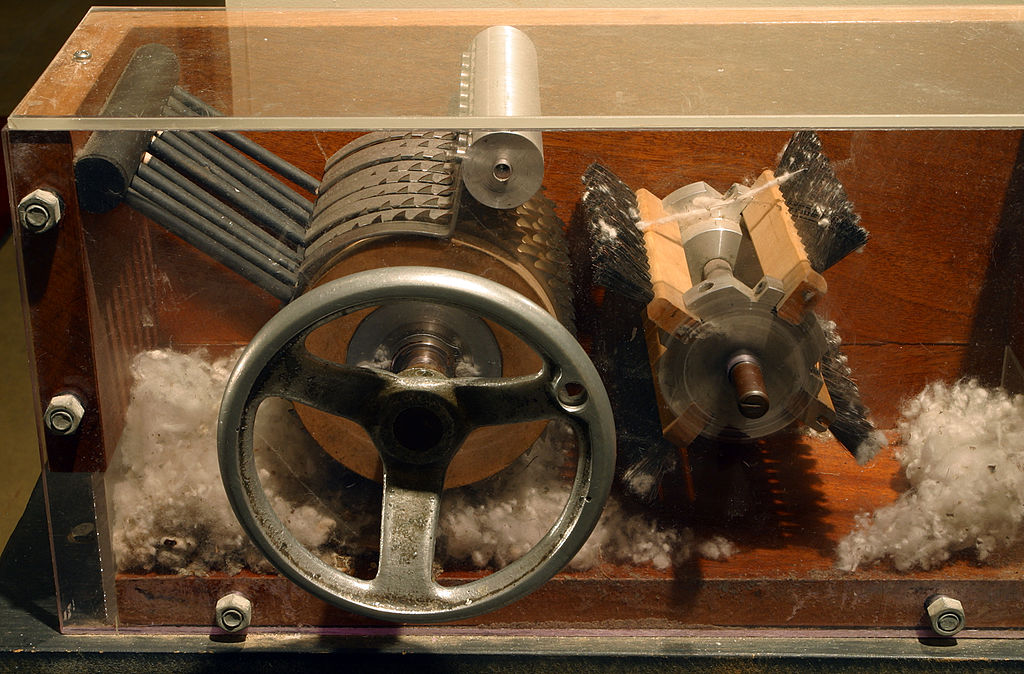
If Eli Whitney had instead built a marginally better set of brushes for slaves to work with and gone on with his day, the story of the cotton gin would be very different.
About mechanical design - I remember in university noticing how some folks would design things that would be very difficult to construct, where folks who already knew how things were made would do much better. It seems like there's something to having early exposure to shop-stuff, and tooling per capita is bound to be higher in rural areas.
Do you have any evidence to support the perpetuation of this stereotype?
I’d love to watch a TV show where every episode is a different eureka.
The closest I have right now is to binge watch Rick&Morty and How It’s Made.
Apparently the “overnight success” founding myth was alive and well even in the 1700s.
Another interesting note, is that Greene went bankrupt trying to defend and monetize the patent.
"... In 1798 he figured out how to manufacture muskets by machine so that the parts were interchangeable. It was as a manufacturer of muskets that Whitney finally became rich. If his genius led King Cotton to triumph in the South, it also created the technology with which the North won the Civil War."