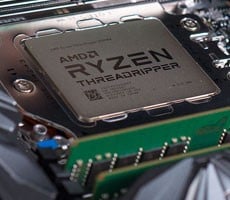
AMD Threadripper 3990X 64-Core Beast Seen Crushing $20K Of Xeon Platinum CPUs In Benchmark Leak
A benchmark entry shows strong performance from AMD
HotHardware
277 points · by signa11 · 6y ago · 220 comments
A few key wins with the three cloud giants, and Intel will feel it. And the cloud giants can start with things like managed messaging, databases, etc, where it's not directly exposed to end users. Similar for the various high end AARCH64 CPUs. Intel is in for a ride.
And Amazon is full steam ahead with their own ARM CPU. I wonder if Google and Microsoft paused and think they will need to act now if they haven't already.
[1] https://www.anandtech.com/show/15433/intel-q4-fy-2019-result...
The difference is that AMD is starting to do the same, and it seems the process and architecture lets them make more chips than Intel.
And this forces Intel to lower prices on the more powerful chips, something that had not happened in about a decade.
Right now the winners are the customers, having such great chips at good prices.
I think Graviton has really big potential. Maybe the biggest challenge is for AWS to market it well.
Just get the biggest honking Noctua fan+heatsink you can fit in your case and call it good. It's silent, simple, reliable, and if the fan does fail the heatsink will save your CPU.
Although you can buy the CPUs in TRAY format without the cooler, the prices are almost identical to the BOXED version and your warranty is lower since they're designed to be sold to businesses not consumers.
It can, just fine. A better cooler keeps it cooler, and you might get an extra 0.1 mhz from it. With the Prism, if you have had/having trouble with it keep in mind two things:
1. there is a switch on it for a higher or lower fan setting 2. you have to crank that little lever HARD all the way over to properly clamp it down. Lot of people miss that.
But AMD value is tremendeous, especially comparing with Intel CPU supporting ECC. I'm thinking about buying Xeon W-2265 workstation and it's just 12 cores for $1200, AMD is much cheaper and for that price I can get Threadripper monster.
AMD CPUs are used on servers so there is no reason they won't make all it's possible to have a stable system, are you referring to AMD GPUs? I read it takes up to 1 year after release until the graphics driver gets stable on Linux.
I never had, or even heard of stability problem with AMD's CPU Core, but during the early days AMD surely had worse chipset especially in I/Os. Where it had compatibility or performance issues. But these days most of them are third party IPs, from USB Controller to PCI-E Express, and they are the same IPs used by millions if not billions on Smartphone, Tablet and many other use cases. So you can be sure they are pretty damn well tested.
Never had a single issue.
Come on, AMD announced it would be $3990 at CES!
Is this now a factor? I know memory has gotten faster, and multi-channel of course helps, but is that all really enough for typical workloads?
In 2005, Opterons used a 940-pin socket and had dual-channel DDR, for 6.4GB/s total bandwidth to feed two cores. In 2009, Xeons the LGA1366 socket to provide triple-channel DDR3, 32GB/s for four (later six) cores.
Now, we're up to 4094 pin sockets providing 8 channels of DDR4 for a total of 204.8GB/s of memory bandwidth for 64 cores, which is exactly the same per-core bandwidth we had in 2005.
(And for comparison, a $200 graphics card will also have around 200GB/s of memory bandwidth.)
Modern CPU cores are way faster than ones in 15 years old CPUs.
That 2015 processor has AMD K8 cores. I wasn’t able to find exact info, but slightly newer AMD K10 can do 8 single-precision FLOPs/cycle, at 2.8 GHz.
Modern Zen2 cores can do 32 FLOPs/cycle at approximately same frequency, i.e. per-core performance improved by a factor of 4.
Both numbers are theoretical limits only achieved with very specific workloads and heavy use of manual vectorization. Still, real-life general-purpose code scales quite similarly between them. CPU benchmark says their single-threaded performance improved by a factor of 3.5.
The saving grace is not that there is a lot of memory bandwidth to go around; there isn't; the saving grace is that a lot of processing either doesn't use too much data (making caches effective) or is complex enough to not be limited by memory bandwidth. Rarely using all cores and threads at the same time helps a lot as well.
Wow wow wow.
Your references are TIGHT.
----------
The main RAM / CPU issue is latency: it takes over 100-clock cycles to communicate with DDR4, which a CPU could process ~400 instructions if they were lined up just right (modern CPUs are super-scalar, executing multiple instructions per clock tick).
Only once you have sizable caches + data locality will you solve the latency problem.
Without locality, I'm not sure if the latency problem can be solved at all. Fortunately, many problems have an element of locality that can be taken advantage of.
My experience is that it takes well structured memory access to actually max out memory bandwidth even if the numbers seem like the CPU would be starved.
Things like adding two huge images with SIMD and writing out a new image could be like this. It would be much better of course if the image is tiled and more operations are done per tile, which would use the cache.
Good use of the prefetcher but poor use of the cache could still run through memory bandwdith.
They still have some performance advantages over all competitors.
But if you are not enterprise, I see no point in paying their prices.
As you say, free products have caught up and are just good enough.
The VMware thing was that they figured out how to make virtualization on i386 compatible hardware hobble along despite the hardware architecture being technically unvirtualizable, using clever binary translation style tricks. Virtualization support came to x86 hardware many years later.
If Xen has a show stopping bug I get to patch it myself.
Oh you mean technical reasons? None.
It takes years for the big companies to get interested in such a big of a platform switch. For now, they've been sticking with Intel and observing how the situation develops. If Intel keeps screwing up, which they do, eventually the big migration will happen.
With Intel, I get advanced warranties, presales support, next day parts, details marketing and product information alongside access to privileged information and roadmaps.
With AMD, I was waiting the best part of 3 months for a call back, and their "partner" site which is open to the world is severely out of date and doesn't even have all products listed.
Intel is frictionless when it comes to doing business, AMD put up roadblocks.
I'm still running a i7 2700k and haven't even felt the need to upgrade. I guess i didn't want to when Intel only released $600-$800 scam CPUs, now were seeing reasonable competition is it worth another look?
[0]: https://www.pc-kombo.com/us/benchmark
[1]: https://www.pc-kombo.com/us/benchmark/games/cpu/compare?ids%...
There are many gamers using 144Hz displays now, so 60 FPS is just one of multiple possible targets :) Witcher 3 is also really not the heaviest of games.
> Of course processors HAVE become massively faster but the question remains whether one has a workload that's sufficiently parallelizable to warrant the upgrade.
Well, sure. But all common workloads are parallelizable now. Whether it's games or running your browser, the time of strictly single threaded workloads is over.
> Individual core speed improvements are still lacking.
Interestingly, that really depends on your definition, of what one expects. The difference in single threaded workloads is smaller than in multithreaded workloads - obviously, there are more cores - but the cores are also ~30% faster in this case, and Ryzen 3000 got another round of singlethread performance improvements. For example https://www.computerbase.de/2019-07/amd-ryzen-3200g-3400g-te... shows that, a benchmark of single core application workloads.
Every day work just feels more snappy and compile times are down by a lot. Single thread is a lot faster and of course having 12 threads instead of 4 makes a huge difference (of course that effect might be less for you since you already have SMT).
Paired with a 1060 I even notice quite a difference in gaming. Even though I didn't necessarily have 100% usage on the CPU, I was 10-20FPS below benchmarks for my GPU. This didn't really make sense to me, but after I upgraded I indeed got those extra frames.
I haven't done any scientific on the performance improvement, but according to PassMark, I am getting roughly a 120% performance increase on parallelizable workloads, even when taking my OC into account.
That can happen when the game performance relies on the workload of one thread (or at least less then cores/thread count) that couldn't be properly offloaded to the idle cores. The 3600 has not only more but also stronger cores than the 2500K, and thus even without reaching 100% processor usage before the game can run faster now, because the critical thread runs faster.
Therefore I really thought it couldn't have been a CPU bottleneck (since one would assume it could have scaled at least another 10% on every core, but in the end it was.
Before that I had a Radeon 6970, that I bought with the 2500k, but I upgraded that in 2016.
The AMD Ryzen 9 3900X 12-core was what I was looking at. This new 3990X looks amazing, but its probably overkill for what I need.
I would recommend getting a different cooler though. The stock cooler, while adequate, runs noisy and doesn't feel all that sturdy.
In my mind this makes it preferable to opt for a stronger GPU, if you have to decide between a stronger CPU or a stronger GPU (e.g. you have 300 $ left in your budget and want to decide where to put them).
Apple is already using AMD graphics, so they already have a business relationship.
They don't have to. Most of the Mac users don't care. They know that the latest Mac is the best Mac they can get.
The figure from 2017 /2018 were 80% Laptop and 20% Desktop. And since Apple is kind of stuck with AMD for Graphics, it sort of make sense if Apple unify their GPU stack on Laptop as well. Assuming they get the Thunderbolt issue sorted.
I feel like Apple could have easily prototyped the Mac Pro on older TR designs and evolved the design as AMD got deeper into sampling the current gen.
I think what eliminated the risk of switching to AMD for them was the ability to test their thermal design on already shipping parts from Intel. The chipsets haven't changed at all so they've been working on a stable platform since day 0. Or maybe they got an offer they couldn't refuse from Intel.
CPU compatibility with macOS is also a total non-issue, considering how well the AMDOSX community is doing.
And there is Thunderbolt, its certification is still not released from Intel. Before than Apple could not leave Intel just yet.
I have one computer with Gigabyte X399 Aorus Xtreme and it is an utter crap, especially the firmware. It randomly resets its settings, even after you just saved them. Sometimes it takes few reboots to get it to acknowledge, that yes, I did enable AMD SVM and want to use it.
Intel do servers at all levels including low core count/high core frequency, where as AMD have a very decent core count, but, performance between the models is largely just an increase in core count (there is very little difference in frequency - e.g. NO high frequency/low core)
So many jobs still require Windows licenses unfortunately and since the shift to core count, it's ludicrously expensive to license a lot of the new AMD machines on SPLA licensing.
Not that I'm not trying though...
Meanwhile if all you need is single thread performance for lower core counts, that's Ryzen rather than Epyc, but it's not like they don't make that.
For example, I7/I9 is much cheaper and more powerful than entry level Xeons, but, you VERY rarely see them in a rackmount chassis/server.
Same goes for Epyc and Ryzen.
Whether or not it's common, it's available if you want it.
So relevant? Probably just as important now as then, but a few P3 designs not melting two decades ago shouldn't give you confidence to do this with a 9900KS.
P3s melted, Throttling was a brand new P4 feature, probably a must considering how hot they ran
That's what I meant by "a few P3 designs"; some, not all of them.
Without the advent of Quantum computers, solving P=NP for our computational benefit, and/or some other unworldly mathematics, the PC industry is pretty fucked in ~10-15 years save those who transition into services.