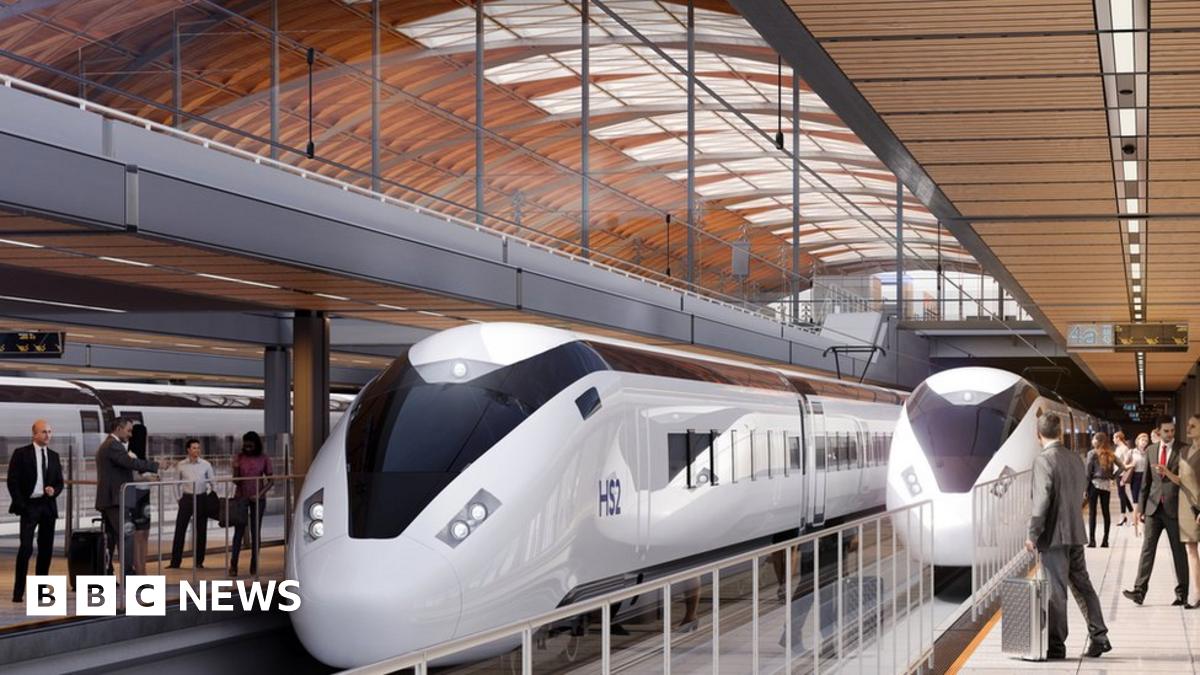
HS2: Six reasons why the rail route is so expensive
The controversial high-speed rail project could potentially cost as much as £106bn.
BBC News
41 points · by AndrewDucker · 6y ago · 69 comments
https://www.ianvisits.co.uk/blog/2019/08/20/taking-a-look-at...
On the redevelopment of Euston station:
> Building not just more platforms for HS2, but critically, the extra tunnels for those trains to use shifts intercity services to the HS2 line, releasing lots of capacity in the old tunnels for suburban services. If that doesn’t sound too important, then where’s the UK’s most congested train... it’s the 17:46 out of Euston which carries more than twice the number of passengers that it’s designed for. When completed, HS2 is expected to more than double the number of seats out of Euston station during peak hours.
It seems building HS2 is only part of the cost. A lot of it is also paying down "infrastructure debt" that hasn't been touched for decades.
The amount of track has gone down as rail travel has gone up. Passenger numbers are even higher than predicted when HS2 was proposed. We are at capacity.
Double decker trains like abroad are too wide for the tracks. Longer trains would also require major works at stations.
I don't think saving 20 minutes off the journey matters either, but I also don't think that is the main benefit of the project.
But then the contractors won't get their back pockets filled.
Instead it feels to me like companies have become more centralised. Regional offices are gutted (much of their work can be done over the internet from headquarters), more firms are crammed into London, all competing for the same people and this competition drives up wages (and house prices) and this encourages more people to want to work there which makes it one of the few places for companies to find talent and so on.
Maybe my impression of the state and change of things is just wrong. But my theory of the change in office work due to the internet is that it let things become more centralised and that this change is the reason for various other political changes (eg rising house prices -> weird policies to help people buy houses without decreasing the sale price; pushes towards better transport infrastructure in and to London; weakening of the rural and regional economy; trains in high demand which everyone hates; ...)
His answer is essentially transaction cost and co-ordination overhead. So logically as technology changes those, the natural size and configuration of businesses and other organisations changes.
What has ended up happening is that modern communications has made it much easier to do business to business transactions over larger distances than before, which has led to centralising to a smaller number of specialist firms rather than a larger number of geographically spread firms. This has been very noticeable in areas like law as well. There was a time when a manufacturing business in the Midlands had a local accountant, local law firm, etc. Now that is all centralised in a small number of cities. This has led to a more hub-centric global economy than ever before.
Now you might expect that this same effect would also encourage more remote working which would have the opposite effect on firm concentration geographically. It seems to have turned out that the effect of the same technology within firms has been less drastic. In other words, while it has led to more remote working and more part time working from home, it has not had the drastic effect of completely blowing up the nature of the team.
I suspect this has something to do with human nature and with transaction cost. Basically making a b2b relationship more geographically distant has turned out to be easier than physically dispersing a team within the low transaction cost company boundary.
Google does search for everyone... but Google employees are usually expected to spend at least a few days a week physically co-located with their teams.
All the world's widebody aircraft engines are made by only two manufacturers... who choose to concentrate their own design operations geographically.
As a result, paradoxically it seems that modern technology has led to more geographical concentration rather than less.
If we want to counteract that in the UK, we need to create counterweights to London. To a certain extent that already exists for things like aerospace and high end automotive - if you were starting a new business there you'd be crazy not to do around Derby. The challenge is that in most other areas London is so dominant that its dominance becomes a self fulfilling prophecy. No idea how to do that though.
The effect of transport links on all this is quite hard to predict as well. Do you end up making well connected cities and towns economic extensions of London in terms of creating employment there? (Might as well start a tech company in Birmingham if it's so close to London). Or do you just turn them into commuter communities?
Right now, London salaries are easily 2x to 3x Manchester's for Software devs (yeah I know the average data is only 30% higher but you need to compare the top vs the top, not the aggregated data). As a Junior dev moving from Hertfordshire (which is 30mins from London....) to London meant my salary instantly doubled, while living cost only maybe increased 50% if we are conservative. That's going to take a long time to offset.
Are you saying that if money was spent on Northern infrastructure instead, it somehow wouldn't go to the same contractors? Contractors are agnostic on where the infra spend is geographically.
> There are at least 100 stations across the north and Midlands that would benefit from released capacity, according to Network Rail, which owns and manages Britain’s railways.
I don't think the contractors care where you build; they make money either way.
Certainly, I'd not much thought of it in these terms.
https://www.independent.co.uk/news/uk/home-news/hs2-logistic...
(Form the Independent too, I once loved but now loathe).
Seems like our government has a bit of a track record explaining the benefits of grand but socially-contentious schemes... .
This is unusual, and the price reflect this.
This is nothing more than a desperate bid to reduce the sticker “price”, fooling precisely nobody.
Basically, if Balfour Beatty says we need £x, then they'll get £x because the market is locked with the blessing of the government.
This sort of article always tries to rationalise the price tag but rarely goes into investigating beyond that, including the issue of the glacial pace of most projects.
They'd probably need to be combined with a map of population density and nature reserves to produce a "rail planners map". You can already see where the "empty" areas of the UK are already, like the Scottish borders.
If you stood by the track, a train could pass you at 360km/h (224mph) every 3 1/2 minutes - the kind of safety and control systems to make that possible must be astounding.
I wondered about this, and hit gold on Google: the requirements specification! https://assets.publishing.service.gov.uk/government/uploads/...
HS2 will, unlike the rest of the UK legacy network, use ETCS: https://en.wikipedia.org/wiki/European_Train_Control_System (at level 2 with the possibility of level 3). Conceptually it's the same as the ancient tokening system - a train requires a token to enter a particular section of rail. Except these are digital tokens granted over a cryptographic protocol over the GSM network or trackside radios. When a train has cleared a particular point, a calculation is made based on the speed and braking distance of the train behind, which is then granted an authority to move further along the track. As long as the train receives a continuous series of valid "movement authority" tokens for the correct sections, it will proceed. If not, it applies the brakes.
(That's a really nicely written requirements document - concise, but including rationales for every point. More reading on the crypto: https://www.cs.bham.ac.uk/~tpc/Papers/TRAKS.pdf )
While I’m always happy to keep using something that works, « upgrading to EDGE by 2030 » still gives me a laugh.
Because the whole point of HS2 is to increase capacity by taking the high-speed long-distance trains off of the existing lines, where they get in the way of running local stopping services (because everyone has to get out of the way of the high speed trains).
The rails are the easy part. There's also signalling and monitoring, power gen/distribution, train stabling and maintenance, and all kinds of other infrastructure.
You can't build it piecemeal without incurring huge extra costs.
The insane part with HS2 is the relatively small economic benefit, and the fact that the price is going to spiral out of control even more than it has already.
The UK badly needs an integrated transport policy, making connections between all modes - trains, busses, airports, ferries, roads, and so on. Currently all the modes compete with each other. And that's a huge problem.
Instead we get a project that might have been progressive in the 19th century but makes no economic sense at all in the 21st.
For the same price as HS2 the UK could have hugely improved broadband everywhere, improved rail - especially electrification - and seed funding for new businesses everywhere, especially the North.
For the same price as invading the gulf we could have had a lot of stuff instead.
I've been around a long time and the infrastructure in the UK has barely improved since I was a kid. The ideal time to be doing this stuff was maybe 30 years ago but since that never happened the second best time is now.
The cost of bus travel in the UK is currently £3bn/year. For the same price as HS2 we could have about 20 years of completely free bus travel nation-wide.
There are a lot of things we could do with £100bn that would be better than reducing the time it takes to get to Birmingham by 20 minutes.
After HS2 is built we have an extrememly valuable asset which will generate returns for years to come.
Capital and current spending are very different, and it's quite unhelpful to compare the two.
Its really alot more than that, inform yourself first before making sweeping statements.
https://www.ianvisits.co.uk/blog/2019/08/20/taking-a-look-at...
Even a ridiculously low bar like "every town over 10k people should have at least one bus service on 10-minute intervals during peak commute times" will not be met in a lot of places.
However, other people have a very valid point that this is not just about latency but about bandwidth. It's not replacing the existing links but adding to them. And that will then improve "local" commuting to non-London locations.
Another time in Spain where they had a free public transport day based on some kind of green agenda.
In both cases the result was the same - absolute chaos.
Edit, more background on the extra capacity: https://www.ianvisits.co.uk/blog/2019/08/20/taking-a-look-at...
The technology doesn't need proving, plenty is built already.
Midlands Connect have some useful details on how just the London to Birmingham link improves local services around Birmingham https://www.midlandsconnect.uk/publications/hs2-released-cap...