562 points · by kccqzy · 6y ago · 214 comments
https://secure.myshopcouponmac.com
Doing a fast google for these domains shows they are mostly known for being associated with malware...
Pretty bad solution if that was indeed the case.
https://i.imgur.com/oCqmZZ3.png
"just to shut the error up" is about right.
To see for yourself, simply `curl -I https://zoom.us`
†: I didn't misspell the name of the executable. It's missing an h.
A little ‘humour’ is allowed, right?
It is also reported that their engineering team are not native English speakers but I don't think that's the main issue. I've seen codebases full of spelling errors where all developers were native speakers.
I've seen a lot of posts defending Zoom wrt other offences. But at this point it should be clear what their practices are.
Sometimes when coding I think there is technically an obscure race condition security flaw and, from time to time, leave a TODO instead of spending those grueling hours. This weirdly makes me sleep better at night.
At any rate, "sunlight is the best disinfectant"!
My point is that Zoom is replaceable and in fact, IMO should be replaced. Their tactics of using these dodgy techniques is because they want to have an edge over competition along the lines of "it just works".
I would contrast this to pure research services that add value that would otherwise not be there. Examples of this would be at the time that they were startups: Google (search algorithms) or Spotify (music categorisation algorithms). I'm not saying that today either of Google or Spotify are paragons of morality. At the hardware level I would include Tesla (battery tech) and Intel (processors).
My point is that the shady practises are at this point Zoom's product offering. If their video scaling algorithms are superior (and not just lifted from some open source libraries) then that should be their product offering. Not "it just works" via security exploits.
Edit: Typos.
Later when I heard that Zoom installs and leaves a web server open on your machine, even if you uninstall it, I felt duped, since I did my due dilligence by Googling if it's malware. If it leaves a webserver running after uninstall, it's obviously malware, same as if it launched a Windows search for "passwords.txt". There's no real room for interpretation here.
But I didn't find that at the time.
Whereas if I did that Google search today I would find that it:
monitors activity on your computer - https://news.ycombinator.com/item?id=22657384
is not encrypting end to end despite claims - https://news.ycombinator.com/item?id=22735746
allows any web site to access your camera at any time without requesting any kind of permission or making the user aware - https://news.ycombinator.com/item?id=20387298
reinstalls itself silently after uninstall (if you click a zoom link, after uninstall) - https://news.ycombinator.com/item?id=20390755
If I were considering installing it today, I would install it only in a virtual machine after Googling what kind of protections to use when trying malware in a VM. (Since it can be expected to play shenanigans with your network and with the host's USB devices etc.) Just basic stuff, as Zoom isn't very sophisticated.
After I read all this I was angry. Not because all of this makes it obviously malware but because it's sloppy malware, and I specifically Googled whether it was sloppy, obvious malware and didn't get a clear "yes, Zoom is malware."
By the way sending data to Facebook doesn't make my list of links, as that is par for the course and anyone might do that. I have a pretty high tolerance for crap and to be honest Zoom is the only mainstream software that failed it so far.
Though I guess technically I still use Zoom every day (until I buy a new computer), you know, since I did install it that one time, before I uninstalled it...
Didn't stop them from becoming very successful.
They get away with it because they aren't liable for any damage caused by exploitation of vulnerabilities caused by their bad practices. If they had to indemnify the victims of their negligence, I guarantee they'd care a lot more about doing things right.
Code signing just says you can trust that the software you clicked on came from the actual developer.
It doesn't say anything at all about what the software does. Of course signed software can do whatever it wants. It's not like there's supposed to be some chain of trust that it's only allowed to run further signed code. It's free to run a Python script or shell command or whatever it wants. And installers certainly run scripts.
And as other comments here state, to do anything that requires root privileges, it pops up to ask for your admin password, so it's not getting around that.
I see references to this being a "malware pattern" but no explanation of why or what that means specifically. Zoom is commercial software (not malware) and I don't see how this is a vulnerability (something malware could take advantage of) so I'm not getting it.
Can someone explain what the problem is here? Or is there no problem?
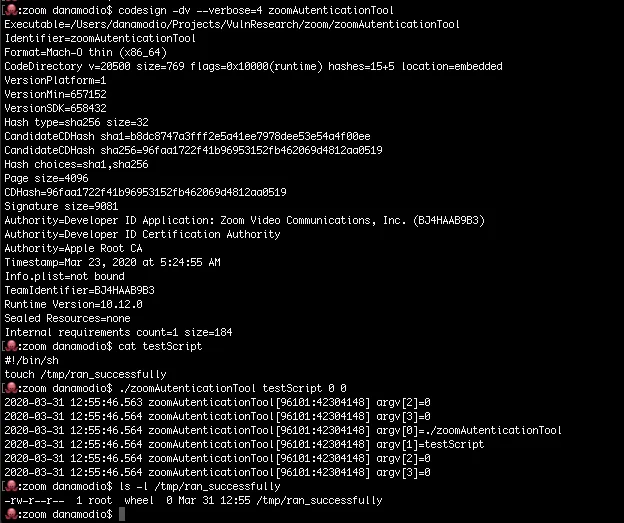
If the binary runs an unsigned script, then that script could be modified to do something malicious.
Signing isn't difficult or expensive so why not insist on it?
You get the zoom signed package installing your unsigned code.
Same with the recent story on UNC links in Zoom chat. That's an issue in Windows. Why is windows sending your password out on the internet willy nilly? In this climate, 2020, Microsoft should know better.
Consider that any Mac app that:
* Supports plugins that aren't signed by Apple
* Executes scripts or macros from a file
would technically have the same "problem". That's a heck of a lot of apps.
On iOS Apple do insist on a full chain of security, which is why only Apple's own browser app can JIT code. It's an extremely perverse and serious limitation that has no real security justification: consider that Android manages just fine without it.
As far as I can tell, Zoom is currently the target of a witchhunt. People are digging for dirt and blowing stuff well out of proportion.
(Someday there will be a solid cross-platform native p2p video client with e2e encryption.)
> We designed iMessage and FaceTime to use end-to-end encryption, so there’s no way for Apple to decrypt the content of your conversations when they are in transit between devices.
the zoom witchhunt is really something. zoom may or may not be a witch (im no China apologist, i yell at all my friends for using tiktok), but if we get the answer right it will be based on luck and emotion, not logic and reason.
Zoom is an American company, headquartered in the US, employing mostly Americans, subject to US law, etc. Its CEO is an immigrant, but that's true of half the American tech companies out there, including Google and Microsoft.
EDIT: I'm white, but my wife is Asian-American and has told me more than once how white people often treat Asian-Americans as if they're not real Americans. I'd never witnessed that myself, but I guess the above comment is the kind of sentiment she's talking about. Zoom may or may not be a scummy company, but its founder's birthplace is immaterial. He's a US citizen, and deserves the same treatment we give to maybe-scummy white American CEOs like Mark Zuckerberg.
"“Our product development team is largely based in China, where personnel costs are less expensive than in many other jurisdictions,” Zoom wrote in a regulatory filing."
Source: https://www.cnbc.com/2019/03/26/zoom-key-profit-driver-ahead...
I'm beginning to think the same thing. Someone seems to be orchestrating a full out attack on Zoom. I'd say it's working.
However, it’s bafflingly weird to include such a thing just to skip a button press or two in the installer.
Not at all. Generally every mouse click required to get an app running will slash your userbase in size by some staggering amount, like 20-50%. I can't quite recall the exact number or where I've seen this, but I've definitely heard this fact from multiple sources, including at Google. Try counting how many clicks are required to get Chrome on your system and you'll be surprised how optimised it is.
Companies measure this, they're very sensitive to it of course. They want as many conversions as possible, but they can see that the more complex the install process gets, the fewer users make it through the other end. It's entirely normal for Zoom to want to simplify as much as possible.
All in all Apple does their best to provide the mechanisms but they are not necessary easy or trivial (w're dealing with the topic of security so what's to expect). Also with every step Apple takes to bind things down there is a public outcry that they are restricting peoples freedom in installing custom applications and pushing everyone into the Appstore ecosystem.
This of course doesn't excuse bad developer practices, but often it's the choice of doing things right or not being able to do them at all (never meeting your deadlines).
I had the pleasure of implementing one of the suggested privilege escallation systems in a pet project[1] and it was a fun puzzle for me. But I can tell you it will be a PITA if you solve this problem under pressure as (even though Apple provides some tooling to verify everything [2]) it's really hard to figure out if all moving components are setup right for everything to work and to debug any issues.
[0] https://developer.apple.com/library/archive/documentation/Se...
[1] https://github.com/aequitas/macos-menubar-wireguard/
[2] https://developer.apple.com/library/archive/samplecode/SMJob... https://github.com/brenwell/SMJobBless-Demo
https://www.idontplaydarts.com/2016/04/detecting-curl-pipe-b...
He knows theoretically that this could be spyware or worse, but hey, everybody else is using it. Seems like no big deal.
Same with that curl script. What are the chances it’s bad? Small. So you run it and hope for the best.
Edit to add: I mean, I hope they’ll lose a substantial number of paying customers over this? But I doubt it.
I don't get why people are so negative. I mean zoom is not unique in this sense, many of the everyday apps we use share at least some of these issues.
How many of us use Intel CPUs that had (still have) infinite number of vulnerabilities? Or MacOS that at some point allowed root to login without passwords? How many security issues we (software engineers) create on a daily bases simply because the management needs something for yesterday?
Yes, me too! I was going to edit my comment again to clarify, but I figured it wasn’t worthwhile trying to list all the caveats explicitly. But yes, if they fix this stuff and continue to be successful, that would be good.
How many security issues we (software engineers) create on a daily bases simply because the management needs something for yesterday?
I disagree with your premise there. Sure, security bugs can sneak in if you’re rushed, but that’s qualitatively different from actively exploiting security holes and using dark UI patterns to make your own life easier. I hope most engineers would refuse to implement feature requests like that. It should be considered a form of malpractice.
Very few. Zoom is written with a total disregard to security.
The reason is that we are living in an age of cognitive overload and time poverty. Time and cognitive space are far more expensive than the long tail risks associated with bad security and privacy.
I'm not sure about binaries in general - having secure boot as an anchor at least makes the exercise less futile - but there an interesting point brought up here:
https://stackoverflow.com/questions/1732927/signed-executabl...
Dynamic linker, dynamic libraries and dlopen.
I see solaris has elfsign - and it appears to be in OpenSolaris too: https://github.com/joyent/illumos-joyent/blob/master/usr/src...
Not sure if it would work on Linux - and you'd might want to prevent running unsigned binaries. Not sure if that's a thing on OpenSolaris. Still, being able to verify a binary might help with handling random downloads, I suppose.
> Modules built and shipped by Canonical with the official kernels are signed by the Canonical UEFI key and as such, are trusted. Custom-built modules will require the user to take the necessary steps to sign the modules before they loading them is allowed by the kernel.
In fact I never understood why the HN crowd finds this policy so inoffensive. I've always considered it a massive intrusion on computing freedom.
It comes down to how you perceive the technology. My MacBook Pro is a tool I use for work that needs to be highly flexible and configurable, so I’m willing to work to maintain it. My iPhone is a convenience. I will not put work into maintaining a convenience, that defeats the point.
Others view their phones differently, they may elect for more configuration at the expense of maintenance burden. That’s their choice to make. I for example view the idea of wanting to root ones phone to be absolutely insane.
Interesting that we didn't know Zoom did this until everyone started using it, and someone finally audited it.
/usr/bin/osascript -e 'do shell script "touch /tmp/ran_successfully " with administrator privileges'Are they the biggest?
Besides that, this certainly isn't the first time Zoom's shady practices have been exposed, where many other conferencing products haven't had such a track record.
Zoom has been repeatedly breaking the trust of their users - it's a clear pattern that won't change.
Moreso than others? I deal with customers/partners all the time, and I count the following desktop clients installed on my laptop:
- Zoom - GoToMeeting - BlueJeans - Skype for Business - WebEx - Join.me
Also:
- Teams - Slack - Hangout Meet
And I'm probably missing a bunch. Is Zoom that much bigger?
https://www.fosslinux.com/3534/how-to-completely-uninstall-a...
App Store, Gatekeeper, etc are now working against what they were supposed to solve and encouraging worse developer behavior.
Really the best solution would be tackling the reasons why Zoom are doing this in the first place. Like how they provided a gentler version of Sandboxing to work around pro creative apps being basically unusable in the first versions.
The more you lock it down the more bad behavior you'll encourage from less ethical developers.
Are you talking about something else or am I misunderstanding here?
Just based on the title, consider that web browsers are signed binaries that run any unsigned script :)
It's opensource, free and doesn't require user accounts. Plus you can host it yourself.
This is yet another indication that nobody at Zoom has a single clue on how to build a secure and stable application. Another example of that mindset released today: https://www.theverge.com/2020/3/31/21201956/zoom-leak-user-i... They are proving to completely not understand how to design security/privacy features. Frankly, their technology team sounds like total amateurs that hack things together.
Public, profitable, founder was Head Engineer for Cisco WebEx. Runs global videoconferencing under massive new load during Covid-19, on their own servers.
HN comment: "total amateurs".
Love this place.
You're free to analyse it and publish your findings. That's not making zoom any better.