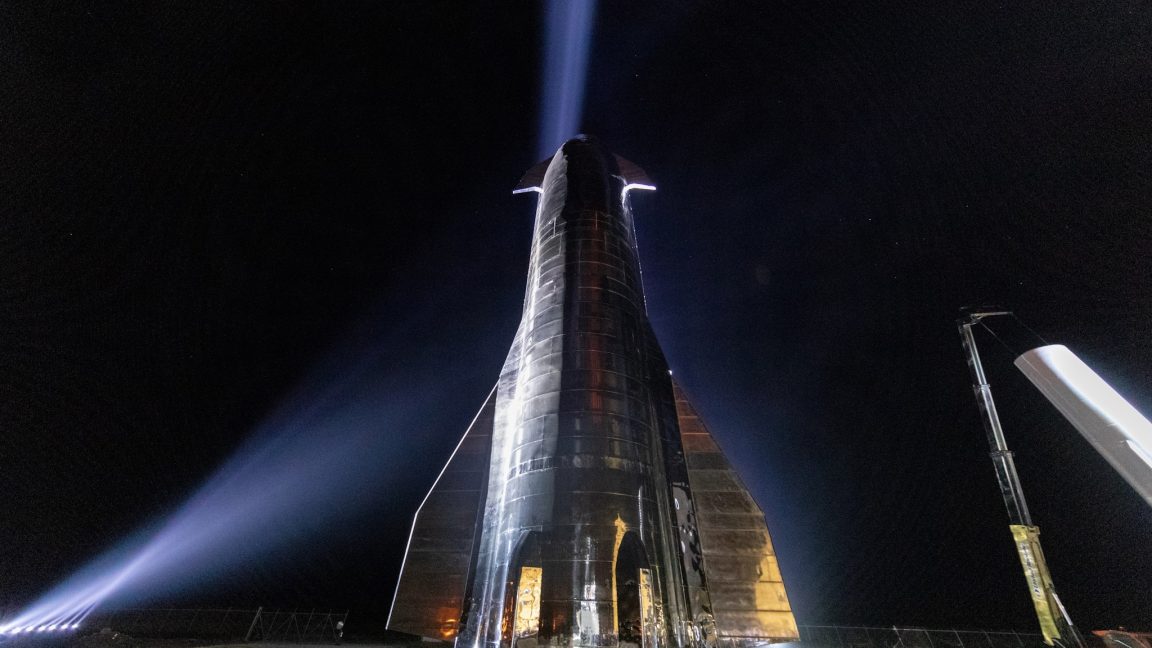
SpaceX loses its third Starship prototype during a cryogenic test
We will see what data review says in the morning."
Ars Technica
196 points · by rbanffy · 6y ago · 198 comments
To me, this looks like it was definitely a noteworthy fuckup, but in the big picture it doesn't seem to be a major setback -- nothing like the recent Boeing issues. That is, as long as a pattern of such events doesn't develop. SpaceX continues to push the industry forward in interesting and exciting ways.
To continue the arm-chair quarterbacking... I feel like a moderate decrease in process aversion would be a good response to this incident. Reduce the chance of similar future fuckups without slowing down too much.
To oversimplify things massively, "how careful do we want to be to avoid testing failures" is a parameter that SpaceX management gets to control. At the extreme careful end everything costs billions of dollars because you're paralyzed analyzing things and double/triple/quadruple/quintuple checking things. At the not at all careful end of things you keep building "complete rockets", pointing them at mars without any testing, and blowing them up. Obviously neither is rational.
They've settled on some parameters that are basically "don't worry that much about test failures, but keep the failures really cheap". They seem to be doing pretty well by doing that. They're experimenting with manufacturing techniques, hiring and training a workforce, building facilities. The prototypes that they are building keep failing, but that looks to be a relatively minor cost considering that the current primary goal is (according to them) to build out the manufacturing processes and make the design easy to manufacture.
Being slightly more careful would undoubtedly reduce the numbers of prototype failures, but would it actually be worth the cost of slowing other things down? Remember that the main cost of this program to SpaceX is engineering salaries, the faster it goes the cheaper it is.
So of course this test didn't go as planned, of course it would be better if it had worked, but would it have really been worth it to management to reduce the probability of this test failing? Like I said, maybe they aren't being careful enough, but I don't think we have any real evidence for that right now and I personally doubt it.
That's just for robotic/satellite missions. It's ten times worse when a manned mission ends fatally.
1. The risk is different when there are human lives on the line.
2. NASA is publicly funded and if they want to keep receiving funding, they can’t be blowing up the public’s money.
I do have some hints that it's probably more or less where SpaceX wants it to be, some hints that they have chosen this parameter rationally, and some faith that they aren't stupid. For instance, Elon often discusses future tests failing as acceptable, they've declined to put in place more stringent QA efforts, they're still mostly building the hardware exposed to the elements, Elon has discussed that currently their approach is building a lot of starships to iterate on the manufacturing methods and to help them make an easy to manufacture design - he has signaled fairly clearly via his tweets that actually flying the "ships" is secondary, and so on.
My prior is that the parameter is as likely to be set as too high as too low. The testing failure at this stage in development is weak evidence that it is too low, the rest of the information I've just talked about is more convincing evidence that it is an appropriate value or too high, hence I think the post I responded to is "probably wrong".
An example of where I think the level of caution was probably too low (or there were other issues, but let's pretend for a second that this is the only knob management has, as I said it is an over simplification) - the recent CST 100 orbital flight test failure. That test was intended to demonstrate they were ready to fly humans, instead they suffered a series of serious failures, failing that sort of test is pretty strong evidence that they weren't careful enough. They've indicated this type of failure was unexpected and that it will cost the company slightly under half a billion dollars, which is also pretty strong evidence that they weren't careful enough. Moreover I know that they neglected to use procedures such as end-to-end software simulation that would have reduced this risk, and that they were in fact contractually required to perform. Meanwhile I don't have any real evidence that they were careful enough with regards to that test. So starting with the same prior as above, I quickly fall to the "they probably weren't careful enough side".
> Or was at an optimal point for SpaceX in general
The optimal point is definitely not a global value for all of SpaceX. Human spaceflight programs have obviously set it very high instead of very low. As they progress from experimenting with manufacturing to flying payloads it obviously gets turned up. Etc.
This is a silly loss, as it sounds like it was a test procedure error and not a valuable experimental failure. But even then, how much is lost? The rocket was built on-site in a tent, welding some cheap steel together. They've got more test articles being built. The engine is probably salvageable. This is a month or two set-back at worst.
And just like when our software fails in a silly way, I'll bet you there will be new automatic tests, procedures, etc, so that this kind of error can't happen again. They'll learn, iterate, and continue to move fast (and break things).
With nearly all of their competitors, any kind of failure like this would be millions of dollars lost, months or years of setback. This fundamental difference is why SpaceX is slowly coming to dominate the industry.
I won't call their approach a "start-up" or even unique one, especially considering they made a huge component of this (Raptor) in a pretty standard way. Building in a "tent" just means they don't need anything more than it being a tent right now, not that they won't ever need more.
For some reason, rocket engineering has that reputation of being a complete waterfall process. It isn't deserved and doesn't make sense. Rapid iterative development and quick discarding of failing prototypes in the early phase is as common in space industry as it is everywhere. It just doesn't usually make headlines and isn't that visible.
[1] https://www.amazon.com/Skunk-Works-Personal-Memoir-Lockheed/...
This is a failure, and failure is perfectly ok working on something like this, but what drives people to volunteer their time to spin such things as positively as possible or even signal boost ? I can’t believe it’s purely investor driven. It’s almost as if people are finding personal purpose in sacrificing their time to this cause.
Many people like to dream big, but most of the time life is mundane. SpaceX's efforts are the embodiment of sci-fi fantasy with a chance of becoming real. Why not cheer?
Let people enjoy things.
Regarding the cost, the aerospace industry needs some scrappy young start ups. However, quality pedigree is a large chunk of the cost of flight and SpaceX has shown some gaps in the past. I think a big question is whether they can keep that scrappy startup up culture while also building processes robust enough to meet space flight quality standards
Say they have a check valve in their titanium system that fails. They could spend a lot of research dollars on the fundamental science of why that valve failed or just replace it with a burst disk. From an operational engineering point, they may feel like they solved the problem. But from a scientific standpoint we haven’t learned much other than “check valves are bad”.
It’s akin to the old joke about a mathematician, physicist, and engineer trying to find the volume of a cow. The mathematician tries to formulate a triple integral for the cow’s shape. The physicist drops the cow in water and measures the displacement. The engineer says, “let’s suppose the cow is a sphere...”
Point being, often in engineering they’re shooting for “good enough to get the job done” not to increase fundamental understanding
What has convinced you that this is optimal, or even "good", in either software or space technology?
>This fundamental difference is why SpaceX is slowly coming to dominate the industry.
They're making progress in the industry, sure. But dominating it? In what sense is this true?
In addition to capturing most of the commercial market that makes sense for them.
They are NASA most trusted partner, for both cargo to ISS. They will be the first private company to fly humans into orbit.
They are by far the cheapest, and even the rockets that are in development can't really compete against their lineup.
They are operating the largest launch vehicle on the planet.
They are universally considered to be the global leader in rocket engine design as both their Merlin and Raptor engines break many records and did stuff people thought was not possible.
They are in prime position to capture the single most valuable space market, LEO internet.
They are clearly the dominant player in the industry, every other player has admired it. Russian are out of commercial launch, Europeans are spending 2.5 billion to develop the Ariane 6 (who already has problems finding missions), ULA is dropping both their Atlas and Delta rocket to have a chance against SpaceX, and they have a very clear strategy to focus only on military and NASA launches.
The article makes it seem like this is a good thing, I.e., there’s nothing inherently wrong with the design.
If true, it means it may be a procedural escape which can be every bit as dangerous. Some of the fallout from the CST-100 Boeing Starliner issues seem to point to process escapes as well. Makes me wonder if in the rush to get “boots on the moon” by 2024 we may be letting schedule get the best of us...
It is a good thing that there is nothing inherently wrong with the design, just because that would mean more re-design work for SpaceX. A procedural issue (possibly this failure), a manufacturing defect (MK1 failure), a failure due to a temporary hack (SN1 failure), etc are all understandable errors and easily fixable at this point in time.
Starship isn't really being driven by the "boots on the moon by 2024" push by the government. Starship is a private venture being developed on their own schedule (and with their own money).
You’re right, bad choice of phrasing on my part to boil it down to a turn-of-phrase. What I’m really poking at is how schedule pressure affects decision making. SpaceX is well known to have very ambitious timelines. I am wondering how much that pressure affects process checks like configuration control
The top tank was covered in ice, indicating it was nearly full, while the bottom tank had no ice. That leaves three possibilities:
* The intention is the bottom tank was pressurized with gas:. There is no way that much gas at ~4 bar is safe. It would destroy all nearby buildings if it failed. That's a serious safety failing.
* The intention is the bottom tank was filled with LN2. Whoever was running the test didn't notice the tank didn't turn white, and didn't have any kind of level gauge or flow meter?
* The intention is the tank was unpressurized. The design could never withstand the top tank filled and the bottom tank unpressurized and empty. Whoever designed and ran the test didn't understand the basics of the design.
All of those 3 possible explanations point to more than a simple oversight, and IMO suggest the team working at 3am might possibly not really understand what they were doing.
Wat?
This is a launchpad, the safety assumption at play here is that this vehicle (and in fact a much larger vehicle with this vehicle as a second stage) can be filled with liquid methane and liquid oxygen, explode (with the energy of a small nuclear bomb, a few kilotons), and no one will get hurt. The area around the launchpad is kept clear during testing by local law enforcement for this very reason.
Hours before the test that failed, in a different test, the same test article was pressurized with room temperature nitrogen, likely up to ~7 bar (based on previous tests for which we were given figures).
For comparison, this is the same location that the following test was performed at, all the additional structures you see have been added recently by SpaceX as ground support equipment and they are undoubtedly perfectly aware and ok with the idea that they might be damaged in the case of a failure https://www.youtube.com/watch?v=bYb3bfA6_sQ
As for the rest of your post, yes, if you assume the people running the tests were incompetent then they would be incompetent. We can't fully rule out the idea of course, but it's far from the only option. Most likely the failure was not nearly so simple as "we forgot to pressurize a tank" - particularly considering that the bottom tank was clearly pressurized as it was venting.
The most reasonable suggestion for a proximate cause I've seen, for instance, is that the pressure release valve on the lower tank iced over and leaked until the pressure was no longer enough to support the above mass and it failed. This is supported by the evidence that we know they were having valve issues related to cryogenic liquids earlier in the day, and that the bottom tank was inexplicably venting for roughly 13 straight minutes before the failure. It doesn't quite line up with Elon's suggestion that this was possibly a test configuration error.
Boeing's hardware is effectively finalized, but the control software is still undergoing testing with the finalized (i.e., "frozen") hardware specs.
Not only was Boeing software supposed to be effectively finalized, but Boeing hardware also appears to have failed on that test. The thrusters experienced issues, and the antenna that were contractually required to provide end to end connectivity failed to do so. Moreover on the second most recent demonstration (pad abort) Boeing suffered a parachute failure.
Some days ago I read that they are currently trying to reduce material thickness to reduce weight. Maybe that contributed to the RUD.
https://spacenews.com/spacex-reports-problem-in-crew-dragon-...
Von Braun's V-2 team built 700 rockets before hitting a target.
After learning from all those failures they now have reusable first stage rockets and have moved the entire space industry forward.
Same thing happening here.
https://youtu.be/kkqgkccWKYI?t=130
While i've happened to be wrong anytime i've questioned Musk's decisions/approach, looking at that and the previous pressure test failure and how the body crumples, i wonder whether the way the Starship body is built isn't faulty by design - like all this steel plates horizontally oriented.
Of course, fast and cheap is the only way to get to build hundreds of Starship, the Liberty ship of our time, yet the current structural design of the body seems to require re-work.
My question is "What is their net income and their current cash assets? What does their runway look like?"
Even in the best case scenario SN3 was planned to after this test make a static fire and then a hope to about 150m.
SN4 is already being assembled and will go threw the same tests.
Not their overall financial situation, but looks like investor appetite has been pretty strong.
A good example, here's their info on Starship prototypes: https://old.reddit.com/r/spacex/wiki/starships
EDIT: Wiki excluded!
https://www.youtube.com/channel/UCBNHHEoiSF8pcLgqLKVugOw/vid...
They didn't loose any Starship, they are still testing tank weldings with various pressure tests, which had a problem from the beginning. Then they switched the manufacturer and the tank welding might still not be good enough. Or as announced it was just a bad test.
Such iterations are totally expected, it's the third now (SN3, serial number 3), but no engine tests yet in integration with the spectacular new Raptor engine.
Thankfully, they seem to be fairly easy to build, and the tests aren't burning through the really expensive bits thus far, the engines.
The fact that SpaceX has missed every deadline Musk has ever set?
They get some absolutely impressive and ground-breaking stuff done, but they don't do it on-time.
I think they'll get to the Moon. I don't think they'll do it on the original schedule.
There's no way they'll land on the moon in 2022.
I don't think citing dates like that in a way that implies schedule slippage is fair.
And they never claimed they will land on the moon by 2022. Maybe fly around the moon in 2023.
Elon has already indicated that they are hoping to prove out Starship and then get NASA to approve them substituting it for those missions [1].
[1] Tweet seems to be deleted, so here's an embedded copy on NSF https://forum.nasaspaceflight.com/index.php?topic=47352.msg2...
Musk seems to be off by 1.8 on average.
1.8 is also one Mars year in Earth years. Coincidence?
Because I am not sure how you average out against an infinite time frame (E.g. where are the country-wide summon, snake-charger, car carrier, etc?).
Model Y was early, Model 3 was pretty close to on time, Starship is progressing well.
Will be interesting to see how Cybertruck, Semi and new Roadster stick to their timelines.
Yes.
• even if they manage the first orbital flight this year, there's no guarantee they'll stick the landing as well (took quite a few tests for F-9)
• Mars missions require in-orbit refuelling, thus a tanker version of the fairing and a docking adaptor need tobe developed first
• given they manage to develop both the tanker fairing and the docking adaptor earlier next year, they'd still need to test the refuelling process
• provided they have a working Starship, a proven in-orbit refuelling capability and a reliable landing system for Mars (i.e. no carefully prepared landing pads and guided reentry), they'd still be missing any kind of payload to actually send to Mars (in-situ fuel production plant, habitat module, or anything else useful)
There's just so many firsts that they'd need to achieve that there's zero room for failure to get all that done within 24 months. And that's just not in any way realistic.
Sure, but they have 2 years to pull that off, and there is a way this happens even in one it's just a bit ambitious.
> Mars missions require in-orbit refuelling, thus a tanker version of the fairing and a docking adaptor need to be developed first
Tanker version is dead simple, just put more rings in both tank sections. In-orbit refuelling might be a bit trickier since it's reasonably novel (technically it's done with the ISS) - but the concept is really simple. SpaceX has done docking before and has complete design authority over both things docking together, I doubt the adapter part is a serious concern for them.
> and a reliable landing system for Mars
Who said anything about reliable?
> they'd still be missing any kind of payload to actually send to Mars
A cybertruck or something. The point is the PR and the capability demonstration not the payload. If they pull this off you can bet they can get significant NASA funding to do it with NASA funded cargo next time around.
They don't need a 'tanker version' initially any Starship can refuel any other Starship. The 'tanker version' would just make it more efficient.
How do you know that they don't have any payload? Do you have special insight into what SpaceX is doing? Or are you just assuming because they haven't developed that stuff outside in a tent it can't possibly exist.
Edit: everybody is taking this as an attack on night crew. It was poorly worded -- I believe the latter is more likely, since Elon expects his employees to work 80-100 hours a week. https://www.businessinsider.com/elon-musk-says-80-hours-per-...
Just playing devil's advocate, but the logic chain is plausible.
Smart people seem to be very good at conceiving a plausible chain of logic for almost anything. Something Star Trek demonstrated well with the the Vulcans. I mean that as no snark towards yourself, it's just a subject I've been thinking about recently.
Yes, during the production process you've got shifts of workers/technicians/engineers. Testing: it's all engineers plus enough of technicians they like the most (by negotiating to shuffle around the shifts where possible). It's probably the same at SpaceX.
But I also figure they can control around such small differences given they load supercooled cryogenic liquids into rockets during the day on a regular basis for the Falcon 9 so... yeah.
It makes all sense to test at night and keep building during the day.