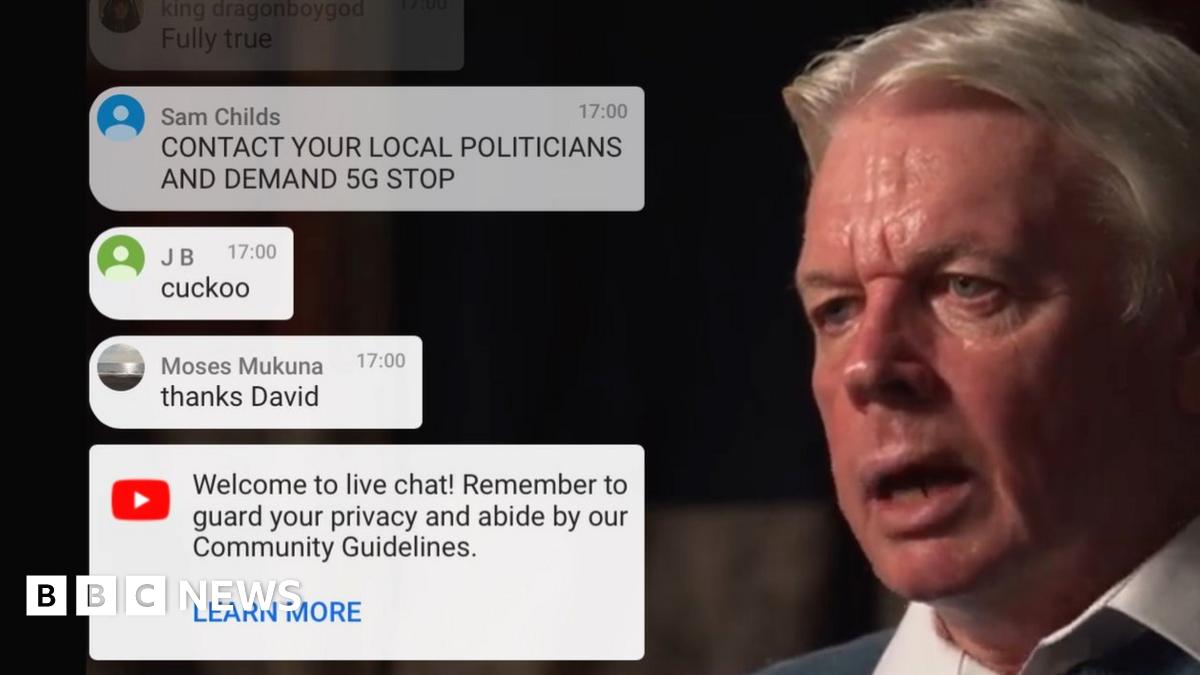
Coronavirus: YouTube tightens rules after David Icke 5G interview
Videos will now be deleted if they falsely link coronavirus to 5G mobile networks.
BBC News
106 points · by laumars · 6y ago · 223 comments
This also raises concerns for me around the question of freedom of speech and censorship. I fear we are centralizing too much power into a few private companies that effectively wield more power than the government and the people for whom it represents.
I'd rather have freedom of speech even if it means tons of misinformation out there.
If and when there is some information that is unpopular but critical for people to know, I don't want censorship to be the norm.
As to your point of information that can potentially do harm, who gets to be the judge of that? That seems like it can be very controversial and subjective.
So far the courts have erred on the side of only ruling against things that pretty much everyone agrees upon and I think we should stick with that.
Having objective criteria for limits to speech is important. Otherwise we run into scenarios where people start claiming "your opinions and words I don't agree with are considered violence against me". At which point ALL speech is fair game.
No new legal precedent has been created, nor has any existing legal precedent been changed. Youtube has always had the right to curate or ban content for any reason, and has always done so, albeit typically in service of advertisers and copyright owners. Legal precedent has never recognized "freedom of speech" to mean that no form of speech can be abridged or forbidden, rather, it has recognized that censorship is permissible under certain circumstances for the common good (laws against slander, libel, fraud, perjury, etc.)
>As to your point of information that can potentially do harm, who gets to be the judge of that? That seems like it can be very controversial and subjective.
Just because it can be controversial and subjective in some cases, doesn't mean it is equally controversial and subjective in all cases, nor does it follow, therefore, that no cases can reasonably be judged by any criteria, because all cases cannot be equally judged on exactly the same criteria.
>Otherwise we run into scenarios where people start claiming "your opinions and words I don't agree with are considered violence against me". At which point ALL speech is fair game.
The problem with the slippery slope argument is that it assumes humans merely process the law like algorithms, and that it will consider a statement like "your opinions and words I don't agree with are considered violence against me". perfectly valid merely because it is logically consistent. Even without "objective" criteria for limits to speech, someone making the argument you're presenting will be laughed out of court, both of law and public opinion.
The only way the slope can be slippery is if no one had ever looked at the slope, considered that it might be slippery, and maybe added a sidewalk or some stairs or a railing or a sign or something. We as a society are already aware that the dynamics involved in something like speech can be complex, and that the potential to abuse freedom of speech exists. Feedback has already been added to the system, because the system is self-aware and self-correcting. It may not be perfect in that regard, but it's still there.
And where precisely has that happened here? Icke floated a theory. Some of his other theories include Hillary Clinton being a literal lizard. Should we ban his videos saying that as well, before people start trying to put chemicals toxic to lizards in the food of politicians?
The only way this could be comparable if someone threaten or assaulted you to get Medicare for all or stop Climate Change.
>"Information" that's not only going to get people killed but also is factually wrong is definitely fair game IMO.
We don't want an advertising company in a capitalist society deciding that. That's the whole point.
Everyone has the responsibility to decide that! Their platform, their responsibility.
Meanwhile the author of the video played with and mocked the censorship regime to market themselves. Spelling words out, writing them on a whiteboard, talking up how many times this information has been taken down, etc. The more a topic is censored, the more the nonsensical narratives look like forbidden knowledge. It plays directly into the conspiracy angle.
If something technological needs to be done to address misinformation, it revolves around viral sharing, filter bubbles, and most importantly basic scientific literacy. Swiping at the video hosting itself is an ineffective blunt instrument from the same exact toolbox that regressive dictators always reach for.
I think this is a false dichotomy. There is a difference between freedom of speech and freedom to use the most popular communication service. Just because a communication service is popular, does not automatically mean that everyone should get equal access. Freedom of speech means that you are free to say what you want. You are free to publish what you want. It does not mean that the most popular distributors of information a forced to carry your message.
Going back in time, it means that you are free to write a book. You are free to print the book. You are free to distribute the book. You are not free to demand that the most popular bookstore must carry your book. Neither does it mean that the most popular newspaper must publish serialised versions of your book.
It also doesn't mean that you must have equal access to the most cost effective means of distributing your message. Even though the news paper (in times gone by) reached every house and syndicated stories could travel the world incredibly efficiently, it doesn't mean that they are forced to syndicate your story. They have a choice. It may be true that you can't afford to send information to practically everybody in the world like the wire services can do, but that's just too bad.
These days because communications are so cheap to be practically free, people often thing that they should be entitled to the best delivery mechanism possible and that everything else should be considered censorship. A private entity choosing not to spread your message is not censorship. It's a choice and it's a choice that every private entity should be able to have.
I'd rather have the freedom to choose even if it means that tons of people do not have access to the most popular and efficient means of spreading their message.
Of course, if there are groups of people colluding to block your message, then that might be a form of censorship. If you have Youtube making deals with ISPs to make sure that you can't host your own content, etc, then I think that's a problem. That's the kind of action that only governments should be able to take (and with the correct oversight). But people and corporations should have the right to choose what business they want to engage in unless it impinges on special categories that we have already marked for protection (and insane consipracy theories are not marked for such protection).
I don't think facebook and twitter can be compared to something like an ISP, the truth is somewhere in the middle.
I personally find it concerning that more and more everyday human communication is moving to platforms that can arbitrarily ban you from communicating.
Now, YouTube’s algorithms are finely tuned to keep you hooked in front of the screen by continuously feeding you things that are just enough outside the expected zone to keep your attention. Slowly eroding away that critical thinking by simply normalizing the non-expected.
So while I might agree on the principle I think the area is a little gray.
Youtube is not more powerful than the government. The government has the power to create laws, levy taxes, raise an army and wage war, arrest, detain, torture and kill. Youtube only has the power to control speech on its own platform, governments have the power to do so across entire societies, and to enforce that will on businesses subject to their laws.
You can say the same about any social media platform - none of them are governments, nor are any more powerful than governments. This kind of hyperbole only undermines the strength of your argument.
"outsource our critical thinking to private companies"
But by profiting off ignorance, that's exactly what media companies are doing.
That's a nice normative statement, but that battle has been lost over a century ago with advent of cheap mass media that enshrined consumerism. Consumerism advocates that the optimal behavior isn't "what is optimal and fair here?" but "what do I want ?"
It erodes critical thinking at grassroots levels.
Not to mention that these days media companies have perverse incentives to generate outrage and polarizing viewpoints instead of just reporting the damn news
YES lots of people get things very wrong. But we are now throwing data, charts, statistics in front of the general population. People are seeking out data and trying to make decisions for themselves (even if they are not doing a great job yet, it's far better than before!).
I know it is fun to be doom and gloom but the reality is our society is better than it was before. People are calling out the media and politicians on their BS faster than ever before.
No one understands even a small fraction of all branches of science, let alone engineering and the rest of it.
Freedom of speech is just double-speak for the idiot masses. You're free to say things and others are free to put you in jail for hate speech, inciting violence or the other 100+ laws that limit free speech.
The sooner you quit thinking in double-speak slogans meant for idiot masses, the sooner you'll realize you don't know what you're talking about, realize how much work it'd take to know what you're talking about, give up and live your life, relying on appeals to authority.
Try knowing what the hell you're talking about in your professional discipline of choice, intimate relationships, physical health and parenting. That's enough for a single human being - most are utterly incompetent at these matters of vital importance to their well being. When you have those under a solid grasp - you can venture out into contemplating politics, propaganda and law.
It doesn't even work in principle: as long as you are limited to receiving information over the internet, it's impossible to verify any of it from first principle. The results of some automatic processes can maybe use cryptography for verification. But any real-world fact relies on people observing it and providing you with texts/photos/videos: there's no end-to-end process to definitely proof that Angela Merkel is the chancellor of Germany. You have to either travel to Berlin and check for yourself, or you have to trust a single source completely, or you construct some most probable version of reality by aggregating many sources weighted by whatever trust you assign them.
"Having trust in..." is obviously the same as "appeal to authority". And if you belief you're not relying on that mechanism you're delusional.
Every time you trust Google Maps to get you to your destination, you do so because your experience with Maps specifically and Google more generally has taught you that this company and product can be trusted to a certain degree.
Every time you're more open to lending your car to your spouse than some random stranger, you're acting on trust.
Every time you return to your favourite restaurant, you're relying on the intuition that past behaviour is predictive of future behaviour. That's yet another formulation for "trust".
Do you believe there's a virus going around right now? How do you know? Are you just counting the number of sources saying so? Because in that case I can probably find more anonymous twitter accounts denying it. Do you consider a story in the New York Times to carry more weight than @justin1256 on Twitter? That's trust.
When you get a vaccination, you're relying on the combined authority of your doctor, and your country's licensing scheme for physicians, and the FDA and the company producing the vaccine.
What does "thinking for yourself" mean in that context? Reading a few papers online doesn't qualitatively change anything: you're just distributing your trust more widely. In practice, it typically means giving yourself license to find whatever study or YouTube video best conforms to your priors. Those people currently setting 5G towers on fire in Britain are excellent at "thinking for themselves" and "consuming a wide variety of sources".
Not relying on some sort of authority implies proving information from first principle. How do you go about it? Are you going to run your own clinical trial? That would cost billions, and expose dozens or hundreds of people to whatever danger you're trying to evaluate, defeating the purpose. It would probably also involve more work than you could do yourself, so you'd need to trust some collaborators. Foiled again!
I also don't get what's so bad about trust? If you want to define it, it's making predictions (about some person's or institution's honesty and competence) based on past experiences. Is there any difference between extending someone (limited) trust after a good experience to, say, jumping headfirst into a pool after you've swam in it to check its depth? Or cuddling a dog you know to be friendly? Yes, people can change (so can dogs), which is why trust isn't binary, and needs continuous updating. Which is why it's so fortunate that nature has evolved a whole range of emotions, from love to friendship to sympathy to fear, to keep track of this elusive quantity called trust.
There are two things at play here, one is misplaced trust. These people are trusting the wrong authority that are feeding them bullshit. Why? They may have had legitimately bad experiences with the sources you and me trust. Or they may just not know one way or the other.
To go along with your example, flying these people to Germany so they can check for themselves whether Angela Merkel is the Chancellor might actually work.
Then there are also people with mental illnesses like schizofrenia. They will not be persuaded either by logical arguments or having the evidence in front of their two eyes.
We ran into the same issues as mass communication started to appear in the 1920s and 1930s. The danger of giving everyone the megaphone is obvious then and now. Tight regulation limited the impact of extremists and crazy people in the United States and other places, it empowered fascists and dictators in other places.
Twitter and YouTube's promise was and remains amazing. The problem is people whose speciality is garnering attention will drown out rational voices. That why the POTUS is a demented game show host.
An entity has the inherent right to control what is on it's own property. Full stop gentlemen.
Freedom of speech doesnt apply on websites. It's their platform, they call the shots.
Dont like it? Start a competitor and pay the bandwidth bill. Google doesn't have to allow misinformation any more than they have to allow someone being an incendiary asshole in a comment section.
Allowing private owners to have total control of these public resources is obviously not what we want or need. The problem is that the formal owners of such resources also have a tremendous amount of influence - as single entities or altogether ("Big Tech") on the politics of states. And this influence is very fundamental to modern democracies, it's not some aberation.
Also:
1. It's nearly impossible to "compete" with such platforms once they are established.
2. Google not only allows misinformation, it intentionally pushes misinformation on YouTube: Sources which are politically acceptable to it are strongly promoted and recommended (e.g. CNN, MSNBC, Fox) - even when they peddle misinformation, which they occasionally do.
> It's their platform, they call the shots.
Agreed. But let's call spades spades.
I wish the WHO made more transparent arguments about the utility of masks. Their failure and apparent flip-flop gives the crazies low-hanging fruit and ethos.
I struggle to figure why anyone trusts an organization that is so in China’s pocket they’re happy to report it’s not human to human spreadable then fake a disconnect on a video interview just to try and avoid answering a question about Taiwan and then to double down by answering the question pretending Taiwan doesn’t exist and just substitute China in place (no, Taiwan is not an “area of China”).
I don’t care about the opinion here. The WHO has lost almost all credibility to me.
[Taiwan isn’t a country] https://m.youtube.com/watch?v=HjpOqVgP36o
[No human to human transmission, China says so] https://mobile.twitter.com/WHO/status/1217043229427761152?re...
Media isn't a "truth-finding institution". Neither are global political organizations. What we have a problem with is people being brainwashed into believe that media/political organizations are "truth-finding institutions".
> There've been enough instances in recent decades of arrogant incompetence and self-serving deception
Because they are in the business of deception. And it's not decades. It's centuries.
"Nothing can now be believed which is seen in a newspaper. Truth itself becomes suspicious by being put into that polluted vehicle."
"I will add, that the man who never looks into a newspaper is better informed than he who reads them; inasmuch as he who knows nothing is nearer to truth than he whose mind is filled with falsehoods and errors." -- Thomas Jefferson
I don't mean to paint a false equivalence between the likes of Icke, and the first person to say "maybe bloodletting isn't helpful". But what does one do about collective/consensus quackery? Even if the consensus of experts is the more solid bet on average, the outliers are consequential, whether it's telling citizens not to wear masks, or invading Iraq for no good reason.
> Despite having what are, essentially, television channels?
Mu. The new media landscape doesn't map cleanly to the old. For better and for worse, cheap and asynchronous publishing puts us in uncharted territory relative to the "Blue Church" of 20th-century broadcast media: https://medium.com/deep-code/understanding-the-blue-church-e...
(I do find it interesting that InfoWars is now incorporating their pariah status into their branding: they brag that they are the "Most Banned Network in the World". For those on the other side, a banning by the Social Media Giants can serve as an erroneous counter-signal that the bannee should be trusted. Cross-reference with the Streisand Effect, and Orwell's admonition that "journalism is printing what someone else does not want printed".)
What about the experts - including those at the CDC - that said COVID-19 was no worse than a flu? Are they no real experts, or are they just the wrong kind of expert?
https://www.businessinsider.com/wuhan-coronavirus-lesser-thr...
"Trust the experts" is nothing but an argument from authority. You're likely going to trust whatever expert confirms what you already believe.
Researchers, scientists, and people on the ground in China, Taiwan, and South Korea issued early warnings well ahead of the WHO, CDC, and FDA flip flopping on transmit-ability, masks, and testing.
Unfortunately the average person can’t tell the difference between a researched investigative journalism piece in the New York Times and an opinion column in the New York Times. Most people can’t tell the difference between the Washington Post and the Washington Times. Many people can’t tell the difference between the Chicago Tribune and a random website that stole the Chicago Tribune’s layout.
All these differences matter an enormous amount. They don’t matter subtlety like missing the freeway exit and taking the next one. They matter like chopping your hand off instead of keeping it.
> Although the CDC considers this coronavirus (whose scientific name is 2019-nCoV) to be a serious public-health concern, the agency said in a statement Friday that "the immediate health risk from 2019-nCoV to the general American public is considered low at this time."
Your paraphrasing of them is dramatically misrepresenting what they said, which I think is the real problem. "Experts" tend to hedge and use inconclusive language, because that is correct. Then journalists come along and confuse/misinterpret things a bit, but the real damage comes from people like you come on social media. The vast majority of people seem to only ever read these misunderstandings and misrepresentations from other social media users.
Back when 5 known cases of COVID-19 where in the US, the risk on that specific day was lower from the virus than the flu for the average American. “immediate health risk” However, understanding that risks change over time is critical to understanding what was being poorly communicated by that piece.
If you stop people knowing he is also talking about this then the only people left to talk about it are the regular normal seeming folks. Channels like this https://www.youtube.com/channel/UCsAwM1EqcYXKeIEufJqwWjw/vid... thousands of views per video, seems like any normal bloke you'd chat to down the pub.
So well done by silencing a known eccentric you just made the only voices in this conspiracy the normal everyday folks, if regular people searched this theory and Icke popped up they might have actually questioned it because they don't want to be associated with the lizard guy.
I think this is begging the question. Why does Youtube, in particular, have an obligation to not "suppress" this person, especially when there's no element of Youtube's terms of service that would force them to carry his content?
He's not being hauled to jail by the authorities, he's just being denied (the greatest use of) the Youtube platform. If Youtube wants to enforce a degree of content control over what it hosts, that would ordinarily be its right -- in the same way that if I run a print shop I don't have to print flyers from any crank who walks in the front door.
Moreover, you're making a testable point here, that suppression "only makes this conspiracy stronger." Is there social science evidence to back this claim up, or is this just an intuitive opinion? An alternative framework is that by denying a pernicious idea its greatest platforms, it makes the topic seem more rare and thus less credible. (The converse of "everyone's saying it, there must be some truth to it.")
If there is, you might begin with this: https://en.wikipedia.org/wiki/Streisand_effect
But the conspiracy minded do seem to latch on to anything resembling information suppression.
And yes it is a problem to have this much depend on the decisions of a single organisation, as they are wrong no matter what they do, and frankly they don't have the mandate to make such decisions to begin with.
In other words: even a broken clock is right twice a day, that doesn't mean it's working.
"Wuhan: Disinfection Spray over Wuhan" https://www.youtube.com/watch?v=bCY6OJskQRk
9 Feb 2020 was full conspiracy theory while mass media stood silent.
Even today its not entirely common knowledge to what lengths China went at the end of January while WHO was spreading lies about no human to human transmission, no masks, and definitely no international border closing necessary.
Someone showed me the Icke lecture, and so we discussed what are easy ways we could falsify his claims. E.g. countries with high incidence of covid19 and no 5g.
Especially when the conspiracy theory is so easily debunked the media should handle such cases more liberally. Think of it as inoculating the population against misinformation.
I do tentatively agree there are some kinds of misinformation that should be suppressed, but any such thing should be very exceptional, and very well explained. Otherwise, the media will end up being the modern Catholic church and go the way of the reformation. The church has spent centuries undoing the mistakes it made handling Luther's and other's criticisms.
Sure, right after we feed them some unicorn tears for breakfast.
Substantial numbers of people don't trust their own pediatricians on vaccinations. 40% of Americans think God created humans in their current form instead of evolution.
Society has become hostile to facts, and sites like YouTube are all too often happy to serve up bullshit if it gets engagement.
Should we? Probably.
Can we do it in a way that isn't worse? Probably not.
Except a significant (and growing) number of people aren't. There's a huge 'anti-science' (or 'anti-elite' if you move in those circles) movement in this country. Without getting into politics, the proof is in the pudding: just the other day, we had the governor of one of our biggest states saying he 'didn't know the coronavirus could be transmitted before people showed symptoms' even though that fact has been readily available to everyone for weeks if not months. When would rather believe politicians than experts, giving those politicians an unchecked way to propagate their message will only kill people.
Initially there was fear that 'deplatforming' would make these ideas stronger, and the people promoting them 'martyrs' and their 'martyrdom' a 'cause célèbre' that would promote them even further. In other words, that the Streissand effect of deplatforming someone would make them more powerful.
Reality seems to contradict that. People who used to enjoy quite a bit of notoriety a couple years ago have essentially disappeared since being deplatformed. Idiots like Milo Yiannopoulos, Gavin McInnes, Alex Jones and a whole bunch of other alt-righter 'personalities' who promoted white supremacy, homophobia, xenophobia, etc. have lost their audiences and are only recognizable by a handful of people who were aware of their positions before they got deplatformed.
On the other hand, the people that put the effort to continue following such personalities and ideologies in whatever platforms they managed to stay on, belong to the extreme fringe of the original audience. Because the platforms that still host these people tend to host all kinds of terrible stuff, it's possible that some are being exposed to bad views they didn't espouse before. But let's face it: anyone digging through white supremacist sites to get the latest from Gavin McInnes was a lost cause anyway.
In conclusion: deplatforming seems to limit exposure of new people to such perspectives, without requiring government-enforced violations of the First Amendment. There's nothing we can do against people actively looking for such anti-perspectives, because they are already biased against the 'normal' perspective. Conspiracy theorists have existed forever, but only recently they've become mainstream and affect public policy.
If they did, no one would buy the BS that the mainstream sells (cf. Iraq War, Vietnam War, ... nearly every war, the 'Russian collusion' of current era). Power is obtained not when people are taught to think - it is when you keep them stupid and limit their brain feed to one gutter.
Twitter, YouTube, Facebook has brought the long tail of politics and stupidity to the mass audience.
It may well be that it can no longer be peacefully stopped, and that battles and violence will decide this.
> One falsely suggests 5G suppresses the immune system, the other falsely claims the virus is __somehow using the network's radio waves to communicate and pick victims, accelerating its spread.__
(__ emphasis mine)
W T Actual F people!
Facepalm.
If it were true it might be one of the greatest discoveries of all time ;)
Can't remember him when he was a footballer, but I wonder how many times he headed the ball ;-)
Edit: Downvoted on a site for pointing out the rules of the site. Maybes it’s just me, but since the Great Quarantine, some websites have been a little extra smug and “hide the wrong think” prone.
That isn’t the topic of an ad hominem however. Saying “he’s been kicked in the head too many times” is.
Do you think it should be illegal to think lizard people exist?
Do you think there is any degree of comprise in a best case argument you could make to how some actions are made with people’s “reptilian brain”?
Should it be the responsibility of someone else to make sure you aren’t “assaulted” with other people’s wrong ideas? Or should you take responsibility for your own intake and just ignore the guy?
I wonder how much credit do you give to your own “has serious mental issues” justification? Isn’t that the exact argument that transphobic people use? That this person has a serious mental illness so they shouldn’t be afforded like-protections? Seems like a bad argument on either use because it’s all opinion based on disagreement.
I was raised to respect people’s right to express their ideas even if... especially if I disagree.
I dont think this specifically would count as an ad hominem, given the “personal attack” (lots of concussions in the past) is directly relevant to the current criticism and is a very probable source of their crazy illogical statements and opinions.
EDIT: just fyi, I didn’t downvote your comment. I think your question is very relevant and is in good faith. It is a shame that some people ganged up on your comment, because it seems genuine.
An ad hominem is “he is a lunatic with head trauma, so take his platform away!”.
A real argument would be that Iran has no 5G and has been hit hard with covid19 so his correlation and his causation seem disproven easily.
That's the usual way this belief is debunked. Find people who say they can sense radio waves or are made sick by them. Wait until they complain they're sick. Show them the device was switched off. Job done.
I'd love to know what it is about 5G specifically that's got these people so worked up. Maybe tower density? There are going to be just way more 5G towers than prior generations?
Take flat earthers. Because many people believe it we should investigate - so people post evidence that the earth is round, the flat earthers reject that evidence and make the flat earth claim again. So do we keep investigating? The same number of people still believe. How many times around that wheel do we go? Do you believe that no one has honestly looked into the health effects of 5g? What evidence do you think it'll take for someone who believes radio waves are causing these effects, even though scientists have pictures of the virus, to have their mind changed?
Bertrand Russell's Teapot is an example of what I mean:
"If I were to suggest that between the Earth and Mars there is a china teapot revolving about the sun in an elliptical orbit, nobody would be able to disprove my assertion provided I were careful to add that the teapot is too small to be revealed even by our most powerful telescopes. But if I were to go on to say that, since my assertion cannot be disproved, it is intolerable presumption on the part of human reason to doubt it, I should rightly be thought to be talking nonsense."[1]
In that same vein, it would be a supreme waste of time to try and scientifically debunk the trolls that are promoting this nonsense; they have the burden of proof.
Still I agree it would be fun to watch it be debunked. But how would you propose it be done? Gather a large number of healthy people around a 5G tower and do a cohort study of COVID-19-like symptoms among that group and compare to a control population? There's any number of possible methods, but it sounds pretty silly when you say it out loud.
What's worse is even if you _did_ such a study, its results would fall on deaf ears as far as the conspiracy theory folks go. They are not interested in proof.
References: [1]: https://en.wikipedia.org/wiki/Russell%27s_teapot
For example, look at how yellow fever played out in the past. The fever swept across large populations, killing many....then people started to pick up on the fact that individuals drinking from private wells (or cisterns) weren't getting sick as often. Conspiracy theorists back in the day would have said "The public water is making us sick!", and anti-conspiracy-theorists would have said "Oh yeah? How about you prove it to me!". Considering they didn't have the technology to "prove it" (or at least it wasn't nearly as accessible as today), the anti-conspiracy-theorists were probably strutting around thinking they won the debate.
I swear to god I thought the internet would be so different in 2020.
Before (and even after) the ban there was a lot of good information on YouTube, a lot of it was from trained medical professionals and now it’s all going away and people will be left with gossip and guesses.
Or is actually saving lives to much bother and it's more fun attacking people who believe in reptilians?
I understand why it's harmful to spread anti-vax memes, but 99% of "misinformation" is harmless. It's often difficult to separate theory and conspiracy from harmful information, a dubious concept.
Misinformation and the hole that leads into it are not harmless, and lead to mental degradation and emotional trauma.
Some of them have been burning down 5G towers here in the UK.
That's a part of it!
I mean, that's part of the problem with all the scaremongering pseudoscience bullshit out there - people act on it.
And that’s TOTALLY FINE. But the issue surrounding the whole “should these monopolies be the free speech overlords?” Is that if they say this guy can’t be allowed speech, they should have to take responsibility for the speech they do allow. Publisher vs Platform.
To your other point, they are responsible for content on their platform in many cases (violent threats, illegal adult content, allowing access to adult content to minors, copyright violations, dissemination of classified information, and so on) so I don't see a problem.
edit: please don't downvote the parent poster? This is a perfectly fine response and good faith dialogue. We don't downvote something because we disagree with it.
Wow.
Is this a "misinformation control" issue or is it more a "monitor mental health of employees in high trust positions" issue?
> This includes conspiracy theories which claim that the symptoms are caused by 5G.
Yeah, fair point. But it's a red herring.
> For borderline content that could misinform users in harmful ways, we reduce recommendations. We'll continue to evaluate the impact of these videos on communities around the world.
This one is KEY. Truth is, the majority of views comes from the Recommended, Trending and Next to Play. No one without a direct link will see your video, if it's nerfed by the algorithm. Checkmate.
Corona is a very heated topic with many unknowns. Deciding what can and can not be labeled as misinformation is thus very tricky even for an expert, because there is a very fine line between misinformation and speculation (which is different in the sense that it's done in good faith and thus perfectly fine). Who's going to make these decisions? A private corp with zero transparency?
We sorely need very clear distinction (maybe even legal - e.g. a framework for Terms of Service) between media and medium. With the former being free to set arbitrary rules, push agendas, ban otherwise harmless content, fuck with content promotion in whatever ways they want, etc. And the latter providing just the infrastructure and technical means to publish content with minimal governance. Status of being either of these must be granted upfront and then prohibited to change.
Otherwise every "social media" platform will eventually mutate into a weaponized propaganda machine, promoting the interests of its stakeholders and greater powers-that-be and suppressing any dissenting opinion. This temptation is evidently impossible to resist.
In the case of the coronavirus, we are dealing with a very dangerous global pandemic, and I personally think that this falls into the category of "misinformation can be very dangerous."
Is there anything that defines your view of what nonsense is other than government approval? Wait, except up-thread I am reading that the problem is politicians who don't accept experts.
So who defines expertise? Who gets the label of expert and who doesn't, in your view, if qualifications aren't it?
I would say that the answer to this involves peer review.
Do the statements have the backing of the expert's organization?
Experts speaking alone are less credible than experts speaking on behalf of a committee (consisting of members from more than one organization, ideally) which reviewed information and prepared statements for presentation to the public.
https://www.facebook.com/londonreal/videos/206277527340570/?...
If 5G wasn't in the news, it would be something else. Suppressing the signal only makes it stronger, because now you've "proven" that "the elite can't allow the secret information out".
David Icke is preaching to the choir, he isn't converting anyone. Nobody who is otherwise capable of sound reasoning is going to watch him and go: "I might disagree with this person on whether Zionist Reptile Shapeshifters are controlling the world, but his analysis of the effects of 5G on human health and COVID-19 seem credible!"
Conspiracy thinking is extremely common even among clinically sane people. The "cure" is not suppression, not derision, but letting people figure it out how their mind sometimes works against them. The biggest obstacle is the human ego.
My only complaint is that Icke wasn't demonetized over this. He should be banned from the platform entirely. He's actively harmful to society.
That means a set of people who could've otherwise ended up in classic Nazi conspiracy circles end up in something closer to a science fiction fanclub. Yet another set of people who dipped their toes into conspiracy theories might actually start to question whether it's all bullshit, upon finding that the Pope is supposedly a lizard.
The 5G thing on the other hand is something that a lot of people think is probably dangerous, whether they're conspiracy theorists or not. Of course conspiracy theorists picked it up, but if it wasn't 5G, it would be fluoride, or contrails, or literally anything else that might somehow be polluting water, ground or air.
See for example this. https://twitter.com/davidicke/status/667764406466441216
The reason this distinction is important is because if you believe "your enemy" is really reptilians from another dimension, you don't have a reason to be hating or threatening the jews next door. It's strictly better than you becoming a Neonazi ready to pick up where the "final solution" left off, which is another possible trajectory.
Bottom line, if you have the predisposition to believe in "secret group controls the world" stuff, I'd much rather have you believe in Icke's theories. If you don't have that predisposition, you're not going to believe in any of that stuff either way. You don't need to be "protected".
If you think 5G is dangerous, and that there's a conspiracy to harm the public through wanton disregard for public health, you are a conspiracy theorist, it's just a matter of degree.
I don't understand the point of your comment.
The Indian government allegedly (can't find source except John Oliver's TV show, so take with grain of salt) published textbooks claiming that Caucasian people are undercooked toast and Africans are burnt toast, and is currently running an ethnicity cleansing campaign to eliminate Muslims.
If you ever wanted a trip through la la land go visit his website's forums....
Its a not so coherent and less nasty version of 4Chan where everyone is off the hinge. some more than others.
It’s really depressing these theories, anti vaccine, and anti science ideas are gaining so much momentum in recent years. And then the world governments pull something like they just did, saying masks don’t work when in fact they help... how can you ever convince anti science people to trust, well, science and governments when this happens??
I suspect this will become a bigger and bigger problem, with more and more people dying of illnesses we have vaccines for. Very sad.
https://www.nytimes.com/2019/10/14/business/media/turkey-syr...
"The Protocols of the Elders of Zion aren't a legitimate historical document laying out a plan for world domination"
"No world leaders are human/shapeshifting-alien hybrids"