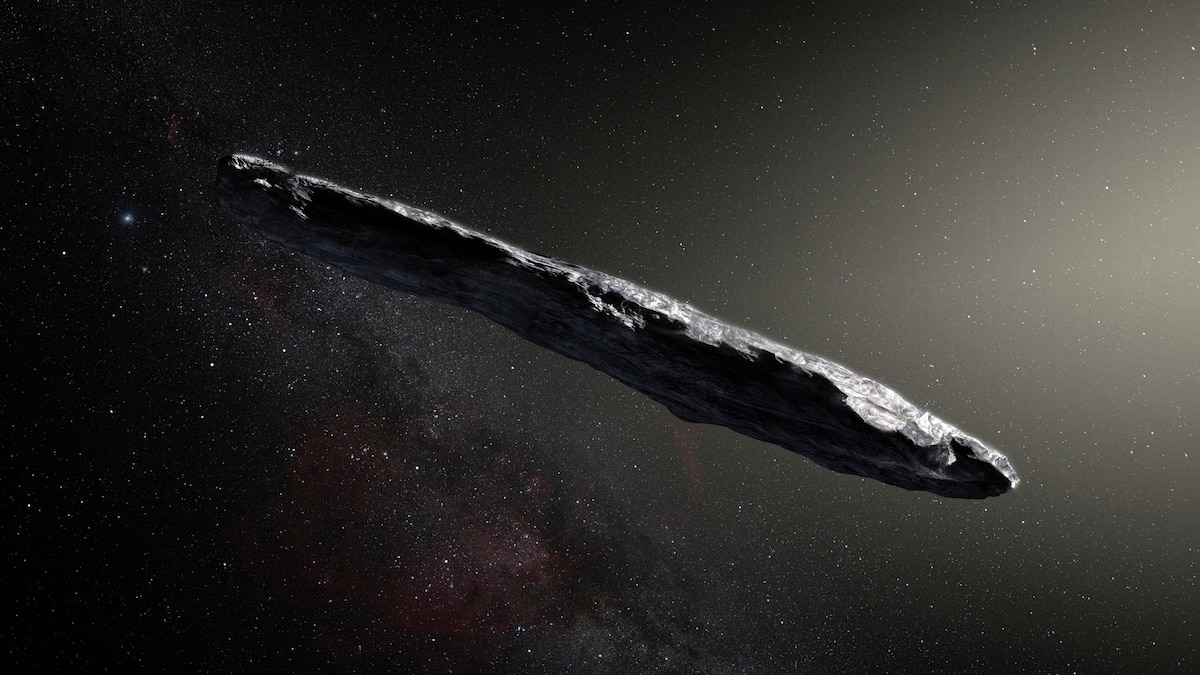
Interstellar object 'Oumuamua could be a shard from a dead planet
'Oumuamua, the first object known to have come from beyond the solar system, might have gotten its oblong shape when a planet was shredded by a faraway star.
Science
116 points · by egfx · 6y ago · 58 comments
This reads like “Disney” science: take some facts and spin them to be entertainment. I thought the same of this article where I thought the reporting was twisting facts to make a headline: https://www.nationalgeographic.com/science/2020/04/lost-your...
It mostly follows the paper (here's what looks like an earlier version of this paper that is easily available [1]), doesn't engage in too much hyperbole, isn't publicizing something widely outside of the consensus.
Disclaimer that I don't work on planetary formation/dynamics so am not an expert on this, but still, pretty impressed.
[1] https://www.hou.usra.edu/meetings/apophis2020/pdf/2018.pdf
https://arxiv.org/abs/1906.03696
So it seems like there is still a lot of conjecture involved... Yet the National Geographic article misleads by showing an artists impression (pictures are truthy) while treating the elongated shape as fact on every line (the alternate disc model was also mentioned in original paper trying to deduct the shape, although the paper concluded it was less likely). Poor reporting IMHO.
I am not an astrophysicist, but this is the second Nat Geo article that I’ve read recently that has really failed my good reporting sniff test. Edit: failed to meet the high standards I expect from Nat Geo.
> But [Bannister] and Laughlin introduce a new wrinkle to the mystery: They’re skeptical that ‘Oumuamua is actually a cigar-shaped object, pointing to a paper published last summer that revisited the original observations of the object. The newer analysis concludes that ‘Oumuamua may actually have a pancake-like shape—a shape that Bannister likens to an overstuffed pita, similar to an object in the outer solar system called MU69, or Arrokoth.
I get your point that the article doesn't promote the significance of the disc-shape analysis enough however my takeaway from the article wasn't that it was claiming the origin of Oumuamua was solved but rather new research has identified potential scenarios where cigar-shaped objects could be naturally created (research which was spurred on by the discovery and mystery of Oumuamua).
If that was what the article intended to cover then it doesn't make sense to cover the disc-shaped analysis extensively throughout the article however for clarity the mention of Oumuamua probably should also have been demoted in at least the title. Sadly I think there's little chance of putting click-bait headlines back in the proverbial genie bottle.
Facile views wrapped up in easily digestible photo journalism essays, then never reviewing the topic again.
It's always been fluffy pap.
(I've had great results for a site like this using Gatsby + Netlify)
I think that the mention of DMCA [down thread] doesn't really work here, that's for sites with primarily legitimate use; if the site in question has a route for acquiring permissions, and has a system to check with users before they (the website service's commuters) download content - to check they have a license - then safe harbor provisions could apply.
Even torrent sites, I gather, tell you not to put up copyright content before giving the opportunity to do so.
All that aside, such sites are definitely copyright infringement in the UK (but I don't now how jurisdiction applies over the internet; I've yet to find good sources on that).
Yes, indeed
It's the funniest sound I ever heard! I can't understand a single word. Is he serious or is he playing?
Not difficult at all.
The question at that time was, is it something more than that? and that's what made it interesting.
Seems highly unlikely these crazy 'from outside the solar system' ideas are likely.
This meme spreads well, but that to me means there is far more chance it is not true. The fact no one questions it also seems suspicious.
This meme spreads well, but that to me means there is far more chance it is not true. The fact no one questions it also seems suspicious.
This left about 24 km/s faster than anything can go and remain inside of the Solar System. Do you have any idea how much energy it takes to get something going that fast?
A baseball going that fast has about 42 megajoules of kinetic energy. A semi on the interstate has about half a megajoule of kinetic energy. This thing was at least 100 meters long and all of it was going that fast.
For the record we do not have the technology to fire a rocket that fast. We only managed to get rockets to leave the Solar System by loading them up with gravity assists from planets. And even so they didn't get to that speed. If two asteroids have a head on collision, the pieces won't move that fast. (And it would have to be a heck of a collision to make a piece that big.)
If this came from inside of the Solar System, WTF accelerated it, how did it do so without breaking the object into smithereens, and why didn't we see evidence of the event that caused it?
By contrast this was going just about the average speed of interstellar objects in our neighborhood. (The Sun happens to be just passing through the ecliptic, and spends most of its time well above or below the Milky Way. Therefore to us, everything in our neighborhood is moving fast.) Any junk hanging around would have a trajectory that looks like this one. Now obviously space is pretty empty. Which is why it is so impressive that we actually spotted something from space.
Yes. It is highly unlikely that anything we see in the Solar System didn't come from here. But it is effectively impossible for anything starting in the outer reaches of the Solar System to get to this speed. And extremely likely that an interstellar object would go about this fast. Therefore it probably is an interstellar object.
1. It may have stolen some energy from another object (an accidental gravity assist), but we know that it didn't come close enough to anything big on its way though.
2. It came from outside the solar system and so entered with some velocity, and therefore will leave with roughly the same velocity it came in with.
We have well known mechanisms to eject objects from star systems so it isn't crazy to have things passing through. No-one questions it because high school level physics is enough to show why it is the only reasonable explanation.
We know it's 'possible' for a tennis ball to go through a wall. But it's not actually within the realms of the possible.
So I guess I still question the 'crazy' part. What are the mathematics here.
If a planet breaks into 5000000000000000 (Earth / Oumuamua) pieces how many hit another solar system? I'd expect zero, but have no idea.
I think it's more likely 1. We missed the fact it went close to another body or it's in a complicated gravity assist eons in the making.
But you're still focusing on the wrong thing. The idea of "a complicated gravity assist" getting something going this fast in the Solar System is laughable. The only thing in the Solar System heavy enough to do a gravity assist on the necessary scale is the Sun itself, and it started nowhere near the Sun.
Also, most (interior) walls are far weaker than you might expect.