123 points · by luu · 6y ago · 169 comments
Meanwhile, my local Target is still sold out...
2669K23 is a pack of 20 (I have this sitting in my closet right now) and 2669K24 is a pack of 60. 1-3 week lead times, plan ahead.
Smaller stores are likely more agile in this respect, because they don't need to rely on the items having bar codes and entries in their central inventory system. That's what tends to hamstring large, centralized retailers.
It was very hard to get basic supplies and food when all small shops were ordered to close, and only big supermarkets were kept open, and supplied by organised convoys.
This appears to be rational at first, but it only led to people all rushing to those few supermarkets the moment the convoy arrives, and them being emptied clean by first 50 something people.
It also led to wholesale bases being emptied by supermarkets, as they have the biggest buying power, and biggest truck fleets. Here, I heard that they went through more than 8 months supply of flour in just few weeks.
The situation got much better when small shops were let to open.
Both supermarkets, and wholesalers are of course very happy with that, but that left near nothing for small shops when they reopened.
But in smaller towns in North America it's getting rarer and rarer to see even an independent butchery, let alone veggie market or bakery.
At least one restaurant chain already is:
https://www.houstonchronicle.com/neighborhood/tomball/busine...
At least 2 restaraunts in my town do this. Order online, drive around beck (sometimes with a line of cars, but never more than a 5 minute wait), and they drop your food/tp/etc in the trunk. Much better than hitting up Safeway or Costco, and not really much more expensive.
Wait, they didn't place restrictions on how many items individual customers could buy?
> Wait, they didn't place restrictions on how many items individual customers could buy?
Barely did, and even when it was enforced, this didn't prevent panickers reliably rushing to supermarket all and every time the truck arrived to buy full bag of food, or two. People were literally running after that truck.
And the more people see that, the more people do that.
Even switching to food stamps wasn't able to stop that entirely until they got the trick with small shops.
Anyway, in addition to making pretty good money as working the desk as a lab consultant if people had any questions and to just keep an eye on things, I sold individual floppy disks. I don't remember the numbers but basically I could place a bulk 100 diskette order for maybe a tenth the price that individual diskettes were sold for in the campus store. It was a nice profitable little side gig that took almost zero effort.
I haven't seen that yet, but at least one grocery chain in my area was offering 25 lb bags of flour for sale about a month ago (or maybe they were 40-50 lb bags).
Haven't been back since to that store since to see if they're still doing it (been slowly rotating through the four we visit regularly), but flour has been available in 5lb bags so long as you're not too picky about the brand or type
I've been baking cakes since I was about 13 and I have never used anything other than AP flour. OK. I've used bread flour in a pinch, being super-careful to mix it very little because of the high protein content.
Pasta: roll it out thin and cut with a knife. It really doesn't take that much longer. I did it like this forever until I got a pasta roller/cutter.
Not trying to be contrarian, but I felt to point out that nothing here is a show stopper, it just takes a little creativity/experience.
Yeast is still available online: https://www.amazon.com/dp/B00HST626C/
> cakes aren’t very good with all purpose flour
We only stock all-purpose, and there are a lot of great cakes you can make with it. Here's one I make a lot: https://www.jefftk.com/recipes/choccake
Before organizing this, we had already gone through about 30lb since we started staying in (https://www.jefftk.com/p/stepping-up-isolation)
Realized yeaast wasn't to be had for love or mone:
https://mastodon.cloud/@dredmorbius/103845407941910287
Starter recipe:
https://www.kingarthurflour.com/recipes/sourdough-starter-re...
Took about 6 days to get going. 3rd loaf was a winner. Feedback from household and neighbours is strongly positive as well.
Flour sourcing has been spotty, but even that has upsides: testing out spelt and einkorn, along with whole wheat, AP, and (blech) bleached flour.
Loaves, rolls, pizza, crumpets, and more.
Most of this based of Youtube videos:
https://youtube.com/watch?v=BJEHsvW2J6M
https://youtube.com/watch?v=2FVfJTGpXnU
Dutch oven, food scale, bench knife (I use a plastering spatula) highly recommended.
The mechanical keyboard community wouldn't exist without group buys, they rely on them to hit minimum order quantities from producers of custom keycaps, PCBs, and other manufactured items. These are then shipped to proxy vendors around the world who do last-mile shipping to end users.
Homebrew clubs also put in wholesale orders for raw materials like yeast, grain, and hops. These are usually more localized given the large volumes involved, and involve a physical meetup where the goods are repackaged and distributed to the buyers.
I daresay there are more groups like this (home bakers maybe?) but they're largely invisible outside their own circles.
Most products have Drop / Massdrop in the name now.
The most recent two actual (keyboard) group buys that I participated in have been really poorly handled. One is still delayed and has not shipped (order placed 561 days ago). The other shipped broken (to everyone in the drop) after being delayed for months. I had to manually ISP flash a bootloader.
In their case, they're also trying to host the various communities rather than simply being a tool that anyone can use to run a buy.
We'd buy over a tonne of grain and probably 10 kg of hops every time. It saved us over 50% of what it would cost at the homebrew shop.
I think my record for cheap brewing using bulk-bought ingredients was about $5 for a 5 gallon keg.
But now they sell it like a main product; even today when I went to buy some bread at one of my local shops, they had sacks of flour set up in the storefront and showcases.
In my opinion, we haven't even begun to feel the economic shock of this thing, because we've been able to ignore the foundations of our society for so long.
Having most everyone in a city or neighborhood buying from a single chainlink or two isn’t a very resilient system, nor does it make for very efficient markets.
Commodities like flour should be available sort of like data on ipfs; the problem is, of course, trust and risk of tampering. Hopefully it won’t be much of an issue and more decentralized supply chains can emerge, making more opportunities for more people.
I’d love to be able to be a local cache node in the food supply chain (or web, perhaps), as I imagine others would be.
Distributed, not just hub-and-spoke decentralized. We just watched the failure mode of that one.
Distributed systems in software are hard. Th idea it'll somehow be easier when you need to truck tonnes of physical goods around is wishful thinking - the same failure modes still apply.
Particularly when it comes to staple commodities like flour, salt, sugar, etc -- grocery stores by and large buy these items from the same small number of distributors. Grocery and food distribution in general have been consolidating aggressively over the last decade or so.
More can definitely be done on this front with regional produce or prepared/processed foods though.
> Unfortunately, between placing the order and them shipping it they ran out of stock
Insanity! I'm heartened that people are still baking at home though. For comparison, retail King Arthur All-Purpose flour goes for about $3.69 for 5lbs, or $0.73/lb, so at $0.56/lb Sir Galahad flour is still a bargain. Whole wheat flour has bran and germ and the oil they contain make it harder to store than white flour, so I wouldn't buy a lot of it.
Flour is for more than just bread. Top of my head: tart shell, pizza dough, tortilla, thickening up sauces, can't make a roux or a bechamel without flour, fresh pasta, cookies, muffins, cakes.
It's very irritating for those of us who actually bake on a regular basis and resisted the temptation to hoard for hoarding's sake.
I'm doing this quite explicitly - on my last shopping trip I bought one loaf that went straight into the breadbox. When it is gone it will be replaced by a baked loaf.
I don't know if this thinking is common, but obviously extending the time between grocery store visits is a good thing.
tangentially related: I think there's been a lot of unwarranted gleeful bashing of people as universal stockpilers when I suspect that most of this is a tempo/timing thing (which easily destroys a JIT supply chain.) It's not that most people were stockpiling unnecessarily, it's that everybody was shopping at the same time, and fully stocking their larder rather than doing it as casually as they usually would. The special cases of particular staples like toilet paper were intensely covered by the media, IMO creating the hoarding of those staples. In normal times, if I have three rolls of toilet paper at home and I'm at the grocery store, unless a sale jumps out at me I'm probably not going to buy - I only buy when I'm critically low. In current times, that would be a bad move that would result in a special trip just for TP (which would be trivial in normal times.) Not buying the largest size of TP available (which is only around $20) seems reckless under the circumstances. If I hear that people are stockpiling, I might want to buy more than one for fear that when I need TP, I might have to travel from store to store to find it, exposing myself even more.
I'm saying this as somebody who always buys the largest size unless there's a sale that makes a smaller size cheaper by sheet, went shopping a couple of weeks before any quarantines were announced, and therefore hasn't had to buy any during the pandemic. The fact that I was able to make it 5 weeks on what I had at home before going out again was a comfort.
I've talked to most of the friends in the group buy about their baking; it just comes up. People are making bread, pizza, naan, waffles, all sorts of things. I don't think this is people buying flour who aren't going to bake with it.
https://news.ycombinator.com/item?id=22885192
Hoarders suck, especially super hoarders like this.
Please don't reflexively characterize people who do different things or have different needs as "super hoarders".
Bread, especially good bread, gets stale kind of quickly. If you want fresh bread right now and don't want to continually go out an expose yourself to infection the only real option is to make it at home.
A quick crowd pleasing recipe using all staples
And so delicious!
To me specialized would be something like an "avocado cutter" or a "poached egg cooker", etc. Or a waffle iron ;)
Few months back we bought Waffle maker with great expectations. However after 2 disastrous attempts which resulted in very stogy waffles, we put that away. I was wondering should if we just buy some readymade batter that some stores sell.
1 3/4 C milk
1 stick butter (melted but not hot)
2 C flour
1 T sugar
1 t salt
1 1/2 t yeast
2 eggs
1 t vanilla extract
Whisk everything together in a lidded container. Stick in fridge overnight (10 hrs min, 24 hrs max). It'll be thick and bubbly in the morning, ladle it in your hot waffle iron, don't whisk it down, it'll deflate the gas. Makes 7 - 8 waffles.
Otherwise it's an appliance that doesn't get much use around lunch/dinner time.
Might help? https://helpatmyhome.com/where-to-buy-flour-online/
I'm sending out feelers locally to see if anyone is interested (I'm in Louisiana), and so far I've got a little interest. I was wondering if you'd come into any problems other than the animal thing with your experience, or if there's anything else I might need to know. I was wondering how you found people who wanted to participate? And how you organized it. If it was all friends, or if it was people you didn't really know or found online. I don't have a ton of friends who are really into this so I'm kind of casting a wider net.
I could imagine someone having issues with theft depending on the area, but that's not something I'm worried about here.
If you did end up getting a pallet you'd want to make sure that either they could put the pallet where you wanted it or that you had the equipment to move the pallet.
> I was wondering how you found people who wanted to participate?
I wrote to a few groups:
* Facebook: primarily friends in the contra dance community
* Work email list
* Email to area family
* Email to area college friends
It ended up being a mix of all these groups.
If I wasn't doing it with friends then pickup is harder. I trusted my friends to pay me and to pick up from my porch unattended -- that would be harder with a group put together from, say, reddit
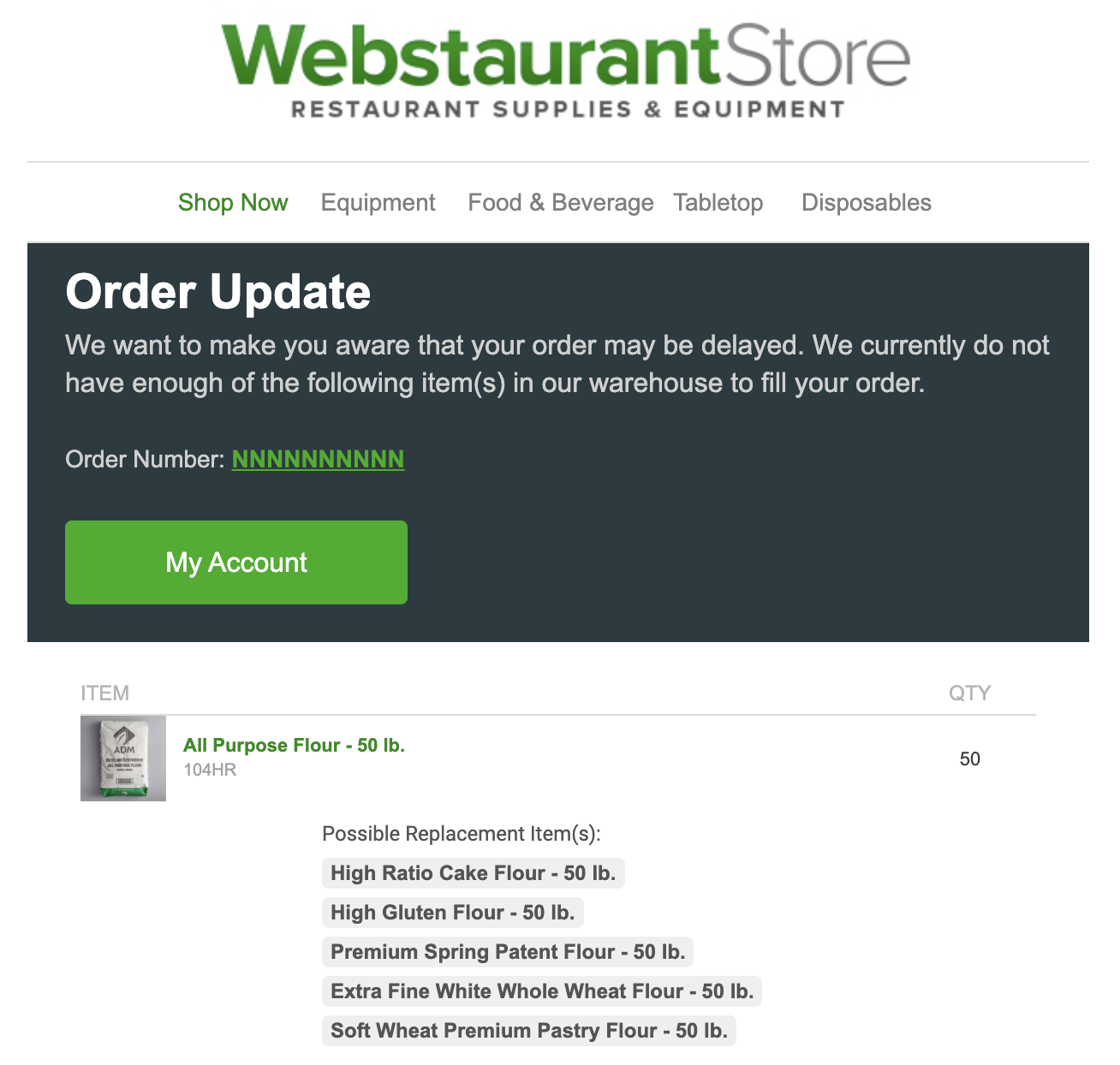
The original flour we were thinking of buying was https://www.webstaurantstore.com/all-purpose-flour-50-lb/104... $12.25/bag (50lb), mildly cheaper than the Sam's Club price above. But then adding in shipping on a truck from PA added another $9.40/bag.
In places where people can easily buy individual 25lb bags for $6.50, though, you don't need to organize a group buy!
When I got home my wife asked me if they had toilet paper too. Doh!
The food supply chain in US is much better than in Europe, and Europe is better than most of Asia.
A week ago, I was very scared myself for there being a 21st century famine in Asia, but I never could've imagined how bad panic buying can hit countries even with robust food supply chains.
The difference is enormous, and it's far too soon to relax about famine. We'll know if that happened by about 2023.
The Irish famine has happened when UK was drowning in corn, and had the best harvest in many years.
The Bengal famine has happened in times when most regions of India had otherwise at least bearable harvests.
The Ukrainian famine has happened in times when the soviet union had bumper harvests, and was exporting megatons of grains, and other foods.
The Great Chinese Famine has happened when Mao too has tried the same trick as soviets did, except it failed on him even worse, like ten times as much.
Bangladesh 1973 famine has happened when Bangladesh was awash with humanitarian aid.
The chronic undernutrition of socially marginalised groups in 1st world countries keeps happening with governments throwing billions of cash on food stamp programs.
If no food is available, sure. If other food is available, no way. Are people starving in the US yet due to food unavailability?
But really though, a family buying 5 pounds of flour isn't the problem, it's the hoarders loading up shopping carts full of toilet paper and flour that give us empty shelves. I think we'd have enough for everyone if we didn't have greedy hoarders.
So the store increases their orders. But their suppliers only have X% slack. So they have to ramp up too. The whole supply/demand balance takes time to stabilize.
The same number of people are eating the same calories as before, but the supply chains for those calories have shifted rapidly. Same for toilet paper: No one's pooping on company time anymore!
Yes there are some hoarders, but we'd get temporary problems even with 0% hoarders.
Our supply chains are optimized to have essentially no slack. When people switch from using the toilet at work to home, and when they buy a month at a time instead of a week at a time in order to comply with shelter in place orders, they drain the grocery stores extremely hard.
No selfish or hoarding behavior is required to produce the effects you're talking about.
The shortage of flour, butter, TP, chips, and everything else is due to individuals' selfishness. There is certainly enough food to account for the extra meals at home, its just now very unevenly distributed.
The entire grocery supply chain works on a just-in-time model. Demand for stuff like flour, toilet paper, etc. on a chain-level scale is entirely predictable in normal times - Walmart can likely tell you what a given day's sales will be of stuff like toilet paper down to within a couple percent.
A sudden, unexpected, and sustained 10-20% increase in purchases of various staples blows a gaping hole in the entire thing.
The entire supply chain plans months ahead for Thanksgiving-level demand. We basically all did a Thanksgiving shop without warning.
For most Americans, they will eventually use their normal brand of flour, so buying extra is essentially no extra cost. (Time-value of money over, say, 6 months means that we're talking about a 1% difference here.) It's a cheap hedge against supply disruptions. But that's not very likely to happen. The organic brand is often at least 20% more expensive, making the calculus not worthwhile.
Put another way, if you expect flour prices to rise 10%, you should buy as much flour as you will use before it goes bad at today's prices, and 0 organic flour at a 20% premium.
Knowingly putting pesticides in your body never seems rational to me, even if it saves some money. But if they were going to do that anyway, then sure, your point stands.
Three weeks ago, there was no flour of any sort in the store I went to. No corn meal, not grains at all. Except for matzo meal, however, on the end of aisles where seasonal products are held, so I finally made matzo ball soup for the first time! There were also no beans except for a completely ridiculous $8/pound of dried lentil in some sort of super fancy packaging.
My experience with commercial toilet paper has been the same, watching it dry up just like retail. People seem to be stockpiling cheap familiar essentials, plain and simple, wherever they can get it.
That said...
>People seem to be stockpiling cheap familiar essentials, plain and simple, wherever they can get it.
I'm sure there's some truth to this. I'm not stocking up on huge quantities of things I don't need. But, for example, a couple weeks ago there happened to be one bag of my favored flour in the store so I grabbed it even though I wasn't necessarily at the point where I would normally buy it. I also have an extra dozen eggs at home. Etc.
Multiply that behavior by most people and that's a lot of extra buying from stores and inventory scattered around everyone's houses even though most people aren't doing the two-year supply of beans level of prepping.