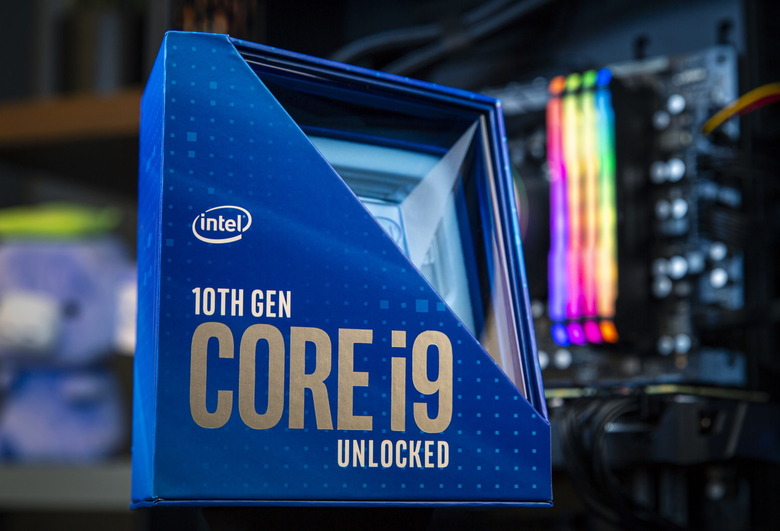
Intel's flagship 10th-gen desktop CPU has 10 cores, reaches 5.3GHz - Engadget
Intel's powerful 10th-gen desktop chips are here: the Core i9-10900K has 10 cores and hits 5.3GHz.
Engadget
223 points · by redm · 6y ago · 332 comments
> The 10900K has a 125-watt TDP, for example, while AMD's Ryzen 9 3900X's is just 105-watts.
My understanding from other articles (like [1]) is however that Intel had to _massively_ increase the amount of power the CPU consumes when turboing under load:
> Not only that, despite the 125 W TDP listed on the box, Intel states that the turbo power recommendation is 250 W – the motherboard manufacturers we’ve spoken to have prepared for 320-350 W from their own testing, in order to maintain that top turbo for as long as possible.
Somehow it feels like back in the Pentium 4 days again.
[1]: https://www.anandtech.com/show/15758/intels-10th-gen-comet-l...
Power increases linearly with frequency and squarely with voltage. Higher freq. needs higher voltage. This applies to pretty much any CPU/GPU. Also AVX loads are significantly more power hungry.
230W would be a low estimate for a fully clocked one.
Going by the common use of "squarely," the power usage might also be interpreted as being linearly with voltage. Rather, I understood you meant that power increases proportional to the voltage squared.
(For the lurkers: Friction increases proportional to velocity squared, as does kinetic energy. These are all quite useful things to know, and should be part of the takeaways from your basic science education.)
I run it at a 5.2ghz all-core overlock and it pulls nearly 200W under load. (yes, beefy watercooling). From memory it was around 150W @ 5ghz but I haven't played around with the OC settings for a while after I got it tuned right.
When you overclock, no wonder you get more power draw than the official spec says.
A large air cooler will be as effective, possibly more effective, than an AIO water cooler. What matters is radiator surface air x airflow. AOIs tend to have small surface area radiators and quiet fans because that is their target market. Water cooling does have some advanteages, but for coninuous heavy loads all that really matters is radiator capacity. The large air-cooled radiator is going to have more veins with more surface area covered by a more powerful fan than the typical AOI radiator.
Some people seem to think air can be better because at idle, heat pipes can end up a few degrees cooler. Ultimately what you want though is heat dissapation, ideally without super powerful fans and water cooling is far better.
The closest thing I have found to filling the void when Kyle had the gall to shut down HardOCP :/
Another issue is that VRM needs cooling too, and custom loops can come VRM cooling (monoblocks). AIOs would need forced airflow (fan).
What we've got here is actually the mysterious, long-overdued Pentium 5 (which was known for its greater-than 5 GHz clock speed and never released due to the huge heat dissipation issue). History repeats, but this time, it actually got released.
This looks like they're turning every nob to 11 on the current architecture to try to get something that they can sell until they can come up with whatever will succeed the Core line.
AMD just has a good architecture and are using good fabbing facilities.
Intel can have the best architecture in the world but that won't matter much if they are stuck with their fabbing at the current 14 nm process.
Jim Keller might be doing just that with Intel right now. I only hope whatever they come up with, AMD is ready and able to keep up. Otherwise we're going to see a rerun of the following period too: Intel tweaking the same architecture for years at a time, and squeezing low single digit performance improvements that come with questionable security sacrifices and deeply unpleasant sticker prices.
This time around though Intel isn't in the same position at all to dictate to major market players for a variety of reasons. The current big lucky break catapulting AMD way into the lead is certainly temporary, but it does seem like they'll be able to gain some real marketshare and attention. That will hopefully serve to make this time around end up in a much more stable back and forth.
Jim Keller has said he is technically the manager for thousands of people now and that they are working on even more IPC with even bigger out of order buffers. Even so I don't see the same leap being made in power and single threaded performance.
Then again apple has an incredible amount of performance per watt in their cpus, so I don't know where the limits really are.
Than maybe they'll come up with a core design again.
AMD CPUs OTOH run significantly higher power than their spec'd TDP right out-of-the box. For example, that "105 W" 3900X actually ships with a power limit of 142 W and it is quite capable of sustaining that under an all-core load.
AMD's turbo numbers are also pure fantasy. If AMD rated turbo frequencies the same way Intel did that 3900X would have a max turbo of 4.2 or 4.3 GHz instead of 4.6 GHz. When Intel says their CPU can hit a given turbo frequency they mean it will actually hit that and stay there so long as power/temperature remains within limits. Meanwhile AMD CPUs may-or-may not ever hit their max turbo frequency, and if they do it's only for a fraction of a second while off full load.
The outrage over Intel CPU's power consumption is pretty silly when you realize that the only reason AMD CPUs don't draw just as much is because their chips would explode if you tried to pump that much power into them. If you care about power consumption just set your power limits as desired and Intel CPUs will deliver perfectly reasonable power efficiency and performance.
I'm pretty sure you've got that exactly reversed, AMD's power draw tends to stay closer to the rated TDP than Intel's.
>>The outrage over Intel CPU's power consumption is pretty silly when you realize that the only reason AMD CPUs don't draw just as much is because their chips would explode if you tried to pump that much power into them. If you care about power consumption just set your power limits as desired and Intel CPUs will deliver perfectly reasonable power efficiency and performance.
I'm not even sure what this means. AMD CPUs are on a more advanced and physically smaller process, with smaller wires, and a different voltage-frequency-response curve. Of course they would "explode" if you try to pump them with voltages that the process isn't designed to operate with, that the Intel CPU with it's larger process can handle. But the power draw isn't really the "point" of the CPU -- performance is.
Imagine thinking that the Pentium 4 or Bulldozer was better than their contemporaries because they were capable of drawing incredible amounts of power.
I was talking about the CPUs in their factory default configuration. Intel CPUs default to limiting their sustained power draw to exactly their TDP, AMD CPUs meanwhile run significantly higher.
Where Intel CPUs will draw more is when you disable the power limits, but that power buys you extra frequency over what AMD is capable of.
> That's like complaining that speaker wire is deficient because you can't use it to charge an electric car. It's a CPU, not a space heater -- how much power it can draw isn't the point, performance is.
Yes, and Intel CPUs achieve significantly higher frequency, and thus per-thread performance, in exchange for that higher power.
With Intel you have the option of running high power/high frequency or lower power/high efficiency. With AMD you don't get the former option due to limitations of the fabrication process used. Somehow this has come to be considered a win for AMD.
I'm pretty certain that I remember watching videos from GN, LTT, or Bitwit (can't recall which) where they noted that AMD chips were turboing up to a few hundred MHz above the specced numbers.
Have you actually tried to do that? When Intel says their CPU can hit a Turbo frequency, it's usually pure fantasy because they can't actually do it within the power/temp constraints.
Yes, they'll get to 5-whatever GHz on maybe half the cores if you're lucky, but full all-core load at the top stated Turbo? No chip will stay there, it will throttle down, likely by a lot.
And AVX loads will bring it to, or close to, maximum non-turbo clocks, that's how hot they run.
It could maybe be done with extremely good cooling and undervolting, and completely removing power limits (in which case it will probably consume close to 500W if it doesn't fry something first :D).
This is an incredibly poor showing and if I were an investor I would be seriously questioning the future of Intel as a company.
Intel does not know how to compete from a marketing, sales, and business standpoint, for a few decades they only really competed with their own product line, now that they have actual competition in the market they are unable to react to it properly even if they had the tech stack to do so
I'll take one AMD Ryzen 9 3900X, thanks MicroCenter!
The 10900KF will do 4.8 GHz all-core at $472, the 3900X will do it at around 4-4.1 GHz[0]. AMD has a slight IPC advantage in productivity, Intel has a slight IPC advantage in gaming[1].
The market for the 10900K/KF is basically someone who wants the fastest gaming rig, but then as a secondary priority wants more cores for productivity. Kind of an overlap with the 3900X, sure, but the 10900K/KF will still outperform it in gaming, where the 3900X tilts a little more towards productivity.
There are of course exceptions, CS:GO loves Zen2's cache and Zen2's latency makes DAWs run like trash, so your specific task may vary.
I'd personally point at the 10700F as being the winner from the specs, 4.6 GHz all-core 8C16T with slightly higher IPC in gaming than AMD, for under $300. That's competitive with the 3700X: little higher cost, and more heat, but more gaming performance too. The 10900 series and 10600 series are a little too expensive for what they offer, the lower chips are too slow to really have an advantage.
But really it's not a good time to buy these anyway. Rocket Lake and Zen3 will probably launch within the next 6 months, if you can stretch another 6 months there will be discounts on Zen2 and more options for higher performance if you want to pay.
[0] https://www.pcgamesn.com/amd/ryzen-9-3900x-overclock
[1] https://www.techspot.com/article/1876-4ghz-ryzen-3rd-gen-vs-...
People seem to have a deep hatred for Intel, exactly the way they had deep hatred for AMD (pre-Conroe days, when Intel released Conroe in 2005/06, people were rooting so hard for Intel, it was hard to find any positive comments about AMD). I don't get it. Both are multi-billion dollar companies and innovating like crazy. We can't just sit back, and feel the utter awe of what it takes to make computer chips whether it is Intel or AMD. You know, its engineers like anyone else - they have good intentions and work hard to make all of this possible, the fans have this egregious entitlement that is so infuriating and dismissive.
Second to this, is competition is important and having competitive products tends to bring pricing down to what is probably closer to optimale.
Aside: I've thought for a long time, that if medications had a dual-sourcing requirement it would help a lot.
I wouldn't call the cost « little higher » if you factor in the motherboard (and possibly the cooler). Any AM4 board will run a 3700X whereas Intel's using yet another socket for their new chips.
You don't really want to be using the sub-$100 tier of motherboards for AMD either. People will talk up how cheap motherboards are but tell people you're going to put a 3900X (only 105W TDP) on a B450 and their eyes will roll at you.
It's relevant for the TDP number.
> I'd personally point at the 10700F as being the winner from the specs, 4.6 GHz all-core 8C16T with slightly higher IPC in gaming than AMD, for under $300
I think the 10700F would only be the winner if you have a motherboard that either isn't following Intel's recommendations for turbo or lets you ignore them.
Otherwise the 10700F's 4.6ghz all-core isn't going to happen with a 65W limit after unknown seconds. That TDP limit is going to really cripple that chip. Whether or not you can ignore that limit will I guess decide whether or not the i7-10700KF is worth the extra $50.
But the 9700 appears to be almost nonexistent. I think the 10700 will end up in the same camp. The 10700K will likely be the only chip with any meaningful coverage/reviews in the i7 lineup.
e.g. it's possible for a Intel chip to sustained turbo at levels unsupported by the nominal TDP.
what do you mean by this? I researched intel vs. amd gaming performance pretty extensively last summer, and I paid particular attention to csgo benchmarks. AFAIK, 9700k/9900k are a little faster than the 3900X in csgo at stock speeds, and a good bit faster on a typical overclock.
LTT (not OC'd): https://i.redd.it/fnw15b6dxv831.png
The doubled cache really made an enormous difference in performance. Zen2 averaged about a 15% IPC improvement on average, in games the average was more like 30%, and in CS:GO it was about 42% improvement. It went from being pounded in this title to tying or beating the 9900K.
And that's against a 2700X, the 1800X was significantly worse than that. Compared to the 1800X, CS:GO is more like 50-60% improved.
The slightly higher clocks don't hurt, but Zen2 really made huge progress in handling the "unhappy cases" for their architecture. I tend to point the finger at cache for this specific case, cause I don't think of source engine titles when I think clean, well-optimized, highly threaded code.
Reading this makes me feel like I need to build a new PC now lol. Any idea what percentage of desktop PCs are still on Sandy Bridge?
-Do they still pack that PoS Intel management inside the CPU? And are these new CPU still vulnerable to Meltdown? Because if any of those questions are answered with "yes" then no amount of cores, GHz and performance % is going to change my mind from Ryzen
Sadly AMD CPUs have something pretty similar too: https://en.wikipedia.org/wiki/AMD_Platform_Security_Processo...
I am not praising AMD, don't get me wrong, I am merely choosing the lesser evil. In this case the lesser evil happens to be better and cheaper. ¯\_(ツ)_/¯
Why not AMD? Answer: iGPU. AMD's best iGPU offering seems to be the Ryzen 9 4900HS, which has fewer cores, and you can't just order it - it seems to be for OEMs only. So staying with Intel.
AMD has a "NUC-gap". At the high end, there's Epyc2 datacenter offerings, and going low there's the embedded line. And every device in between either assumes a discrete GPU (Ryzen 7) or is a wimp (G-series).
I built a beefy NUC-alike based on an Intel chip, because AMD has no offerings here. Google "Ryzen NUC" and the demand is evident.
And none of them have been well received or commercially successful. They seem to be more defensive bet hedging against Intel than anything intended to go anywhere.
"Primary" means simple majority. >50% ARM market share for consumer PCs as defined below.
"Consumer CPU" refers to non-server application PCs. Workstations, desktops, laptops, and DIY. Personal and professional use (including enterprise purchases, so the full fleet of corporate laptops at any company are included). Some current examples would include things such as the Talos POWER workstations and ARM workstations.
For "PC", the definition gets a little rough, and I'd be willing to negotiate this. I'd say anything where the primary interaction mode is mouse and keyboard. With this definition I would exclude most tablets, but something such as the Microsoft Surface would be included. The test that includes the Surface and excludes most other tablets is that the Surface is sold with a keyboard and trackpad. If the keyboard and trackpad is not included or required, then it's not a PC. This rule would also exclude something like a NAS, where the hardware is basically that of a tower desktop, but the use is headless; this would be a server. Like I said, this can get a bit loose. Happy to negotiate a firmer definition.
As for "nowhere close", I'd say that we won't see ARM as the primary consumer CPU for the next decade easily. I'd be willing to bet $1,000 US on this.
If you wanted different timelines, I'd put $5,000 on 5 years, and $500 on 15 years.
Apple's market share won't push ARM past 50%. Enterprises move slowly and make up a lot of the PC market. If you assume a 3-year hardware replacement cycle, then ARM would have to come to dominance at least 3 years before the end of a betting period for it to have a chance of meeting the end of the betting period. Thus, for the 5 year timeline, ARM would have to be dominant by 2022. For the 10-year, by 2027.
Separately, in writing this response, I realize that you could easily make the argument that a "consumer CPU" includes cell phones and tablets. This is a very different conversation.
At home, it's a high percentage and has been for many years.
In office environments at work, it's still near zero (emphasis on primary). A couple hundred million people across middile and upper development nations use desktops and laptops every day at work. They're not going to switch to ARM systems anytime soon for that work. Good desktop processors are a few hundred dollars; ARM has no great angle there (including on pricing). For businesses the cost of a decent Intel or AMD processor is a modest share of the overall system they're buying for the employee to work with.
In developing nations with primitive economies, certainly smartphones are much more common for primary work purposes. And that's a case where ARM pricing does bring a huge advantage that Intel and AMD struggle to compete with. Cost obviously matters in personal businesses where your income is $50-$200 per month. Numerically this category wins, primarily due to the intense poverty of three billion people in India, Africa and China. This market alignment based on incomes probably won't change much in the coming decade, as ARM's ability to push into higher value office work environments as a primary will be very limited.
My gf already uses her Samsung S8 as primary "computer". Only for a few things does she reach for her laptop, and that's mostly due to the screen and webpages not being mobile friendly.
Perhaps, I need to take that as an axiom, right? i7 5820K was non-typical for that matter then.
And yes, Xeon-W with 5.3GHz frequency? Tell me more :)
Supposedly the new socket is PCI-E 4.0 capable, which the next CPU "Rocket Lake" will supposedly enable.
But since it's still 16 lanes from the CPU only, that means you'll only get PCI-E 4.0 to likely a single slot. And likely not any of the M.2 drives, which typically are connected to the chipset instead.
On the AMD side where they already have 4.0, few care for it (I do though - just ordered a mobo and processor that use it) - 4.0 nvmes aren't faster for common use cases, and it mostly matters when going multi-gpu which is only seen in some professional use (and even then you can use a threadripper and just have a lot of 3.0 lanes). Then next ~year ryzen 5000 which will require a new socket seems likely to already support 5.0. I'm guessing Intel will just altogether skip 4.0.
You should go AMD if you want PCIe4 currently. Which is a bit funny as Intel sells certain peripherals that supports it.
One thing that bothers me a lot is the 2.5Gbps Ethernet that is supposed to come with those new Intel motherboard ( assuming MB vendors uses it ). Why not 5Gbps Ethernet? How much more expensive is it? It seems we still dont have a clear path on how to move forward from 1Gbps Ethernet. Personally I would have liked 10Gbps, but the price is still insanely expensive.
Personally I'm with the other guy, I think this is a dumb half-measure and we should just move straight to 10 Gbps. Right now the single biggest cost in your household multi-gig deployment will be switches, a switch with 4-8 10Gbase-T ports will run you around $500, and this figure is not really any cheaper with multi-gig. You are paying through the nose for something that is a watered-down version of the "real standard".
Say you have two switches, one is upstairs and one is downstairs, are you really going to drop $1000 on a half-baked deployment? People need to try it, figure out if their existing cable is stable enough for their needs (maybe that segment can run at 5gbit speeds and it can be 10 gbit on your machines and on the switch), and just pull cable where it's not.
The question is will they get cheaper faster than 10G? Perhaps. Despite being 14 years old 10G is just starting to get put into reasonably priced prosumer switches so it doesn't have that much of a head start practically.
Having 5Gbps End point gives you much more flexibility, instead we got 2.5Gbps. Unless the BOM cost made a lot of difference I dont understand this trade offs. Especially considering we have 802.11ax potentially offering 5Gbps+ and 802.11ay that runs faster then 10Gbps. We are coming in an age where a cheaper Wireless equipment is outrunning our wired counterpart.
> 802.11ax potentially offering 5Gbps+ and 802.11ay that runs faster then 10Gbps
Well, ax is at best about 1Gbps per antenna, and even with MIMO I'm pretty doubtful you'd ever beat 2.5 in practice.
ay is faster but it works inside a single room. It's for peripherals, not home networking.
(House is a mix of Cat6a and optical/SFP+ 10G networking and it is tremendous.)
(Will they go even higher in the future?)
Intel has been backed into a corner by AMD, so they’re pushing clockspeed over balancing against TDP and bus.
Also, the multi-year delays in the next process shrink gave them lots of time to improve yields and micro-optimize the fabrication generation these are running on.
Core architecture brought it down to around 8 cycles to complete an op. Clock speeds dropped, but more shit got done at lower clock speeds.
All this time I thought everyone was going on about interprocess communication improvements :)
Strangely, not all cpu reviews take this into consideration.
Eh? From anandtech's coverage: https://www.anandtech.com/show/15758/intels-10th-gen-comet-l...
"Users wanting the 10-core 5.3 GHz will need to purchase the new top Core i9-10900K processor, which has a unit price of $488, and keep it under 70 ºC to enable Intel’s new Thermal Velocity Boost. Not only that, despite the 125 W TDP listed on the box, Intel states that the turbo power recommendation is 250 W – the motherboard manufacturers we’ve spoken to have prepared for 320-350 W from their own testing, in order to maintain that top turbo for as long as possible."
Power is going up and by a lot to hit that 5.3Ghz. And requires a much lower temperature to do it.
[0] https://hanweiconsulting.com/cpu-frequency-world-record-hist...
Apple may drag the OSX ecosystem kicking and screaming, battered & bloody over to ARM so Apple can control more of the stack, but why would that have any impact whatsoever outside of Apple's corner of the market?
For my computer graphics and processing work, multithreaded tasks scale amazingly well with the number of cores so single core performance doesn't matter all that much. A single thread isn't even be able to process all the data that's streamed from an SSD. I need three threads just to process/prepare the data in the background, in addition to the main thread that keeps rendering.
I suspect it's only a matter of time until multithreading is a must for games. The additional programming effort may not have paid off if players only have 2 or 4 core CPUs, but now that 8 cores with 16 threads are increasingly common, it's going to make a difference.
The value proposition of these chips is pretty bad, as well. Enormous power and cooling requirements, short-lived motherboard sockets, and sheer price/performance ratio are all not great in comparison.
Single core performance is always preferable for CPUs.
The CPU manufacturers basically conned everyone into thinking multi-core was "good enough". Software people who knew what they were talking about back in the day called them out on it but nobody listened. Now here we are on Hacker News in 2020 and people still not understanding this.
We also all know that a single core with twice the performance and twice the cache space costs a lot more than two cores. It's a lot more expensive than even 3 cores.
I'd rather have 3 4Ghz cores than 1 8Ghz core (except for the novelty value).
Sure, if you forget all the additional cache evictions, memory reads and writes and TLB flushes caused by all the competing threads on a single core. Not to mention that one shitty bit of code in one thread can poison the cache enough to re-read the data from memory every context switch.
You wouldn't have true parallelism then, would you? So if you have something, for whatever reason, blocking further processing, the entire computer would lock up. Why is this a better scenario again?
The high clocks result in less pipeline stalls meaning your high frame rates are more achievable as well as significantly reducing the dips (0.1% lows is what every reviewer hates).
This isnt about "average", this is about having the best experience possible, which Intel provides in this very specific scenario.
Intel has three things going for it(in the consumer space), which matter a lot or not at all to different folks:
    - better idle/low usage power consumption than AMD (low load laptop battery life)

    - Intel's QuickSync is fantastic for media encode/decode (NVENC is typically better, AMD is basically non-existent)

   - Intel has the highest clock rates.
https://www.techspot.com/article/1171-ddr4-4000-mhz-performa...
I've seen some people on Reddit running modded Skyrim (can probably throw Fallout 3/4/etc into that bucket as well) who are really mad about the performance of their Zen2 processors. ARMA3 probably runs poorly. That kind of thing.
Also, DAW performance is not very good on Zen.
That said, even in games that use more threads, there is often noticeable performance scaling from having faster per-thread ("single core") performance because there is one thread that is bottlenecking everything else. No real-world game ever has the magical 0% serial code necessary to scale perfectly according to Amdahl's law. It is just a question of whether that scaling starts dropping off at 6 cores, or 8 cores, or maybe 10 cores. Very few games can saturate a 3900X or 3950X yet, maybe Ashes of the Singularity but I doubt much else.
Intel tend to give turbo performance which can only run for so long before heat becomes a problem.
Also, though you're statement is technically correct, it fails to account for the nuance that increasingly across all applications, not just gaming, multi-threaded processing performance is becoming the far more important benchmark to look at.
crushing adjective [usually before noun] used to emphasise how bad or severe something is
I had to check the dictionary just in case. And in this case neither was it technically correct, or downvoted because of the tone. I downvoted it because it was factually wrong.
Zen 2 actually has better IPC than Skylake in many cases, on a sustained single thread performance they are likely to be on a similar level despite having a slightly lower clock speed disadvantage on a much lower TDP.
Hardly crushing.
Intel's per-core performance is decently higher in gaming, between their lower latency giving them slightly higher IPC in gaming tasks[1] (as these are latency sensitive) and the much higher all-core clocks they are pushing (at least 10% higher than AMD at present). That still gives them an edge in gaming, although certainly much less of an edge against Zen2 than it was against Zen1 (which was much worse than people were willing to admit at the time, people at the time were benching it with a GTX 1080 (the fastest card available at the time) at 1440p and 4K and claiming there was "no noticeable difference", but faster GPUs showed the weakness).
I think the 10700F looks good, 4.6 GHz all-core 8C16T part for under $300 looks compelling for gaming customers if you can keep it cool. The 10900K fills the "I want the top gaming performance first and foremost, with as many cores as I can get, and I'm not super concerned about budget" but is definitely on the expensive side. Other than that, nothing terribly impressive here IMO, the other chips fall into a range between "not fast enough" and "not cheap enough".
[1] https://www.techspot.com/article/1876-4ghz-ryzen-3rd-gen-vs-...
A very bad proxy then, since performance-per-core with multiple cores in use will almost certainly be limited by constraints on (1) memory bandwidth and (2) power/thermals. "Single-core performance" only applies when you're literally pegging one core at 100% cpu.
If you want to max out gaming benchmarks right now, this is your CPU. And there are a decent number of people who do, so heavily tuning existing dies (I mean, let's be honest, this a rebinned and overclocked 10900X) makes sense.
Web browsing is no longer a "light" thing to do. You need solid integer single core computing performance to have a snappy browsing experience.
AFAIK, there is not yet a web browser core that can parallelize tasks in a meaningful way.
Firefox is getting there. The CSS style engine is parallelized already, and graphical compositing+rendering will follow shortly (already enabled experimentally in some configurations). Other parts of the browser will be next, including the DOM.
Have a look at the web benchmarks though (starting at Mozilla Kraken 1.1):