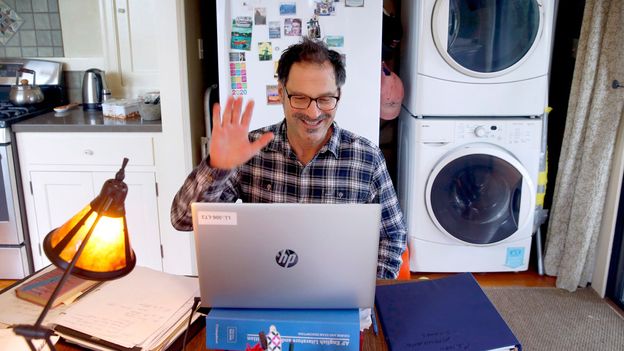
Why are some people better at working from home than others?
In a world of telework, some people just take better to working from home. Does this productivity come naturally, or can you learn it?
bbc.com
181 points · by BerislavLopac · 6y ago · 164 comments
I also pay thousands of dollars to live in a cool place, and now I am finally getting to enjoy it, and enjoy it with my SO.
At the end of the day, maybe I am less "productive", by normal standards, but maybe I didn't need to be in an office for 8+ hours every day to get the parts of my job done that need getting done.
There surely are parts of this that I want to change or can't wait to change, but at the end of the day I am grateful for the forcing function to working from home full-time.
On the positive side, it's more quality time with family but I'm still wondering how to fix the health part.
What I've found helps is to not buy snacks. I eat junk if it's available, but if nothing is nearby, then I can't be bothered to go out and purchase it, so I'll eat a grapefruit instead.
Another thing that I have found helps is to order a community supported agriculture (CSA) produce box. A lot of farmers that supply restaurants are losing a lot of business lately, and at least in the Bay Area, many are starting to sell directly to consumers. I'm on a weekly schedule now where every Wednesday I pick up a box of restaurant quality vegetables in SF, and it's pretty fun because a lot of these vegetables are ones I've never even heard of before. It has become a hobby to come up with new types of meals, and it also gives my wife and I a nice break from the monotony to go for our vegetable pickup excursion.
I can easily not buy potato chips. I don't even pretend like I'll control myself and not eat a whole bag in one night if it's in the house.
And the main trick to doing that is to not go shopping while hungry. If you are hungry, eat something small before going for groceries, and the temptations will have a lot less power over you.
Of course, the downside is that I now have to figure out what to do with fennel for the 6th week in a row...
Went from working out 3 days a week to none. Went from 2 meals only a day to stopped counting. Productivity has gone out the window.
Man, I used to love my job. I can't wait to run back to my office and have both externally imposed structures and a physical separation of work and fun.
Everything you've mentioned is entirely in your own hands i.e. it's entirely self-control. You don't need an office, or the boss watching, to get up with time to spare, to not eat crap or get out for some fresh air.
With the above being said, don't beat yourself up too much. We're in a situation whereby we're all experiencing a sense of loss of control and total uncertainty about the future, combined with many other factors to worry about, so it's not surprising that it may propagate itself to affect the control you exercise over your own life.
If you're comfortable with it, just look at it as accumulating debt much like tech debt. Not tackling these things now might be fine but eventually you'll have to pay some of it down in the near future, and that may be a conscious trade-off yourself, and indeed many others, are happy to make right now.
More to do with being on lockdown than WFH.
Also, I've been previously hitting gym 4-5 times a week on top of that, WFH can only go down in such scenario - I still try to motivate myself with some basic weights I have found at home, but it ain't the same as using ie squat rack with proper weights for example. At least running is +-same.
Human interaction is a topic on its own, I feel sorry for many single folks or those in relationships that aren't living together. In many cases it must be stressful.
I think people are going to come out of this one of two ways - half will come out fitter, mentally and physically, more positive, with new interests and skills and stronger relationships, and the other half are going to come out a mess (understandably.)
Im also not eating as fresh as I normally do. I can usually get fish and vegetables and cook the day of. Now I gotta stock up on groceries for the week to reduce shopping frequency.
My food has been pretty much perfect. I’ve reduced calories to match reduced activity but what I eat is still proportioned correctly, lean meats, vegetables, rice/potatoes.
What I have noticed though is due to isolation only going out when necessary, not lifting weights four days a week, no general daily walking about and no cardio is that now walking up the four flights of stairs to my apartment I’m getting slightly out of breath when I shouldn’t. I’m getting cardiovascular unfit when at the start of the year I was the fittest I’ve ever been.
I’ve also noticed body composition changes. I’ve lost 1-2 kilo, looking a lot less muscular / smaller. As food has been good I don’t think there’s an increase in body fat I just have less mass overall. When you’ve been training hard it’s demotivating.
Things are starting to relax as where I am the numbers are very good so am going to start going for runs to get my cardio back even though I’m not a runner. That’ll again make body composition less muscular as burn off more calories.
For the gym to do my weight training, unfortunately they will be the last to open and it’s a huge mental down knowing I’ll essentially need to start from the very beginning again.
We'll be fine once this is over and we can get back to our old routines.
For me it’s the variety of city food I miss the most. I live quite a way out from where I work and while there are still a few open takeaways, they’re pretty average in quality and lacking in variety. However there are larger and mostly well stocked supermarkets so buying fresh food to last the week hasn’t been a problem (most veg will last a week albeit some items will need to be refrigerated). However I definitely feel your pain about fish.
To be honest very little has changed with regards to shopping for me because i have two young kids and my wife works full time as well, so we are used to doing big weekly shops since that’s the most practical way for us to shop even pre-COVID19. I guess the biggest change is where we used to order it online and have it delivered, now we are driving to the store and picking the items ourselves.
With you until the last part. This is an inward period. People are getting to know themselves, improving themselves, learning to be more independent, etc. because the space previously occupied by other people has been freed.
    Unless you're talking about cohabitants? Seems to me
    that excessive contact would ruin the strongest
    relationships even faster than no contact would.
Unless you're talking about cohabitants? Seems to me
that excessive contact would ruin the strongest
relationships even faster than no contact would.
Folks cohabitating in cramped living conditions 24/7, particularly in the city where they can't just easily go outside and enjoy some fresh air and open space? Yikes. I mean, even in prison they give ya outdoor time and you get to mingle in the yard.
At the opposite end of the spectrum you have people living out in the country or the suburbs in houses with multiple rooms. My partner and I fall into this category. We each have our own work spaces and outside of work hours we can spend time together or we have plenty of space in which to avoid each other. Plus we can go for walks and get fresh air and some minimal social interaction with neighbors and fellow dog walkers from a safe distance. I call this "social distancing on easy mode." Our relationship is doing okay.
Fair assumption, but my fiancé and I are doing just fine. If anything this proved for sure that we can go ahead and get married.
What COVID-19 lockdown has revealed, imo: relationships that were on shaky ground accelerate their demise [0]. Those that were "meant to be" come out more intimate.
[0] Breaking up after realizing you can't survive 24/7 together is not necessarily a bad thing.
i personally enjoy this period and wouldn't mind if the lockdown stays up for a few more months/years lol
It's important to remember that this is not a normal state of affairs, this doesn't accurately reflect WFH. I'm personally curious ot try WFH more once we return to 'normal'.
I think the name "social distancing" isn't a good choice. It should be called physical distancing.
Because socially, you can be as close as ever, just use video chat. Whereby, Zoom, Skype, etc. to hang out with groups of people (be it friends, colleagues, etc.)
I have no S.O. so much lonelier not having co-workers to talk to, eat lunch with, etc...
What are normal standards?
I do not believe now is the time to be drawing comparisons or conclusions between the office norm and the fully remote situation most of us have been thrust into.
Sure, some people procrastinate more than others. Some people need more management than others to keep going. Some people are better self-driven and self-organized than others.
The effects of the externalities many are now faced with
- worry over savings / the state of the market
- job security as we watch others get laid off
- how the kids are holding up, how will this impact their education and future
- sick family members
- etc. etc.
renders it impossible to draw conclusions meaningfully e.g. "Susan was super productive when we were working in the office, but she seems to have really dropped off now that she's remote. Looks like remote isn't for her!"
or
"I was so effective in the office but now that I'm at home I can't seem to get anything done, or focus, therefore I must not be cut out for remote work".
Whilst in the background you, or Susan, are facing a big drop in your 401k, or you're worried your kids are watching too much tv at home all day, or Mom is headed out to get groceries again when she really shouldn't be and there's nothing I can do about it.
I believe the sweet period when some sense of normality resumes but we're still mandated to WFH because it'll be impossible to institute social distancing effectively in cost-optimized open office spaces will be when we can more effectively starting measuring and drawing conclusions over fully remote work and its impact on people and the office.
Also the fact that it was a dramatic change overnight, so people can no longer follow their old habits, but didn't have enough time to develop new habits. For example, it is possible to exercise in a gym, and it is also possible to exercise at home, but people who used to exercise regularly in a gym are probably exercising less now, because their habits have been broken.
Not just habits. For example, I have a standing desk at my job, but I didn't have one at home. It took me some time to reorganize my desk, so that I can use the computer comfortably while standing. Then my kids complained, because it was too high for them. It took some time to adapt to the new situation.
People who slack at work by hide it by having lots of meetings / playing politics are useless whilst working-from home because they don't know how operate when their productivity is more visible.
When we all went on lockdown recently, I noticed that at first people were careful to create a "proper" workspace that was not only silent but also photogenic for their camera. Naturally, a kid sees a closed door with the most interesting new thing in the house happening on the other side. The only proper recourse is to bang on the door.
Even within just a few weeks, things have relaxed considerably. Now, I rarely attend a meeting, even when there are higher-ups in attendance, where there are not kid noises in the background, folks going on "mute" to deal with a meltdown, even just letting the kids play in the same room. Going shopping during the work day, when the stores are less crowded, is completely normal now.
When all of this started, some folks said: "Finally this will normalize working from home." Maybe it will go even further, and normalize folks having a real life.
I absolutely love this. I love seeing my colleagues contextualized in their private spaces, that reflects their personal choices, humanity, wholeness. In the office this is reduced to a 2x5' desk.
Office as a space also has a sense of self-importance to it. It is not unlike a church or a stadium where the purpose of the gathering is super-salient and the participants' rich humanity is backgrounded. Working from home, it is harder to be reduced to one's function as a worker, it is impossible to forget that you are a human with a life when constantly surrounded by the cues that remind you of that life, in the space that you live that life.
Sorry, ahem, bathroom.
My closest collaborator falls pretty squarely under "terrible at written communication", but we still have sufficiently frequent face-to-face time to be about as productive as before.
I'm in agreement with the general sentiment elsewhere in this thread, though. I've found nothing about people's WFH productivity that's surprising. People with kids are handicapped, but are often determined enough to find a way to make it work. For everybody else, it seems like the inequality in productivity just goes up, and it's harder to mask non-productivity by socializing well.
Which is good, because they are all more interesting and valuable than the article, which skips the "varied" part and basically lumps everything in to "if you have troubles working from home, you need more willpower" (paraphrase).
I found it insulting and was a bit surprised to see what I assumed to be American work-fetish from a BBC article.
There are LOTS of reasons because people are very different and our environments are very different. I don't have kids, I am easily distracted by visuals or sounds in my periphery, I have a separate room for my home office, I don't have neighbors that share a wall or live above my ceiling, I have good internet service, I'm an introvert...so yeah, I have an easier time working from home. But those that don't, they obviously just lack dedication to work. Garbage.
That is not to say that all distractions are easily fixed or that everybody should have great focus and attention.
First, the biggest way to make improvements quickly is to make sure you are getting good sleep, exercising regularly, and eating well. This does huge benefits for mood, alertness, and energy. Also if you drink, smoke weed, or take some other non-stimulant drug regularly that you don't need to be taking - stop. Not only do these impede focus while under the influence and for a day or two after, they also prevent you from getting high quality sleep (which is why you get very vivid dreams after ceasing regular use for a few weeks - you are catching up on REM sleep).
Second, set small bite sized goals. Instead of thinking about the long path ahead, it's better to think about what is the first thing you need to do. That really helps me prevent procrastinating. You can also do what I think of as "reverse procrastinating" where you tell yourself you'll take a 30m break from procrastinating right now to get something done - usually I end up getting in the zone and working for longer than 30m.
Taking breaks is also helpful. The frequency/length depends on the person and for me changes from day to day. If you catch yourself slacking or losing focus, or stuck on something, get up and walk around. When I'm at work I basically drink 5+ diet sodas a day, partially for the caffeine, but weirdly enough also because it makes me pee a lot so it forces me to get up and walk around every 1-2 hours.
The goal setting, and seeing them to completion or at least making good, sustained effort, is the part that improves over time with practice. Eventually you start setting larger goals and can start planning more (if you are like me, paralysis by analysis is really easy to fall into, so you have to take it easy here). I'm by no means some kind of self-actualized ubermensch, but these have really worked for me, to the point where I've transitioned from a serial procastinator in college - doing almost everything day before, day of, or late if the penalty was low - to someone who actually does stuff in advance and spends almost the entire workday working.
It's exceptionally practical, since 95% of the time I end up working on that thing for longer than that ten minutes. For me, it alleviates the pressure of thinking I'll need to push through a task for hours by giving myself an escape hatch.
It's a "motivation follows action" technique/trick/hack.
- I can work at my own natural pace whenever I want. Some days I work 4 hours. Some days I work 12 hours until 1-2 am.
- If I need to buy something I just do it. I can go to the supermarket at the best times.
- I can eat home made food and follow any schedule I wish. My SO also works at home and we're doing intermittent fasting 4/20. We start eating at 2pm and stop at 6pm.
- I loooove espresso. To give you an idea my espresso setup costs more than my work setup and I roast my own beans. No office could provide me with this.
- We have 2 large dogs and we just couldn't abandon them for 8-10 hours every day. I don't know how people do that.
- We can live wherever we want and we don't have to pay extra to live in a nice house. Gone are the days of living in apartments without garden.
Espresso - I don't roll my own but I love 85% Aribica with 15% Rombusta. I gather that is the Italian default brew and I concur. We do bean to cup rather than tree to cup.
We used to look after other people's dogs. Wifey now walks me! We live next to a park and see many of our customers daily from afar. I could not give a shit about the money but we miss our friends. Even now I smile thinking about Cwtch (not a typo) and co. running madly around the meadow down hill from my house.
Anyway, I am now seriously thinking about how we properly integrate home working in the future. There is a massive win-win if we all do it.
Do you track those hours to make sure you don't think you worked enough but in fact consistently work too little or too much? Wondering because I had that problem (working slightly too much every week).
Most of these 10 years I've been working as a freelancer or now building my thing. Even when I was working for a company for a couple of years I was completely independent as far as time management goes.
This sounds great, but is really only attainable if you're a freelancer. Unfortunately, this is not an option for many people, especially those just starting out in their careers.
Depends. I managed a small remote dev team for a company for a couple of years and we all had our own schedules. This was never really a problem.
Apparently i'm not. That gives me great hope for my future plan to do home office when buying a farm.
Just yesterday i did nothing in the morning and worked highly concentrated and efficient until 10pm (that was a one time thing normally i'm quite punctual as i had an private appointment).
When working at the office, i have to hurry to be on time and at the evening i'm stressing on going home because i wanna see my wife and a wanna eat something. Now my wife is here anyway and i'm much more flexible now.
Yup, the thing I always try to remember is tomorrow's another day and that whatever I'm working on likely isn't as important as I'm making it out to be.
I have 80+ teenage pupils to manage remotely, with me on camera for a significant amount of that time. I find it very easy.
All pupils have an iPad. We all have full accounts in Microsoft Outlook and in Google Classroom, Forms, Docs and Meet.
Being remote has made me tighten up my document formatting game. I just set up a nice asciidoctor template to make classroom materials have a bit more wow factor for the assignments and ideas I post online.
The tools hold pupils to deadlines. It’s a boundary they respect and it gets a lot more out of them. They find remote work a lot harder than I do of course. It makes school feel a lot more tiring.
(Periods have about 30% face time and the rest they are left to work under their own steam — with parents no doubt pushing them on my behalf.)
We will go back to school eventually and we had all these tools before but I don’t feel we used them to anything like the full extent we do right now. Remote teaching has really changed the game for me, for the better. It’s not something I’d choose to do — for their sake — but I’m enjoying what it’s helped me learn and look forward to carrying a ton of techniques over into the new school year.
Now, working in a company, I miss the office so much. I don’t like this lack of border between work and personal life. I didn’t sign up for this, my home is my own space and I don’t want calls, I don’t want anything related to work in there. I don’t like having my work laptop and equipment in my personal space and office, I don’t like switching laptops just so that I can do something else that I like. The thing is, I like the office where I work, I like my colleagues, I like our lunches, I like the social interactions, it was always a nice change of space where I could fully focus on my work, knowing that when I leave the building, work is done and I’m switching to my other environment.
I'm also called productive by my team and I do the same as I save so much time by not having to deal with interruptions, leaving meetings on in the background, and and being able to work through lunch.
I'm slowly regaining trust in my ability to focus, getting into flow, and feel "normal" again. I'm starting my day with food-related stuff, sports and work communication, then going for an open-end session only towards late afternoon when communication slows down, working into the night.
Work from office seems like a lose-lose situation however. I have to commute, and at work, I just waste more time because showing up counts as work. I sort of wish I felt more at ease at home. I mostly work harder. So the one-size-fits-all-butts-in-seats, in some cases, falls into that stupidity where one party (the employer) causes a loss for both parties without benefits, because they’ll make no effort to figure out what works best for who and just have a dumb blanket policy.
Not every company will have a stack of meetings or require you to be on Slack. For 10 years I did WFH for a company where everything happened via email, and it was designed to be asynchronous. That meant I could choose any hours to work, and I often worked at night & slept in through the morning. As long as the work got done and milestones were finished on time, it didn't matter.
My personal opinion, but if a company is requiring you to work synchronously from home, something has gone a bit wrong and their processes are fragile. It's like multi-threaded code but the threads are always blocked waiting on each other. (In that case, the company is probably just doing WFH to save on rental costs and to get the employees to buy the office equipment instead.)
At least in those cases you still get the benefit of designing the work environment you want with the gear you want, but you miss out on the time flexibility.
Especially when working from home, doesn't one have to judge performance by the work output rather than physical presence? I understand that this ideal is not the reality everywhere, especially in the office if people don't know you started at 7am that they they'll look weird if you leave at 15h instead of 17h, but from home you can slack off anyway so you really have to look at the output and not presence. If not done already, you might want to look at tracking work time to make everyone feel confident that the others are doing their part, and bosses should notice when time worked does not match output.
The self-motivated people are getting just as much if not more work done.
The people who are chatty in the office are more unproductive at home simply because the main reason they stopped chatting was because the boss walked by. I don't think they are more productive as shirking work in the office is equally easy. Just claim to be doing "background research."
Work from home just removes the outside influences, causing people to become more like who they would otherwise be.
In my case, I ignore meetings and just have them on in the background. I am barely in attendance. I can't do that in the office as my managers/team are watching. That is my one behavioral change.
That said, you could still catch up from home, if not more, simply because you don't have to scurry around looking for a quiet place or finding the colleague.
WFH has been a blessing these two last months. Minimum interruptions. I am probably 10-20% more productive than in the Office.
Schedule:
- get up at 8
- eat b/f with kids
- work 8:30-12
- lunch + exercise 12-1pm
- work 1-5pm
It just works. I am much happier, less fatigued due to no commute AND I get exercise.
There's much less cause for engaging in that behavior when everyone is working from home, so it becomes more apparent that they don't actually do anything productive.
Dating: moving from bars to apps
Social: moving from third places to apps
Working: moving from the office to apps
Just like some people are more intelligent than others, or more athletic than others... some are more self-motivated and can work through their own initiative rather than relying on external input (such as managers).
That's not a bad thing, either! We should encourage those self-motivated people to work however makes them the most productive members of our economy. That is incredibly crucial for the times that we live in.
I don't think it's that easy as self-motivation as a scale, it's all about the environment and task that makes people the most productive.
I always want there to be someone with insane amounts of grit and ask how they do it. Insane amounts of grit would be: - Six pack and can run a marathon when old. - Recognised in their field. - Earned enough through work (not through the insane rise in housing prices) to be able to stay in their home for a decade without working.
Checking all these boxes, would be the master of grit.
Hence i foresee a lot of people currently loving it will change views after a few months or so and also a lot of companies getting frustrated with their employees and will request the majority of them to return to their premises.
1) My productivity seems to be polarizing. In some day I feel I have accomplished a lot more, but in other days not great. Generally, many things seem to take longer to attain.
2) My working environment simply sucks. I only have cluttered desk with my personal equipment. I improvised the TV to use as my secondary monitor, but is definitely not optimal from ergonomic standpoint, so mostly ended up working on the tiny laptop screen. I upgrade to better chair, and that at least helped me a lot.
3) I don't have air conditioning, and if the WFH prolongs, this will be problematic.
4) My workout level certainly has dropped for a while after the lockdown WFH started. I have gradually improved this, by establishing daily walking, and remote work out sessions.
But procrastination isn't the problem, I can do that at the office too. The office even has many avenues of approved procrastination. No, the problem is I am not working at home by myself, in blissful isolation, but with a number of other people who demand my time and attention.
I have read a number of "The self-motivated people are getting just as much if not more work done" posts, and to be frank, that is codwobble. Even self-motivated people experience pandemic anxiety and financial pressure, and have partners and children who they need to spend time with.
Having to share my innovation space with work work is jarring, and I'm having a lot of difficulty disentangling the two. I now spent a lot of my work day thinking about my startup since I'm in the place where I used to do that in isolation. Ultimately I'm now a lot less productive at both. It's driving my focus and energy down.
Success working from home boils down to two things: 1. Desire to work from home and 2. Space free from distraction.
I am the only long-term WFH guy working with an office of 40 “In office” folks who have found themselves at home. Some of them complain, others don’t. Some of them have toddlers (!!), others don’t.
While wfh and online conference brings so much benefits, it cannot replace the value of face to face meeting. There are some problems that can be easily tackled with physical discussion, that can be complicated with online meeting / conference.
I never 'missed the office'. I found most people that do are confusing work with having an actual social life, which they lack because they spend the time it would take to build one listening to podcasts while stuck in traffic.
I've done some WFH on every job I've had, with wildly different results, depending on how motivated I was to do the work.
Just because WFH did not work for you once doesn't mean you're not suited to it.
Well that's depressing.
1. https://www.youtube.com/watch?v=snAhsXyO3Ck
2. https://www.youtube.com/watch?v=snAhsXyO3Ck&lc=Ugzl3DOl0s0oS...
For instance having a set schedule, regular breaks, getting fresh air and filling the social need is not something that comes naturally to everyone or that a home office magically solve.