Solar’s Future is Insanely Cheap (2020)
This is part 1 of a series where I’ll look at the future costs of clean energy and mobility technologies.
rameznaam.com
152 points · by epistasis · 6y ago · 213 comments
Also, while storage would be helpful, it is not the only way to enable a renewable transition. Additional transmission is enormously helpful: as the sun goes down on California, the wind is picking up in the Midwest. And don’t forget demand response: if smart thermostats received price signals (maybe we should precool this house...) that would alleviate the evening ramp-up issue.
So I claim we’ll need less storage than “a whole day’s usage”. But the learning curve applies to batteries as well! This storage won’t cost as much anyway.
The whole issue of intermittency is overrated. While a single solar panel might generate intermittently, the solar fleet across a whole state generates more predictably.
I am predicting that grid emissions will come down a lot over the coming decades. Partially I’m predicting the past: they’ve already come down, a lot!
On the storage issue, at ~100$/kWh batteries that do a conservative 1,000 cycles are ~10c/kWh stored + generation costs + conversion inefficiency. Take current unsubsidized grid solar prices of 2c/kWh solar and double that for 4c/kWh as a conservative redundant safety margin. Tracking solar for example has much better morning and evening generation though at slightly higher prices.
If 2/3 of your electricity is at 4c/kWh and 1/3 is at 15c/kWh that’s 7.7c/kWh for pure solar 24/7 including peaking power needs. Obviously a specific mix of generation determines storage needs, but those are also really pessimistic estimates.
PS: Hydro power is 6.1% of the total U.S. electricity generation. If 80% of that is released at night that’s a huge reduction in storage needed. Similarly transmitting power east or west makes a large difference in storage needs.
Is there an existing model for retail intraday rates? Would intraday rates be desirable for all market participants?
"Add area for curtailment data?" https://github.com/tmrowco/electricitymap-contrib/issues/236...
Most of my loads, on average, don't need to run that exact second.
I don't mind if my hot water tank super-heats water in the middle of the day for the rest of the day. If electricity is really cheap, my freezer can jump into overdrive.
I don't need my clothes to dry in the next hour, just over the next 8.
I don't care if my fridge/freezer takes a break while I run the microwave or pre-heat the oven.
I don't care if my car charges ASAP as soon as I park, as long as it's charged by 8AM. And let it run as a grid-power bank for a fee.
Then you could have A/C systems that make ice or compress refrigerant in a tank.
Then why not just hang them up for drying? Zero power consumption and they will dry in eight hours, maybe not under all conditions but under many.
I'd even go a step ahead: dryers ruin clothes.
A bit diff in a humid area, or where the A/C would need to condense the added humidity (if dried indoors), or the furnace would have to counter-act the cooling from evaporation, but HVAC is usually more efficient than the dryer.
Water does not have the capability to store much energy.
>If electricity is really cheap, my freezer can jump into overdrive.
Your freezer can't if it's not a ammonia refrigerant. You will actually be wasting energy.
>I don't care if my fridge/freezer takes a break
Your fridge actually does not use electricity constantly. It detects the temperature and run the motor, stops it when it reaches the desired temp. It's already having a break.
OK on the freezer. Could still take the fridge down to 2C.
The concept of the fridge taking a break while running other loads is to reduce peak draw current. If everyone did that, it would make the grid more stable.
Systems that make ice at night and use it for A/C during the day date back to the 1950s.
The general class of these facilities is phase-change materials. Water is pretty amazing, both for ice and for steam.
The future of low emissions energy production will be largely driven by overproduction and demand shifting, not banks of grid level batteries.
This likely won't happen as soon in America, however, the economy is too tied in to fossil fuels and the appetite to upgrade the electric grid by utility companies heavily invested in gas isnt really there.
>A startup run by a Tesla veteran and backed by Bill Gates is promising to build a long-duration battery that's 50 to 100 times cheaper than lithium-ion https://www.businessinsider.com/form-energy-battery-startup-...
Disconcerting.
even before reliable utility-scale storage, there is a lot of low hanging fruit from covering the southwest US in solar and wind. but yes, the costs of intermittent power like wind and solar doesn't by itself end with installation.
Don't worry -- every single time renewables are mentioned on HN, this aspect is at the top of the posting.
Modern Gas turbines can also act as a good backup for solar in times where there is unusual demand because they can start up on under a minute
For example, use solar power during the day to pump fluid from a lower reservoir into a higher reservoir, and then harness the energy of the water flowing from the higher reservoir into the lower reservoir through turbines.
As long as your output energy is always coming from the turbines, and as long as your solar powered pumps running during the day can keep up with double the rate of drainage flow, then you should have a constant loop with a steady supply of power.
This type of system could be retrofitted onto virtually any dam, giving you a way to create a closed loop with constant power and without the water loss typical from a dam (other than evaporation).
For areas where water is scarce and a dam isn't feasible, there are also other ideas, such as gravitational potential energy systems that use solar powered energy to lift weights on pulleys, which then power a generator as the weights are lowered by gravity.
Other ideas: Thermal storage including molten salts which can efficiently store and release very large quantities of heat energy, compressed air energy storage, flywheels, cryogenic systems, etc...
For one thing, existing dams absolutely cannot be converted to pumped hydro. Dams do not store water below them. Water flows downstream because a dam is in a river. There is no water to pump uphill. Unless, of course, you also build a second dam very close downstream to create another lower reservoir. This is usually a bad idea, and better to just find better geography that will support a new pumped hydro dam.
Sadly, dams tend to destroy healthy fishery ecosystems —- a side effect of not “wasting” the water.
Trying to rely only on intermittent power sources has huge storage requirements due to weather along with daily/seasonal variation. If grid energy storage was a simple problem it would have been done decades ago.
For example, one estimate is that for Germany to rely on solar and wind would require about 6,000 pumped storage plants which is literally 183 times their current capacity:
>...Based on German hourly feed-in and consumption data for electric power, this paper studies the storage and buffering needs resulting from the volatility of wind and solar energy. It shows that joint buffers for wind and solar energy require less storage capacity than would be necessary to buffer wind or solar energy alone. The storage requirement of over 6,000 pumped storage plants, which is 183 times Germany’s current capacity, would nevertheless be huge.
https://www.econstor.eu/bitstream/10419/144985/1/cesifo1_wp5...
Overprovisioning is so simple and widely accepted a concept that anyone ignoring it is likely trying to intentionally mislead.
Except storage is much less useful in the old paradigm, so the motivation wasn't there. Going forward, prices will swing wildly, so storage will be more valuable.
I'm still hoping for this one, just because it's so epic: the giant rock-piston gravity storage: https://www.heindl-energy.com/
"Utility scale solar" is ambiguous and can mean solar thermal or pv solar.
I think solar thermal might be a completely different animal that is not long-lived and not clean.
It might be a similar situation to where "renewable power" turns out to me mostly burning garbage or burning trees.
This documentary might be a little biased but also have some interesting insights: https://youtu.be/Zk11vI-7czE
A hypothetical cheap ~30% efficient solar panel could add something like 40 miles of range per day to a car in ideal conditions. That starts to look actually useful vs a simple gimmick.
A 100 watt solar panel, producing the full 100 watts, would take 80 hours of perfect sunlight to produce enough power for an extra 40 miles of range.
Assuming best case (unrealistic) conditions, if you get 8 hours of perfect sunlight in day, and your solar panels produce 100% of their rating for all 8 hours, it would take 1000 Watts worth of solar panels to produce that extra 40 miles of distance over 8 hours. It seems kind of unrealistic to fit 1000 Watts of solar on top of a car. And that's an absolute minimum, under best case conditions.
If you had, say, maybe a more realistic 300 watts worth of panels on top, and they got 4 hours of full sunglight, you'd be producing an extra ((300W * 4h) / 200Wh/mile) = 6 miles. And that's still assuming best case condition for power consumption per mile.
[Edit] - And like the other commenter stated, those few extra miles get cut down when you consider the weight of hundreds of watts of solar panels added onto the vehicle.
To me it looks like it will never be a meaningful solution, due simply to physics.
> The usable clear area of a Model S glass roof is 42” x 45”
A Model S is actually 195.9” by 77.3 (ex. mirrors). Assuming a reasonable shaped solar car using 75% of that surface is covered in panels that’s 12x the area. But you also gain from panels covering the sides of the vehicle.
Further “Because the vehicle roof is flat, it collects less light than if it was positioned at the optimum angle to the sun.“ as I said your not limited by the roof. “Lastly, we lose at least 10% more due to the safety glass,” we don’t need glass and that’s already part of panel efficiency numbers. “and the inverter/charging is only 81% efficient.” Solar panels and batteries are both DC so you don’t need an inverter, the charge discharge efficiency of lithium ion can be over 90%.
San Francisco 5.34kWh/m * .3 efficiency * 7.33 square meters = 11.7kW/day /.3kW per mile = 35 to 39.14 miles in San Francisco depending on how much your charging the battery with plenty of areas getting more sunlight. Using the highest efficiency panels currently produced that goes up significantly, but cheap 30% efficient panels seems like a more reasonable mid term prediction.
PS: Example of a flexible 1m panel zero glass required at under 300$/m: https://www.amazon.com/dp/B082FCZ4MD/ref=emc_b_5_t?th=1
The maximum daily energy density of sunlight in sunny Los Angeles is about 6.4 kWh / m2 [1] (assuming perfect, moving angle of panels to sun).
If we can turn the entire footprint of a Model X into solar panels, that gives us about 10 m2 (big car!).
The US DoE reports the Model X gets 100 mi / 31 kWh [2]. Or 12.4 kWh for 40 mi.
So those panels would need to get 1.2 kWh / m2 of solar power. Which is about 18% efficiency and pretty reasonable for good consumer panels [3].
But it assumes the car is in sunlight all day at the perfect angle, there is no loss (eg due to weight), in a locale as sunny as LA (eg Seattle gets half of the sunlight as LA), and can be completely coated in efficient panels (the model S solar roof is <1 m2 in comparison). Bumping efficiency to 30% gives some headroom but it still seems pretty impractical.
[1] https://globalsolaratlas.info/detail?c=34.270738,-116.929301...
[2] https://www.fueleconomy.gov/feg/Find.do?action=sbs&id=41196
[3] https://news.energysage.com/what-are-the-most-efficient-sola...
It is true that you lose some energy every time you store or transfer it, but if we install solar panels on every roof (so we get excess energy from solar) and also find a way to store energy cheaply for a long time, that should be enough to completely switch from fossil fuels, (well, mostly)
routinely sells panels for 30 cents/watt.
If you could skip the inverter step, charging your electric car could be very low cost.
5,000 watts of (raw) solar panels for $1500 and would give even the most power-hungry 350wh/mi tesla ~ 70 miles of charge in 5 hours of sun.
(a 200wh/mi car would need ~ $500 of panels for 40 miles)
Does this take into consideration the increased weight of the solar panel and any additional equipment?
I am not really an expert on electricity but there could also be additional equipment involved as well (inverters, transformers, etc).
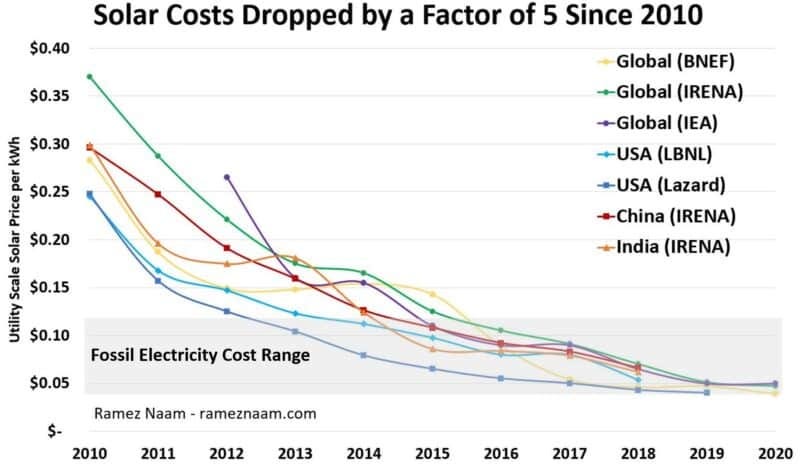
basically every model from around 2010 badly miscalculated the learning coefficient of the solar industry. apparently some forecasts are still badly calculating it.
Some of those are fixed. Even if Labour and Solar are free, you will still have to paid for land. In a way I think this is quit optimistic projection of solar.
If it reached me, I'll have an Arduino controlled hot water heater, furnace and fridge/freezer dynamically turning on/off to take the most advantage of prices pronto.
When it seems like you might die from the heat but the price charged is $8.50 per kWh how much longer do you want to wait before switching on the AC? (If you live somewhere it never gets hot, figure on the same but for a midwinter freeze and deciding when to pay for your resistive circuit heat pump boost)
In some places, industrial users have the second algorithm.
Line sag is worst when demand is highest or it’s hot outside. Same with running out of transformer capacity.
When an upgrade is triggered, it’s to build more peak capacity.
It's already cheaper to use batteries than natural gas peaker plants (the most expensive form of energy). The next phase of storage is to defer or replace transmission like upgrades (which are also super expensive). After that we get into daily cycle operations like giving small amounts of dispatchability to solar or wind projects.
And just like solar, batteries are getting cheaper far far faster than anybody ever predicted. What people used to consider the absolute floor in terms of raw material cost For lithium ion batteries is dropping all the time too.
However, the challenge for scaling up renewables and storage is not technical, it's going to be political. Utilities are not typical businesses that will just switch to the cheapest way of doing things. They are excessively political, and lobby a ton in order to influence how they are regulated (and thus how they profit off a captive audience), and they have been close bedfellows of fossil fuel interests for a loooong time because their combined lobbying power is so much stronger.
Oddly enough, just as hydro won't be able to scale even where it makes sense because of popular political opposition, we won't be able to scale renewables and storage because of entrenched interests lobbying Against popular opinion (renewables are popular across all of the political spectrum).
If they didn't, wouldn't that unspent energy make the panels even hotter and shorten lifespan/reduce efficiency?
No, there's no cost to just not drawing power from the modules. They would become slightly hotter, but that's not a big deal.
[1] https://www.nytimes.com/reuters/2020/05/08/us/08reuters-heal...
The real challenge is of course bringing down cost of storage, which is the key to make solar systems efficient (not just cheap).
Wind has a scalability problem. Residentially, it's only a good sell as a backup supply for when solar isn't cutting it to hopefully prevent generator use. And even that's a tough economic argument.
Towers have huge economies of scale, both in total size and height. So the turbines just keep getting bigger and bigger because it's more and more cost effective.
Wind power in the USA generated 7.3% of the electricity in 2019. Solar did 1.8%.
One of the stated points was that solar and wind cannot be relied upon 24/7 -- to account for the lack of reliability, you need to have a backup power generator (e.g. coal power plant) running. The thing about coal plants (does it apply to natural gas plants too?) is that if you "idle" them, then have to ramp them up to feed demand, then later ramp them down -- it's a very inefficient way of running them. Now based on my understanding, it might be more efficient to just run the coal plant (or natural gas planet?) 24x7, in which case you've just added waste with the use of solar/wind. How much truth is there to this?
Some examples:
https://www.theguardian.com/environment/2020/apr/28/climate-...
https://www.commondreams.org/views/2020/05/05/real-problem-m...
https://medium.com/@btincq/10-reasons-planet-of-the-humans-g...
That said, knowing which statements are outright wrong is indeed valuable.
Still worth watching IMHO.
In contrast your gas stove goes on and off in a moment.
Coal vs gas is the same way.
Of course, it's very possible for nuclear reactors to load follow from a physical point of view. Naval reactors load follow into battle mode quite impressively, and power stations could do the same, again if there were a market for it.
Even traditional reactors can couple to some kind of thermal energy storage system to allow them to stay mostly at 100% while the whole system load follows very nicely.
There are many exciting possibilities in on-demand, low-footprint, low-carbon energy with nuclear technology.
There was a brief window in the 1970s where US nuclear construction projects were finishing on time. But the utility industry had planned for waaaaay too much new capacity. So when all the construction projects with poor execution, that struggled to complete and therefore came in way over budget, finally came online in the early 80s, they were financial disasters in a scale that nearly bankrupted several utilities.
Since then, utilities lost their appetite. And there's basically no way for us to replace the 400 or so reactors in the world that eMate nearing end of life.
However, I'm not sure we will need nuclear. With how cheap wind and solar are getting, far faster than anybody anticipated, we have finally found the technologies that may some day provide energy "too cheap to meter." However, like nuclear they are not dispatchable (except for some designs in France), so if we want to power a grid we either need to overbuild capacity by quite a bit, or use energy storage. There's a cost trade off for the two that depends on how cheap storage gets, and how cheap extra capacity is, and how cheap transmission is from an area with different weather that day. (For example, one can imagine building 2x of panel capacity over the amount of inverter capacity on a solar install, so that even on cloudy days you can chug along at near full energy output... it all depends on the cost trade offs.)
And as fast an solar is getting cheap, far beyond expectations, so is lithium ion storage. And there are many chemistries with high specific energies (and thus unsuitable for vehicles), that we are just now dipping our toes into.
Nuclear would be a nice tool to have, if it was competitive with other technologies, but it's going to be decades before it can prove itself and establish a positive track record for deployment. Utilities have been burned too many times by financial dumpster fires.
I’m reminded here a bit of Ted Chiang’s short story, Exhalation, where the people devise clever ways to try to put air back in the ground without using more than they’re sequestering. I hope our situation is better than that.
> do they still require fossil fuel energy to create, not to mention maintain and rebuild
That's not really particularly relevant. What is crucial is that they produce more energy than they consume. This is an important figure, EROI (Energy Return on Energy invested), which should be >1
https://en.wikipedia.org/wiki/Energy_return_on_investment#Ph...
Photovoltaics generally have been well over 1. There are still sustainability challenges with the technology, but I think they're minor (relative to current alternatives and carbon technology).
I see no reason we couldn't use excess solar during the daytime to heat our hot water heaters, or cool/heat the house.
Modern Construction and Water Heaters have great insulation, and its possible to use the `cheap` electricity during peak solar to store as heating/cooling.
Switching to an electric heat pump water heater from my natural gas water heater saves nearly as many emissions per year as stopping 12,000 vehicle miles. And it saves money, though it front loads the cost a tiny bit.
We could have a massive economic boom just by retrofitting existing buildings with more efficient and modern technologies.
"the quest for renewable electricity generation. And yet, although they exploit the wind, which is as free and as green as energy can be, the machines themselves are pure embodiments of fossil fuels. • Large trucks bring steel and other raw materials to the site, earth-moving equipment beats a path to otherwise inaccessible high ground, large cranes erect the structures, and all these machines burn diesel fuel. So do the freight trains and cargo ships that convey the materials needed for the production of cement, steel, and plastics. For a 5-megawatt turbine, the steel alone averages 150 metric tons for the reinforced concrete foundations, 250 metric tons for the rotor hubs and nacelles (which house the gearbox and generator), and 500 metric tons for the towers.[...] For a long time to come—until all energies used to produce wind turbines and photovoltaic cells come from renewable energy sources—modern civilization will remain fundamentally dependent on fossil fuels."
Source: https://en.m.wikipedia.org/wiki/Energy_return_on_investment
You can’t get fully renewable energy production until you can use EV trucks to deliver the windmills, and you can’t get clean EVs until you have windmills to power them. Sure, we currently burn some diesel to setup these windmills, but the alternative is to burn coal. Don’t let the perfect become the enemy of the good.
Also, who’s the ominous “they” above? Energy companies don’t setup power production out of spite; they setup energy production so we can have AC and TVs. We’re the consumers of all of that electricity, directly or indirectly.
I guess some people have hard times adjusting to some novelties. Their arguments don't stand, and they don't see that.
There is a strong 'abundance' bias implicit in articles by people like Ramez Naam, who push so strongly for green energy production because they don't want to consider the very obvious alternative, dematerialisation and reduction of energy consumption. People like Naam still categorically hang onto a growth narrative so they tend to neglect the downsides of the solutions they provide.
This is FUD. The mass of construction materials pads the quote but is not a useful measure of environmental impact.
1) power is produced by plants that take fossil fuels to build and fossil fuels to run
2) power is produce by plants that take fossil fuels to build and no fossil fuels to run
3) power is produced by plants that were built using renewable energy and run off of it too.
Most of the people who focus on phase 2 basically want us to stay on fossil fuels forever, but they don't want to come out and say it.
How do you know this? Serious question.
Imagine debating using an abacus to develop a computer - "ah but we must remain pure to the hopes, dreams and philosophies of what the computer aspires to be." Yeah, ok. I'll be over here funding wind turbine companies, you can debate the merits of the methodology and strategies of funding green tech with petroleum-based products yourself. Sounds a little boring to me.
There's no relationship to computers here, it's not a question of philosophical purity, but of correct evaluation of the costs and benefits of a technology.
And if that is not what you are saying, then what exactly do you think we should be doing today?
Instead of promoting electrical cars which consume vast amounts of materials and still run on a dirty energy mix cut down on the car reliance altogether, for a trivial example.
Another way to see it is that we already have an electric grid, so we are just finding ways to provide electric power cheaper--then the "efficient market" will figure things out. Also, electricity is used directly in manufacturing, for example smelting aluminum, and that is often done with renewable electricity (hydro in the US Pacific Northwest, geothermal in Iceland). Trains in many parts of the world run on electric power, and of course you can charge EVs with solar power or other renewable energy. And I'm sure some ICE cars are manufactured with electric-powered tools that run on solar energy during the day.
PS: if you know your tone is off, why not ask in a different tone?
As for batteries, not every dollar application needs metal or chemical batteries. There are other options as low tech as pumping water uphill, heating water, compressing air, etc.
10% of our energy needs come from 440 nuclear power plants worldwide. for comparison, the sun is a nuclear plant 1.3 million times the size of the earth. all life on earth basically runs on solar energy (or a derivative of it).
Resource extraction / recycling is a whole other issue of course.
These kind of articles rarely calculate the price to dispose old solar panels.
Our country recently found that current methods for disposing solar panels pose a grave danger to the environment and imposed strict regulations for it. As a result the price for disposal quadrupled. Because consumers of the solar panel, which are mostly individuals, can't afford those prices, the government is preparing for a law that charges manufactures up front for the price of disposal.
It is assumed that solar will be more expensive than natural gas after the changes.
Same for Wind too. 81 tons of waste needs to be processed after 20 years of service of a 5MW wind turbine but operators and manufacturers does not take the price of disposal into account.
There is no reason to include As in PV. There are anti-renewable propaganda screeds that pretend otherwise ("look! GaAs PV cells are a thing, therefore all PV uses As!")
That leaves lead. Lead has been used for connections, but it is being phased out, not least because of EU environmental regulations. The PV cells themselves do not need lead.
I suspect you are just repeating anti-renewable lies here.