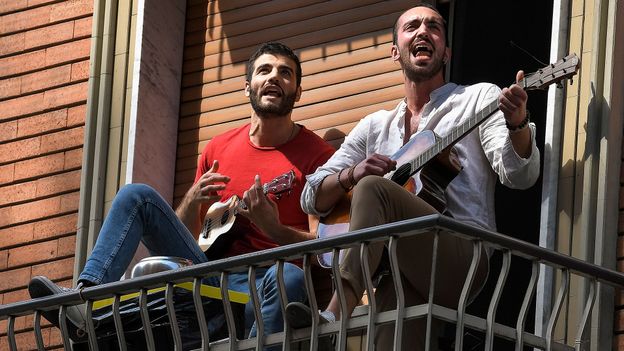
The world's most accessible stress reliever
Whether you have the voice of a songbird or sound like some ball-bearings in a blender, singing can have some remarkably positive effects.
bbc.com
138 points · by laurex · 6y ago · 81 comments
I would generalize that "breathing is the most accessible stress reliever".
Breathing consciously is the single thing you can do always to relieve stress and get your hormons in balance again.
Singing and chanting and drumming can be even more powerful obviously, but you cannot always do that, but you can (and should) always breathe the right way.
He could hear if a box had a delay about 2-3ms. Quite hard requirements.
https://music.stackexchange.com/questions/30454/how-does-a-p...
Seriously? Even if electricity has a drift velocity of 50% the speed of light, that's still 150,000 meters in 1 ms - how long is this cable???? There must be something else at play.
Human hearing is quite extraordinary.
I think a technological solution would exist: A and B hears choirmaster, A and B's sound is sent back to server which syncs it with the choirmasters sound before sending to C, D, E and F. C, D, E and F's sound is sent back to the server which syncs it and sends to G, H, I... etc.
So most people can sing along hearing some of the choir and the latency overall shouldn't be too bad. Scales with log(n) * max(latency)
That is, you hear my "Gently" and join in with "Row," but it's not played back for me until I start singing "Merrily." This could work, but as you can see, it would need some clever delay management.
Not where I live in an apartment in a crowded city where the culture is to not bother others. Neighbors would not be happy to hear me sing no matter how good am, any more then they are happy to hear my stereo.
When I commuted to work in a car I had 30 to 60 minutes of singing time each way. Now I have karaoke box 3 - 4 times a year.
human voice relatively patterned, esp if the computer knows the song you're singing / you've sang it before. I wonder if there's room for a custom noise cancelation algo that can dampen my neighbor's opera practice?
Plus, therapeutic levels for singing probably require something louder than mezzo piano.
My last tenancy agreement had specific references to playing any music instruments / singing practice.
So I think singing should be fine legally speaking unless you live somewhere with a lot stricter limits, especially during the day. It's a good idea to check with neighbors though. Often they won't mind if you do it as long as you avoid certain times or certain rooms. That's how we (sort of) resolved things with our student friends... and thankfully we moved out of there pre-quarantine :)
That really depends on what kind of music you like to sing
Seriously though. How would singing be relaxing if you had to deal with angry neighbours every few times you sung?
I will try to search algolia and come back to you with my research
But okay, this at least was the revelation for me: try to blow air like blowing out a candle. Meaning a directed, focused blowing that comes with a good strength. This is basically how you want your breathing to be when singing. A steady air flow, without muscular tensions. Then, you just slowly add voice to that air flow. With a humming voice first, trying to utilize as much of your vocal cords as possible. Then you can try singing louder, and seeing if you can keep the same steadiness. What you are trying to get the hang of, is a certain "bite" where your voice resonates with a good clarity and has strength to it, without really trying too hard. (Go watch John Denver singing to know what I mean)
An issue I, and probably many others, face is an inefficient breathing that generates friction in your vocal cords, causing your voice to quickly fall apart becoming weak and crackly.
So avoid "pushing" your voice as much as necessary. It will just cause bad muscle memory, like doing deadlifts with a bad technique. You have to build up the nervous system and the muscle memory slowly, never extending it too far. It might feel annoying singing with "half-volume", when all you want to do is to sing along with your favourite singer with full power. Yet once you build up the technique the whole thing becomes significantly easier. Hard to explain, but you shouldn't be feeling like you have to expend a lot of effort to get a strong voice.
Well, I hope that's something. I would be curious to know if it helped.
This is one example: https://m.youtube.com/watch?v=eTX9LxZ9YUQ
Definite improvement
* commit to the notes you're singing: singing tentatively makes it harder to evaluate yourself
* sing along with a recording and emulate the singer--every ornament, every nuance in timing--you can find your own voice (so to speak) once you know what you're doing
* repeat a song or even chorus or line over and over, especially singing along with a recording
* record yourself: everyone hates doing this, but again, it's much easier to evaluate what you're doing
* if you're having trouble with a specific line, find the notes on an instrument and sing along (though make sure you're not just locked in to fixed pitches--a lot of the beauty of great singing is exploiting the marvelous glissando capabilities of the human voice)
* drink water and don't hurt yourself
sudo apt install audacity
Then play back your voice, from the recording, and find out what you'd like to change about your voice, and what you can get better at. It's harder to sing, than what I thought!
And, juts like running or table tennis or whatever, everyone is going to be not-good at it, in the beginning, I think.
When taking lessons is not an option, I've seen this course get recommended at /r/singing a lot: https://singingsuccess.com/
Don't have first hand experience with it, though.